Admission opens for 2026-27 sessions for all university.

Blog Detail

  • Healthcare Administration Career in India: Courses, Skills and Job Opportunities

    • 21,Oct 2026
    • Posted By : uaeautomates@gmail.com
    • 0 Comments
    • BBA correspondence college in Karnataka
    • correspondence college in india
    • Healthcare Administration
    • Healthcare Administration Career in India
    • Healthcare Administrator Salary in India
    • Healthcare Management Courses
    • Hospital Administration Courses
    • Hospital Management Jobs
    • management distance education in bangalore
    • MBA distance education in bangalore
    Healthcare is not only about doctors, nurses, and medical treatments. Behind every well-managed hospital is a team responsible for coordinating staff, organising patient services, managing budgets, maintaining records, and ensuring that daily operations run smoothly. These responsibilities make healthcare management an important career area for people interested in administration, leadership, and the healthcare sector. For students exploring management distance education in bangalore, healthcare administration can be an interesting option to consider. It combines management principles with the operational needs of hospitals, clinics, diagnostic centres, and other healthcare organisations. You do not always need to be a doctor to explore this field. Depending on the role and qualification, graduates from management, commerce, science, and other relevant backgrounds may find suitable opportunities. If you enjoy organising work, solving problems, coordinating people, and improving services, this career path may be worth exploring. Let us understand what healthcare administration involves, which courses can help you enter the field, the skills employers look for, and the career opportunities available in India.

    What Is Healthcare Administration?

    Healthcare administration is the process of planning, coordinating, and managing the non-clinical and operational activities of a healthcare organisation. It helps hospitals and other medical facilities deliver services efficiently while maintaining appropriate standards of patient care, safety, documentation, and resource management. A healthcare administrator may coordinate staff schedules, monitor expenses, manage patient service processes, support quality initiatives, organise medical records, and communicate with different departments. The exact responsibilities depend on the organisation, the job title, and the employee’s level of experience. For example, imagine a hospital where patients experience long waiting times, departments struggle to share information, and staff schedules are poorly coordinated. Healthcare administration helps identify these operational problems and develop practical solutions. The objective is not to replace medical professionals. Instead, administrators support the systems and processes that allow doctors, nurses, technicians, and support teams to perform their work effectively.

    Why Is Healthcare Administration Important?

    Healthcare facilities handle people, information, equipment, finances, and time-sensitive processes every day. Poor coordination can affect patient experience, increase costs, and place unnecessary pressure on staff. Healthcare administrators help organisations manage these challenges by focusing on areas such as:
    • Hospital operations: Coordinating daily activities and ensuring departments work together.
    • Patient services: Improving registration, appointment scheduling, help desks, and patient communication.
    • Human resources: Supporting recruitment, staff scheduling, training, and workforce coordination.
    • Financial management: Monitoring budgets, expenses, billing processes, and resource allocation.
    • Quality and compliance: Supporting documentation, internal audits, safety procedures, and applicable standards.
    • Information management: Coordinating records, reporting systems, and digital hospital processes.
    These responsibilities make healthcare administration suitable for people who want to contribute to healthcare delivery through planning, organisation, and management.

    Why Choose Healthcare Administration as a Career in India?

    India’s healthcare ecosystem includes government hospitals, private hospital networks, speciality clinics, diagnostic laboratories, rehabilitation centres, health insurance companies, and public health programmes. Each type of organisation requires people who can coordinate operations and support effective service delivery. Healthcare administration offers a way to work within this ecosystem without necessarily pursuing a clinical profession.

    1. Opportunities Across Different Healthcare Settings

    Healthcare administrators are not limited to large hospitals. Depending on their qualifications and experience, they may work in clinics, nursing homes, diagnostic centres, medical colleges, healthcare consulting firms, insurance organisations, or public health projects. This variety allows professionals to explore different working environments as their interests develop.

    2. A Combination of Healthcare and Management

    If you are interested in both healthcare and business operations, this field brings the two areas together. You may work on improving patient services, coordinating departments, managing resources, or supporting operational decisions. A management background can be useful because healthcare organisations also need planning, budgeting, communication, and leadership.

    3. Opportunities to Develop Professionally

    Career progression depends on qualifications, work experience, organisational requirements, and performance. A person may begin in an administrative or coordination role, gain experience in hospital operations, and later move towards supervisory or departmental management positions. However, senior roles usually require stronger experience and may require specialised postgraduate qualifications.

    4. A Career That Values Practical Skills

    Academic qualifications are important, but employers may also look for communication, problem-solving, teamwork, documentation, and basic technology skills. Internships and practical exposure can help students understand how healthcare facilities function in real situations.

    5. A Field With Multiple Learning Routes

    Students can explore undergraduate management programmes, healthcare-focused bachelor’s degrees, postgraduate management courses, and specialised training. The most suitable route depends on the student’s existing qualification and intended job role. For learners considering distance education in bangalore, the key is to check whether the programme is recognised, relevant to their goals, and compatible with any practical or internship requirements.

    What Does a Healthcare Administrator Do?

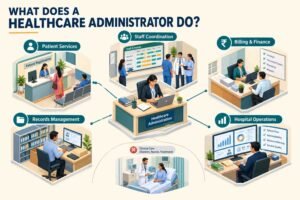
    A healthcare administrator’s daily work depends on the size and type of organisation. In a small clinic, the role may involve appointments, patient registration, staff coordination, and billing support. In a large hospital, responsibilities may be divided among specialised teams for operations, finance, quality, human resources, and patient services. Illustration of healthcare administration tasks including patient registration, staff coordination, hospital billing, records management, and operations reporting.

Description: An isometric view of a hospital administration hub showing how different non-clinical departments work together to keep hospital services organised. Typical responsibilities include:
    • Coordinating administrative activities across departments.
    • Monitoring appointment flow and patient service processes.
    • Supporting staff scheduling and workforce coordination.
    • Preparing reports and maintaining administrative records.
    • Assisting with budgets, invoices, and operational expenses.
    • Coordinating with suppliers and service providers.
    • Supporting quality checks and internal documentation.
    • Helping implement policies, standard procedures, and service improvements.
    • Communicating with patients, families, employees, and management teams.
    • Identifying operational issues and helping departments resolve them.
    Healthcare administrators should understand the boundaries of their role. Clinical decisions, diagnosis, and treatment must remain with appropriately qualified healthcare professionals. Administrators support the systems through which clinical services are delivered.

    Which Courses Can Help You Become a Healthcare Administrator?

    There is no single course that suits every healthcare administration role. Some positions accept graduates from general management or related disciplines, while specialised hospital management and senior administrative roles may require relevant postgraduate qualifications or professional experience. Your choice should depend on your current education, preferred responsibilities, and the eligibility requirements of the jobs you want to pursue.

    Courses for a Healthcare Administration Career

    The following table compares common education routes. Programme names, eligibility criteria, duration, and recognition can vary by institution, so always verify the current details before applying.
    Course or qualification Typical eligibility How it can help
    Bachelor of Business Administration (BBA) Usually Class 12 or equivalent, subject to institution rules Builds a foundation in management, communication, accounting, and organisational behaviour
    Bachelor of Hospital Administration (BHA) Usually Class 12 or equivalent, subject to programme rules Introduces hospital operations, patient services, healthcare systems, and administration
    Bachelor of Healthcare Management Usually Class 12 or equivalent, subject to programme rules Provides an introduction to healthcare organisations, management, and service delivery
    Bachelor of Commerce (B.Com) Usually Class 12 or equivalent Can support entry into billing, accounts, finance support, and administrative roles
    Bachelor of Business Administration through distance or correspondence mode Eligibility depends on the institution and programme Can provide general management knowledge for suitable administrative roles
    Master of Business Administration (MBA) Usually a recognised bachelor’s degree; other conditions may apply Develops management, finance, human resources, operations, and leadership knowledge
    Master of Hospital Administration (MHA) Eligibility varies; some programmes require a specific academic or professional background Provides specialised preparation for hospital administration and healthcare operations
    MBA in Healthcare or Hospital Management Usually a bachelor’s degree, subject to institution requirements Combines management concepts with healthcare-specific operational challenges
    Postgraduate diploma or certificate in hospital management Eligibility and duration vary May provide focused knowledge in hospital operations, quality, or healthcare administration
    Short-term training in hospital operations, medical records, or healthcare quality Depends on the training provider Can help develop targeted skills alongside a relevant degree or work experience
    A specialised healthcare qualification may provide more direct exposure to hospital systems, while a general management degree can offer broader business knowledge. The right choice depends on your career plan and the entry requirements of employers. For an example of specialised hospital administration education in India, explore the AIIMS Department of Hospital Administration. Its programme information illustrates how advanced hospital administration education can include operations, financial management, quality assurance, human resources, healthcare systems, and patient safety.

    How Do You Choose the Right Course?

    Before enrolling, compare the curriculum, admission requirements, mode of learning, practical exposure, and recognition status. Do not select a programme based on its title alone. Ask these questions:
    • Does the course cover healthcare operations or only general management?
    • Are internships, projects, hospital visits, or practical assignments included?
    • Is the institution and programme appropriately recognised for the qualification being offered?
    • Will the qualification meet the eligibility criteria for the jobs you want?
    • Are the fees, study schedule, and examination requirements manageable?
    • Does the programme provide clear information about its syllabus and assessment methods?
    Students exploring a correspondence college in india should pay particular attention to programme recognition and eligibility. Distance learning can be useful for some learners, but not every healthcare programme is offered in every mode, and practical training may be essential for particular roles.

    Can You Enter Healthcare Administration Through Management Distance Education?

    Yes, distance learning may be a useful route for building general management knowledge, provided the chosen qualification is recognised and accepted for your intended career path. However, it is important to distinguish between studying management and gaining specialised experience in healthcare operations. For example, a BBA can introduce students to business communication, accounting, marketing, human resources, and organisational behaviour. An MBA may build more advanced knowledge in operations, strategy, finance, and leadership. These subjects can be relevant to administrative roles in healthcare, but they do not automatically qualify a graduate for every hospital management position. Learners researching MBA distance education in bangalore should compare programmes based on curriculum, recognition, eligibility, and their intended career outcomes. If your goal is specifically hospital administration, check whether the syllabus includes healthcare management, hospital operations, patient services, healthcare quality, or related subjects. Similarly, students considering correspondence degree colleges in bangalore or a BBA correspondence college in Karnataka should verify the exact programme and delivery mode instead of assuming that all courses have the same recognition or career value. Indian College of Correspondence can be one option to explore when comparing educational pathways. Review the available programmes and confirm their suitability for your academic background and career goals before making a decision.

    Essential Skills Needed for Healthcare Administration

    A degree can provide the academic foundation, but healthcare administrators also need practical skills to coordinate people, processes, and information. These skills become increasingly important as responsibilities grow.

    1. Communication Skills

    Administrators communicate with patients, hospital staff, suppliers, and management teams. Clear communication helps prevent misunderstandings and ensures that information reaches the right people. You should be able to write professional emails, explain procedures, prepare reports, and communicate politely in stressful situations.

    2. Organisation and Time Management

    Hospitals operate through multiple departments, appointments, shifts, and support services. Administrators must prioritise tasks, manage deadlines, maintain records, and coordinate activities without overlooking important details. Using checklists, schedules, and digital task-management tools can help build this skill.

    3. Problem-Solving and Decision-Making

    Administrative issues may include delayed appointments, staff shortages, missing documents, billing queries, or resource constraints. Administrators need to identify the cause of a problem, collect relevant information, and coordinate a practical response within their authority. For example, if registration delays are affecting patient flow, an administrator might review peak-hour patterns, discuss bottlenecks with the team, and recommend improvements.

    4. Basic Financial Knowledge

    Healthcare facilities must manage expenses, supplies, salaries, billing, and budgets. Administrators working in these areas benefit from understanding basic accounting, cost control, budgeting, and financial reporting. Advanced finance knowledge may be required for specialised or senior financial positions.

    5. Digital and Documentation Skills

    Healthcare organisations increasingly use digital systems for registration, billing, scheduling, records, inventory, and reporting. Familiarity with spreadsheets, email, document management, and relevant hospital information systems can be useful. Patient information must be handled carefully and only accessed or shared according to authorised procedures and applicable privacy requirements.

    6. Teamwork and Leadership

    Hospital services depend on coordination between different professionals. Administrators should be able to listen, delegate tasks appropriately, resolve routine conflicts, and support cooperation between departments. Leadership also involves accountability: following up on tasks, communicating changes, and recognising when a concern needs to be escalated.

    7. Understanding of Healthcare Quality and Patient Safety

    Administrators do not replace clinical staff, but they can support processes that help maintain quality and patient safety. This may include accurate documentation, clear communication, incident reporting, internal checks, and adherence to approved procedures. A strong administrator understands that efficiency should never come at the expense of patient dignity or safety. “Aspiring healthcare professionals can enhance their career prospects by pursuing an MBA in Healthcare Management, which equips them with the managerial and leadership skills needed to succeed in hospital administration, healthcare operations, and medical services. Learn more about the program at MBA in Healthcare Management.”

    Healthcare Administration Job Opportunities in India

    Healthcare administration includes several career paths. Your first role will depend on your qualification, experience, communication skills, and the hiring organisation’s requirements.

    1. Hospital Administrative Executive

    Administrative executives support routine hospital operations, documentation, departmental coordination, and service-related activities. This may be an entry-level option for candidates with suitable management or administrative qualifications.

    2. Patient Relations Executive

    Patient relations professionals help patients and families navigate hospital processes. Their work may include responding to non-clinical queries, coordinating feedback, explaining administrative procedures, and escalating complaints to the appropriate team. Strong communication and empathy are especially valuable in this role.

    3. Front Office or Operations Coordinator

    Front office and operations coordinators may handle registration workflows, appointment scheduling, staff coordination, service desks, and administrative reporting. The exact responsibilities vary by organisation.

    4. Medical Records or Health Information Coordinator

    These professionals support the organisation and management of healthcare records and related information processes. Roles may require specialised training, familiarity with medical terminology, or knowledge of applicable documentation standards.

    5. Billing and Insurance Coordinator

    Billing and insurance teams help coordinate invoices, claims documentation, payment queries, and communication with insurers or third-party administrators. Attention to detail and basic financial knowledge can be useful.

    6. Quality and Patient Safety Coordinator

    Quality-related roles support audits, process documentation, quality indicators, and improvement initiatives. Employers may prefer candidates with relevant training or experience in healthcare quality and patient safety.

    7. Human Resources Executive in a Healthcare Organisation

    Healthcare HR teams support recruitment, onboarding, staff records, training coordination, attendance, and employee communication. A background in HR or general management may be relevant.

    8. Hospital Operations Manager

    Operations managers oversee defined operational areas, coordinate teams, monitor performance, and help improve service delivery. These roles commonly require relevant experience and stronger management capabilities.

    9. Healthcare Project or Programme Coordinator

    Healthcare projects may involve service expansion, public health activities, digital systems, community programmes, or operational improvement. Requirements vary widely depending on the project and employer.

    10. Hospital Administrator or Senior Healthcare Manager

    Senior administrators may oversee multiple departments, operational performance, budgets, workforce planning, and strategic initiatives. Such positions generally require substantial experience and may require specialised qualifications. For career exploration and job searches, the National Career Service portal operated by the Government of India provides career and employment services. You can use it to explore job-search resources and learn about opportunities, while checking each vacancy’s actual qualification requirements.

    Healthcare Administration Salary in India

    Salary is one of the common questions students ask before selecting a career. In healthcare administration, pay depends on the job role, employer, city, qualification, experience, size of the healthcare facility, and level of responsibility. The figures below are illustrative estimates, not official salary statistics or guaranteed offers. Actual compensation can fall outside these ranges. Treat them as broad planning examples and verify current vacancies in your preferred location.

    Estimated Salary by Role

    Job role Illustrative annual salary range in India Factors that can affect pay
    Front Office or Administrative Executive ₹1.8–3.6 lakh Communication skills, organisation size, and experience
    Patient Relations Executive ₹2–4.5 lakh Patient-facing experience, language skills, and service responsibilities
    Billing or Insurance Coordinator ₹2–4.5 lakh Billing knowledge, claims experience, and accuracy
    Medical Records or Health Information Coordinator ₹2–4.5 lakh Relevant training, systems knowledge, and employer requirements
    Hospital Operations Coordinator ₹2.5–5 lakh Operational exposure, reporting skills, and facility size
    HR Executive in Healthcare ₹2.5–5 lakh Recruitment experience, HR systems, and workforce responsibilities
    Quality Coordinator ₹3–6 lakh Quality training, audit exposure, and healthcare experience
    Hospital Operations Manager ₹5–12 lakh Team size, years of experience, and operational scope
    Hospital Administrator or Senior Manager ₹6–15 lakh or more Seniority, facility size, specialised expertise, and leadership responsibilities
    These ranges are broad estimates for career planning and should not be interpreted as a verified market average. Entry-level positions may pay less, while specialised or senior roles at large organisations may pay more. Some positions also require qualifications beyond a general management degree.

    What Can Help You Earn More?

    Salary progression is generally linked to a combination of education, practical experience, performance, and responsibility. Useful steps include:
    • Building experience in hospital or healthcare operations.
    • Learning relevant billing, reporting, documentation, or information systems.
    • Developing strong communication and team-coordination skills.
    • Understanding quality improvement and operational performance.
    • Completing relevant postgraduate study when required for your target role.
    • Taking responsibility for projects and measurable service improvements.
    • Researching vacancies regularly to understand the skills employers request.
    Instead of choosing a course only because it promises a high salary, compare the course with actual job descriptions. This will help you identify which skills and qualifications are relevant to your preferred career path.

    How to Start a Career in Healthcare Administration: A Practical Roadmap

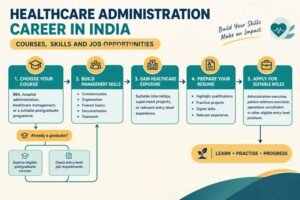
    If you are interested in this field but do not know where to begin, follow a step-by-step approach. Healthcare administration career flowchart showing education selection, management skills, healthcare exposure, resume preparation, and applying for entry-level jobs.

    Step 1: Identify Your Current Qualification

    Start by reviewing your educational background. A student who has completed Class 12 will have different options from a graduate who is considering postgraduate study. If you already hold a degree in business, commerce, science, or another relevant discipline, compare the eligibility requirements for hospital administration courses and entry-level jobs.

    Step 2: Choose a Suitable Course

    Decide whether you need a broad management qualification or a specialised healthcare management programme. Review the syllabus and confirm that the course supports your intended career. If you are considering a BBA, MBA, healthcare management degree, or hospital administration programme, verify eligibility and recognition before applying.

    Step 3: Learn How Healthcare Organisations Work

    Read about hospital departments, patient registration, appointment systems, billing, medical records, procurement, and quality processes. Understanding the relationship between these functions will make your studies more practical. You can also review institutional programme descriptions, such as those published by AIIMS, to understand the range of topics covered in specialised hospital administration education.

    Step 4: Build Practical Skills

    Practise spreadsheet reporting, professional communication, scheduling, documentation, and basic data interpretation. If you have access to a suitable internship or supervised project, use it to understand workplace expectations. Never use real patient records or confidential hospital information for personal practice. Use authorised training material or fictional examples instead.

    Step 5: Seek Relevant Exposure

    Look for internships, project work, volunteering opportunities with appropriate supervision, or entry-level administrative roles that match your qualification. Exposure to a real work environment can help you understand patient-service processes and departmental coordination.

    Step 6: Prepare Your Resume

    Highlight your education, relevant projects, communication skills, administrative experience, computer skills, and any healthcare-related training. Describe what you actually did rather than listing skills without examples. For example, if you completed a project on improving appointment scheduling, explain the problem you studied, the process you mapped, and the recommendations you developed.

    Step 7: Apply for Suitable Entry-Level Roles

    Search for roles such as administrative executive, operations coordinator, patient relations executive, billing coordinator, or other positions that match your qualifications. Read each job description carefully because titles and eligibility criteria differ between employers. As you gain experience, review the additional qualifications and skills needed for more specialised or senior positions.

    Is Healthcare Administration Suitable for You?

    Healthcare administration may suit you if you enjoy organisation, communication, planning, and solving operational problems. It can also be a suitable area to explore if you are interested in healthcare but prefer a non-clinical role. However, the field has its own challenges. Hospital environments can be busy, priorities may change quickly, and administrators sometimes need to handle complaints or coordinate urgent operational issues. Accuracy, patience, confidentiality, and professional judgement are therefore important. Consider the following questions:
    • Do you enjoy coordinating tasks and working with different people?
    • Can you communicate clearly and professionally?
    • Are you comfortable handling documentation and following procedures?
    • Are you willing to learn about healthcare operations and patient-service expectations?
    • Can you remain organised when several tasks need attention?
    • Are you interested in developing your management skills over time?
    You do not need to answer yes to every question today. Many skills can be developed through study, practice, and workplace experience. The important thing is to understand the nature of the work before committing to a particular course.

    How to Choose a College or Learning Mode

    Selecting the right institution is an important part of your career planning. A course should support your learning goals, fit your circumstances, and meet the eligibility requirements of your intended career. If you are comparing management distance education in bangalore with other study options, review the following factors: Recognition and eligibility: Check the recognition status of the institution and programme, and confirm that the qualification is suitable for the roles or further study you intend to pursue. Course content: Compare subjects such as management principles, finance, operations, human resources, healthcare systems, and quality management. Learning format: Understand how classes, study materials, assignments, examinations, and practical components are delivered. Practical exposure: For healthcare-focused programmes, look for suitable projects, internships, field exposure, or other ways to understand healthcare operations. Fees and schedule: Review the total cost, examination requirements, payment terms, and expected study workload. Career relevance: Compare the course with current job descriptions to see whether its content matches your intended role. Students considering a correspondence college in india should avoid assuming that all distance programmes have identical recognition, flexibility, or career outcomes. Verify the specific programme rather than relying only on a general description. Indian College of Correspondence provides a starting point for exploring education options. Review the available course information, check the eligibility requirements, and contact the institution through its official website if you need clarification about a programme.

    Future Scope of Healthcare Administration in India

    Healthcare administration continues to be relevant wherever healthcare organisations need to coordinate staff, facilities, budgets, information, and patient services. As healthcare delivery involves increasingly complex processes, organisations need people who can help maintain efficient operations and improve service quality. Several areas may offer opportunities for appropriately qualified professionals: Hospital operations: Hospitals need administrative support for scheduling, departmental coordination, resource planning, and daily operations. Digital healthcare processes: Digital registration, appointment systems, billing platforms, and information systems create a need for people who can support workflows and data management. Quality and patient experience: Healthcare organisations may require staff to support documentation, service standards, feedback systems, and improvement projects. Healthcare finance and insurance: Billing, claims coordination, and administrative processes can provide opportunities for people with relevant financial and operational skills. Public health programmes: Some projects need coordination, reporting, logistics, and administrative support. Eligibility depends on the programme and employer. Specialised healthcare services: Diagnostic facilities, rehabilitation centres, speciality clinics, and other providers also need operational and administrative support. These areas should be viewed as potential career directions rather than a guarantee of employment. Job availability depends on location, employer requirements, experience, and the qualifications held by the applicant. The Government of India’s National Health Mission is another useful official resource for learning about public health programmes and health-system initiatives. Exploring such resources can help you understand the broader environment in which healthcare organisations operate.

    Conclusion

    Healthcare administration offers a way to contribute to healthcare delivery through planning, coordination, operations, and management. From patient services and hospital administration to quality coordination, billing, human resources, and healthcare projects, the field includes several possible career directions. The best starting point is to match your current education with a suitable course, develop practical management skills, and gain relevant exposure wherever possible. A general management degree may support some administrative roles, while specialised hospital administration or healthcare management education may be more appropriate for certain positions. If you are comparing management distance education in bangalore or exploring healthcare-related study options, take time to verify course recognition, eligibility, curriculum, and practical learning opportunities. Make your decision based on your intended role rather than salary promises or course titles alone. With a clear learning plan, relevant skills, and realistic expectations, you can begin exploring whether healthcare administration aligns with your interests and long-term career goals.

    Frequently Asked Questions

    1. What is healthcare administration?

    Healthcare administration involves coordinating and managing the operational and administrative activities of healthcare organisations. Responsibilities may include patient services, staff coordination, budgeting, documentation, and quality-related processes.

    2. Which course is best for healthcare administration?

    The right course depends on your education and career goal. Options include BBA, Bachelor of Hospital Administration, healthcare management programmes, MBA in Healthcare or Hospital Management, and Master of Hospital Administration. Check eligibility and recognition before choosing.

    3. Can I work in hospital administration after a BBA?

    A BBA may be relevant to some entry-level administrative, coordination, or support roles. Specialised and senior positions may require healthcare-specific qualifications, experience, or additional training.

    4. Is an MBA necessary for healthcare administration?

    An MBA is not necessary for every healthcare administration job. Some entry-level roles may accept a relevant bachelor’s degree, while management positions may prefer postgraduate education and experience. Requirements vary by employer.

    5. Can I study healthcare management through distance education?

    Some management programmes are available through distance or flexible learning modes, but availability and eligibility differ by institution. Verify the exact programme’s recognition and whether it includes any required practical components.

    6. What is the salary of a healthcare administrator in India?

    Salary varies by role, experience, location, employer, and qualifications. Entry-level administrative roles may offer lower pay than specialised or senior management positions. Check current job advertisements to understand the salary range in your preferred city.

    7. Is healthcare administration a non-medical career?

    Many healthcare administration roles are non-clinical and focus on operations, finance, human resources, patient services, or administration. However, some specialised positions have specific professional or clinical eligibility requirements.

    8. What skills are needed for hospital administration?

    Useful skills include communication, organisation, problem-solving, teamwork, documentation, basic financial knowledge, digital literacy, and an understanding of healthcare quality and patient safety.

    9. Where can healthcare administrators work?

    Depending on their qualifications and experience, they may work in hospitals, clinics, diagnostic centres, nursing homes, medical colleges, healthcare companies, insurance organisations, public health projects, and related settings.

    10. How do I find healthcare administration jobs in India?

    Search for relevant job titles on reputable job portals and the National Career Service website. Review the qualifications, skills, location, and experience required for each vacancy before applying.

    Take the Next Step Towards Your Career

    If healthcare administration interests you, start by identifying the qualification that matches your background and career goals. Compare the course content, check recognition and eligibility, and build practical skills that employers value. Indian College of Correspondence can help you explore available educational pathways and understand which options may fit your learning needs. Visit the official website to review course information and contact the institution if you need further details. Explore your options today: Visit the ICC website

Leave A Comment