Admission opens for 2026-27 sessions for all university.

Blog Detail

  • How to Become an Accountant After 12th: Courses, Skills, Salary & Career Path

    • 08,Oct 2026
    • Posted By : uaeautomates@gmail.com
    • 0 Comments
    • 12th PUC correspondence college in Bangalore
    • Accountant After 12th
    • accountant career in India
    • accounting career after 12th
    • accounting courses after 12th
    • B.Com distance education in Bangalore
    • Commerce distance education in Bangalore
    • correspondence college in india
    • distance education in bangalore
    • Traditional distance education in bangalore
    If your goal after Class 12 is to work in accounting, the first decision is not simply “Which accounting course should I take?” The better question is: “What kind of accountant do I want to become, and what qualification will help me reach that role?” An entry-level accounts assistant, a GST executive, a corporate accountant, a financial reporting professional and a Chartered Accountant may all work with financial information, but their education, responsibilities and career progression are different. For students researching B.Com distance education in Bangalore, a useful starting point is a commerce degree combined with practical accounting skills. Students who need flexibility can also compare options through a correspondence college in India, while learners who have not yet completed higher secondary education may first need a suitable 12th/PUC pathway. This guide takes a different approach. Instead of treating accounting as one course, it maps the career backwards: job → responsibilities → skills → qualification → experience → professional progression. It also explains where ICC’s flexible education pathways can fit into that journey.

    Start with the job, not the course

    A common mistake after 12th is to search for the “best accountant course” before understanding what accountants actually do. Accounting is a business function built around recording, checking, classifying and reporting financial transactions. Depending on the organisation and seniority, an accounting professional may work on:
    • Sales and purchase entries
    • Invoices and payments
    • Ledger maintenance
    • Bank reconciliation
    • Accounts payable and receivable
    • GST-related records
    • Payroll-related accounting
    • Expense tracking
    • Financial statements
    • Audit support
    • Tax documentation
    • Budgeting and reporting
    • Management information
    That means there is no single skill that makes someone employable in accounting. A candidate might have a B.Com but lack accounting software experience. Another might know Tally but have weak accounting fundamentals. A third might understand bookkeeping but struggle with Excel. The stronger profile combines qualification + accounting knowledge + software + compliance awareness + workplace experience. That is the central idea behind planning an Accountant After 12th career.

    What does the accountant career actually look like?

    Think of accounting as a ladder rather than one job title.
    Career stage Typical role What you may handle
    Entry Accounts Trainee / Accounts Assistant Entries, invoices, documentation
    Early career Junior Accountant Ledgers, reconciliation, reports
    Developing Accounts Executive GST support, payables, receivables, reporting
    Experienced Senior Accountant Closing, reporting, compliance coordination
    Specialist Tax / GST / Audit / Costing professional Specialised financial work
    Professional CA / CMA or other qualified professional Advanced accounting, audit, tax, advisory or costing
    Leadership Finance Manager / Controller / Head of Finance Financial planning, reporting and decision-making
    Not every person needs to climb every level. Someone may want a stable accounting position in a small or medium-sized company. Someone else may want to build a long-term career in corporate finance. Another student may eventually target CA or CMA. The education decision should reflect that destination.

    The three-layer route to becoming an accountant after 12th

    A practical accounting career can be understood through three layers:

    Layer 1 — Academic foundation

    This is where a degree such as B.Com can become important. It provides structured exposure to accounting, finance, economics, taxation, business law and related commerce subjects.

    Layer 2 — Job-ready tools

    This is where students build skills employers can actually test:
    • Tally or relevant accounting software
    • Excel
    • GST fundamentals
    • Bookkeeping
    • Reconciliation
    • Financial documentation
    • Basic reporting

    Layer 3 — Professional progression

    Once the foundation is established, a learner can consider:
    • CA
    • CMA
    • M.Com
    • MBA Finance
    • Taxation specialisation
    • Audit
    • Financial analysis
    • Management accounting
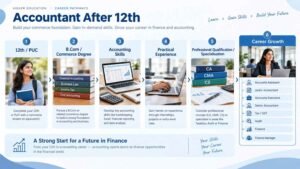
    This layered approach is more useful than treating a single certificate as the complete answer. Career pathway from 12th to B.Com, accounting skills, experience and finance roles

    Which course should you choose after 12th?

    There are several routes, and they serve different purposes.
    Route Suitable for Main advantage Long-term direction
    B.Com Students wanting a degree foundation Broad commerce knowledge Accounting, finance, banking, higher studies
    B.Com + accounting skills Students targeting employment Degree + practical capability Accounts and finance roles
    CA Students targeting professional accounting Advanced professional qualification Audit, taxation, advisory, accounting
    CMA Students interested in costing and management accounting Specialised management accounting route Costing, finance, management accounting
    Short accounting course Students wanting additional practical skills Faster skill development Entry-level support roles
    BBA Students more interested in business/management Wider management exposure Management, finance, MBA
    B.Com + M.Com Students planning deeper commerce education Academic progression Teaching, finance, commerce specialisations
    For many students, these routes do not have to be mutually exclusive. A learner can pursue graduation while developing accounting software and Excel skills. A B.Com graduate can later consider M.Com, MBA, CA, CMA or another specialisation depending on eligibility and career goals.

    Why B.Com is a strong foundation for accounting

    For students specifically interested in accounting, B.Com distance education in Bangalore can be worth considering when flexibility is an important part of the decision. B.Com introduces students to the commercial side of organisations rather than limiting learning to bookkeeping. Depending on the university and curriculum, subjects can include areas such as:
    • Financial accounting
    • Corporate accounting
    • Cost accounting
    • Business economics
    • Business law
    • Taxation
    • Auditing
    • Financial management
    • Business statistics
    • Management
    • Banking and finance
    This broader foundation matters because an accountant eventually has to understand why financial information is being recorded, not just how to enter a transaction. For students comparing B.Com distance education in Bangalore, the key comparison should therefore not be only the fee. Look at:
    1. Degree-awarding university
    2. Recognition and programme status
    3. Curriculum
    4. Examination structure
    5. Academic support
    6. Study resources
    7. Flexibility
    8. Progression options
    9. Total cost
    10. Whether the programme fits your intended career
    ICC currently lists B.Com among its commerce and traditional education pathways and provides admission guidance across its partner-university options. 

    What should you learn besides your degree?

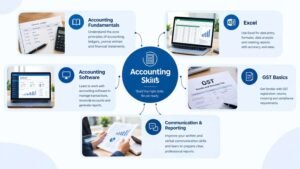
    This is where many fresh graduates underestimate the accounting profession. A degree tells an employer that you completed a structured academic programme. It does not automatically demonstrate that you can handle a company’s books. Build your skill stack around actual workplace tasks.

    1. Accounting fundamentals

    Before learning software, understand:
    • Debit and credit
    • Journal entries
    • Ledgers
    • Trial balance
    • Profit and loss account
    • Balance sheet
    • Depreciation
    • Accruals and adjustments
    • Bank reconciliation
    If you understand the logic behind these concepts, accounting software becomes easier to use.

    2. Tally or accounting software

    Accounting departments use software to process transactions and generate reports. Students should learn how to work with:
    • Company creation
    • Ledgers
    • Sales vouchers
    • Purchase vouchers
    • Payment and receipt entries
    • Journal vouchers
    • Inventory where relevant
    • GST-related transactions
    • Reports
    • Backup and documentation
    Do not learn software only by memorising menus. Create a mock business and practise entering one month’s transactions. That exercise can teach more than repeatedly watching software tutorials.

    3. Excel

    Excel is one of the most useful additional skills for an aspiring accountant. Start with:
    • SUM
    • IF
    • SUMIF/SUMIFS
    • COUNTIF
    • Sorting
    • Filtering
    • Conditional formatting
    • Data validation
    • VLOOKUP/XLOOKUP
    • Pivot tables
    • Basic charts
    An accountant may spend significant time checking, cleaning, comparing and presenting financial information. Excel helps with those tasks.

    4. GST awareness

    Students do not need to become tax experts immediately, but an entry-level accounting professional should understand the basic GST environment. Learn concepts such as:
    • CGST
    • SGST
    • IGST
    • Input tax credit
    • Tax invoices
    • GST returns
    • Reconciliation
    • E-invoicing where applicable
    The official GST portal should be treated as the reference point for current rules, forms and filing information rather than relying on old social-media posts or outdated tutorials.

    5. Communication

    Accounting is not isolated work. You may have to ask a sales employee why an invoice is missing, explain a payment difference to a supplier, request documents from another department or explain financial information to a manager. So build:
    • Email writing
    • Business communication
    • Documentation
    • Presentation
    • Basic professional English
    • Question-asking skills
    Technical knowledge gets you into the conversation. Clear communication helps you function inside the organisation. Accounting professionals also need to understand how financial information ultimately feeds into formal financial statements, including the balance sheet, statement of profit and loss and cash-flow information. The Ministry of Corporate Affairs provides the applicable Indian Accounting Standards framework for financial reporting.  Accounting skills including Excel, accounting software, GST, financial fundamentals and communication

    Seven practical moves that can make an accounting career stronger

    Instead of collecting random certificates, use these seven moves.

    Move 1: Choose the degree around your destination

    If your goal is accounting, finance or taxation, compare B.Com pathways before choosing a completely unrelated degree. Students looking specifically for Commerce distance education in Bangalore should evaluate the course based on curriculum and career direction rather than convenience alone.

    Move 2: Start software practice early

    Do not wait until graduation. Build familiarity with accounting software while studying.

    Move 3: Treat Excel as an accounting skill

    Do not learn Excel as a generic computer course. Practise it using financial examples:
    • Expense sheets
    • Sales reports
    • Outstanding payments
    • Purchase analysis
    • Monthly summaries

    Move 4: Learn GST alongside accounting

    Understanding the relationship between invoices, tax records and accounting entries makes your learning more practical.

    Move 5: Build a mini accounting portfolio

    Create sample work such as:
    • One month of transactions
    • Ledger reports
    • Bank reconciliation
    • GST invoice examples
    • Monthly expense report
    • Simple profit and loss statement
    • Excel dashboard
    A portfolio gives you something concrete to discuss in an interview.

    Move 6: Get workplace exposure

    Look for:
    • CA firms
    • Small businesses
    • Finance departments
    • Accounting offices
    • Internships
    • Part-time accounts work
    The first objective is not necessarily a high salary. It is learning how accounting works when the data is incomplete, deadlines exist and someone is waiting for the report.

    Move 7: Decide whether you need a professional qualification

    After understanding accounting work, ask whether your ambition requires CA, CMA or another advanced qualification. This prevents students from choosing a difficult professional route simply because it sounds prestigious.

    CA or B.Com? They are not the same decision

    One of the most common questions from students planning an Accountant After 12th route is whether they should choose B.Com or CA. The answer depends on what you want to become. B.Com is a degree. CA is a professional qualification. A student can pursue a B.Com and simultaneously work towards a professional qualification, subject to the relevant rules and eligibility. The Institute of Chartered Accountants of India states that students can register for the Foundation Course after Class 10, while eligibility to appear for the Foundation examination is tied to appearing in the Class 12 examination or an equivalent recognised examination. The current Foundation structure includes Accounting, Business Laws, Quantitative Aptitude and Business Economics. Therefore, CA should not be presented simply as “the next accounting course.” It is a separate professional route with its own examination and training requirements.

    What about CMA after 12th?

    CMA can be relevant for students who are particularly interested in:
    • Cost accounting
    • Management accounting
    • Budgeting
    • Cost control
    • Financial planning
    • Business decision support
    The Institute of Cost Accountants of India provides a Foundation route for eligible students and outlines progression toward Intermediate and Final levels.  This makes CMA worth researching if your interests go beyond routine bookkeeping and into the way organisations manage costs and financial performance.

    What salary can an accountant expect in India?

    Salary should be treated as a range influenced by skills, city, experience, employer and role, not as a guaranteed outcome of completing one course. Current salary data from Indeed, updated in September 2026, reports an average accountant salary in India of around ₹19,200 per month, based on thousands of reported salaries. Its current data also shows significant variation between roles and cities; Bengaluru appears among the higher-paying locations in its dataset.  A useful way to think about progression is:
    Career stage Typical earning factors
    Fresher Qualification + accounting basics + software skills
    1–3 years Experience + GST + Excel + reconciliation + reporting
    3–5 years Independent accounting responsibility + compliance exposure
    5+ years Team responsibility + reporting + specialisation
    Professional qualification CA/CMA or specialisation can change the type of roles available
    Do not choose a course because someone promises a fixed salary. Instead, ask: What skills will make me eligible for the next role? That is a more useful salary strategy.

    Why Bengaluru can be an interesting market for accounting careers?

    Bengaluru has a large mix of technology companies, startups, service businesses, manufacturing companies, consulting firms, retail operations and professional-services firms. That means accounting work is not restricted to traditional trading businesses. An accounting professional may work in:
    • IT and technology
    • Manufacturing
    • Retail
    • Logistics
    • Healthcare
    • Education
    • Hospitality
    • Startups
    • Professional services
    • E-commerce
    • Real estate
    The industry changes, but the need to maintain financial records does not disappear. For a student searching for B.Com distance education in Bangalore, this creates an interesting combination: a flexible academic route can be paired with local internships, practical training or entry-level work, subject to the programme’s requirements and the student’s circumstances.

    The search journey students usually follow

    A useful SEO and student-intent perspective is that people rarely search only one phrase. Their searches change as their decision becomes more specific.
    Search intent Typical search What the person wants
    Career discovery Accountant career after 12th Understand the profession
    Course discovery Accounting courses after 12th Compare routes
    Degree intent B.Com after 12th Find a graduation pathway
    Local intent B.Com distance education in Bangalore Find flexible study options
    Institution intent Correspondence college in India Compare providers
    Flexibility intent Distance education in Bangalore Understand flexible options
    School-leaver intent 12th PUC correspondence college in Bangalore Complete/continue 12th
    Professional intent CA after 12th Explore professional qualification
    Skill intent Tally GST Excel course Become job-ready
    Salary intent Accountant salary in India Understand earning potential
    This is why a strong education website should not publish ten articles that all answer the same question with slightly different wording. The pages should serve different stages of the student’s decision.

    Where ICC fits into the Accountant After 12th pathway

    For a student comparing a correspondence college in India, ICC’s value is not simply having a long course list. The more useful role is helping a learner identify the appropriate academic route based on where they are starting. ICC’s current website lists pathways including SSLC, PUC, B.Com, BBA, B.Sc, BCA, MBA and other undergraduate and postgraduate programmes. It also describes admission guidance and ongoing support for students pursuing flexible education options.  That matters because not every prospective student starts at the same point.

    Student A — Has completed 12th

    A student who has completed PUC/12th and wants accounting can investigate B.Com and build practical accounting skills alongside the degree.

    Student B — Has not completed 12th

    A learner who needs to complete higher secondary education first should look at an appropriate recognised 12th pathway before planning graduation. ICC currently has a dedicated 12th programme page describing its PUC/12th pathway and admission support.

    Student C — Wants management rather than pure accounting

    A learner who likes business but is less interested in detailed accounting may compare BBA instead. ICC’s BBA pathway includes areas such as finance, business economics, business law, banking and insurance, depending on the programme. 

    Student D — Wants to progress into management later

    After graduation and relevant experience, a student may investigate postgraduate management education such as an MBA. ICC offers distance MBA pathways with multiple specialisations.  This is why course selection should be viewed as a pathway rather than an isolated admission decision.

    What should you check before choosing a distance or correspondence programme?

    Students searching for traditional distance education in Bangalore or distance education in Bangalore should be especially careful about the exact programme and awarding institution. The words “online,” “distance,” “correspondence” and “traditional” can be used differently by different providers. Before paying an admission fee, check:
    • Who awards the final qualification?
    • What is the exact programme?
    • What is the approved mode?
    • Is the institution/programme recognised for the relevant session?
    • What is the duration?
    • What are the examination requirements?
    • What study resources are provided?
    • What is the complete fee?
    • Are there additional examination or service charges?
    • What are the progression options?
    UGC-DEB maintains year-wise information on recognised/entitled institutions and programmes. Its current guidance tells learners to confirm recognition status before admission and provides the DEB-ID system for ODL/online learners.  This check is particularly important when comparing a correspondence college in India because the name of a provider alone does not determine the recognition status of the degree.

    Is a correspondence route suitable for an aspiring accountant?

    It can be suitable for students who need flexibility, but the qualification should not be treated as the entire career plan. For example, a student pursuing B.Com distance education in Bangalore can use the flexibility to build additional capabilities outside the degree: Degree study → Accounting fundamentals → Finance and commerce knowledge → Taxation and business concepts Parallel skill development → Tally/accounting software → Excel → GST fundamentals → Communication Practical exposure → Internship → CA firm experience → Accounts assistant role → Small-business accounting Career progression → Junior Accountant → Accounts Executive → Senior Accountant → Finance specialisation / professional qualification That combination is more career-oriented than simply completing a degree and waiting for employers to recognise the qualification.

    What if you are still comparing commerce courses?

    Accounting is only one destination within commerce. Students may also prefer:
    • Banking
    • Finance
    • Taxation
    • Business management
    • Financial analysis
    • Human resources
    • Marketing
    • Entrepreneurship
    • Business analytics
    ICC’s commerce-focused resources also discuss B.Com, M.Com, BBA and broader career pathways for commerce students.  This is useful for students who are interested in accounting but have not yet decided whether they want to stay in accounting long term. A B.Com foundation can leave room for several of these directions, depending on the programme and later qualifications.

    The practical Accountant After 12th roadmap

    If you want the shortest useful roadmap, use this: 12th / PUC ↓ Choose your academic route B.Com / relevant degree / professional route ↓ Learn accounting fundamentals Journal → Ledger → Trial Balance → Financial Statements ↓ Build workplace tools Tally or relevant software → Excel → GST basics ↓ Get practical exposure Internship → CA firm → Accounts department → Entry-level role ↓ Choose your specialisation Accounting / Tax / GST / Audit / Costing / Finance ↓ Add higher qualification if required CA / CMA / M.Com / MBA Finance / relevant specialisation ↓ Move from transaction work to analysis and responsibility That is the point at which an accountant’s career starts becoming more specialised.

    Common mistakes to avoid after 12th

    Choosing CA only because someone said it pays well

    CA is a demanding professional route. Choose it because its work and qualification structure match your ambitions.

    Learning Tally without understanding accounting

    Software can process transactions, but you need to understand what the transaction means.

    Completing B.Com without practical skills

    A degree should be supported by tools and experience.

    Ignoring Excel

    Many finance and accounting workplaces use spreadsheets extensively.

    Treating salary websites as promises

    Salary data is market information, not a guarantee.

    Choosing a distance programme only because it is cheap

    Recognition, university, curriculum, support and progression matter.

    Collecting too many certificates

    Five unrelated certificates may be less useful than one relevant degree plus demonstrable practical skills.

    Frequently Asked Questions

    Can I become an accountant after 12th?

    Yes. A common route is to pursue a B.Com or another relevant commerce qualification while developing practical accounting, Excel, GST and accounting-software skills. Students can later consider professional qualifications such as CA or CMA depending on their goals.

    Is B.Com necessary to become an accountant?

    Not for every entry-level accounting role. Some employers may hire candidates based on practical skills and other qualifications. However, a B.Com can provide a stronger academic foundation and broader progression options in accounting, finance and commerce.

    Is B.Com distance education in Bangalore good for accounting?

    It can be suitable for students who need flexible education, provided the specific programme and awarding institution meet the learner’s requirements and recognition expectations. Students should verify the programme before admission.

    Can I study B.Com while preparing for CA?

    Students can pursue graduation alongside professional-course preparation, subject to the applicable rules and schedules. The two routes can complement each other because B.Com provides commerce education while CA follows a separate professional qualification pathway.

    What skills should an accountant learn after 12th?

    Start with accounting fundamentals, then build accounting software skills, Excel, GST awareness, reconciliation, reporting, documentation and communication. Practical experience is also valuable.

    What is the salary of an accountant in India?

    Salary varies significantly by city, role, employer, skills and experience. Current Indeed data updated in September 2026 reports an average of roughly ₹19,200 per month for accountants in India, but individual salaries can be substantially lower or higher.

    Can I study through a correspondence college in India and work at the same time?

    A flexible programme can make this possible, depending on the programme’s schedule and requirements. Students should check examination dates, assignments, practical requirements and study expectations before enrolling.

    What should I check before joining distance education in Bangalore?

    Verify the awarding university, programme recognition, mode of delivery, eligibility, curriculum, examination structure, total fees and progression options. UGC-DEB should be used to verify applicable recognition information for ODL/online programmes. 

    Final decision: choose the career before choosing the course

    The most useful answer to how to become an accountant after 12th is not simply “do B.Com.” A stronger plan is: “Choose a relevant academic foundation → learn accounting properly → build software and Excel skills → understand GST → gain practical experience → decide whether you need CA, CMA or higher education → progress into a specialised accounting or finance role.” For students who need flexibility, B.Com distance education in Bangalore can be one route to build the academic foundation while managing other commitments. ICC provides access to flexible education pathways across commerce, management, traditional and other academic categories, with guidance through the admission process. Students who are still completing higher secondary education can first explore the appropriate 12th PUC correspondence college in Bangalore pathway, while graduates can consider further commerce or management education. The important thing is to avoid treating the degree, the software course and the first job as separate decisions. They are stages of the same career plan.

Leave A Comment