Admission opens for 2026-27 sessions for all university.

Blog Detail

  • How to Build a Career in EdTech After B.Ed in 2026: Roles & Skills?

    • 19,Aug 2026
    • Posted By : opsadsthrivein@gmail.com opsadsthrivein@gmail.com
    • 0 Comments
    • B.Ed course for working professionals
    • M.Ed correspondence college in Bangalore
    • Teaching distance education
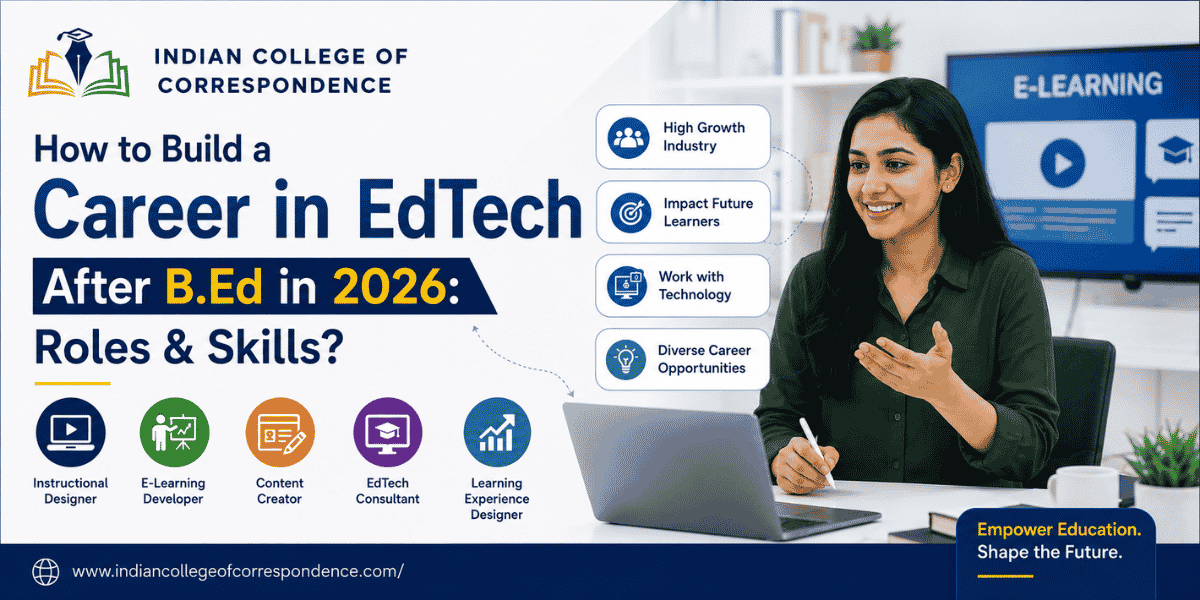
    A Career in EdTech After B.Ed is fast gaining ground as many teachers and education graduates are realizing the need to pivot their career path from the conventional way of working. Traditional learning in the form of books, hand written notes and face to face teacher-student interaction is no longer the new normal, especially in 2026. Virtual classrooms, learning programs, digital curriculums, electronic assessments, educational apps and artificial intelligence are being leveraged to enhance learning outcomes as well as redefine teaching and learning. For a B.Ed graduate, this is a great opportunity to leverage their teaching knowledge and skills to be part of the edtech revolution. Such B.Ed holders may explore a career as an instructional designer, curriculum expert, academic writer, online teacher, learning specialist, academic operations executive and more. The best part about Career in EdTech After B.Ed is that one does not have to be a software expert or code-savvy. All that one needs to do is to enhance one’s knowledge and skills in teaching, learning and learners, as well as expand one’s digital competences and add value in the form of academic expertise and practical projects.

    Why Choose a Career in EdTech After B.Ed in 2026?

    The education sector is undergoing a digital transformation. From schools and colleges to coaching centers and corporate training divisions, everyone is looking for professionals who understand education and have the skills to implement technological solutions. If you are a B.Ed graduate and wondering why you should build a career in EdTech, here are strong reasons: A B.Ed graduate has an innate understanding of a few concepts that would take a long time for tech graduates to learn. For instance,you know
    • How do students learn?
    • How are lessons planned?
    • How are assessments designed?
    • How are learning outcomes defined?
    • How are concepts explained?
    • And how students respond to various teaching methodologies.
    You also know how learning material must be organized to yield the best results. An EdTech career, therefore, makes perfect sense. Not only do you get to comprehend how learning takes place, you also get to make learning easier and more effective for students. A B.Ed graduate is familiar with the basics of teaching but he/she is not aware of how technology can make a difference. So while a teacher may wonder how to explain a concept, an EdTech professional will think about how to make learning interesting by using technology. Similarly, while a teacher is more concerned with how to design an assessment, an EdTech professional will think about how to make assessments interactive. A career in EdTech thus requires you to think from the perspective of a student. It will enable you to leverage technology to enhance the learning experience and yield better results than conventional teaching methodologies.

    What Does an EdTech Professional Actually Do?

    When most students hear the term EdTech, they think of online classes. While teaching is a part of the EdTech industry, it’s only one piece. A Career in EdTech After B.Ed can include content, technology, curriculum, learner support, course design, academic operations and learning analytics. For example, an instructional designer could take a subject and turn it into an online course. A curriculum developer could design courses and exams. An academic content specialist could create videos, questions and course material. A learning technology professional could work with a learning management system. So, the first step in choosing a career path in EdTech is not to choose a course, but rather to choose the type of work that suits you.

    Which EdTech Role Is Right for You?

    If You Enjoy… Suitable EdTech Role Main Responsibility
    Designing lessons Instructional Designer Create structured learning experiences
    Explaining subjects Subject Matter Expert Develop and review educational content
    Writing Content Developer Create digital study material
    Technology Learning Technology Executive Work with digital learning platforms
    Student interaction Learner Success Executive Support and engage learners
    Data Learning Analytics Executive Study learner performance
    Organisation Academic Operations Executive Manage academic processes
    Creativity E-Learning Designer Develop engaging digital content
    This variety is one reason a Career in EdTech After B.Ed can be appealing to graduates who do not want to leave education but want to explore a different working environment.

    The Most Promising EdTech Roles After B.Ed

    1. Instructional Designer

    Instructional design is one of the most obvious career fields for a B.Ed graduate to consider. An instructional designer generally deals with the creation of the course framework, including learning outcomes, lesson plans, activities, assessments, and much more. A Career in EdTech After B.Ed would allow an instructional designer to utilise their creative skills while working in the field of education. Some of the various tasks that an instructional designer may perform include:
    • Learning management system development
    • Storyboarding
    • Assessment development
    • Interactive learning module development
    • Video scriptwriting
    • Online course development
    • Learning objective writing

    2. Curriculum Developer

    Curriculum development deals with the learning outcomes and organisational arrangement of a particular course of study. As a B.Ed graduate already has experience in lesson planning and the fundamentals of curriculum development, this Career in EdTech After B.Ed could be well-suited for them. Some of the possible tasks that a curriculum developer may perform include:
    • Designing course frameworks
    • Reviewing educational material
    • Aligning various learning outcomes
    • Developing assessments

    3. Educational Content Developer

    For those who are strong in terms of writing and exposition, the field of content development may be well-suited. Educational content developers may engage in a number of tasks, including:
    • Article writing
    • Lesson note writing
    • Question paper writing
    • Worksheet development
    • Video scriptwriting
    • Development of explainer content
    • Development of digital study material
    When it comes to a Career in EdTech After B.Ed, one does not necessarily need extensive technical expertise to become a content developer. In most cases, a competent command of the relevant subject, coupled with strong writing and digital content development skills, may be sufficient.

    4. Online Educator

    Distance education is yet another viable career option for someone with a B.Ed. An online educator may facilitate online courses and live lectures and may operate using online mediums. While this Career in EdTech After B.Ed may appear to be similar to traditional teaching, there are significant differences. A competent online educator needs to have a working knowledge of pedagogy applicable to online or distance learning, as well as presentation skills, presentation tools, and much more. Those who are considering a career in teaching distance education may benefit from further developing these competencies.

    5. Learning Experience Designer

    Beyond making content available online, there is another concept called learning experience design. A learning experience designer focuses on the overall feel of the course, as well as whether it is appropriate for the target audience. Some of the questions dealt with by learning experience designers include: Are the lessons easy to navigate? Are the activities engaging? Are the assessments informative? Are the students given sufficient practice? Is the course accessible? Does the course flow intuitively? This career option may be ideal for someone who aspires to have a long-term career in the field of EdTech.

    8 Skills You Should Build for an EdTech Career

    While a degree provides theoretical grounding, practical competencies are also vital to landing a job in the field. These include such skills as

    1. Instructional Design

    This entails knowledge of terms such as learning outcomes, assessment, learning pathways, and instructional design models.

    2. Digital Content Creation

    This competency involves such digital skills as production of presentable material, videos, graphics, and digital content for the purpose of instruction.

    3. LMS Knowledge

    While one may not always be required to operate at the administrative level, a good grasp of how these systems function and host online courses is important.

    4. AI Literacy

    AI is being used in content writing, instructional design, assessments, and support services. It is important to gain skills in applying the technology responsibly while also being able to verify information and avoid sharing confidential information.

    5. Communication

    Written and verbal communication skills are still in demand, with instructional designers and technologists working closely with teachers, facilitators, developers, academic experts, and learners.

    6. Assessment Design

    Assessment design competency goes beyond test-question creation; it entails being able to develop informative assessments and evaluations.

    7. Basic Data Understanding

    With the rise of learning analytics, data has become a key player in education. It is important to have basic data skills and be able to understand how they may inform learning.

    8. Accessibility Awareness

    Digital materials need to be accessible to all, and having basic knowledge about such aspects as large print options, audio transcripts, and captioned videos can be vital in one’s career.

    How to Build a Career in EdTech After B.Ed: Step-by-Step Roadmap?

    A Career in EdTech After B.Ed should be built incrementally and not through random certificates. To build your EdTech career roadmap, understand the following steps.

    Step 1: Decide  Your Preference

    First of all, decide whether you want to go for teaching, content, design, tech, learner support, or academic management.

    Step 2: Learn Digital Tools

    The first step is to learn presentation skills, digital content creation, LMS, and AI tools.

    Step 3: Pick a Specialisation

    Based on your interest, you can choose between instructional design, content development, or learning technology.

    Step 4: Make Projects

    Make sure to make your own projects before landing your first EdTech job.

    Step 5: Make a Portfolio

    Make your best projects into a portfolio or a digital file.

    Step 6: Update Your Resume

    Instead of writing B.Ed graduate as your qualification, write down your projects and skills.

    Step 7: Apply for EdTech Jobs

    While searching for EdTech jobs, remember that apart from EdTech, instructional designer, curriculum developer, content specialist, academic executive, and learning designer are also relevant.

    Step 8: Keep Learning

    Since EdTech is a constantly evolving sector, it is important to keep learning and update your skills for a long-term Career in EdTech After B.Ed.

    What Should You Include in an EdTech Portfolio?

    A portfolio can be a crucial ally in the short term if your experience in the industry is limited. For instance, you may want to include:
    • one full online lesson
    • one instructional-design storyboard
    • one interactive quiz
    • one short educational video
    • one sample course outline
    • one AI-driven lesson plan
    • one learner assessment
    • one simple learning analytics report.
    • It shows what you are capable of achieving.
    This is especially important in the case of a resume for a job in the educational technology field after B.Ed since experience, rather than qualifications, is likely to give you an advantage over other candidates.

    Tools B.Ed Graduates Can Learn

    You do not need to master every digital tool available. Start with categories rather than chasing software names.
    Skill Tools You Can Explore
    Presentations PowerPoint, Google Slides, Canva
    LMS Moodle, Google Classroom and similar platforms
    Assessments Google Forms, Quizizz, Kahoot
    Content Canva and video-editing tools
    AI ChatGPT, Gemini and similar AI assistants
    Analytics Excel and Power BI
    E-learning Articulate, Rise, H5P and similar tools
    The objective is to understand how the tools solve learning problems, not simply to collect tool names on your resume.

    How AI Is Transforming a Career in EdTech After B.Ed?

    AI is one of the most significant forces in digital learning innovation. EdTech pros can utilise it to design:
    • lesson planning,
    • content creation,
    • quizzes,
    • personalised learning,
    • feedback,
    • course syllabi,
    • adapting content,
    • And learning support
    services. However, the rise of artificial intelligence (AI) makes it essential for B.Ed graduates to learn how to spot fake information, safeguard learner data, and ensure quality education. This way, they can provide reliable pedagogical guidance throughout their careers. Pedagogy makes it possible for an individual to evaluate if AI-generated information is appropriate for the learner. It means that edtech professionals can make use of technology without sacrificing education for the sake of convenience. Overall, a career in EdTech after B.Ed is about embracing innovation while retaining the essence of quality learning.

    Can Working Teachers Move Into EdTech?

    Yes A teacher may explore the fields of EdTech without having to leave the classroom. Here is how: Teacher → Content Creator → Subject Matter Expert → Instructional Designer or: Teacher → Online Educator → Academic Coordinator → Learning Program Manager are adept at interpreting concepts and recognizing areas students face challenges in so as to create effective learning material.  For working professionals, the B.Ed course may prove to be a good investment as they acquire skills to build an effective online presence The idea would be to begin developing your EdTech portfolio while being able to continue your career.

    Can Distance Learning Support an EdTech Career?

    Education delivered through online platforms is a flexible resource that fits the student’s need for balancing professional life with ongoing studies and personal development. Therefore, a learner searching for universities offering distance education in Bangalore should assess how the academic program aligns with their personal goals, professional ambitions, and career. In parallel, a candidate analyzing the best correspondence college in India should go beyond convenient schedules and additional qualifications and pay attention to the eligibility criteria, syllabus structure, and the educational level of the course. A learner enrolling at a leading correspondence degree college in Bangalore can complement their studies with professional experience in the field of digital learning. The key takeaway from this reflection is that one’s educational pathway, in isolation, will not generate a lucrative career in the EdTech industry, but the range of competencies mastered, projects designed, and experiences delivered will influence the professional growth.

    Is an M.Ed Useful for an EdTech Career?

    An M.Ed can be useful for an edtech career, depending on what direction you want to take your career. If you are aiming for a leadership or administrative position, or for a role in curriculum, research, or higher education, it could help to have a postgraduate qualification. Someone considering an M.Ed correspondence college in Bangalore should think about their eligibility, the programme’s accreditation, its syllabus, and how it will help their career, rather than jumping to the conclusion that a distance programme is the best option. On the other hand, if you want to go into instructional design, you may find that building a portfolio and gaining experience with digital learning software is more important than getting a degree. It all depends on what you want to achieve.

    How Much Can You Earn in EdTech After B.Ed?

    Salary largely depends on the position, experience, employer, and location, apart from technical skills. As of now, the industry seems to have a range for instructional design and content creation, but the numbers vary for different kinds of profiles. For instance, one can refer to the latest salaries mentioned in the articles for an idea about the kind of compensation one can expect for instructional-design jobs at the entry level, which is around ₹3–8 LPA. However, one can also expect much higher numbers depending on one’s profile and seniority. Do not get tempted by the lure of money to get a career in Ed Tech after B.Ed. Decide on a role and upskill to the relevant qualifications to level up your career.

    90-Day Action Plan for Your EdTech Career

    Period Action Expected Result
    Days 1–30 Learn LMS, AI and digital-content basics Digital skill foundation
    Days 31–60 Create a course, storyboard and assessment Portfolio material
    Days 61–90 Improve resume and apply for roles Job-ready profile
    This simple approach makes a Career in EdTech After B.Ed feel achievable instead of overwhelming.

    Common Mistakes B.Ed Graduates Should Avoid

    Learning too many tools

    You do not need to learn 20 different apps. It is better to master a few selected ones.

    Having certificates but no projects

    A certificate proves that you have completed a course. However, a project demonstrates that the knowledge is practical.

    Thing that teaching experience is enough

    While teaching experience is important, EdTech employers often value digital-content creation, learning management systems, and instructional design skills more

    Not seeking to develop AI literacy

    AI literacy is becoming increasingly important in the EdTech space.

    Looking only for EdTech jobs

    It is a good idea to explore related fields such as instructional designer, curriculum developer, content developer, and academic operations and learning experience professional positions.

    Underestimate the needs of learners

    Technology is a means to an end, not the goal itself.

    Where Can You Work After Building an EdTech Career?

    After graduating with B.Ed and building a career in the ed-tech industry, one can work in various organisations, such as:
    • EdTech companies
    • Online education platforms
    • Schools offering digital-learning programmes, etc.
    • Universities
    • Educational publishers
    • Coaching platforms
    • Corporate learning companies
    • Skill development organisations
    • Learning management companies
    • Educational content production houses
    There are also many opportunities in the cities of Bengaluru and other tech and educational hubs. The ed-tech industry offers a wide range of opportunities beyond online coaching and teaching.

    How ICC Can Support Your Education Journey?

    For students looking to expand their learning horizon and plan for the future, ICC can be a helpful step. Students considering a B.Ed course for working professionals have an option to pursue further studies without having to put their professional career on hold. In addition to traditional learning, students can develop their digital skills in parallel. Similarly, students considering higher education, after completing their B.Ed can look into various options to further specialize and understand how it can complement their area of work. As such, the student can consider other options offered by ICC but the ideal combination will include a professional degree and practical knowledge.

    Conclusion

    Therefore it can be concluded that you do not need to learn everything at once.
    • First you need to focus on one area that you like.
    • If you like to design lessons, you can go for Instructional design.
    • If you like to write, you can try educational content writing.
    • If you like to teach, you can become an online educator.
    • If you like technology, you can learn about LMS software.
    • If you like analytics, you can explore learning analytics.
    • After that you can build one project to showcase your skills.
    The career options in EdTech after B.Ed becomes so easy and simple if you start looking from your own perspective and stop thinking about your B.Ed degree.

    Ready to Start Your EdTech Journey?

    Your B.Ed does not have to limit you to a classroom. Instead, it can serve as a foundation for exploring the fields of instructional design, digital content, online education, curriculum design, learning technology and academic operations. If you are looking to pursue higher education, take a look at the different programmes offered by the Indian College of Correspondence and identify the one that best fits your needs. Explore ICC Courses and Take Your First Step Towards a Career in Education & EdTech Your first step can be as simple as identifying an EdTech job role of interest, learning about the skills required, creating a portfolio project of your own and applying your teaching experience in the digital field. Teach better. Design better. Get equipped to take your education career beyond the traditional classroom.

    FAQs

    1. Can I get an EdTech job after B.Ed?

    A graduate with a B.Ed can choose a career in edtech as an instructional designer, curriculum developer, educational content developer, online educator, academic coordinator and learning-support professional. Your options for a Career in EdTech After B.Ed improve further with digital skills, instructional-design expertise and a strong portfolio.

    2. Which EdTech job is best after B.Ed?

    Every aspiring edtech professional needs to understand his/her strengths and preferences. Instructional design is a rewarding career avenue for B.Ed graduates who enjoy teaching, whereas content development is a suitable option for skilled writers and subject-matter experts. A Career in EdTech After B.Ed in online education can be a good fit for individuals with a flair for teaching.

    3. Do I need coding to work in EdTech?

    Most entry-level EdTech jobs for B.Ed graduates do not require coding skills. Proficiency in instructional design, digital content development, and academic operations is sufficient for a Career in EdTech After B.Ed. Technical roles in the field, however, require additional expertise in data structures and computer programming.

    4. What skills should I learn after B.Ed for EdTech?

    You should learn instructional design, digital content development, LMS basics, AI essentials, communication, assessment design, and data skills to build a successful Career in EdTech After B.Ed.

    5. Is instructional design a good career after B.Ed?

    Instructional design is a lucrative career option for B.Ed graduates, as it blends education and technology. In fact, current career guidance in India even recommends pursuing a Career in EdTech After B.Ed due to the sector’s growth narrative.

    6. Can teachers move into EdTech without leaving teaching?

    Yes, they can. EdTech offers multiple avenues for teachers, beginning with developing digital content for the corporate or education sectors. They can also become subject-matter experts or learn instructional design to transition into a full-time edtech professional, if needed. Teachers can, therefore, plan a seamless transition to a Career in EdTech After B.Ed.

    7. Is an M.Ed necessary for an EdTech career?

    It depends on your aspirations. An M.Ed. makes you eligible for higher academic and administrative roles, including management positions. It is, therefore, a valuable addition to your profile if you are considering a senior-level Career in EdTech After B.Ed. You should, however, evaluate a distance M.Ed from reputable colleges in Bangalore and across the country.

    8. What tools should B.Ed graduates learn for EdTech?

    As a B.Ed graduate, you should learn presentation-tools, digital content-development tools, an LMS, AI tools, and basic analytics before exploring other options. You will also need to learn advanced e-learning authoring tools for a deeper Career in EdTech After B.Ed.

Leave A Comment