Admission opens for 2026-27 sessions for all university.

Blog Detail

  • How to Build a Career in Artificial Intelligence: Skills, Courses and Job Opportunities

    • 24,Nov 2026
    • Posted By : uaeautomates@gmail.com
    • 0 Comments
    • AI Career in India
    • AI course selection
    • AI job opportunities
    • AI skills
    • Artificial Intelligence
    • Artificial Intelligence courses
    • Bca distance education in bangalore
    • Data Science careers
    • IT distance education
    • Machine Learning careers
    Artificial Intelligence is changing how businesses work, how people access information and how technology solves everyday problems. From voice assistants to medical analysis tools, AI is becoming part of many industries. For students and professionals exploring IT distance education, understanding Artificial Intelligence can open up new areas of learning and career development. But how do you actually build a career in this field? Do you need a computer science degree? Which programming languages should you learn? Can you start after Class 12, or move into AI after working in another industry? The good news is that there are several ways to begin learning about AI. However, becoming job-ready requires more than understanding AI tools. You need a combination of technical knowledge, practical experience, problem-solving ability and continuous learning. This guide explains what Artificial Intelligence means, the skills you need, the courses you can consider, possible job opportunities, salary expectations and how to choose an education pathway. Whether you are a student, working professional, graduate or someone returning to education after a break, you can use this information to plan your next step.

    What Actually Happens Behind an AI Tool?

    Think about a shopping application that recommends products based on what you have previously searched for. Or consider a voice assistant that understands a question and provides an answer. These experiences are powered by different forms of Artificial Intelligence. Artificial Intelligence refers to computer systems designed to perform tasks that usually require some form of human intelligence. These tasks may involve recognising patterns, understanding language, making predictions, processing images or generating content. But AI does not work like magic. Behind an AI application, there is usually a combination of data, algorithms, computing systems and trained models. A simple way to understand the process is:
    1. Data is collected: Information is gathered from relevant sources.
    2. Data is prepared: Incorrect, incomplete or unnecessary information is identified and handled.
    3. A model is developed: A suitable algorithm learns patterns from the available data.
    4. The model is tested: Its performance is evaluated using relevant measures.
    5. The model is used: The system produces predictions, recommendations or other outputs.
    6. Performance is monitored: Developers and technical teams review how well the system continues to work.
    For example, a shopping platform may study customer searches, product views and previous purchases to recommend products that could be relevant to a user. Understanding this basic process is a useful starting point for anyone interested in an Artificial Intelligence career.

    AI Is Not Just One Career

    One common misunderstanding is that everyone working in Artificial Intelligence must become an AI engineer. In reality, AI involves several types of work. Some professionals build models, while others prepare datasets, develop software, test AI applications or help businesses use AI responsibly. Consider a company developing an AI-powered customer support system.
    • Data professionals prepare and organise customer information.
    • Software developers build the application that customers interact with.
    • Machine learning professionals develop or integrate models.
    • Testing teams check whether the system produces reliable results.
    • Business professionals identify customer problems that the technology should solve.
    All these activities contribute to the same product. This means that your career direction can depend on the kind of work you enjoy. You may prefer programming, analysing information, developing software or applying technology to practical business problems.

    One Everyday AI Application, Three Important Skill Areas

    Imagine an online shopping platform that recommends products to customers. Several technical activities work together to make the recommendation system useful.
    Data and Information Programming and Model Development Testing and Real-World Application
    Collect customer activity data Write code to process information Check recommendation accuracy
    Organise and clean datasets Develop or use machine learning models Identify incorrect outputs
    Identify useful patterns Train and evaluate models Improve the user experience
    Prepare information for analysis Connect models with applications Monitor system performance
    The three areas are closely connected. A model cannot produce useful results if the data is poor, and even a technically strong model needs proper testing before it is used in a real application. This is why AI education should include both theoretical understanding and practical work.

    Where Is Artificial Intelligence Being Used Across Industries?

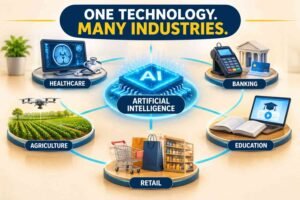
    Artificial Intelligence is not limited to software companies. Organisations across different industries are exploring ways to use it for analysis, automation and decision support. Circular editorial illustration showing Artificial Intelligence applications in healthcare, banking, education, retail, agriculture and manufacturing. Here are some examples.

    Healthcare

    AI-based systems can help analyse medical images, organise healthcare information and support certain diagnostic processes. Medical professionals remain responsible for clinical decisions, and AI systems need appropriate validation and oversight.

    Banking and Financial Services

    Financial organisations use technology to identify unusual transaction patterns, assess information and support fraud monitoring.

    Education

    AI-powered tools can support learning recommendations, language assistance, content organisation and administrative activities.

    Retail and E-commerce

    Online platforms use recommendation systems, demand forecasting, customer support automation and inventory-related analysis.

    Agriculture

    AI applications can support crop monitoring, weather-related analysis, agricultural advisory services and other data-driven activities.

    Manufacturing

    Manufacturers may use AI-based systems for equipment monitoring, quality inspection, production planning and predictive maintenance.

    Customer Service

    AI chatbots and language-processing tools can help organisations respond to common questions and organise customer requests. These examples show that AI knowledge can be relevant to several industries. The exact skills required depend on the application and the role.

    The Skills You Need Before Working with AI

    You do not need to master every advanced technology before starting. However, building a strong foundation can make the learning process easier.

    1. Logical Thinking and Problem-Solving

    AI development involves identifying problems and deciding how technology can help solve them. For example, if a business wants to understand why customers stop using its application, you may need to examine customer behaviour, identify patterns and develop a method to analyse the information. Logical thinking helps you approach such problems systematically.

    2. Mathematics and Statistics

    Mathematics plays an important role in AI, particularly in machine learning and data science. Useful topics include:
    • Basic algebra
    • Probability
    • Statistics
    • Functions and graphs
    • Linear algebra
    • Basic calculus for more advanced study
    Beginners can start with foundational concepts before moving towards more complex mathematical topics.

    3. Programming

    Programming allows you to work with data, develop applications and implement algorithms. Python is a widely used language in AI education because it has a large ecosystem of libraries and tools. You should begin with:
    • Variables and data types
    • Conditions and loops
    • Functions
    • Lists and dictionaries
    • File handling
    • Basic object-oriented programming
    Once you understand these concepts, you can explore Python libraries used for data analysis and machine learning.

    4. Data Handling

    AI systems depend on data. Learning how to collect, organise, clean and interpret information is therefore important. Useful areas include spreadsheets, databases, SQL and data visualisation.

    5. Communication

    Technical knowledge alone is not enough. AI professionals often need to explain project results, discuss problems with other teams and present findings to people who may not have a technical background. Clear communication helps connect technical work with business requirements.

    6. Responsible AI Awareness

    AI systems can produce incorrect, biased or misleading outputs. Professionals should understand privacy, data protection, fairness, transparency and responsible use. Learning to question an AI output rather than accepting it automatically is an important professional habit.

    Learn the Tools That Help Turn Ideas into AI Projects

    After understanding the foundations, start exploring tools that are commonly used in AI and data-related work. You do not need to learn all of them together. Begin with the tools that match your current skill level.
    Tool or Technology What It Helps You Do Where It Is Useful
    Python Write programs and work with data AI development and automation
    SQL Retrieve and manage database information Data analysis and applications
    NumPy Perform numerical operations Scientific computing and data work
    Pandas Organise and analyse datasets Data preparation and analysis
    Matplotlib Create charts and visualisations Understanding data patterns
    Scikit-learn Work with traditional machine learning methods Predictive modelling
    TensorFlow or PyTorch Develop deep learning models Advanced AI applications
    Jupyter Notebook Write and test code interactively Learning and experimentation
    Cloud platforms Access computing and deployment services Hosting and scaling applications
    A beginner may start with Python, SQL and spreadsheet-based analysis. Later, they can explore machine learning libraries and more advanced development tools. The most useful approach is to learn a tool while solving a small problem. This makes it easier to understand why the tool matters.

    Machine Learning, Deep Learning and Generative AI: What Is the Difference?

    These terms often appear together, but they do not mean exactly the same thing.

    Artificial Intelligence

    Artificial Intelligence is the broader field of developing systems that perform tasks associated with human intelligence. Examples include speech recognition, recommendation systems and intelligent automation.

    Machine Learning

    Machine Learning is a branch of AI in which systems learn patterns from data and use those patterns to make predictions or decisions. For example, a model may learn from previous sales information to estimate future demand.

    Deep Learning

    Deep Learning is a specialised area of machine learning that uses multi-layered neural networks to learn complex patterns. It is used in areas such as image recognition, speech processing and advanced language applications.

    Generative AI

    Generative AI refers to systems that can create new content, such as text, images, audio, video or code, based on learned patterns. Examples include AI writing assistants, image-generation tools and conversational systems. Understanding these differences helps learners select suitable courses and avoid treating every AI-related tool as the same technology.

    Build Your First AI Learning Project

    Reading about AI is useful, but practical projects help you understand how the concepts work together. You do not need to begin with a complicated application. Start with a small problem that can be explained clearly. Here are some beginner-friendly project ideas: Project 1: Student Performance Analysis
    • Work with a sample student performance dataset.
    • Organise the information.
    • Identify patterns in attendance and marks.
    • Create simple charts.
    • Explain the observations.
    Project 2: Product Recommendation Basics
    • Use a sample product dataset.
    • Identify customer preferences.
    • Explore how similar products can be grouped.
    • Build a simple recommendation demonstration.
    Project 3: Customer Review Analysis
    • Collect a suitable sample of product reviews.
    • Organise the text.
    • Identify positive and negative expressions.
    • Explore basic sentiment analysis.
    Project 4: Sales Forecasting Introduction
    • Work with sample monthly sales information.
    • Identify trends and seasonal patterns.
    • Explore a basic forecasting method.
    • Compare predicted and actual values where available.
    When documenting a project, explain the problem, the data used, the approach, the results and the limitations. A well-explained beginner project can demonstrate your understanding more effectively than a long list of tools on a resume.

    Which Courses Can Help You Enter the AI Field?

    There is no single educational route for everyone. Your choice should depend on your current qualification, technical background and career goals.

    BCA

    A Bachelor of Computer Applications introduces students to computer applications, programming and software-related concepts. It can provide a useful foundation for learners who want to progress towards data science, machine learning or AI-related studies. Students should check the actual curriculum to understand how much programming, mathematics and data-related content is included.

    B.Sc. Computer Science

    A B.Sc. in Computer Science generally focuses on computing concepts, programming, algorithms and related subjects. It can provide an academic foundation for further learning in AI and other technical areas.

    B.Tech in Computer Science or Related Disciplines

    A B.Tech in Computer Science or a relevant engineering discipline can provide a deeper technical foundation through subjects such as programming, mathematics, algorithms and computer systems. Some programmes may include specialised AI and machine learning subjects.

    M.Tech in Artificial Intelligence or Related Areas

    An M.Tech may help eligible graduates explore advanced technical subjects, research and specialised areas of computing. Admission requirements and available specialisations depend on the institution.

    Specialised AI and Machine Learning Programmes

    Short-term certificates, diplomas and specialised training programmes can help learners develop specific technical skills. These programmes may focus on Python, machine learning, data preparation, deep learning, computer vision or natural language processing. However, a short course should not automatically be treated as equivalent to a recognised degree.

    Online Courses and Skill-Based Learning

    Online courses can help learners explore specific tools and technologies at their own pace. They may be useful alongside a formal qualification or as an introduction to the subject. Before enrolling, check the syllabus, practical components, assessment method and value of the certificate.

    Choosing an Education Route Based on Your Starting Point

    Your current education level can influence which AI learning pathway is suitable.
    Class 12 Students and Beginners Graduates and Degree Holders Working Professionals and Returning Learners
    Build computer fundamentals Learn Python and data handling Refresh programming fundamentals
    Explore BCA, B.Sc. Computer Science or relevant undergraduate programmes Consider specialised AI, ML or data science courses Identify technical skill gaps
    Develop basic mathematics and logical thinking Build machine learning knowledge Learn tools relevant to the intended role
    Practise small programming projects Develop a portfolio of projects Balance structured learning with professional responsibilities
    A student after Class 12 may need to focus first on foundational education. A graduate with a computing background may be ready to explore specialised technical training. A working professional may already understand an industry such as banking, retail or healthcare. Combining that knowledge with AI skills may help them explore technology-related responsibilities in their existing field.

    Can You Learn AI Through Online or Distance Education?

    Yes, online learning and suitable distance-learning programmes can help people study computing fundamentals and develop theoretical knowledge. They can be especially useful for learners who need to balance education with work or personal responsibilities. However, Artificial Intelligence is a practical technical field. Learners should not depend only on reading material or recorded lessons. A useful AI learning plan should include:
    • Programming exercises.
    • Data-handling practice.
    • Problem-solving assignments.
    • Machine learning demonstrations.
    • Small projects.
    • Model testing and evaluation.
    • Opportunities to explain project results.
    A recognised academic qualification can provide a structured foundation, while additional practical courses and independent projects can help develop specialised skills. Students exploring BCA distance education in Bangalore should compare the actual curriculum and check whether the programme includes relevant computing fundamentals. A BCA qualification may provide a starting point, but specialised AI knowledge generally requires further study and practice. Similarly, people researching IT distance education should examine the exact programme, awarding institution, learning mode and academic requirements before enrolling. The Government of India’s IndiaAI FutureSkills initiative provides another example of how AI learning is being introduced through different skill levels. Its training curriculum includes foundation courses in Artificial Intelligence Technology, Data Science and Analytics, and Data Curation using Python. 

    What About B.Tech and M.Tech Qualifications for AI?

    Some learners search for phrases such as B.Tech correspondence college in India when looking for flexible engineering education. However, engineering qualifications require particular care when checking the permitted mode of study. Do not assume that a B.Tech advertised as correspondence or distance education is automatically valid or recognised. Check the applicable regulatory requirements, awarding institution and programme approval before considering admission. Similarly, learners searching for an M.Tech correspondence college in Karnataka should verify whether the exact programme and delivery mode are permitted and recognised for the relevant academic session. For advanced technical AI careers, an appropriate engineering or postgraduate qualification can be useful. However, the programme’s actual curriculum, mathematical depth, programming content and practical exposure matter more than the course title alone. The All India Council for Technical Education’s model curriculum for Computer Science and Engineering includes Machine Learning and discusses mathematical foundations, Python-based implementation and applying machine learning to real-world problems. This provides an example of the technical subjects learners may encounter in a computing education pathway. 

    Which AI Job Role Matches Your Strengths?

    Artificial Intelligence offers different career directions. The role you choose should match your skills and the kind of work you enjoy.

    AI Engineer

    AI Engineers work on developing and integrating AI-based applications. Their responsibilities may involve programming, model integration, data processing and application development. Useful skills include Python, software development, data handling and knowledge of AI frameworks.

    Machine Learning Engineer

    Machine Learning Engineers focus on building, testing and deploying machine learning models. They may work with algorithms, datasets, model evaluation and deployment systems. Programming, statistics, mathematics and machine learning knowledge are important for this role.

    Data Analyst

    Data Analysts work with information to identify trends and prepare reports that support business decisions. They may use spreadsheets, SQL, Python and data visualisation tools. This can be an entry point for learners interested in data-related careers, although the role does not necessarily involve developing AI models.

    Data Scientist

    Data Scientists use statistics, programming and machine learning techniques to analyse complex datasets and solve problems. They may work on predictive modelling, experimentation and data interpretation. The role usually requires stronger mathematical and analytical skills.

    Natural Language Processing Engineer

    Natural Language Processing (NLP) professionals work on systems that process and understand human language. Their work may involve text classification, language models, search systems and conversational applications.

    AI Researcher

    AI Researchers explore new methods, algorithms and technical approaches to improve AI systems. Research-oriented positions often require advanced mathematical knowledge and postgraduate education, and some may require doctoral-level qualifications.

    AI Testing and Quality Professional

    AI testing professionals evaluate whether AI systems produce reliable and appropriate outputs. They may test model performance, identify errors, examine edge cases and assess system behaviour. Testing knowledge, analytical thinking and understanding of the application are useful. “Explore the Top 10 Engineering Courses to Build a Career in Robotics, AI and Cloud Computing  to discover the skills, qualifications and learning pathways that can help you prepare for emerging technology careers.”

    What Does an AI Professional Actually Do at Work?

    AI-related responsibilities can be grouped into three broad areas.
    Data-Focused Roles Model and Software Development Roles Testing and AI Application Roles
    Data Analyst AI Engineer AI Tester
    Data Engineer Machine Learning Engineer AI Quality Analyst
    Data Scientist NLP Engineer AI Application Support Associate
    Data Quality Analyst AI Software Developer AI Operations Associate
    These job titles are examples. Organisations may use different names for similar responsibilities, and the skills required can vary significantly. For instance, a Data Analyst may spend much of the day preparing reports and studying trends, while a Machine Learning Engineer may work on model development and deployment. Before choosing a role, read actual job descriptions and identify the technical requirements employers expect.

    AI Career Opportunities Across Industries

    AI skills can be useful in several industries, depending on how organisations apply the technology.

    Banking and Financial Services

    Possible areas include fraud monitoring, transaction analysis, customer support automation and risk-related data analysis.

    Healthcare

    AI-related work may involve medical data processing, image analysis support, healthcare administration and research applications.

    Retail and E-commerce

    Professionals may work on product recommendations, customer behaviour analysis, demand forecasting and inventory-related systems.

    Education

    AI applications may support learning platforms, content organisation, educational analytics and personalised learning tools.

    Manufacturing

    AI can be used in quality inspection, production monitoring, equipment maintenance and operational analysis.

    Agriculture

    AI applications can support crop monitoring, weather-related information analysis and agricultural advisory systems.

    IT and Technology Services

    Technology organisations may develop AI applications, maintain data systems, integrate machine learning models and provide technical services to clients. The Ministry of Electronics and Information Technology’s IndiaAI Mission focuses on building an AI ecosystem in India through areas such as computing infrastructure, datasets, innovation, applications and talent development. Its work illustrates why AI knowledge is relevant beyond one particular industry.  AI Salary Expectations: What Should Beginners Know? Salary is an important consideration when choosing a career. However, AI does not have one fixed salary structure. Compensation can vary according to:
    • Job role and responsibilities.
    • Programming and analytical skills.
    • Previous work experience.
    • Academic qualifications.
    • Project portfolio.
    • Employer and industry.
    • City and location.
    • Technical interview performance.
    The following table provides broad illustrative annual salary ranges for selected early-career technology roles in India. These are planning estimates, not official salary scales or guaranteed AI job offers.
    Example Role Indicative Annual Salary
    Junior Data Analyst ₹2.5–4.5 lakh
    Python Developer – Entry Level ₹3–5 lakh
    Junior Data Engineer ₹3–5.5 lakh
    Machine Learning Associate ₹3.5–6 lakh
    Junior AI Developer ₹3.5–6 lakh
    Business Intelligence Analyst ₹3–5.5 lakh
    Junior Data Scientist ₹3.5–6 lakh
    Actual salaries may be lower or higher depending on the employer, location, skill level and market conditions. Some specialised AI roles require significant experience or advanced qualifications and should not be compared directly with entry-level positions.

    Does an AI Certificate Guarantee a Higher Salary?

    No. A certificate can demonstrate that you have completed a learning programme, but employers also consider your ability to apply knowledge. For example, a candidate who understands Python, can work with datasets and has completed meaningful projects may be better prepared for a technical interview than someone who has only collected certificates. Focus on building demonstrable skills rather than choosing a course only because it advertises high salary potential.

    How to Build an AI Portfolio Without Previous Job Experience

    If you are a fresher or changing careers, you may not have professional AI experience. A project portfolio can help demonstrate what you have learned. You can begin with three or four small projects. Start with a clear problem Choose a problem that can be explained in a few sentences. For example, predicting sales trends or analysing customer reviews. Use suitable sample data Find a dataset that is appropriate for learning and check its usage conditions. Avoid using private or confidential information. Explain your approach Describe how you prepared the data, selected a method and evaluated the result. Show the output Use charts, tables or a simple demonstration to make the result understandable. Discuss limitations Explain where the model may produce incorrect results and what could be improved. Document your work You can organise code and project descriptions using a portfolio platform such as GitHub, where appropriate. A portfolio should show your thinking process, not just the final output. This is particularly useful when you are applying for entry-level roles.

    How to Choose the Right AI Course or Qualification

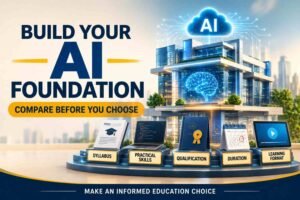
    There are many courses that use terms such as Artificial Intelligence, Machine Learning, Data Science and Generative AI. Before enrolling, compare the actual learning content. Circular editorial illustration showing Artificial Intelligence applications in healthcare, banking, education, retail, agriculture and manufacturing. Use this checklist:
    1. Check the syllabus
    Does the course include programming, mathematics, data handling and relevant AI concepts?
    1. Review practical learning
    Does it provide assignments, coding exercises, projects or laboratory work?
    1. Understand the qualification
    Is it a degree, diploma, certificate or short-term training programme? Do not treat these qualifications as interchangeable.
    1. Verify the awarding institution
    Check the institution, programme status and applicable recognition requirements for the relevant academic session.
    1. Review the learning mode
    Understand whether the course is classroom-based, online, blended or offered through a permitted distance-learning mode.
    1. Compare the duration
    Make sure you understand how much time is available for theory, practice, assignments and assessment.
    1. Check the technical requirements
    Some programmes may require access to a laptop, suitable software and a reliable internet connection.
    1. Understand the fees
    Compare the total cost, including registration, examination and other applicable charges.
    1. Review academic support
    Check whether learners receive guidance, feedback, study resources and access to instructors.
    1. Think about your next learning step
    A beginner course should help you progress towards more advanced technical learning. Consider whether the programme provides a useful foundation for your intended career direction. Learners comparing correspondence degree colleges in Bangalore should examine the exact qualification and programme details rather than relying only on promotional descriptions. Similarly, people exploring distance education in Bangalore should verify the institution, awarding university, programme and permitted learning mode before applying.

    Is AI a Suitable Career for Working Professionals and Returning Learners?

    Not everyone begins an AI career immediately after school or college. Some people work in other fields before deciding to study technology. AI can be explored by learners from different backgrounds, although the preparation required may vary.

    For Class 12 Students

    Students can begin by developing computer fundamentals, mathematics and logical thinking. They can then explore suitable undergraduate programmes in computer applications, computer science or related disciplines.

    For Graduates

    Graduates can identify whether their existing degree provides enough computing knowledge for specialised AI study. Those from non-technical backgrounds may need to strengthen programming and mathematics first.

    For Working Professionals

    Professionals in IT, finance, retail, healthcare, education or operations may already understand problems that AI tools can help address. For example, someone working in retail operations may explore demand forecasting, while a finance professional may study data analysis and fraud detection applications.

    For Learners Returning After a Break

    If you have taken time away from formal education, begin by reviewing your existing computer knowledge and identifying the subjects you need to refresh. You can then choose a structured qualification or skill-based programme that fits your current responsibilities. The important point is to take a realistic learning path. You do not have to move directly into advanced machine learning. Building a strong technical foundation is a sensible first step. “To build a successful career in Artificial Intelligence, explore the AI and Business Management programme  and develop skills that align with the evolving demands of the digital business world.”

    Frequently Asked Questions About Artificial Intelligence Careers

    1. How can I start a career in Artificial Intelligence?

    Start by learning computer fundamentals, mathematics, Python programming and data handling. Then explore machine learning concepts and build small projects. Choose a suitable academic or skill-based programme based on your current qualifications.

    2. Can I study Artificial Intelligence after Class 12?

    Yes. Students can explore relevant undergraduate programmes such as BCA, B.Sc. Computer Science or eligible engineering programmes. The appropriate choice depends on admission requirements, academic interests and the course curriculum.

    3. Is coding necessary for an AI career?

    Many technical AI roles require programming knowledge, particularly Python. However, some AI-related roles focus more on data quality, business applications, testing or technology support. Requirements depend on the specific job.

    4. Which programming language is best for AI beginners?

    Python is a common starting point because it is widely used for data analysis, machine learning and AI development. SQL is also useful for working with databases.

    5. Can non-IT students learn Artificial Intelligence?

    Yes, but they may need to develop computer fundamentals, mathematics and programming knowledge before moving towards advanced AI subjects. A gradual learning approach can help.

    6. Is BCA useful for an AI career?

    A BCA can provide a foundation in computer applications and programming, depending on the curriculum. Learners generally need additional study and practical projects to develop specialised AI skills.

    7. Can I learn AI through distance education?

    Distance and online learning can help learners study computing fundamentals and theoretical concepts. However, AI development also requires practical programming, data work and project experience. Verify the exact qualification and permitted learning mode before enrolling.

    8. What is the difference between AI and Machine Learning?

    Artificial Intelligence is the broader field of developing intelligent systems. Machine Learning is a branch of AI in which systems learn patterns from data to make predictions or decisions.

    9. Which AI job is suitable for freshers?

    Depending on their skills, freshers may explore junior data analyst, Python developer, data quality analyst, AI testing or entry-level software development roles. Advanced AI engineering positions may require stronger technical knowledge and experience.

    10. Is an M.Tech necessary for an AI career?

    No. An M.Tech is not necessary for every AI-related job. Some positions may be accessible with a relevant undergraduate qualification and strong practical skills, while advanced research and specialised roles may require postgraduate education.

    Conclusion: Start with the Right Foundation, Then Keep Building

    Artificial Intelligence is a broad and developing field that combines programming, mathematics, data, software development and problem-solving. It offers different learning and career directions, from data analysis and machine learning to AI application development and testing. The right starting point depends on your current qualification and experience. Students can build their technical foundation through relevant undergraduate education. Graduates can explore specialised courses and projects, while working professionals and returning learners can develop skills gradually alongside their other responsibilities. If you are exploring IT distance education, compare the available qualifications carefully and check whether the learning pathway provides the computing fundamentals you need. Remember that an academic qualification is only one part of AI career preparation. Practical projects, technical skills and continuous learning also matter. At Indian College of Correspondence, learners can explore education pathways based on their academic background and future plans. Before choosing any technology-related programme, verify the exact course, awarding institution, learning mode and current eligibility requirements. If you want to understand your available education options, visit ICC or contact us to discuss your learning requirements. You do not need to learn every AI technology at once. Start with the fundamentals, practise what you learn and gradually build the skills that move you towards your career goal.

Leave A Comment