
Admission opens for 2026-27 sessions for all university.

Blog Detail

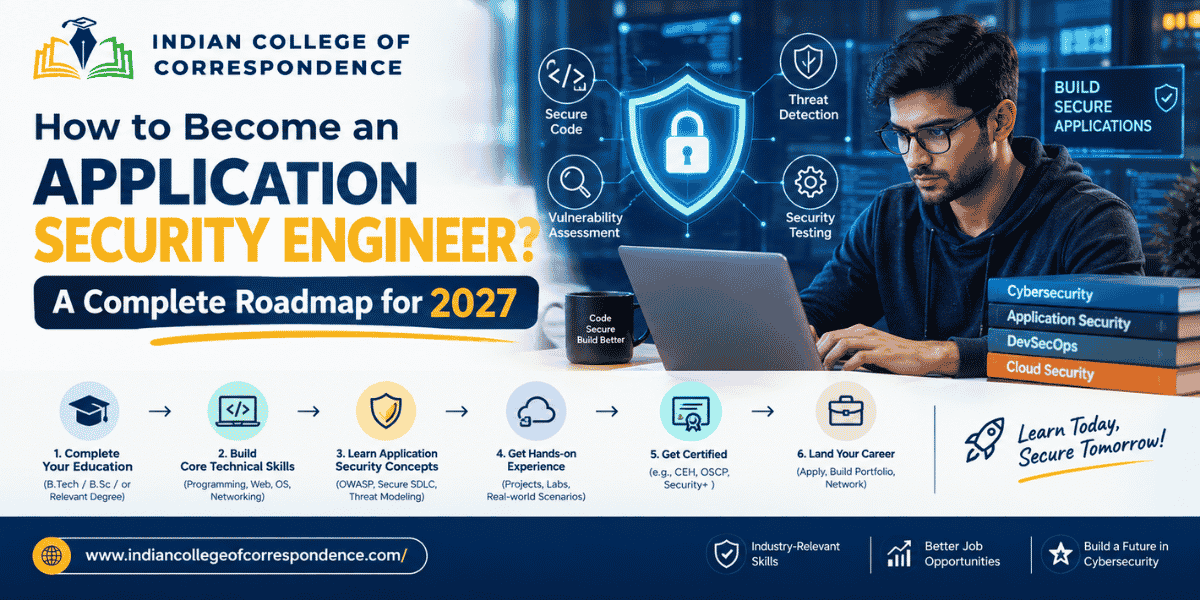
  • How to Become an Application Security Engineer? A Complete Roadmap for 2027

    • 16,Sep 2026
    • Posted By : opsadsthrivein@gmail.com opsadsthrivein@gmail.com
    • 0 Comments
    • B.Tech correspondence college in India
    • correspondence degree colleges in bangalore
    • Engineering distance education
    • M.Tech correspondence college in Karnataka
    Applications are now part of almost every business, from banking and healthcare to education, e-commerce, and entertainment. As more organizations depend on websites, mobile applications, APIs, cloud platforms, and connected systems, protecting these applications has become an important part of software development. This is why many students and technology professionals are exploring how to Become an Application Security professional and build a career around secure software. If you are wondering how to Become an Application Security engineer, the journey involves more than learning a few security tools. You need a combination of programming knowledge, networking fundamentals, cybersecurity concepts, application testing, secure coding, and practical experience. This guide explains how to Become an Application Security engineer step by step, including the skills, education, tools, projects, certifications, and career opportunities you can explore in 2027.

    What Does an Application Security Engineer Do?

    Before learning how to Become an Application Security engineer, it is important to understand what the role actually involves. An Application Security Engineer works to identify and reduce security weaknesses in software applications. Instead of waiting until an application is attacked, the security professional works with development teams to find risks earlier in the development process. Typical responsibilities may include:
    • Reviewing application code for security weaknesses
    • Testing websites and APIs
    • Identifying vulnerabilities
    • Supporting secure software development
    • Performing security assessments
    • Reviewing authentication and authorization controls
    • Helping developers understand security issues
    • Supporting vulnerability remediation
    • Participating in threat modeling
    • Integrating security testing into development workflows
    Modern application security also involves activities such as threat modeling, secure design, code review, penetration testing, and continuous security testing throughout the software development lifecycle. For anyone planning to Become an Application Security engineer, understanding the development process is therefore just as important as understanding security.

    Why Choose Application Security as a Career in 2027?

    Software development is changing quickly. Applications are increasingly built using APIs, cloud services, third-party packages, containers, automation, and continuous deployment. This creates a wider security surface that organizations need to manage. Application security professionals can work across areas such as:
    • Web application security
    • API security
    • Mobile application security
    • Cloud application security
    • DevSecOps
    • Secure software development
    • Vulnerability management
    • Product security
    If your goal is to Become an Application Security engineer, this broader understanding can help you identify the area that matches your interests. Another important point is that application security is not simply about finding vulnerabilities. OWASP recommends integrating security activities into development processes, including requirements, design, implementation, verification, and operations.

    What Skills Do You Need to Become an Application Security Engineer?

    The first step to Become an Application Security engineer is developing a strong technical foundation.

    1. Programming Knowledge

    You do not necessarily need to become an expert software developer, but you should understand how applications are created. Start with languages such as:
    • Python
    • Java
    • JavaScript
    • C/C++
    • SQL
    Programming knowledge helps you understand how vulnerabilities occur inside real applications. It also makes secure code review easier.

    2. Networking Fundamentals

    Learn concepts such as:
    • TCP/IP
    • DNS
    • HTTP and HTTPS
    • Ports
    • Firewalls
    • Proxies
    • VPNs
    • Client-server communication
    Networking knowledge becomes particularly useful when you begin testing web applications and APIs.

    3. Operating Systems

    Linux is especially useful for cybersecurity professionals. Learn the command line, file permissions, processes, networking commands, users, services, and basic system administration. Windows fundamentals can also be useful because many organizations use mixed environments.

    4. Web Application Knowledge

    To Become an Application Security professional, you should understand how web applications work. Learn:
    • Front-end and back-end architecture
    • Databases
    • Sessions
    • Cookies
    • Authentication
    • Authorization
    • REST APIs
    • JSON
    • HTTP requests and responses
    The OWASP Web Security Testing Guide also emphasizes understanding an application’s structure and execution paths before beginning security testing.

    Learn the Major Application Security Concepts

    Once your technical foundation is ready, the next step to Become an Application Security engineer is learning common security concepts. Important areas include:

    Authentication and Authorization

    Understand the difference between proving who a user is and determining what that user is allowed to do.

    Input Validation

    Learn why applications should validate and safely handle information received from users.

    Encryption and Cryptography

    Understand basic concepts such as encryption, hashing, keys, certificates, and secure communication.

    Secure Coding

    Learn how developers can prevent vulnerabilities while writing applications.

    Threat Modeling

    Threat modeling helps teams think about potential threats during application design instead of waiting until development is complete.

    Vulnerability Assessment

    Learn how to identify, understand, document, and prioritize application vulnerabilities. These fundamentals create the foundation required to Become an Application Security engineer.

    Understand the OWASP Approach to Application Security

    OWASP resources are particularly useful for anyone planning to Become an Application Security professional. The OWASP Top 10 can help beginners understand major application security risks, but OWASP itself describes it as an awareness starting point rather than a complete application security program. For deeper verification, OWASP recommends resources such as the Application Security Verification Standard. You should become familiar with topics such as:
    • Broken access control
    • Injection
    • Security misconfiguration
    • Cryptographic failures
    • Authentication failures
    • Vulnerable components
    • Security design problems
    • Server-side request forgery
    Do not simply memorize the names. Try to understand why each vulnerability happens, how it can be identified, and how developers can prevent it. That approach is much more useful when you want to Become an Application Security engineer.

    Which Tools Should You Learn?

    Tools are important, but they should support your knowledge rather than replace it. Some commonly used categories include:
    Security Area Example Tools Purpose
    Web Testing Burp Suite, OWASP ZAP Test web applications
    API Testing Postman, Burp Suite Test API requests
    Code Analysis Semgrep, SonarQube Identify code issues
    Dependency Security Snyk, Dependabot Identify vulnerable packages
    Container Security Trivy Scan container images
    Version Control Git, GitHub Manage and review code
    Learning these tools can help you Become an Application Security professional who can combine theory with practical testing. However, do not make the common mistake of collecting tools without understanding what they actually do.

    Build Practical Application Security Projects

    One of the strongest ways to Become an Application Security engineer is to practice. You can create a small web application and intentionally study how different security weaknesses occur in a controlled environment. Project ideas include:
    • Web application security assessment
    • API security testing
    • Secure authentication project
    • Vulnerability assessment report
    • Secure code review project
    • Dependency vulnerability analysis
    • Threat modeling exercise
    • CI/CD security pipeline
    OWASP provides learning resources and intentionally vulnerable applications such as Juice Shop and WebGoat that can be used for hands-on security learning. When documenting a project, explain:
    1. What the application does
    2. What security issue you investigated
    3. How you identified the issue
    4. Why the issue matters
    5. How it could be fixed
    6. What you learned
    This gives employers something more meaningful than a list of completed courses.

    Education Path to Become an Application Security Engineer

    Formal education can provide a useful technical foundation for students planning to Become an Application Security engineer. Relevant academic backgrounds can include:
    • Computer Science
    • Information Technology
    • Cybersecurity
    • Software Engineering
    • Computer Applications
    • Engineering
    Students researching Engineering distance education may also explore flexible learning options while developing cybersecurity skills independently. Those searching for a B.Tech correspondence college in India may consider programs that provide fundamentals in programming, databases, operating systems, networking, and software development. Similarly, students interested in postgraduate education can research an M.Tech correspondence college in Karnataka if they want to deepen their technical knowledge. For learners comparing correspondence degree colleges in Bangalore, it is useful to examine curriculum, recognition, flexibility, learning support, and how well the course matches their long-term career plans. A Diploma in Engr correspondence college in India may also be considered by learners looking for a shorter technical education route, depending on their eligibility and career goals. The important point is that education and practical security experience should complement each other. If your objective is to Become an Application Security engineer, use your academic course to build fundamentals and use projects, labs, and independent learning to develop security-specific skills.

    How Engineering and Cybersecurity Knowledge Work Together

    Students exploring Engineering distance education often wonder whether an engineering background can help them move toward cybersecurity. It can provide exposure to technical subjects such as programming, computer systems, mathematics, electronics, databases, or networking, depending on the program. Likewise, a learner considering a B.Tech correspondence college in India should look at whether the curriculum provides subjects that support their intended technology career. Those already holding a technical qualification can focus more heavily on:
    • Web security
    • Secure coding
    • Ethical hacking fundamentals
    • Application testing
    • DevSecOps
    • Cloud security
    • API security
    This combination can create a practical route to Become an Application Security engineer.

    Learn DevSecOps and Secure Software Development

    Modern application security is increasingly connected with software development and operations. DevSecOps brings security activities into the development and delivery process rather than treating security as a final step. You should understand:
    • Secure SDLC
    • SAST
    • DAST
    • Software composition analysis
    • Secret scanning
    • Infrastructure-as-Code security
    • CI/CD security
    • Security automation
    OWASP recommends integrating security activities across the software development lifecycle, including secure implementation, verification, testing, and remediation. Learning DevSecOps can therefore help you Become an Application Security engineer who understands both security and development workflows.

    Certifications That Can Support Your Career

    Certifications can complement practical knowledge. Depending on your experience and career direction, you may research certifications related to:
    • Cybersecurity fundamentals
    • Ethical hacking
    • Application security
    • Secure software development
    • Penetration testing
    • Cloud security
    Before selecting a certification, check its syllabus, prerequisites, practical component, recognition, and relevance to your target role. Do not rely only on certificates to Become an Application Security professional. Practical skills, technical understanding, and the ability to explain security findings are also important.

    Build a Portfolio Before Applying for Jobs

    A portfolio can demonstrate that you can apply what you have learned. Your portfolio could contain:
    • GitHub projects
    • Security assessment reports
    • Secure coding examples
    • Vulnerability write-ups
    • Threat models
    • API testing exercises
    • Security automation scripts
    • Lab documentation
    For every project, focus on explaining the problem and your approach. A strong portfolio can help you Become an Application Security engineer by giving recruiters and hiring teams evidence of your practical learning.

    How to Get Your First Application Security Role?

    Once your skills are developing, start looking for entry-level opportunities. Possible starting roles include:
    • Cyber Security Intern
    • Security Analyst
    • Junior Security Analyst
    • Vulnerability Analyst
    • Security Testing Associate
    • Junior Application Security Analyst
    You can then gradually move toward specialized application security positions. A practical career journey can look like: Technical Fundamentals → Security Fundamentals → Labs → Projects → Internship/Junior Role → Application Security Experience → Application Security Engineer This step-by-step approach is more realistic than expecting to Become an Application Security engineer immediately after completing one course.

    Common Mistakes to Avoid

    If you want to Become an Application Security professional, avoid these common mistakes:

    Learning Only Tools

    Knowing where to click in a security tool is not the same as understanding a vulnerability.

    Ignoring Programming

    Application security and software development are closely connected.

    Focusing Only on Certifications

    Certificates can demonstrate structured learning, but practical ability still matters.

    Skipping Web Fundamentals

    If you do not understand HTTP, sessions, APIs, databases, and authentication, application testing becomes much harder.

    Not Building Projects

    Theory becomes easier to remember when you apply it.

    Trying to Learn Everything at Once

    Start with fundamentals and gradually move toward advanced application security concepts.

    Career Growth After Becoming an Application Security Engineer

    After you Become an Application Security engineer, your career can develop in several directions. You may move toward: Application Security Engineer → Senior Application Security Engineer → Application Security Lead Or explore related areas such as:
    • Product Security
    • Cloud Security
    • DevSecOps
    • Security Architecture
    • Penetration Testing
    • Security Engineering
    • Security Management
    Your direction can depend on your technical interests and the type of work you enjoy.

    Quick Roadmap to Become an Application Security Engineer

    Stage What to Learn Practical Action
    1 Programming + Networking Build technical fundamentals
    2 Web Applications Learn HTTP, APIs, databases
    3 Cybersecurity Study common vulnerabilities
    4 OWASP Learn application security concepts
    5 Tools Practice security testing
    6 Projects Build a security portfolio
    7 DevSecOps Learn security in CI/CD
    8 Career Preparation Apply for internships and junior roles
    This roadmap gives learners a clear direction to Become an Application Security engineer without trying to master everything at once.

    Why Choose ICC for Your Education Journey?

    Choosing the right academic path can make it easier to build the technical foundation required to Become an Application Security professional. Indian College of Correspondence (ICC) can be explored by learners looking for flexible education options while working toward their academic and professional goals. If you are comparing correspondence degree colleges in Bangalore, engineering-related programs, or other flexible learning options, review the course structure and eligibility carefully before making a decision. For learners interested in Engineering distance education, combining formal education with cybersecurity labs, programming practice, and application security projects can create a broader technical learning journey.

    Start Your Journey Toward Application Security

    The path to Become an Application Security engineer does not happen overnight. It is built through consistent learning, technical practice, and real-world problem solving. Start with programming, networking, operating systems, and web technologies. Then move into application vulnerabilities, OWASP resources, security testing, secure coding, DevSecOps, and practical projects. If you are considering an academic program, choose one that supports your technical foundation and fits your learning requirements. Then use additional labs and projects to develop application security expertise. With a structured approach, learners can gradually Become an Application Security professional and explore opportunities across application security, product security, DevSecOps, and cybersecurity.

    Conclusion

    Learning how to Become an Application Security engineer is a continuous process rather than a single course or certification. The strongest foundation comes from understanding how applications are built and then learning how to secure them. Build your knowledge step by step: programming, networking, web technologies, cybersecurity, OWASP, security testing, secure coding, DevSecOps, and practical projects. Keep improving your portfolio and follow developments in application security as technologies change. For students exploring M.Tech correspondence college in Karnataka, Diploma in Engr correspondence college in India, or other flexible education routes, the key is to connect academic learning with practical technology skills. With the right combination of education, practice, and continuous learning, you can work toward a career where protecting applications becomes a central part of your professional journey.

    Ready to Build Your Career in Application Security?

    If you are planning to Become an Application Security professional, the right academic foundation can help you move forward with confidence. Explore flexible learning opportunities with Indian College of Correspondence (ICC) and build the technical knowledge needed for your future career. Along with your education, strengthen your skills through programming, cybersecurity practice, application security labs, and real-world projects. Start your learning journey with ICC today and take the next step toward a career in the technology and cybersecurity field.

    FAQs

    1. How can I become an Application Security Engineer?

    To Become an Application Security engineer, start with programming, networking, operating systems, web technologies, and cybersecurity fundamentals. Then learn application security testing, OWASP concepts, secure coding, security tools, and DevSecOps. Practical projects and internships can help you develop job-ready experience.

    2. Is programming necessary for Application Security?

    Yes, programming knowledge is highly useful. You do not necessarily need to become a full-time software developer, but understanding code makes it easier to identify vulnerabilities, perform code reviews, and communicate with development teams.

    3. Which programming languages should I learn for Application Security?

    Python, JavaScript, Java, SQL, and C/C++ can all be useful. Start with one language and understand programming fundamentals before trying to learn several languages simultaneously.

    4. What is OWASP and why is it important?

    OWASP is a nonprofit community focused on improving software security. Its resources cover application security risks, secure development, testing, and verification. OWASP describes the Top 10 as an awareness starting point rather than a complete application security program.

    5. Which tools should beginners learn?

    Beginners can start by understanding web and API testing tools, code-analysis tools, dependency scanners, and container-security tools. Learn why a tool is being used rather than simply memorizing its features.

    6. How long does it take to become an Application Security Engineer?

    There is no single timeline. It depends on your previous technical knowledge, learning schedule, programming ability, practical experience, and target role. Building fundamentals first and progressing through projects can make the learning process more manageable.

Leave A Comment