Admission opens for 2026-27 sessions for all university.

Blog Detail

  • Career Opportunities After a B.Sc. in Information Systems & Management: Jobs, Skills, and Future Scope

    • 13,Oct 2026
    • Posted By : uaeautomates@gmail.com
    • 0 Comments
    • B.Sc career opportunities
    • B.Sc correspondence college in Karnataka
    • B.Sc Information Systems
    • Business Analyst career
    • Data Analyst career
    • distance education in India
    • Information Systems careers
    • IT distance education
    • IT jobs for graduates
    • Online Degree Courses India
    Choosing a career after graduation can be challenging, particularly when a degree combines technology with business and management. Students may be interested in software development, data analysis, IT support or business operations but may not know which role suits their skills. Working professionals face a different challenge: they may already have experience but need additional technical knowledge or a recognised qualification to move into a new role. A B.Sc. in Information Systems & Management can provide a foundation for understanding how technology, data, business processes and organisational decisions work together. However, career opportunities depend on the subjects covered by the programme, practical skills, project experience and the requirements of individual employers. For students exploring a B.Sc correspondence college in Karnataka, it is important to look beyond the course name. Compare the programme curriculum, awarding university, mode of study and recognition, then connect your educational choice with the career you want to pursue. This guide explains possible jobs after a B.Sc. in Information Systems & Management, the skills employers may expect, industries where these skills are used, and how students and working professionals can plan their next step.

    What Can You Do With a B.Sc. in Information Systems & Management?

    Information systems connect people, business processes, data and technology. Organisations use these systems to manage customer information, process transactions, monitor performance and support decision-making. Management knowledge helps graduates understand why a system is needed, while information systems knowledge helps them understand how technology supports the task. Depending on their curriculum and skills, graduates may explore opportunities in:
    • IT and application support
    • Business and systems analysis
    • Data reporting and analytics
    • Software testing and quality assurance
    • Database support
    • Junior software or web development
    • IT project coordination
    • Business operations and process improvement
    • Entry-level information security support
    These are possible career directions, not guaranteed outcomes of holding the degree. Some roles may require additional qualifications, practical experience or specific technical knowledge. Students comparing technology-related education can also explore ICC’s IT courses and learning options to understand the kinds of IT study pathways available. Choose a programme based on your intended role and verify its current details before applying.

    Which Jobs Can You Target After Graduation?

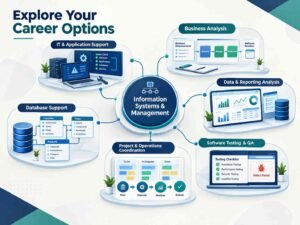
    The best starting role depends on what you enjoy doing. Someone who likes solving technical problems may prefer application support, while a graduate who enjoys spreadsheets and identifying patterns may prefer reporting or data analysis. Career paths after a B.Sc. in Information Systems and Management, including IT support, business analysis, data analytics, software testing, database support and project coordination.

    1. IT Support or Application Support Analyst

    IT support professionals help users resolve technology-related problems. Application support analysts focus more specifically on the software applications an organisation uses. Typical responsibilities include troubleshooting errors, recording support requests, checking system access, documenting solutions and escalating complex issues to technical teams. Skills to develop:
    • Basic computer systems and networking knowledge
    • Troubleshooting and logical thinking
    • Ticketing systems and technical documentation
    • Clear written and verbal communication
    • Understanding of databases and SQL basics
    This can be a practical starting point for graduates who want to understand how business applications work. Professionals already working in customer support or operations may also be able to transfer their communication and problem-solving experience into this area.

    2. Junior Business Analyst

    Business analysts help organisations understand business problems and define requirements for improvements. They often work between business stakeholders and technical teams. For example, an online retailer may want to reduce abandoned shopping carts. A business analyst might study the existing checkout process, speak with stakeholders, document user requirements and help the team evaluate possible improvements. Skills to develop:
    • Requirement gathering and documentation
    • Process mapping and workflow analysis
    • Excel and presentation skills
    • Stakeholder communication
    • Basic understanding of software development processes
    A graduate does not necessarily need advanced programming skills for every business analyst position. However, understanding applications, databases and technical terminology can help when working with developers and IT teams.

    3. Systems Analyst

    Systems analysts examine how existing information systems support business activities. They help identify system limitations, document requirements and evaluate possible technical improvements. Their work may involve understanding how different applications exchange information, investigating recurring problems and coordinating changes with technical teams. Skills to develop:
    • Systems thinking and problem-solving
    • Database fundamentals
    • Process and system documentation
    • Basic SQL
    • Understanding of software applications and integrations
    Some systems analyst positions require previous IT experience. Graduates may need to begin in application support, technical support or another junior role before moving into a more specialised position.

    4. Data or Reporting Analyst

    Data and reporting analysts organise information so that teams can monitor performance and make better-informed decisions. For example, a sales team may need to understand monthly revenue, regional performance, product returns or customer activity. A reporting analyst could clean the relevant data, calculate key measures and prepare a dashboard. Skills to develop:
    • Excel, including formulas and pivot tables
    • SQL for retrieving and filtering data
    • Data cleaning and validation
    • Power BI or another visualisation tool
    • Basic statistics and business communication
    A useful learning sequence is to begin with spreadsheets, move to SQL, and then practise presenting findings through charts or dashboards. Microsoft’s Data Analyst learning resources provide structured learning for common analytics tasks. A portfolio containing clearly explained projects can help graduates demonstrate their practical abilities when applying for junior reporting or analytics positions.

    5. Software Tester or Quality Assurance Analyst

    Software testers check whether applications behave as expected. They may follow test cases, reproduce errors, record defects and verify that a software update has not introduced new problems. Manual testing can be a starting point for some candidates, while automation testing generally requires additional programming and tool knowledge. Skills to develop:
    • Test case writing
    • Bug reporting and defect tracking
    • Logical thinking and attention to detail
    • Basic SQL and application knowledge
    • Familiarity with software testing concepts
    A simple practice project could involve testing a sample shopping website. Document the steps followed, expected result, actual result and any defect identified. This demonstrates a structured approach rather than simply listing testing as a skill on a résumé.

    6. Database Support Professional

    Database support roles involve helping maintain the availability, accuracy and organisation of data systems. Depending on the position, responsibilities may include checking database records, running queries, assisting with backups or escalating performance issues. Skills to develop:
    • Relational database concepts
    • SQL queries
    • Tables, keys and relationships
    • Data validation
    • Basic database security and access controls
    Database administration can require substantial technical experience, so graduates should distinguish between entry-level database support and senior database administrator positions when searching for opportunities.

    7. Junior Software or Web Developer

    Graduates who enjoy building applications may choose software or web development. The precise requirements depend on the role: a web developer may focus on front-end interfaces, back-end services or both. Skills to develop:
    • One programming language
    • HTML and CSS for web fundamentals
    • JavaScript or another relevant language
    • Database basics
    • Version control and project documentation
    A degree title alone is not enough to establish coding proficiency. Candidates should review the syllabus they completed and fill gaps in programming knowledge before applying for development positions.

    8. IT Project Coordinator

    IT project coordinators support teams responsible for delivering technology projects. They may track tasks, organise meetings, maintain project documentation, follow deadlines and communicate updates to stakeholders. Skills to develop:
    • Planning and organisation
    • Spreadsheet and presentation skills
    • Meeting notes and project documentation
    • Task-tracking tools
    • Clear communication and follow-up
    This role may suit graduates who enjoy coordinating work and communicating with different teams. Experience in administration, customer service or operations can also provide useful transferable skills.

    9. Business Operations Analyst

    Business operations analysts study how work gets done and look for ways to improve efficiency, reporting or coordination. For example, a logistics company may want to understand why deliveries are delayed. An analyst might compare delivery records, identify recurring bottlenecks and help the operations team evaluate possible changes. Skills to develop:
    • Excel and reporting
    • Process mapping
    • Data interpretation
    • Problem-solving
    • Business writing and presentation
    Working professionals in administration, sales operations, logistics or customer service may find this path relevant because they already understand some of the processes they would be analysing.

    10. Entry-Level Cybersecurity Support

    Cybersecurity is another possible direction for graduates who are interested in protecting systems and information. Entry-level opportunities may involve access management, security operations support, compliance documentation or basic incident reporting. Skills to develop:
    • Networking and operating-system fundamentals
    • Access control and authentication concepts
    • Security awareness
    • Log analysis basics
    • Ethical and responsible handling of information
    Cybersecurity roles have different entry requirements. Graduates should build foundational IT knowledge before targeting specialised positions that require advanced security experience or certifications.

    Which Career Path Matches Your Skills and Interests?

    Instead of applying to every available technology job, compare the everyday work involved in each role. The following table can help you shortlist suitable options.
    Career option Work you may enjoy Useful starting skills Entry-level consideration
    IT or application support Troubleshooting and helping users Systems basics, communication Look for support or junior analyst vacancies
    Business analyst Understanding requirements and processes Excel, documentation, communication Business knowledge and examples of structured analysis help
    Data or reporting analyst Working with numbers and presenting findings Excel, SQL, dashboards Build sample reports and explain the insights
    Software tester Checking details and finding defects Test cases, logical thinking Demonstrate testing through documented practice
    Database support Organising and querying data SQL, database concepts Start with support-oriented responsibilities
    Junior developer Building websites or applications Programming, version control A working project can demonstrate coding ability
    Project coordinator Organising tasks and updates Planning, spreadsheets, communication Transferable coordination experience may be relevant
    Operations analyst Improving workflows and performance Reporting, process analysis Industry or operational knowledge can be useful
    Use this table as a shortlist rather than a ranking. A role described as “entry level” may still require specific skills or previous experience, so review the actual job description before investing in training.

    Where Can These Skills Be Used in India?

    Information systems and management skills are relevant across many industries because organisations rely on software, data and digital processes. The type of work varies by sector.

    IT services and software companies

    Possible areas include application support, software testing, reporting, business analysis and junior development. Requirements depend on the client, project and technology stack.

    Banking, financial services and insurance

    Banks and financial services organisations use systems for customer servicing, transactions, reporting, compliance and risk management. Technology-related roles may require an understanding of data privacy, accuracy and regulated processes.

    E-commerce and retail

    Retail businesses use digital platforms to manage orders, payments, inventory and customer interactions. Reporting, application support, testing and operations analysis may be relevant functions.

    Logistics and manufacturing

    These organisations use systems to track stock, production, deliveries and supply chains. Graduates with an interest in process improvement may explore operations-related roles.

    Healthcare technology and education technology

    Digital platforms support appointment systems, records, learning management, payments and reporting. Technical and privacy requirements vary with the application and organisation.

    Consulting and business services

    Some teams help clients document requirements, improve workflows, prepare reports or implement technology solutions. Communication, structured thinking and the ability to understand business needs are important in these settings. For Indian students researching opportunities, the Government of India’s National Career Service portal provides job-search and career-related services. Use it alongside employer career pages and current vacancy listings to understand requirements in your preferred location.

    What Should You Learn to Become Job-Ready?

    A broad degree can introduce multiple subjects, but employers recruit for specific responsibilities. Your next learning step should therefore be based on the role you want to pursue, rather than collecting unrelated certificates.

    1. Strengthen digital and spreadsheet skills

    Excel or a similar spreadsheet tool is useful for organising information, validating records, preparing reports and performing basic analysis. Practise sorting, filtering, formulas, pivot tables and charts using sample datasets.

    2. Learn SQL and database fundamentals

    SQL is useful for retrieving and analysing information stored in relational databases. Learn how to filter records, combine tables, group results and check data quality.

    3. Explore reporting and visualisation

    Tools such as Power BI help users turn data into reports and dashboards. Microsoft’s Power BI learning resources provide guided learning on preparing data, building visualisations and working with reports.

    4. Build role-specific technical knowledge

    Choose the relevant skill set instead of attempting to learn everything at once.
    • For development: programming, debugging, web fundamentals and version control.
    • For testing: test cases, defect reporting and software testing concepts.
    • For business analysis: requirements, process maps and stakeholder communication.
    • For support: troubleshooting, ticket management and system fundamentals.
    • For cybersecurity: networking, operating systems and security basics.

    5. Practise professional communication

    Many technology roles require employees to explain problems, write clear documentation, share findings or coordinate work across teams. Practise writing concise reports and presenting the reasoning behind your recommendations.

    Skills and learning priorities

    Skill area Roles that may benefit Practical way to practise
    Excel and reporting Data analyst, operations analyst, project coordinator Prepare a monthly performance report
    SQL and databases Data analyst, systems analyst, database support Query a sample relational database
    Power BI or visualisation Reporting and data analysis Build a dashboard with clearly labelled metrics
    Programming Junior developer, automation-focused tester Create a small working application
    Testing and documentation QA analyst, application support Write test cases and record sample defects
    Requirements and process mapping Business analyst, systems analyst Map an existing process and suggest improvements
    Networking and security basics IT support, cybersecurity support Complete foundational exercises and document what you learn
    Communication Most roles Explain a project in a one-page summary
    The goal is not to master every skill in the table. Choose a primary career direction, learn its fundamentals and demonstrate them through practical work.

    How Can Fresh Graduates Build Experience Before Their First Job?

    Students sometimes delay applying for jobs until they feel completely prepared. A more useful approach is to combine targeted learning with small projects that demonstrate what they can do.

    Build one project that resembles real work

    A project does not have to be complex. It should have a clear question, a method and a result that someone else can understand. Examples include:
    • Data analysis: analyse a sample retail dataset and identify changes in monthly sales.
    • Business analysis: document the steps in a college admission process and identify where delays might occur.
    • Software testing: prepare test cases for a sample website and document defects.
    • Application support: create a troubleshooting guide for common login or access problems.
    • Web development: build a simple information website and document its features.
    Use public or synthetic data, and never publish confidential information from an employer, customer or institution.

    Prepare a project portfolio

    Your portfolio can be a simple document or repository containing the problem, tools used, process followed, result and limitations. Explain what you did personally and what you would improve next.

    Write a role-focused résumé

    Avoid using one generic résumé for every vacancy. If you are applying for a data role, place relevant reporting projects and tools near the top. For support roles, highlight troubleshooting, customer service, documentation and systems knowledge.

    Apply against actual requirements

    Review job descriptions for repeated requirements. If several suitable vacancies mention SQL, reporting or a particular testing tool, use that evidence to prioritise your learning. For more ideas on selecting technical skills, read ICC’s Best IT Courses in 2026: Top Picks for Upskilling and Career Growth. This is the one related ICC blog post linked in this article; other ICC links point to course or programme pages.

    Already Working? How Can You Move Into a Better-Fit Role?

    Working professionals do not always need to start their careers again. Their existing experience may be relevant to a new role, provided they identify and address the technical gaps.

    From customer support to application support

    Customer-facing professionals may already understand ticket handling, user communication, escalation and service-level expectations. Learning application troubleshooting, SQL basics and technical documentation can help them explore application support roles.

    From administration or reporting to data analysis

    Employees who prepare spreadsheets and routine reports may already work with data regularly. They can develop further by learning data cleaning, SQL and visualisation, then building a dashboard that demonstrates analytical reasoning.

    From operations to business analysis

    Operations professionals understand workflows, exceptions and recurring bottlenecks. Learning requirement documentation, process mapping and stakeholder analysis may help them explore business analyst positions.

    From IT support to a specialisation

    IT support employees may choose to develop towards systems administration, testing, databases, cloud technologies or security. The next step depends on the work they enjoy and the technical foundation they already possess. Before enrolling in a course, list your current responsibilities, transferable skills and the requirements of your target role. This makes it easier to distinguish between knowledge you already have and skills you still need to acquire.

    What Salary Can You Expect After a B.Sc. in Information Systems & Management in India?

    There is no single salary figure that accurately represents every graduate in this field. Pay can vary considerably according to job role, employer, city, technical skills, previous experience and responsibilities. For example, a candidate entering technical support may be evaluated differently from someone applying for a development role requiring programming and project experience. A working professional moving into a related role may also have a different salary profile from a fresher. Instead of relying on one broad salary estimate, compare current vacancies for the specific role you want. When researching compensation:
    1. Compare jobs with similar responsibilities and experience requirements.
    2. Check the city or work location and whether the role is remote, hybrid or office-based.
    3. Distinguish fixed pay from variable compensation and benefits.
    4. Review whether the advertised position requires skills you already possess.
    5. Compare multiple employers rather than relying on a single salary website.
    Salary information should support your career decision, not determine it on its own. A role that offers relevant experience and a path towards your preferred specialisation may be more useful than a job title that sounds attractive but does not fit your long-term goals.

    Should You Work First or Continue Studying?

    The right choice depends on your existing qualification, career objective, financial circumstances and readiness for the role you want. Some graduates benefit from entering employment and learning how organisations use technology in practice. Others may need a further qualification because their intended career or future academic plans require it. Working professionals may prefer targeted learning that fills a specific skill gap without interrupting their employment.
    Learning route May suit What to evaluate
    Apply for entry-level jobs Graduates with relevant foundational skills Role requirements, interview readiness and practical evidence
    Short course or certification Learners who need a specific tool or skill Syllabus, assessment, practical exercises and relevance
    Portfolio-based learning Candidates who need to demonstrate applied knowledge Project quality, documentation and feedback
    Postgraduate degree Learners whose career or academic goals require deeper study Eligibility, recognition, curriculum, fees and time commitment
    Flexible online or distance study Students and professionals who need schedule flexibility Programme recognition, mode, support, assessment and workload
    Students exploring online degree courses India should compare the actual programme and awarding university, rather than assuming all online or distance qualifications have identical requirements. Flexible study can help people balance education with work, but the right choice still depends on eligibility, recognition and the purpose of the qualification. For learners considering management study, ICC’s management courses provides information about available management programme categories. Review the specific programme details before making an admission decision.

    How to Choose the Right Career Path Before Investing in Another Course

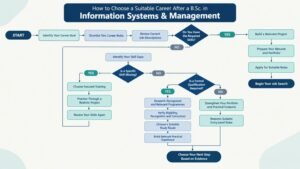
    Rather than following a fixed career timeline, use this decision process to choose the next step that addresses your actual needs. Career decision flowchart for B.Sc. Information Systems and Management graduates, showing how to shortlist jobs, assess skills, identify gaps, build projects and prepare for applications.

    Step 1: Shortlist two roles

    Select two realistic options from the career list. For example, compare business analysis with data analysis, or application support with software testing. Read current job descriptions for both roles.

    Step 2: Identify repeated requirements

    Note the tools, technical knowledge, experience and communication skills that appear across multiple vacancies. Separate essential requirements from skills described as desirable.

    Step 3: Assess your current position

    Mark each requirement as one of three categories:
    • Already have: supported by your education, work or project experience.
    • Need to practise: familiar in theory but not yet demonstrated confidently.
    • Need to learn: a genuine gap that may require structured training.

    Step 4: Choose the smallest useful learning step

    If you already understand spreadsheets but lack dashboard experience, practise reporting before enrolling in a broad programme. If your intended role requires a formal qualification you do not have, investigate eligible degree options. If you lack foundational technical knowledge, start there instead of jumping straight into an advanced specialisation.

    Step 5: Check whether your work demonstrates the skill

    Complete a project, document a process, create a report or prepare a test case that reflects the responsibilities of your target role. Ask a knowledgeable person to review it if possible.

    Step 6: Reassess before spending more

    After practising, check whether the role still interests you and whether you can explain the work involved. Then decide whether you need further study, another project or a focused job search. This approach helps students avoid selecting a course solely because it is trending. It also helps working professionals focus their time and budget on the skills most relevant to their next career move.

    How to Choose a B.Sc. Correspondence College in Karnataka

    For students researching a B.Sc correspondence college in Karnataka, the most important task is to verify the exact programme and university before applying. A course title alone does not confirm that a particular specialisation is available through distance or online learning. Use the following checklist to compare options.

    Check the exact degree and specialisation

    Confirm whether the programme is a general B.Sc., B.Sc. in Information Technology, B.Sc. in Computer Science or another specialisation. Do not assume that a B.Sc. in Information Systems & Management is interchangeable with these qualifications.

    Verify the awarding university and mode

    Find out which university awards the degree and whether the specific programme is approved or entitled for the relevant academic session and mode. The UGC Distance Education Bureau programme listing is an important resource for checking recognised or entitled programmes.

    Compare eligibility, subjects and assessment

    Check the entry requirements, course structure, examination format, practical work and any compulsory attendance or laboratory components. These details matter particularly when a programme includes computing or science subjects.

    Consider flexibility and student support

    Students and working professionals should assess study schedules, learning resources, admission guidance, assessment arrangements and the support available when questions arise. Learners looking for Science distance education can review ICC’s B.Sc. distance education programme. It lists science degree options, but you should confirm the exact specialisation, university and current availability before enrolling. If your goal is an IT-oriented career, ICC also provides a BCA distance education Courses. BCA is a different qualification from B.Sc. Information Systems & Management, so compare the curricula and eligibility rather than treating them as equivalent. Choosing a B.Sc correspondence college in Karnataka should ultimately be based on programme suitability, recognition, cost, academic support and your intended career path—not just the popularity of a keyword or course title.

    How Can Flexible Education Support Students and Working Professionals?

    Flexible education can be useful for learners who need to combine study with employment, family responsibilities or other commitments. However, flexibility is only one part of a good learning decision. When comparing distance learning programs, review the course curriculum, teaching resources, examination requirements, assessment methods and the amount of independent study involved. Confirm whether practical activities or scheduled sessions are required. For students, the main consideration may be whether the qualification matches their interests and future study plans. For working professionals, it may be whether the schedule is manageable and the programme supports their longer-term academic or career objective. IT distance education may be worth exploring when the learner wants a flexible route to build or formalise technology knowledge. The suitability of a particular qualification still depends on its recognition, syllabus and the requirements of the intended role. ICC provides guidance on a range of education options for students and professionals. Before applying, verify the current programme details directly and ask for clarification where information about eligibility, fees, awarding university or mode is unclear.

    Frequently Asked Questions

    1. What jobs can I get after a B.Sc. in Information Systems & Management?

    Depending on your curriculum and skills, you may explore IT support, application support, business analysis, reporting, software testing, database support, junior development or operations analysis. Individual vacancies may require additional skills or experience.

    2. Can freshers apply for business analyst jobs after this degree?

    Some junior business analyst or trainee positions may be open to freshers. Knowledge of Excel, business processes, requirement documentation and communication can help. A project that demonstrates process analysis can also support your application.

    3. Is coding compulsory for every career in information systems?

    No. Programming is central to many development roles, but support, reporting, coordination and some business analysis positions may emphasise other skills. Basic technical knowledge is still useful, and requirements vary by employer.

    4. Which skills should I learn first after graduation?

    Start with the skills required by your preferred role. Excel and communication are useful foundations for many jobs. Data-focused roles may require SQL and visualisation, while development roles need programming and testing roles require structured test documentation.

    5. What is the salary after a B.Sc. in Information Systems & Management in India?

    Salary varies by role, location, employer, skills and experience. Compare current vacancies for the specific job you want rather than relying on a single average figure for the degree.

    6. Can working professionals switch to information systems careers?

    Yes, a career transition may be possible when existing experience is relevant and the professional develops the required technical skills. Customer support, administration, reporting and operations experience may transfer to certain support, analysis or coordination roles.

    7. Should I pursue higher studies after this degree?

    Consider higher studies if they are needed for your target occupation, academic progression or deeper subject knowledge. If your main gap is a particular tool or practical skill, focused training and projects may be a more direct first step. Check eligibility and recognition before enrolling.

    8. How do I choose a B.Sc correspondence college in Karnataka?

    Check the exact programme title, awarding university, mode of study, current recognition or entitlement, eligibility, syllabus, fees and student support. Verify the programme for the relevant academic session before submitting an application.

    Conclusion

    Career opportunities after a B.Sc. in Information Systems & Management can extend across technology support, business analysis, data reporting, software testing, development and operations. The most suitable direction depends on your interests, the subjects you have studied, your practical abilities and the requirements of employers. For fresh graduates, the priority should be to choose a realistic entry-level role, strengthen relevant skills and build evidence through projects. For working professionals, the priority may be to connect existing experience with a new role and address specific technical or academic gaps. If you are searching for a B.Sc correspondence college in Karnataka, compare the actual degree and specialisation, verify the awarding university and confirm that the programme is available in the intended mode. Students considering Science distance education, distance learning programs or IT distance education should also check eligibility, recognition and assessment requirements before enrolling. The right education decision is one that matches your career objective, schedule and current qualifications. Use ICC’s programme pages to research available options, confirm the latest details before admission and choose a path that supports your next step with clarity.

Leave A Comment