
Admission opens for 2026-27 sessions for all university.

Blog Detail

  • Career Opportunities After M.Tech: Industry Roles and Research Options

    • 02,Nov 2026
    • Posted By : uaeautomates@gmail.com
    • 0 Comments
    • Career Opportunities After M.Tech
    • Engineering Careers in India
    • Engineering distance education
    • Engineering Industry Jobs
    • Jobs After M.Tech
    • M.Tech Career Options
    • M.Tech Research Opportunities
    • M.Tech Salary in India
    • Postgraduate Engineering Courses
    • Research and Development Careers
    Engineering is a field that keeps evolving, creating new opportunities for professionals who are willing to develop their technical knowledge and adapt to changing technologies. Completing a postgraduate qualification can help engineering graduates explore specialised roles, take up challenging projects and consider careers beyond traditional engineering positions. However, choosing the right direction is just as important as earning the qualification itself. For students researching an M.Tech correspondence college in Karnataka, it is important to understand both the career opportunities available after postgraduate engineering education and the recognised study options permitted under Indian regulations. An M.Tech can open doors to specialised industry positions, research, product development and academic careers, depending on the candidate’s specialisation, practical experience and professional interests. Some graduates may want to work with established companies, while others may be interested in research laboratories, teaching or technological innovation. Working professionals may also consider advancing their existing careers through specialised knowledge. So, what exactly can you do after M.Tech? Which industries offer opportunities, what skills do employers expect, and how can you decide between an industry position and a research career? Let’s explore these possibilities and understand how to plan your next professional step.

    What Does an M.Tech Add to Your Engineering Career?

    A Master of Technology is a postgraduate qualification designed to develop advanced knowledge in a particular engineering or technology discipline. While undergraduate education generally introduces students to fundamental engineering concepts, postgraduate education allows them to study selected subjects in greater depth. For example, someone who completes an undergraduate degree in mechanical engineering may choose a postgraduate specialisation connected to thermal engineering, manufacturing or machine design. Similarly, a computer science graduate may explore artificial intelligence, cybersecurity, data science or advanced computing. The major difference is the level of technical understanding and specialisation. An M.Tech programme generally involves:
    • Advanced subject knowledge related to the selected engineering discipline.
    • Technical assignments and practical laboratory work.
    • Research methodology and project development.
    • Engineering design, analysis and problem-solving.
    • Dissertation work or a major academic project.
    • Exposure to specialised software, tools and technologies.
    The qualification can be useful for candidates who want to move into specialised technical positions or develop an academic and research-oriented career. However, a postgraduate degree alone does not guarantee a particular job title or salary. Employers also consider practical experience, communication abilities, project exposure and the candidate’s ability to apply technical knowledge in real situations.

    Before Choosing a Career, Understand Your Technical Strengths

    Before exploring job opportunities, it helps to understand what kind of engineering work you actually enjoy. Two graduates with the same postgraduate qualification may choose completely different careers because their interests and strengths are different. Consider the following areas:

    Designing and Developing Technical Solutions

    If you enjoy creating products, improving existing designs or developing engineering systems, design and development roles may suit you. These positions involve understanding requirements, preparing technical models, testing concepts and improving product performance.

    Analysing Systems and Solving Complex Problems

    Some engineering professionals enjoy working with technical data, identifying performance issues and finding solutions. They may work in simulation, system analysis, quality engineering, process optimisation or computational modelling.

    Working with Machines and Industrial Processes

    If you prefer practical engineering environments, manufacturing, production, automation and industrial operations may be suitable. These roles involve improving equipment performance, monitoring production processes and ensuring that engineering systems operate efficiently.

    Programming and Emerging Technologies

    Students interested in software, computing and digital systems can explore specialised opportunities involving artificial intelligence, machine learning, cybersecurity, robotics and embedded systems.

    Research and Academic Development

    If you enjoy investigating technical problems, reading research papers, conducting experiments and developing new ideas, research and higher academic studies may be worth considering. Understanding these preferences will make it easier to identify a career direction instead of applying for every engineering vacancy without a clear goal.

    The Career Opportunity Map: Three Major Directions After M.Tech

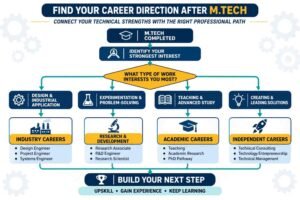
    Career opportunities after postgraduate engineering education can broadly be divided into three directions. Each offers different responsibilities, working environments and long-term possibilities. Visual comparison of industrial engineering, scientific research and technology development opportunities after M.Tech.
    Industry and Corporate Careers Research and Innovation Academic and Independent Careers
    Technical specialist Research associate Assistant professor
    Design engineer Research scientist Lecturer
    Project engineer R&D engineer Academic researcher
    Systems engineer Innovation specialist Technical consultant
    Quality engineer Technology developer Independent engineering consultant

    Industry and Corporate Careers

    This path is suitable for candidates who want to apply their technical knowledge to real business and engineering requirements. They may work with manufacturing companies, IT organisations, infrastructure developers, automotive businesses, electronics manufacturers and engineering consultancies. The main focus is usually on product development, project execution, system improvement and solving operational challenges. Students comparing correspondence degree colleges in Bangalore should verify whether the advertised engineering qualification is permitted in the stated learning mode.

    Research and Innovation

    Research-oriented professionals investigate existing technologies and look for ways to improve them. They may work in university laboratories, corporate research divisions, government research organisations or specialised technology centres. Their responsibilities can include experimentation, technical analysis, research documentation and prototype development.

    Academic and Independent Careers

    Candidates who enjoy teaching and sharing technical knowledge may explore academic opportunities, subject to the applicable qualifications and recruitment requirements. Others may use their experience to provide technical consulting, professional training or specialised engineering services. The important thing is to recognise that these are different career directions. Choosing one that matches your strengths can help you build a more satisfying professional journey.

    Inside the Industry: Where Can M.Tech Graduates Work?

    Engineering qualifications are relevant across several industries. The opportunities available depend on the specialisation, technical skills and recruitment requirements of individual employers.

    Information Technology and Software Development

    The IT industry offers opportunities for engineers with strong computing and analytical skills. Potential areas include:
    • Software development.
    • Artificial intelligence and machine learning.
    • Cybersecurity.
    • Cloud computing.
    • Data engineering.
    • Systems architecture.
    • Software testing and quality assurance.
    Professionals working in these areas may develop applications, maintain digital infrastructure, improve software performance or build technology-based solutions.

    Manufacturing and Industrial Automation

    Manufacturing companies require engineers who understand production systems, machinery and industrial processes. Possible responsibilities include production planning, process improvement, equipment development, automation and quality control. Professionals with knowledge of robotics, industrial automation and advanced manufacturing may find opportunities in specialised technical departments.

    Construction and Infrastructure

    Civil engineering professionals can explore opportunities in structural design, infrastructure planning, construction management and project coordination. Large infrastructure projects require engineers who can understand technical drawings, evaluate structural requirements, monitor construction activities and ensure that projects follow relevant standards.

    Electronics and Semiconductor Industries

    The growth of electronic products and advanced computing systems has increased the importance of specialised electronics knowledge. Career areas may include semiconductor design, embedded systems, electronic testing, chip development and hardware engineering. These positions often require familiarity with specialised design tools and practical project experience.

    Energy and Renewable Power

    The energy sector offers opportunities in conventional power generation, renewable energy, electrical systems and energy management. Engineers may contribute to solar energy projects, power distribution systems, equipment maintenance, energy efficiency and sustainable infrastructure.

    Automotive and Aerospace

    The automotive and aerospace industries involve advanced engineering applications. Potential areas include vehicle design, electric mobility, manufacturing systems, propulsion technologies, material testing and product development. These industries often value candidates who can combine strong engineering fundamentals with practical experience.

    Telecommunications and Networking

    Telecommunication companies and technology providers require professionals who understand communication systems, networking infrastructure and signal processing. Possible roles include network planning, wireless communication engineering, systems development and network optimisation.

    Job Roles That Can Put Your Specialisation to Work

    Understanding industry sectors is useful, but knowing the actual job responsibilities can help you make a more informed career decision. Here are some roles that engineering postgraduates may explore.

    Design and Development Engineer

    Design engineers work on creating, modifying and improving engineering products or systems. Their responsibilities may include preparing designs, developing prototypes, testing product performance and coordinating with manufacturing teams. Knowledge of CAD software, engineering principles and product development methods can be valuable.

    Research and Development Engineer

    R&D engineers focus on improving existing technologies or developing new products and processes. They may conduct experiments, analyse results, prepare technical reports and collaborate with research teams. This position is particularly suitable for people who enjoy investigating problems and developing innovative solutions.

    Systems Engineer

    Systems engineers work with complex engineering systems and ensure that different components function together effectively. They may be involved in system design, performance monitoring, integration, troubleshooting and technical documentation.

    Quality Assurance Engineer

    Quality engineers ensure that products and processes meet the required technical and quality standards. Their responsibilities may include conducting inspections, analysing defects, improving production procedures and implementing quality management systems.

    Project Engineer

    Project engineers coordinate technical activities involved in engineering projects. They may work with design teams, vendors, contractors and management professionals to ensure that project activities meet the required specifications and timelines.

    Data and Computational Engineering Specialist

    Professionals with computing and analytical knowledge may explore roles involving technical data analysis, simulations, predictive modelling and computational problem-solving. These roles are increasingly relevant in sectors that depend on data-driven engineering decisions.

    The Research Route: Turning Technical Knowledge into New Discoveries

    Not every engineering graduate wants to spend their career working on commercial products or industrial projects. Some prefer to investigate unanswered technical questions and contribute to scientific or technological development. Research can be an interesting direction after postgraduate education.

    Research Assistant

    Research assistants support academic or institutional research projects. Their work may involve collecting information, conducting experiments, analysing results, preparing documentation and assisting senior researchers. These positions can help fresh postgraduates understand how professional research environments operate.

    Research Associate

    Research associates generally contribute to more specialised research activities. Depending on the institution and project, they may work on experimental design, technical analysis, project reports and research publications. Eligibility varies between organisations, and some positions require a PhD or substantial research experience.

    Research Scientist

    Research scientists investigate technical problems and develop knowledge in their areas of specialisation. They may work in government laboratories, industrial research divisions, scientific institutions or advanced technology organisations. For example, the Indian Space Research Organisation recruits scientists and engineers under specific qualification and recruitment criteria. Its published recruitment and career information provides a useful example of how specialised postgraduate qualifications can be relevant to certain technical positions. Students interested in such opportunities should regularly review official recruitment notifications rather than assuming that every vacancy has identical eligibility requirements.

    Research and Development in Private Companies

    Many technology companies maintain research and development departments to improve their products and services. R&D professionals may work on:
    • Developing new engineering materials.
    • Improving product performance.
    • Designing advanced electronic systems.
    • Testing new manufacturing techniques.
    • Developing intelligent automation solutions.
    • Improving energy efficiency.
    These roles combine theoretical understanding with practical engineering applications.

    Pursuing a PhD After M.Tech

    A PhD is another possible direction for candidates who want to continue their academic journey. Doctoral research generally involves identifying a research problem, reviewing existing studies, developing a research methodology, conducting investigations and presenting original findings. A PhD may be useful for candidates interested in advanced research, university-level teaching or specialised scientific careers. Admission requirements, entrance examinations, fellowships and research areas differ between institutions.

    Alternative Opportunities: Careers Beyond Traditional Engineering Jobs

    Sometimes, the best career opportunity is not necessarily a conventional engineering position. Postgraduate engineering knowledge can also support careers that combine technology with business, management, education or independent professional work.

    Technical Management

    Engineers with strong technical and organisational abilities may gradually move towards project leadership, technical operations or engineering management. These roles involve coordinating teams, monitoring project progress and making technical decisions.

    Engineering Consultancy

    Experienced professionals may provide specialised advice to businesses, industries and project teams. Consultants can work in areas such as design review, process improvement, technical assessment and engineering planning. However, independent consultancy generally requires practical experience, professional credibility and a strong understanding of applicable standards.

    Technical Training and Education

    Engineers who enjoy explaining complex concepts may explore technical training, instructional roles or academic opportunities. Teaching eligibility depends on the institution, position and applicable regulatory requirements.

    Technology Entrepreneurship

    Some engineers choose to develop their own products, services or technology-based businesses. Examples include automation solutions, software products, engineering design services and specialised industrial tools. Entrepreneurship can provide independence, but it also requires business planning, market understanding and financial management.

    Interdisciplinary Careers

    Engineering knowledge can also be combined with other fields. For example, a technical professional may explore technology consulting, product management, sustainability, operations analysis or technical business development. These opportunities can be especially relevant to working professionals who have developed additional experience beyond their original engineering specialisation.

    Skills That Make an M.Tech Graduate Industry-Ready

    A postgraduate qualification provides advanced academic knowledge, but employers also expect candidates to demonstrate practical abilities. Developing the right combination of technical and professional skills can make a significant difference during recruitment.
    Technical Capabilities Professional Skills Research Capabilities
    Advanced engineering knowledge Communication Literature review
    CAD and simulation tools Team collaboration Experimental methods
    Programming and analysis Project management Technical documentation
    Design and development Problem-solving Data interpretation
    Technical troubleshooting Time management Analytical thinking

    Build Strong Technical Knowledge

    Understand the concepts related to your specialisation rather than relying only on memorised information. Employers may ask candidates to explain how they would approach an actual engineering problem.

    Gain Practical Experience

    Internships, academic projects, industrial training and independent technical projects can help demonstrate your ability to apply classroom knowledge. For example, a mechanical engineering candidate may develop a design prototype, while a computer engineering candidate may build a working software application.

    Learn Relevant Software and Tools

    Different engineering fields use different tools. Candidates should identify the software commonly required in their preferred industry and develop practical familiarity with it.

    Improve Communication

    Engineers regularly interact with colleagues, clients, managers and technical teams. The ability to explain technical information clearly can support career progression.

    Develop a Strong Project Portfolio

    A well-organised project portfolio can help candidates demonstrate their abilities. Include project objectives, your contribution, tools used, challenges encountered and final outcomes. This can be particularly useful for fresh graduates who have limited professional experience.

    Eligibility, Qualifications and Further Academic Options

    Students considering postgraduate engineering education should understand the admission requirements before selecting an institution or programme. Generally, M.Tech admission requires a relevant undergraduate qualification in engineering or technology, although specific eligibility conditions vary according to the specialisation and institution. Common admission considerations include:
    • A recognised B.E. or B.Tech qualification in an appropriate discipline.
    • Minimum marks or CGPA specified by the institution.
    • Relevant subject background.
    • Entrance examination performance, where applicable.
    • Institution-specific admission requirements.
    • Additional eligibility conditions for sponsored or special admission categories.

    Is GATE Important for M.Tech Admission?

    The Graduate Aptitude Test in Engineering is an important examination for candidates seeking admission to many postgraduate engineering programmes. A valid GATE score may be considered by participating institutions, depending on their admission policies and the programme concerned. However, qualifying in GATE does not automatically guarantee admission, a scholarship or employment. Each institution follows its own admission criteria. Candidates should check the examination information and the admission requirements of their preferred institutions before applying.

    What Other Academic Opportunities Are Available?

    After completing postgraduate engineering education, students may consider:
    • PhD programmes in specialised engineering disciplines.
    • Research fellowships where eligible.
    • Advanced professional certifications.
    • Specialised technical training.
    • Interdisciplinary academic programmes.
    The right option depends on whether the candidate wants to strengthen industry knowledge, enter research or develop an academic career.

    Understanding Salary Expectations and Career Growth

    Salary is one of the important factors students consider when choosing a postgraduate qualification. However, there is no single salary applicable to every M.Tech graduate. Earnings depend on the specialisation, employer, location, technical expertise, experience and responsibilities associated with the position. The following figures are broad illustrative market estimates for discussion, not guaranteed salary packages or official pay scales.
    Career Role Indicative Annual Salary Range
    Graduate-level technical engineer ₹3–6 LPA
    Design or quality engineer ₹4–8 LPA
    Systems or project engineer ₹5–10 LPA
    R&D or specialised technical engineer ₹5–12 LPA
    Experienced technical specialist ₹8–15+ LPA
    Actual offers may be lower or higher, particularly in specialised industries and experienced positions.

    What Influences Salary After M.Tech?

    1. Specialisation: Certain specialised areas may offer different compensation opportunities depending on industry demand.
    2. Practical Experience: Candidates with internships, relevant projects and industry exposure may have an advantage.
    3. Technical Skills: Knowledge of specialised software, programming languages, simulation tools and engineering methods can influence recruitment decisions.
    4. Employer and Industry: Compensation structures differ between startups, multinational companies, government organisations and research institutions.
    5. Location: Job markets in cities with established technology and manufacturing industries may offer different salary levels.
    6. Career Progression: Professionals who develop leadership, project management and advanced technical abilities may qualify for higher-responsibility positions over time.
    For example, ISRO publishes specific pay levels and eligibility conditions for its scientist and engineer positions. These official figures illustrate how government recruitment follows defined pay structures rather than general private-sector salary estimates.

    The Future of Engineering Careers: What Should Graduates Prepare For?

    Engineering careers continue to change as industries adopt new technologies and develop more advanced products and services. Postgraduate students should therefore look beyond their current qualification and consider which technologies may influence their preferred industry.

    Artificial Intelligence and Machine Learning

    AI is increasingly being used in manufacturing, healthcare technology, automation, predictive maintenance and software development. Engineers with relevant computing and analytical knowledge may explore opportunities in intelligent systems and machine learning applications.

    Electric Vehicles and Smart Mobility

    The transition towards electric mobility is creating specialised engineering requirements. Battery technology, power electronics, vehicle design, embedded systems and charging infrastructure are important areas to watch.

    Semiconductor and Electronics Development

    Electronic devices and computing systems depend on advanced semiconductor technologies. Professionals with relevant knowledge may explore opportunities in chip design, testing, embedded technologies and hardware development.

    Renewable Energy and Sustainability

    Solar energy, wind power, energy storage and efficient electrical systems are becoming important areas of engineering development. Professionals who understand energy systems and sustainable technologies may find opportunities across infrastructure and industrial sectors.

    Robotics and Industrial Automation

    Industries are increasingly adopting automated equipment and intelligent manufacturing systems. Knowledge of robotics, control systems, sensors and industrial software can support opportunities in this area.

    Smart Infrastructure and Advanced Manufacturing

    Digital monitoring, automation and modern construction technologies are influencing how infrastructure and manufacturing projects are planned and managed. Engineers who understand both traditional fundamentals and emerging tools can prepare themselves for changing industry requirements. The key is continuous learning. A postgraduate qualification provides a foundation, but staying relevant requires professionals to update their technical knowledge throughout their careers. “For students exploring specialised engineering fields, read our guide on Top 10 Engineering Courses to Build a Career in Robotics, AI and Cloud Computing  to discover emerging career opportunities and in-demand technical skills.”

    How to Choose the Right Academic Path for Your Career Goals

    Selecting a postgraduate programme requires more than comparing course names or looking at advertisements. Students should consider how the qualification connects with their intended career.

    Identify Your Career Direction

    First, decide whether you are interested in industry employment, research, teaching or technical management. This will help you identify relevant specialisations and academic pathways.

    Evaluate Your Existing Qualification

    Check whether your undergraduate degree meets the admission requirements of the programme you are considering. Some specialisations accept candidates from multiple engineering branches, while others require a closely related academic background.

    Compare Programme Structures

    Review the syllabus, practical requirements, laboratory exposure, project work and dissertation components. A programme should provide the academic depth required for your intended professional direction.

    Verify Institutional Recognition and Approval

    This is particularly important when researching an M.Tech correspondence college in Karnataka. Do not depend only on advertisements, websites or verbal admission assurances. Check whether the institution and the specific programme are permitted by the relevant regulatory authorities in the exact learning mode being offered. For example, UGC-DEB explicitly lists Engineering among the domains prohibited through ODL and online learning. AICTE also specifies restrictions on postgraduate engineering programmes through these modes. A student should be especially cautious of claims such as fully online M.Tech, distance M.Tech or correspondence M.Tech when these are presented as equivalent alternatives to an approved regular engineering degree.

    Consider Fees and Long-Term Value

    Compare the overall programme fees, examination expenses, learning resources and other academic requirements. Think about the value of the qualification in relation to your intended career rather than choosing only the least expensive option.

    Look at Industry Relevance

    Research the skills employers expect in your preferred field. Check current job descriptions to understand whether the programme provides relevant technical knowledge and practical exposure.

    Exploring Flexible Higher Education Options

    Not everyone can follow the same educational route. Some students may be preparing for postgraduate studies immediately after graduation, while others may already be employed and looking for ways to improve their professional qualifications. There are also people who have taken an academic break and now want to return to higher education. For these learners, flexibility can be an important consideration. Engineering distance education is a phrase frequently used by students when researching ways to continue studying alongside personal or professional responsibilities. However, the availability of a flexible learning option does not automatically mean that every engineering qualification can legally be offered through distance or online education. Under current UGC-DEB and AICTE rules, engineering degree programmes, including postgraduate engineering degrees, cannot be offered through ODL or online mode. Students should therefore distinguish between regular on-campus postgraduate engineering programmes, approved forms of part-time study where available, and prohibited distance or online engineering degree claims. Someone researching a M.Tech correspondence college in Karnataka should verify the exact programme, awarding university, delivery method and regulatory position before making any payment. It is equally important to understand the difference between conventional classroom-based education and other recognised learning arrangements. Traditional distance education in Bangalore may be relevant when exploring permitted non-engineering qualifications, but it should not be assumed to be an approved route for earning an M.Tech. Students comparing a correspondence college in India should also check the institution’s academic status, programme approvals and admission documentation carefully. For additional guidance, the UGC Distance Education Bureau’s official instructions explain the programme categories and regulatory conditions applicable to distance and online higher education.

    Planning Your Next Move: A Practical Career Checklist

    Once you understand the available opportunities, the next step is to convert your career interest into an achievable plan. Use this simple checklist to organise your preparation. FIND YOUR CAREER DIRECTION AFTER M.TECH If you want an industry career:
    • Identify three industries related to your specialisation.
    • Study the technical requirements in current job descriptions.
    • Improve your knowledge of relevant software and tools.
    • Complete practical projects that demonstrate your abilities.
    • Prepare a technical resume and project portfolio.
    • Practise explaining engineering concepts during interviews.
    If you want a research career:
    • Identify research areas that interest you.
    • Read relevant academic publications.
    • Develop research methodology and analytical skills.
    • Explore suitable research projects and assistantship opportunities.
    • Review the eligibility criteria for research positions.
    • Consider whether a PhD fits your long-term goals.
    If you want an academic career:
    • Review the qualifications required for teaching positions.
    • Build strong subject knowledge.
    • Develop presentation and communication skills.
    • Explore research and publication opportunities.
    • Check institutional and regulatory recruitment requirements.
    Working professionals should also evaluate their existing experience. In some cases, a change in technical responsibilities, specialised training or an industry-recognised certification may be more suitable than pursuing another full-time academic qualification.

    Conclusion: Your M.Tech Degree Is a Starting Point, Not a Destination

    Completing postgraduate engineering education can create several opportunities for individuals who want to build a specialised professional career. From product development and industrial automation to research, teaching and technology innovation, there are multiple directions to explore. The right choice depends on your interests, technical abilities, academic background and long-term ambitions. If you enjoy practical engineering, an industry role may be a suitable direction. If you prefer experimentation and innovation, research opportunities may be worth exploring. Those who enjoy knowledge sharing may consider academic careers after meeting the required qualifications. Students should also remember that choosing a recognised academic programme is just as important as choosing the right specialisation. Before enrolling, verify the awarding institution, programme approval, delivery mode and eligibility requirements. For students and working professionals exploring higher education pathways, Indian College of Correspondence provides an opportunity to explore available academic programmes and seek guidance on course-related queries. Make sure that any programme you consider matches your academic goals and applicable regulatory requirements. Your engineering career does not have to follow a single route. With the right preparation, continuous learning and informed decisions, you can build a professional journey that matches your strengths and ambitions. “Students looking to pursue higher education after completing their 12th can explore our guide on Best Distance Education Courses After 12th for Career Growth and Opportunities  to understand available courses and future career prospects.”

    Frequently Asked Questions (FAQs)

    1. What are the best career opportunities after M.Tech?

    Some career options include design engineer, R&D engineer, systems engineer, project engineer, technical specialist, research associate and academic professional. The most suitable role depends on your specialisation, practical skills and professional interests.

    2. Can I get a government job after M.Tech?

    Yes. Eligible candidates can apply for government technical and research positions when their qualifications match the recruitment notification. Opportunities may be available in scientific institutions, research organisations, public-sector organisations and government departments. Each recruitment process has its own eligibility, examination, experience and selection requirements.

    3. Is M.Tech useful for working professionals?

    M.Tech can be useful for working professionals who want to develop advanced technical knowledge or move into specialised engineering responsibilities. However, they should select an approved programme and consider whether its attendance, practical and academic requirements fit their professional commitments.

    4. Can I pursue a PhD after M.Tech?

    Yes. M.Tech graduates can apply for PhD programmes if they meet the eligibility requirements of the institution and research department. Admission may involve an entrance examination, interview, research proposal or other selection criteria.

    5. What is the salary after M.Tech in India?

    Salary varies according to specialisation, employer, location, experience and technical skills. Entry-level positions may offer different packages from specialised R&D or experienced technical roles. Candidates should compare current job offers and recruitment information rather than relying on one fixed salary figure.

    6. Which industries hire M.Tech graduates?

    IT, manufacturing, construction, electronics, automotive, aerospace, energy, telecommunications and research organisations are among the sectors that may recruit postgraduate engineering professionals.

    7. Is GATE compulsory for M.Tech admission?

    No. GATE is not compulsory for every institution or programme. Many institutions use GATE scores for admission, while others may conduct their own entrance examinations or follow alternative admission procedures. Candidates should check the admission requirements of their preferred institution.

    8. Can I pursue M.Tech through distance education in India?

    Under current UGC-DEB regulations, Engineering programmes are prohibited through Open and Distance Learning and Online Learning modes. AICTE’s Approval Process Handbook also restricts postgraduate engineering degrees through these modes. Students should consider recognised regular programmes or other permitted study arrangements instead.

    9. How do I choose the right M.Tech specialisation?

    Consider your undergraduate background, technical interests, career goals and the industries you want to enter. Compare the syllabus, practical exposure, faculty expertise, project opportunities and admission requirements before making a decision.

    10. Is M.Tech better than starting a job after B.Tech?

    There is no single answer. M.Tech may suit candidates who want advanced technical knowledge, research opportunities or specialised positions. Starting a job may be more suitable for those who want immediate industry experience. The better option depends on individual career plans and circumstances.

    Take the Next Step Towards Your Career Goals

    A successful engineering career begins with an informed decision. Whether you are a recent graduate, an employed professional or someone planning to return to education, take time to understand your options before selecting your next academic or professional step. Explore relevant programmes, compare recognised institutions and understand the qualifications required for your preferred career. Visit ICC to explore available educational programmes and contact us for guidance on suitable academic options. Always verify the applicable regulatory approval and learning mode before enrolling in a professional engineering qualification.

Leave A Comment