
Admission opens for 2026-27 sessions for all university.

Blog Detail

  • Bachelor of Retail Management: Eligibility, Course Details and Career Scope

    • 05,Nov 2026
    • Posted By : uaeautomates@gmail.com
    • 0 Comments
    • Bachelor of Retail Management
    • BBA correspondence college in Karnataka
    • BBA Retail Management
    • Management Distance Education
    • Retail Management Career Scope
    • Retail Management Course
    • Retail Management Eligibility
    • Retail Management Jobs
    • Retail Management Salary in India
    • Retail Management Subjects
    Think about the last time you visited a supermarket, clothing store or shopping website. You probably noticed how products were arranged, how discounts influenced your choices, how quickly you received assistance or how easily you completed a purchase. But have you ever wondered who makes all these decisions? Behind every successful shopping experience is a team managing products, people, pricing, stock, customer service and business operations. This is where retail management comes into the picture. If you are exploring a BBA correspondence college in Karnataka, a Bachelor of Retail Management is a course worth understanding, especially if you are interested in business, customer experience and management. Retail management is no longer limited to managing a physical shop. It now connects traditional stores with e-commerce, digital payments, supply chains and customer data. This creates different opportunities for people who enjoy business operations and working with customers. Whether you are a student who has completed Class 12, a working professional looking to develop management knowledge or someone planning to return to education after a break, understanding the course can help you make a more informed decision. Let’s explore what the programme involves, what you may study, who can apply and where this qualification may take you.

    What Is a Bachelor of Retail Management?

    A Bachelor of Retail Management is an undergraduate business programme that introduces students to the principles and practices involved in running retail businesses. It focuses on how products move from suppliers to customers and how businesses manage the people, processes and decisions involved in that journey. Retail businesses include supermarkets, shopping malls, fashion outlets, electronics stores, department stores, pharmacies, online shopping platforms and many other businesses that sell products directly to customers. The course generally combines business management concepts with retail-specific knowledge. Students may learn about:
    • Retail operations and store management
    • Principles of management
    • Marketing and sales
    • Customer relationship management
    • Product merchandising
    • Inventory and stock management
    • Supply chain operations
    • Retail accounting and finance
    • Consumer behaviour
    • E-commerce and digital retail
    The exact programme name may differ between universities. Some institutions may offer a Bachelor of Retail Management, while others may include retail specialisation within a BBA or another management degree. Therefore, always check the exact qualification awarded, syllabus and eligibility before applying. The main purpose is to help learners understand how retail businesses operate and how managers contribute to sales, customer satisfaction and business growth.

    Retail Is More Than Selling Products

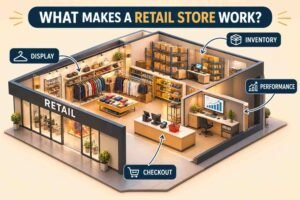
    Many people associate retail with selling products and handling customers. Although these activities are important, they represent only a small part of the business. Isometric illustration of a retail store showing the relationship between product arrangement, inventory storage, checkout operations and customer movement. Consider a supermarket preparing for a major festival. The management team must estimate which products customers are likely to purchase, arrange sufficient stock, coordinate suppliers, plan promotional offers, organise staff shifts and make sure customers can find what they need. If the store orders too much stock, products may remain unsold. If it orders too little, customers may leave without purchasing. If the products are poorly arranged, customers may struggle to find them. Each decision can influence the business. This is why retail management requires a combination of planning, coordination and decision-making. A retail business generally involves several connected activities: Product planning: Deciding which products should be available based on customer needs, demand and seasonal trends. Store operations: Managing daily activities, staff responsibilities, billing processes, product availability and customer assistance. Merchandising: Presenting products in a way that makes them easy to notice, understand and purchase. Inventory management: Tracking stock levels, preventing shortages and reducing unnecessary excess inventory. Customer experience: Making shopping convenient through good service, clear communication and efficient problem-solving. Business performance: Monitoring sales, expenses, customer feedback and other indicators to understand how the business is performing. A person working in retail management may not perform every task personally, but understanding how these activities connect is an important part of the job.

    The Three Business Engines Behind Retail Management

    To understand the field more easily, think of retail management as three connected business areas. Each one supports the overall shopping experience and contributes to the performance of the business.

    The Three-Block View of Retail Management

    Block 1: Customer Experience Block 2: Product and Operations Block 3: Business and Growth
    Understanding customer behaviour Managing stock and inventory Planning sales targets
    Customer service and relationships Product display and merchandising Marketing and promotions
    Improving shopping experience Store and supply chain operations Analysing business performance
    Building customer loyalty Product availability and coordination Developing business strategies
    These three areas do not work independently. For example, a customer may visit a store because of a promotional offer. The marketing team attracts the customer, the operations team ensures that the product is available, and the customer service team helps complete the purchase. When these functions work together, the business has a better chance of creating a positive shopping experience.

    What Will You Learn During the Course?

    The subjects in a retail management programme are designed to introduce students to both general business principles and the specific activities involved in retail operations. The exact syllabus depends on the university, programme structure and academic regulations. However, students may come across the following subject areas.

    Common Subjects in Retail Management

    Principles of Management Introduces the basic functions of management, including planning, organising, directing and controlling. These concepts help students understand how organisations coordinate people and resources. Retail Management Explains the structure of retail businesses, different retail formats, store operations and the responsibilities of retail managers. Marketing Management Covers marketing principles, customer needs, product positioning, pricing and promotional activities. Consumer Behaviour Explores why people choose particular products, how they compare alternatives and what influences their buying decisions. Retail Merchandising Introduces product selection, product presentation, display planning and merchandise management. Inventory and Supply Chain Management Explains how products are purchased, stored, tracked and distributed. It also introduces the importance of maintaining the right stock levels. Business Communication Develops professional communication skills required for customer interaction, teamwork, reporting and workplace coordination. Financial and Retail Accounting Introduces business transactions, basic financial statements, budgeting, costs and other financial concepts relevant to retail operations. E-Commerce and Digital Retail Explores online shopping, digital platforms, electronic transactions and the relationship between physical and online retail. Retail Sales Management Covers sales planning, sales targets, customer handling and the methods businesses use to improve sales performance. Business Analytics Introduces the use of sales information, customer data and business reports to understand performance and support better decisions. The National Skill Development Corporation’s retail occupational standards and qualification information provide an additional reference for understanding practical retail job roles, including store operations, sales and team leadership. These occupational standards are not a substitute for a university degree syllabus, but they help illustrate the kinds of workplace responsibilities found in the sector.

    A Day in the Life of a Retail Management Professional

    Imagine that you are working as a store operations executive at a retail outlet. The store is preparing for a weekend sale, and customer traffic is expected to increase. Your day may begin by checking whether the products included in the promotion are available. You may coordinate with the inventory team to identify stock shortages and speak with the merchandising team about product placement. Later, you may review staff schedules to make sure enough employees are available during busy hours. If customers report a problem with billing or product availability, you may help coordinate a solution. At the end of the day, you may review sales reports and customer feedback to understand whether the store achieved its targets. This example shows that retail management is not just about supervising a shop. It involves making decisions, solving problems and coordinating different business functions. As you gain experience, your responsibilities may expand to include team management, budgeting, sales planning, vendor coordination and business performance.

    Skills That Help You Succeed in Retail Management

    A degree introduces management concepts, but practical skills help you apply those concepts in a workplace. Retail professionals regularly interact with customers, colleagues, suppliers and business managers, so a combination of personal and professional abilities is useful.

    Communication Skills

    Retail professionals need to explain information clearly, understand customer requirements and coordinate with different teams. Good communication helps prevent misunderstandings and supports better service.

    Customer Handling

    Customers may have questions, complaints or different expectations. The ability to listen patiently, understand the issue and provide an appropriate response is valuable.

    Problem-Solving

    Retail operations can involve unexpected situations such as stock shortages, delayed deliveries, billing issues or staff scheduling problems. Managers need to assess the situation and identify practical solutions.

    Leadership and Teamwork

    Store operations depend on employees working together. Leadership skills help professionals assign responsibilities, guide teams and maintain coordination.

    Numerical and Analytical Ability

    Sales figures, inventory levels, discounts, budgets and expenses are part of everyday retail operations. Basic numerical skills help managers understand business performance.

    Organisation and Time Management

    Retail businesses often operate on tight schedules. Managing tasks, coordinating people and responding to customer requirements requires good organisation.

    Negotiation and Relationship Building

    Retail professionals may interact with vendors, suppliers and business partners. Negotiation skills can help them discuss product availability, delivery schedules and business requirements.

    Digital Skills

    Modern retail uses billing systems, inventory software, e-commerce platforms and digital reporting tools. Familiarity with technology can help professionals adapt to changing workplace requirements. You do not need to master every skill before joining the course. The programme, practical activities and workplace experience can help you develop them over time.

    Is This Course Right for You?

    Retail management can be suitable for learners who are interested in business activities and enjoy understanding how products and services reach customers. You may want to explore this course if:
    • You are interested in business, sales and management.
    • You enjoy interacting with people and understanding customer needs.
    • You want to learn how stores and shopping businesses operate.
    • You are curious about marketing, merchandising and product planning.
    • You want to explore careers in retail, e-commerce or business operations.
    • You enjoy organising activities and coordinating with people.
    • You want to develop management knowledge for future business responsibilities.
    The course may also be relevant to people who are already working in sales, customer service, store operations or related areas and want to strengthen their academic qualifications. For learners returning after a break in education, it can provide an opportunity to revisit formal learning and build knowledge of business management. The important step is to select a programme whose eligibility and learning requirements match your circumstances.

    Eligibility for Bachelor of Retail Management

    Eligibility requirements vary between universities and depend on the exact degree title and admission process. For many undergraduate management programmes, applicants are generally required to complete Class 12 or an equivalent qualification from a recognised board. Common admission requirements may include:
    • Completion of 10+2 or an equivalent examination.
    • Meeting the minimum marks specified by the university.
    • Providing the required academic certificates and identity documents.
    • Completing an entrance examination, if applicable.
    • Meeting any additional admission conditions prescribed by the institution.
    Some universities may accept students from Arts, Commerce and Science backgrounds, while others may have specific eligibility conditions. Students who are comparing a BBA correspondence college in Karnataka should check whether the programme is a general BBA, a retail specialisation or a separately titled Bachelor of Retail Management. The eligibility criteria and degree awarded may differ. Do not assume that every university follows the same admission rules. Always refer to the current official admission notification. “Explore our online management programs to discover flexible learning opportunities and advance your career in the field of management.”

    Course Duration and Learning Formats

    The duration of an undergraduate retail management programme depends on the university and the degree structure. Many bachelor’s programmes follow a three-year structure, while some institutions may offer programmes under a different academic framework or duration. Students should check the programme’s current structure, semester or year-wise subjects, credit requirements and examination pattern before applying.

    Regular Classroom Learning

    Regular learning generally involves scheduled classes, direct interaction with faculty and structured academic activities. Depending on the institution, students may also participate in presentations, projects, group activities and practical assignments. This format may suit students who prefer a fixed academic routine and regular classroom interaction.

    Online Learning

    Online programmes use digital platforms to provide learning materials, lectures, assignments and academic support. The amount of live interaction, flexibility and practical exposure depends on the institution. This format may suit learners who are comfortable studying through digital platforms and managing their own schedules.

    Open and Distance Learning

    Open and Distance Learning is designed to provide flexibility through self-learning materials, academic support and scheduled assessments. Students may be able to manage their studies alongside work or other responsibilities, depending on the programme structure. Learners exploring distance education in Bangalore should check whether the exact programme is available in the selected mode for the relevant academic session.

    Regular, Online or Distance Learning: Which Route Fits Your Life?

    The right learning format depends on your schedule, responsibilities, study preferences and the programme’s requirements.
    Learning Format Main Features May Suit
    Regular Scheduled classes, campus interaction and structured academic activities Students who prefer classroom learning
    Online Digital lectures, online materials and platform-based learning Learners comfortable with technology and flexible schedules
    Open and Distance Learning Self-learning materials, academic support and scheduled assessments Working professionals and learners who need flexibility
    Before choosing a programme, consider the following: Check the exact university and course. A university may offer different programmes through different learning modes. Verify the specific course rather than relying on the institution’s general reputation. Understand the practical component. Retail management involves customer interaction, business operations and decision-making. Find out whether the programme includes projects, case studies or other practical learning activities. Review the academic support. Check how learning materials, examinations, assignments and student assistance are organised. Confirm the approved learning mode. Do not assume that a course offered in regular mode is automatically available through online or distance education. Learners comparing management distance education in bangalore should evaluate the actual qualification, syllabus, learning support and mode of study. Similarly, people looking at correspondence degree colleges in Bangalore should compare the university and programme details rather than relying only on general advertisements. A flexible programme can be helpful, but flexibility should not come at the cost of clarity about the qualification and its academic validity.

    How Retail Management Connects to Real Business Decisions

    One of the most interesting aspects of retail management is that business concepts can be seen in everyday situations. Consider a clothing store preparing for a new season. The store manager must understand which products customers may prefer, how much stock to order and how to arrange the merchandise. If a particular product is selling quickly, the team may need to arrange additional stock. If another product is not attracting customers, the store may review its display, pricing or promotional strategy. Similarly, an online retailer must manage product listings, order processing, delivery coordination, returns and customer communication. These examples show how retail management connects several business decisions:
    • Selecting products that match customer demand.
    • Planning stock levels and preventing unnecessary shortages.
    • Coordinating suppliers and delivery schedules.
    • Presenting products effectively.
    • Monitoring sales and customer feedback.
    • Managing promotions and discounts.
    • Improving the buying experience across physical and digital channels.
    Understanding these activities can help students connect classroom concepts with real business situations.

    Career Opportunities After Bachelor of Retail Management

    Retail management graduates may explore opportunities across physical retail stores, shopping centres, supermarkets, fashion brands, consumer electronics businesses, e-commerce companies, distribution organisations and other customer-focused businesses. The career path you choose will depend on your interests, communication skills, practical exposure and the requirements of the employer.

    The Three Career Directions in Retail Management

    Block 1: Store and Customer Operations Block 2: Merchandising and Supply Chain Block 3: Sales, Marketing and Digital Retail
    Store Executive Merchandising Executive Sales Executive
    Store Operations Coordinator Inventory Executive Retail Marketing Executive
    Customer Relationship Executive Procurement Assistant E-commerce Operations Executive
    Department Supervisor Supply Chain Coordinator Business Development Executive
    Let’s understand some of these roles in more detail.

    A. Store and Customer Operations

    1. Store Executive
    Store executives support the daily functioning of a retail outlet. Their responsibilities may include coordinating staff, monitoring product availability, assisting customers and helping maintain store operations.
    1. Store Operations Coordinator
    This role involves supporting operational activities such as staff coordination, store procedures, inventory checks and reporting. The exact responsibilities depend on the organisation.
    1. Customer Relationship Executive
    Customer relationship executives interact with customers, respond to queries, help resolve complaints and support customer satisfaction initiatives.
    1. Department Supervisor
    Department supervisors coordinate a particular section of a store. They may monitor sales, guide employees, maintain product availability and report operational issues.

    B. Merchandising and Supply Chain

    1. Merchandising Executive
    Merchandising executives help organise product selection, presentation and availability. They may work with sales and inventory teams to understand which products need attention.
    1. Inventory Executive
    Inventory executives track stock movement, update inventory records and help identify shortages or excess stock.
    1. Procurement Assistant
    Procurement assistants support purchasing activities by coordinating with suppliers, checking product requirements and maintaining purchase-related records.
    1. Supply Chain Coordinator
    Supply chain coordinators help manage the movement of products between suppliers, warehouses, distribution centres and retail locations.

    C. Sales, Marketing and Digital Retail

    1. Sales Executive
    Sales executives interact with customers, explain product features and support sales targets. This role can provide valuable experience for people interested in moving into sales management.
    1. Retail Marketing Executive
    Retail marketing executives may support promotional campaigns, seasonal offers, product launches and customer engagement activities.
    1. E-commerce Operations Executive
    E-commerce operations executives help manage online store activities such as product listings, order processing, stock updates, delivery coordination and returns.
    1. Business Development Executive
    Business development executives help identify business opportunities, build relationships and support sales growth. Their responsibilities vary depending on the company.

    Where Can You Work After the Course?

    Possible employment settings include:
    • Supermarkets and hypermarkets
    • Shopping malls and department stores
    • Fashion and lifestyle brands
    • Electronics and consumer goods retailers
    • Grocery and convenience businesses
    • E-commerce companies
    • Online marketplaces
    • Distribution and logistics organisations
    • Retail consulting and service businesses
    • Franchise and multi-outlet businesses
    A degree does not automatically guarantee a managerial position. Many graduates begin in executive, trainee or assistant-level roles and move into supervisory and management responsibilities as they gain experience.

    Salary Expectations After the Course

    Salary is an important consideration when selecting a course, but it should be understood realistically. Earnings after graduation depend on the role, employer, city, practical experience, communication skills and level of responsibility. Fresh graduates may begin in entry-level positions. With experience, they may progress into store supervision, inventory management, merchandising, sales management, e-commerce operations or broader business responsibilities.

    Indicative Salary Ranges in India

    Job Role Approximate Entry-Level Annual Salary
    Retail Sales Executive ₹2–3.5 lakh
    Store Executive ₹2.2–4 lakh
    Customer Relationship Executive ₹2.2–4 lakh
    Inventory Executive ₹2.5–4.5 lakh
    Merchandising Executive ₹2.5–4.5 lakh
    E-commerce Operations Executive ₹2.5–5 lakh
    Retail Marketing Executive ₹3–5 lakh
    Store Operations Coordinator ₹2.5–4.5 lakh
    Note: These are broad indicative estimates for entry-level roles in India, not guaranteed salary packages or official pay scales. Actual offers may be lower or higher depending on the organisation, city, candidate’s skills and experience. Some positions may require specialised training or previous work experience.

    What Can Improve Your Earning Potential?

    Practical Experience Internships, part-time work, retail projects and workplace exposure can help you understand how businesses operate. Communication and Customer Skills Professionals who can understand customer requirements and communicate effectively may be better prepared for customer-facing and supervisory responsibilities. Digital Knowledge Familiarity with inventory systems, billing software, e-commerce platforms and business reporting tools can be useful. Analytical Ability Understanding sales reports, stock movement, customer feedback and business performance can support progression into operational and management roles. Experience and Leadership As professionals take responsibility for teams, store operations or business targets, their earning potential may improve. Rather than choosing a programme based only on advertised salary promises, focus on the knowledge and skills it can help you develop.

    Retail Management Beyond Physical Stores

    Retail has expanded beyond traditional shops. Customers can now discover products online, compare prices, place orders through mobile applications and receive deliveries at home. Many businesses combine physical outlets with online platforms. This approach is often described as omnichannel retail, where customers can interact with a brand through different connected channels. Some developments shaping modern retail include: E-commerce: Online platforms allow customers to browse and purchase products without visiting a physical store. Digital Payments: Electronic payment options have changed how customers complete transactions. Quick Commerce: Some businesses focus on delivering selected products within shorter timeframes, creating new requirements for inventory and logistics management. Customer Data: Businesses use purchase patterns and customer feedback to understand preferences and improve product recommendations. Technology-Enabled Inventory: Digital systems help businesses monitor stock, process orders and coordinate product movement. Social Commerce: Social platforms can influence product discovery and purchasing decisions through content, recommendations and brand communication. Digital commerce is also creating new ways for smaller sellers and local businesses to reach customers. The Government of India’s Press Information Bureau explains how the Open Network for Digital Commerce (ONDC) aims to support wider participation in digital commerce by connecting buyers and sellers across interoperable platforms. For future retail professionals, this means that understanding customers and store operations is important, but learning about digital platforms, logistics and online business processes can also be valuable.

    Higher Studies After Bachelor of Retail Management

    After completing an undergraduate degree, students may consider postgraduate education to develop specialised management knowledge or prepare for broader responsibilities. Depending on the qualification, university admission requirements and eligibility conditions, possible options may include:
    • MBA in Retail Management
    • MBA in Marketing
    • MBA in Operations Management
    • MBA in Supply Chain Management
    • MBA in Business Administration
    • Postgraduate Diploma in Retail Management
    • Postgraduate programmes in E-commerce
    • Postgraduate programmes in Business Analytics
    For example, a student interested in managing large retail outlets may consider retail or operations management. Someone interested in brand promotion may explore marketing, while a learner interested in product movement and stock planning may consider supply chain management. Before applying, check the eligibility requirements of the postgraduate institution. Some programmes may require a recognised bachelor’s degree, minimum marks, entrance examinations or work experience.

    How to Choose the Right Retail Management Programme

    Choosing a degree requires more than comparing course names and advertisements. The programme should match your educational background, learning preferences and long-term goals. Here are some important points to consider.

    Check the University and Qualification

    Find out which university awards the degree and what exact qualification appears on the final certificate. Check whether the programme is a separate retail management degree or a BBA with a retail specialisation.

    Review the Syllabus

    Look for subjects that cover business management, marketing, retail operations, consumer behaviour, inventory, merchandising and digital retail. The syllabus should provide a clear picture of what you will learn.

    Understand the Learning Mode

    If you are working or managing other responsibilities, check whether the course is available through a suitable and approved learning format. Review the academic schedule, examination process and study support.

    Check Practical Learning Opportunities

    Retail management is closely connected to business operations. Look for programmes that explain how students will develop practical understanding through assignments, case studies, projects or other activities.

    Compare Fees and Other Costs

    Understand the complete fee structure, including tuition, examination charges, study materials and other applicable expenses. Make sure the payment terms are clearly explained.

    Verify Admission Requirements

    Check the current eligibility criteria, application process, deadlines and required documents. Do not rely only on verbal assurances.

    Consider Academic Support

    For flexible learning formats, find out how students can access learning materials, academic guidance, assignment information and examination updates. Learners researching a correspondence college in India should compare the actual university, programme and learning mode rather than assuming that all correspondence options follow the same academic structure. Students looking for traditional distance education in bangalore should also verify the exact course and its availability for the relevant academic session. A university’s general recognition does not automatically confirm the status of every programme or mode it offers. For information about the policy framework governing foreign investment in retail activities, students can refer to the Department for Promotion of Industry and Internal Trade’s official Foreign Direct Investment Policy information. This is a useful background for understanding the wider retail business environment; it is not an admission or course-recognition resource.

    Is Retail Management a Suitable Choice for Working Professionals and Returning Learners?

    Not every learner follows the same education path. Some students move directly from Class 12 into higher education, while others begin working, take a break or return to studies later. Infographic showing four learner groups who can consider retail management: Class 12 students, working professionals, returning learners and aspiring entrepreneurs. Retail management may be worth exploring for different types of learners. For Class 12 Students Students who are interested in business, marketing, customer behaviour and management can explore undergraduate retail management programmes after checking eligibility. For Working Professionals People working in sales, customer service, store operations or related roles may want to strengthen their understanding of business and management. A suitable academic programme can help them build a more structured foundation. For Learners Returning After a Break A learner who has taken time away from formal education may want to restart studies with a business-related qualification. Reviewing the eligibility requirements and choosing a manageable learning format can make the process easier. For People Interested in Business Ownership Students who eventually want to run a shop, online business or retail enterprise may find subjects such as marketing, inventory, customer management and business operations useful. However, running a business also requires practical experience, financial planning and an understanding of the market. The best choice depends on your background, available time and the kind of work you want to pursue after graduation.

    Your Next Step: Turn an Interest in Business into a Career Direction

    Retail management connects everyday shopping experiences with the business decisions that make them possible. From product selection and inventory to customer service, marketing and digital commerce, the field brings together several areas of management. A bachelor’s programme can help you understand these activities and explore different career directions. However, your long-term progress will also depend on practical exposure, communication skills, digital knowledge and the experience you gain. If you are comparing a BBA correspondence college in Karnataka, take time to understand the exact degree, university, eligibility requirements and approved learning format. Choose a programme that fits your current circumstances while supporting your future plans. The Indian College of Correspondence can be a starting point for learners exploring education options and seeking guidance about suitable study pathways. Before enrolling in any specific course, confirm its current availability, awarding university and approved learning mode. “Students interested in exploring diverse career paths can also check out our online management programs to gain insights into management education and career opportunities.”

    Frequently Asked Questions (FAQs)

    1. What is a Bachelor of Retail Management?

    A Bachelor of Retail Management is an undergraduate business programme focused on retail operations, marketing, merchandising, customer service, inventory management and business planning. The exact course title and syllabus vary between universities.

    2. What is the eligibility for Bachelor of Retail Management after Class 12?

    Many undergraduate management programmes require applicants to complete Class 12 or an equivalent qualification. Minimum marks and admission procedures depend on the university.

    3. What are the subjects in retail management?

    Common subject areas include principles of management, retail management, marketing, consumer behaviour, merchandising, inventory management, supply chain operations, business communication and e-commerce.

    4. How long does a Bachelor of Retail Management take to complete?

    The duration depends on the university and the programme structure. Many bachelor’s programmes follow a three-year format, but students should confirm the current duration and academic requirements of their chosen course.

    5. Can I study retail management through distance education?

    The availability of retail management programmes through distance or online learning depends on the university and the specific academic session. Students should verify the exact programme and approved learning mode before applying.

    6. What are the career opportunities after Bachelor of Retail Management?

    Graduates may explore roles such as store executive, sales executive, inventory executive, merchandising executive, customer relationship executive, retail marketing executive and e-commerce operations executive. Career progression depends on skills and experience.

    7. What is the salary after Bachelor of Retail Management in India?

    Entry-level salaries vary by role, location and employer. Broad indicative estimates for several retail-related graduate roles may range from approximately ₹2 lakh to ₹5 lakh annually. Actual salary offers may differ.

    8. Can Commerce, Arts and Science students apply for retail management?

    Many undergraduate management programmes accept applicants from different academic streams. However, the eligibility criteria of the specific university must be checked.

    9. Can I pursue an MBA after Bachelor of Retail Management?

    A recognised bachelor’s degree may make graduates eligible to apply for MBA programmes, subject to the admission requirements, minimum marks and entrance examination conditions of the institution.

    10. Is retail management a good option for working professionals?

    It may be worth considering for professionals working in sales, customer service, store operations or related areas who want to develop management knowledge. The learning format and academic requirements should fit their work schedules.

    Conclusion

    Retail management is a business-focused field that goes far beyond selling products. It involves understanding customers, planning product availability, managing operations, coordinating teams and making decisions that support business growth. A Bachelor of Retail Management can introduce students to these areas while helping them explore careers in store operations, merchandising, sales, marketing, customer relationships and digital retail. Whether you are a student planning your undergraduate education, a working professional looking to strengthen your management knowledge or a learner returning after a break, take time to compare the course structure, eligibility, learning mode and career relevance before making a decision. Indian College of Correspondence encourages learners to explore their education options carefully and choose a pathway that supports their goals. Visit ICC to explore available education guidance and contact us for information relevant to your academic background. A well-informed course decision can be the first step towards building a stronger understanding of business and preparing for opportunities in the retail industry.

Leave A Comment