
Admission opens for 2026-27 sessions for all university.

Blog Detail

  • Online Diploma in Cloud Computing: Course Duration, Skills and Career Opportunities

    • 06,Nov 2026
    • Posted By : uaeautomates@gmail.com
    • 0 Comments
    • Cloud Computing Career Opportunities
    • Cloud Computing Course
    • Cloud Computing Eligibility
    • Cloud Computing Salary in India
    • Cloud Computing Skills
    • correspondence college in india
    • Diploma in Cloud Computing
    • Engineering distance education
    • IT distance education
    • Online Diploma in Cloud Computing
    Think about how you save photos online, attend a video meeting, use a shopping app or access documents from different devices. Much of this convenience is made possible by cloud technology. As businesses increasingly depend on digital systems, learning about cloud platforms can be a useful step for people exploring IT distance education and technology-related careers. An Online Diploma in Cloud Computing can introduce learners to the systems that store data, run applications and support digital services over the internet. It can also help students understand areas such as virtualisation, networking, cloud infrastructure, security and resource management. However, choosing a course involves more than looking at its title. You should understand what cloud computing actually involves, which skills employers expect, how long training may take and what kind of career path you want to follow. Whether you are a student planning your next qualification, a working professional looking to strengthen your technical knowledge, or someone returning to education after a break, this guide will help you understand the learning journey.

    What Is Cloud Computing? Understanding the Technology Behind Everyday Services

    Cloud computing means accessing computing resources through the internet instead of depending entirely on your own computer or a server located at your workplace. These resources may include:
    • Data storage and backup facilities
    • Servers and processing power
    • Software applications
    • Databases
    • Networking services
    • Security and monitoring tools
    For example, imagine that you save a document to an online storage service. You can open the same document from your laptop, tablet or phone, provided you have the required access and an internet connection. The file is stored on remote infrastructure rather than only on one device. Businesses use cloud computing for similar reasons. Instead of purchasing and maintaining every computing resource themselves, they can access services from cloud providers and adjust their usage according to business requirements. This does not mean that every business has moved all its systems online. Some organisations use a combination of local infrastructure and cloud services. The right arrangement depends on cost, security, performance, regulations and operational needs.

    How Does Cloud Computing Work Behind the Screen?

    Cloud computing may appear simple to a user, but several technical activities happen in the background. Consider an online shopping application. When a customer opens the app, the system may need to retrieve product information, check inventory, process a request and display the result. Cloud infrastructure can support these activities. A simplified process looks like this:
    1. User request: A person opens an application or website and requests information.
    2. Network connection: The request travels through the internet to the relevant cloud service.
    3. Processing: Computing resources process the request and communicate with databases or other services.
    4. Storage or retrieval: Required information is saved, updated or retrieved.
    5. Response: The application sends the result back to the user’s device.
    Behind this process, cloud administrators and engineers may monitor performance, manage access, maintain resources and respond to technical issues. Learning these basic operations is an important starting point for anyone considering a Diploma in Cloud Computing.

    The Three Main Cloud Service Models

    Cloud services are commonly explained through three models. Each provides a different level of control and responsibility.
    IaaS – Infrastructure as a Service PaaS – Platform as a Service SaaS – Software as a Service
    Provides computing infrastructure such as virtual machines, storage and networking. Provides a platform and environment for building, testing and deploying applications. Provides ready-to-use software through the internet.
    Users manage more of the operating environment and applications. Developers focus more on application development while the provider manages much of the underlying platform. Users access the application without managing its underlying infrastructure.
    Example: Renting a virtual server for a business application. Example: Using a managed application development and deployment environment. Example: Using web-based email or online office software.
    Understanding these models helps learners recognise that cloud computing is not one single technology. It includes different services designed for different business and technical needs.

    Where Do Businesses Use Cloud Computing?

    Cloud computing supports a wide range of industries. It is not limited to software companies or large technology organisations. Here are some everyday business applications:
    • Banking and financial services: Digital banking platforms, data processing, customer applications and secure information systems.
    • Retail and e-commerce: Online stores, product databases, inventory systems and customer-facing applications.
    • Healthcare administration: Digital records, appointment systems and information-sharing platforms, subject to applicable privacy and security requirements.
    • Education: Online learning platforms, digital classrooms, content storage and collaboration tools.
    • Media and entertainment: Video streaming, digital content delivery and large-scale storage.
    • Manufacturing: Business applications, data collection, supply-chain systems and connected devices.
    • Small businesses: Website hosting, online collaboration, backup and business software.
    The Government of India has also developed a cloud initiative known as GI Cloud or MeghRaj. Its purpose includes supporting the delivery of government e-services and improving the use of information and communication technology resources. You can explore the  These examples show why cloud knowledge can be relevant across different sectors, even when the job title does not specifically include the word “cloud”.

    What Does an Online Diploma in Cloud Computing Teach?

    An online diploma in this field generally aims to introduce learners to the technologies and processes used to operate cloud-based systems. The exact syllabus depends on the institution, awarding body and course level. Some programmes focus on basic concepts, while others include more advanced infrastructure, virtualisation, security and practical projects. A well-structured programme may cover the following subjects: Cloud computing fundamentals: Understand cloud concepts, service models, deployment models and common uses. Computer networks: Learn how devices, servers and systems communicate. Networking knowledge helps explain how cloud services connect with users and applications. Operating systems: Understand the basics of Windows and Linux environments, including files, processes, users and system administration. Virtualisation: Learn how physical computing resources can be divided into virtual environments. Cloud infrastructure: Explore virtual machines, storage, networking, resource provisioning and basic administration. Cloud security: Understand access permissions, authentication, data protection, backups and common security risks. Monitoring and troubleshooting: Learn how to observe system performance, identify issues and respond to common problems. Practical assignments: Apply concepts through guided exercises, lab work or projects, depending on the course. For a useful reference point, India’s National Qualification Register includes cloud-related qualifications with modules covering operating systems, network management, virtualisation and cloud computing. One listed Cloud Computing Assistant qualification includes a 300-hour structure, while other cloud-related qualifications cover more advanced topics. These are examples of specific qualifications, not a universal duration for every online diploma. Review the National Qualification Register’s Cloud Computing qualification details when comparing course content and learning outcomes.

    The Skills That Help You Work in the Cloud

    Cloud knowledge becomes more useful when it is supported by practical technical and workplace skills. You do not need to master every technology before starting, but you should be willing to build your knowledge step by step. The following three skill groups provide a useful way to understand what learners may need to develop.
    Technical Foundations Cloud Platform Skills Workplace and Problem-Solving Skills
    Computer fundamentals Understanding cloud service models Logical thinking
    Networking basics Virtual machine management Troubleshooting
    Windows and Linux basics Storage and resource management Clear communication
    Basic scripting concepts Identity and access management Documentation
    Understanding databases Monitoring and backup tools Teamwork and learning agility

    Why Are Networking and Operating Systems Important?

    Cloud platforms still depend on computers, networks and operating environments. If a service cannot connect to another system, or a server is not configured correctly, users may experience errors. Basic knowledge of IP addresses, networks, operating systems and permissions can help learners understand these issues.

    Do You Need Programming Skills?

    Not every beginner-level cloud course requires advanced programming knowledge. However, basic scripting and programming concepts can be useful as you progress. Languages and tools such as Python, shell scripting and command-line utilities may help automate repetitive tasks. You can begin with fundamentals and develop these skills gradually.

    Why Is Security Knowledge Necessary?

    Cloud environments can store important business and customer information. Incorrect access settings, exposed storage and weak authentication can create security risks. A learner should understand the importance of strong passwords, multi-factor authentication, restricted permissions, secure configurations and regular monitoring.

    Meet the Major Cloud Platforms

    Cloud providers offer different services and tools. A learner does not need to become an expert in all platforms at the beginning. It is usually more useful to understand the basics of one platform before exploring others.

    Amazon Web Services (AWS)

    AWS provides cloud services covering computing, storage, databases, networking, security and more. Learners may encounter services such as virtual servers, object storage and identity management.

    Microsoft Azure

    Azure provides cloud services for infrastructure, application development, databases, identity and business systems. It is also used by organisations that work with Microsoft technologies.

    Google Cloud

    Google Cloud offers infrastructure, data, analytics, application development and other cloud services. It can be relevant to learners interested in cloud-based data and application environments. When choosing a beginner course, check whether it provides practical exposure to a platform or only explains cloud concepts theoretically. A course that includes guided exercises can help you understand how cloud services are actually configured and used.

    Practical Tasks That Turn Concepts into Skills

    Reading about cloud computing is useful, but practical activities help learners understand how the technology works. Depending on the course and available lab environment, you may get opportunities to practise tasks such as:
    • Creating and accessing a virtual machine.
    • Configuring basic storage.
    • Setting up users and access permissions.
    • Connecting resources through a virtual network.
    • Monitoring resource usage.
    • Creating a backup and understanding recovery.
    • Deploying a basic application.
    • Identifying simple configuration or connectivity problems.
    You can also build a small portfolio of projects. For example, you might create a basic website hosted on a cloud platform, configure storage for sample files or document a simple virtual-machine setup. These projects can help you explain what you have learned during interviews. They do not replace professional experience, but they can demonstrate initiative and practical understanding.

    How Long Does an Online Diploma in Cloud Computing Take?

    There is no single duration that applies to every online diploma in cloud computing. The time required depends on the course structure, number of learning hours, practical sessions, assessments and the learner’s weekly availability. A short introductory course may take a few weeks or months. A more detailed diploma may require several months or longer, particularly if it includes practical labs, projects and assessments. Before enrolling, compare the following:
    • Total learning hours.
    • Number of theory and practical sessions.
    • Live classes versus recorded lessons.
    • Project or internship requirements.
    • Assessment and examination schedule.
    • Access period for course materials and lab environments.
    A useful example is the range of cloud-related qualifications listed on India’s National Qualification Register. Different qualifications have different learning-hour requirements, reflecting their level and intended outcomes. Do not select a programme only because it promises a shorter completion time. A course with sufficient practical work may be more useful than one that covers many topics quickly without allowing learners to apply them.

    Eligibility: Who Can Start Learning Cloud Computing?

    Eligibility requirements vary according to the course provider and qualification level. Some introductory programmes accept beginners, while advanced programmes may expect previous education or technical knowledge. Common learner backgrounds include: Class 12 students: Students who have completed Class 12 may explore beginner-level programmes if they meet the provider’s eligibility requirements. Diploma holders: Learners with a technical diploma may find cloud computing a useful additional area of study, especially if they have a background in computers, electronics or networking. Graduates: Students from computer science, information technology and engineering backgrounds may use a cloud programme to strengthen their technical knowledge. Working professionals: People working in IT support, system administration, networking or software-related roles may want to develop cloud skills for career progression. Career changers: Learners from non-technical backgrounds can begin with computer fundamentals and networking before moving into more technical cloud topics. If you are comparing IT distance education options, read the eligibility conditions carefully. Do not assume that every online diploma has the same entry requirements or awards the same type of qualification.

    Is Cloud Computing Suitable for Your Background?

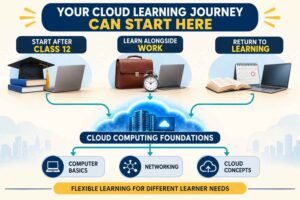
    Cloud computing can be explored by learners at different stages of their education and career. The right starting point depends on what you already know and how much time you can devote to learning. Educational illustration showing how Class 12 students, working professionals and returning learners can begin building cloud computing knowledge from their respective starting points.

    For Class 12 Students

    If you have completed Class 12 and are interested in technology, cloud computing can introduce you to an area of modern IT. Start by developing computer fundamentals, basic networking knowledge and an understanding of operating systems. You can then explore beginner-level cloud concepts and decide whether you want to pursue a deeper technical qualification.

    For Engineering and IT Students

    Students with a background in computer science, information technology, electronics or related subjects may already have some familiarity with networks and systems. Cloud learning can help connect these concepts with practical infrastructure and platform services. It may also complement broader Engineering distance education or technical studies, provided the programmes are appropriate to the learner’s academic goals.

    For Working Professionals

    People working in technical support, networking, software testing or system administration may want to understand how their existing responsibilities connect with cloud environments. For example, someone who handles server maintenance may be interested in learning virtual machines, cloud storage, access management and monitoring.

    For Learners Returning After a Break

    Returning to education can feel challenging, particularly if you have been away from technical subjects for some time. A beginner-friendly programme with clear lessons, practical demonstrations and academic support may make the transition easier. You can also revise computer fundamentals before moving into more advanced topics.

    For Learners Exploring Correspondence or Flexible Study

    Some learners search for a correspondence college in india because they need to balance education with work, family or other responsibilities. In such cases, it is important to distinguish between a recognised academic diploma, a private training certificate and a vendor certification. A learner searching for a Diploma in Engr correspondence college in India should also check whether the qualification is actually an engineering diploma, a cloud computing training programme or a separate technical certificate. Similar-sounding course titles do not necessarily represent equivalent qualifications.

    Your First Cloud Career Roles

    A cloud computing qualification can help you build a foundation for different technical roles. However, completing a diploma alone does not guarantee employment or make someone ready for a senior engineering position. The role you can target will depend on your previous education, technical knowledge, practical projects, certifications and experience.
    Cloud Support and Operations Infrastructure and Systems Development and Automation
    Cloud Support Associate Junior Cloud Administrator Junior DevOps Associate
    Technical Support Engineer Infrastructure Support Associate Cloud Application Support
    Cloud Operations Trainee Systems Administrator Junior Automation Associate
    Cloud Service Desk Analyst Cloud Infrastructure Associate Application Deployment Support

    Cloud Support Associate

    A cloud support professional helps users or internal teams resolve common service issues. Responsibilities may include checking access, reviewing system information, documenting problems and escalating complex incidents.

    Junior Cloud Administrator

    A junior administrator may assist with user permissions, resource configuration, storage, backups and routine maintenance under the guidance of experienced team members.

    Infrastructure Support Associate

    This role may involve monitoring infrastructure, checking connectivity, supporting virtual environments and helping maintain system availability.

    Junior DevOps or Automation Associate

    This path generally requires additional knowledge of scripting, development workflows, version control, automation and deployment tools. A basic diploma can provide an introduction, but further learning and hands-on practice are important.

    Cloud Security Support

    Learners who develop a stronger understanding of access control, monitoring and secure configuration may later explore cloud security-related responsibilities. These roles usually require deeper technical knowledge and practical experience.

    What Salary Can a Cloud Computing Beginner Expect?

    Salary depends on the job role, employer, location, technical skills, education and previous experience. A learner entering cloud-related work for the first time may begin in technical support or junior operations rather than a specialist engineering position. The following figures are broad indicative ranges for understanding possible entry-level opportunities in India. They are not official salary scales or guaranteed outcomes.
    Entry-Level Role Indicative Annual Salary
    IT Support / Technical Support Associate ₹2.5–4.5 lakh
    Cloud Support Associate ₹3–5.5 lakh
    Junior System Administrator ₹2.8–5 lakh
    Infrastructure Support Associate ₹3–5 lakh
    Junior Cloud Operations Associate ₹3–5.5 lakh
    Junior DevOps Support Associate ₹3.5–6 lakh
    These figures are illustrative market estimates, not a promise of what a diploma holder will earn. Actual offers may be lower or higher depending on the employer, city, role requirements and candidate profile.

    What Can Improve Your Earning Potential?

    A qualification is one part of your career preparation. Other factors can make a difference:
    • Practical experience with at least one cloud platform.
    • Good understanding of networking and Linux.
    • Hands-on projects that demonstrate your abilities.
    • Relevant vendor certifications, where appropriate.
    • Basic scripting and automation knowledge.
    • Communication and troubleshooting skills.
    • Internship or entry-level IT experience.
    For a beginner, the most useful goal is to build the skills required for a suitable first role. Salary growth generally follows as responsibilities, experience and technical depth increase.

    Diploma, Certification or Degree: What Is the Difference?

    These terms are sometimes used interchangeably in course advertisements, but they do not necessarily mean the same thing.
    Diploma Certification Degree
    Usually follows a defined course structure with multiple subjects or modules. Usually validates knowledge or skills in a specific technology or area. A broader academic qualification awarded after completing a degree programme.
    May include theory, practical work and projects. May involve training, an examination or both. Usually includes a wider academic curriculum and prescribed academic requirements.
    Duration and recognition depend on the awarding institution and programme. Validity, level and recognition depend on the certification provider. Recognition depends on the university and applicable regulatory requirements.
    Can provide structured learning in cloud computing. Can demonstrate platform-specific knowledge, such as AWS, Azure or Google Cloud. Can provide a broader foundation in computer science, IT or engineering.
    Before enrolling, confirm who awards the qualification, what the certificate represents and whether it meets your future academic or employment requirements. A short course completion certificate should not be presented as equivalent to a formal diploma or university degree unless the awarding authority and qualification framework support that claim. “Students interested in building a career in the IT industry can explore this Diploma in IT course to understand the course details, skills required and potential career opportunities.”

    What Should You Check Before Choosing an Online Diploma?

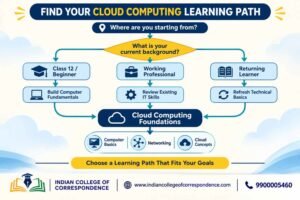
    The course name alone cannot tell you whether a programme is suitable. Two programmes with similar titles may have very different syllabuses, practical exposure and qualification status. Cloud computing learning pathway flowchart showing how learners assess their background, build technical fundamentals, compare suitable programmes and develop practical cloud skills. Use this checklist before making a decision.
    1. Course syllabus
    Check whether the programme covers cloud fundamentals, networking, operating systems, virtualisation, infrastructure, security and practical applications.
    1. Practical learning
    Ask whether learners get access to cloud labs, guided exercises, projects or demonstrations. Practical learning is important because cloud platforms involve configuration and troubleshooting.
    1. Platform exposure
    Find out whether the programme introduces AWS, Azure, Google Cloud or another platform. Check which services are actually covered rather than relying only on platform names in promotional material.
    1. Course duration
    Confirm the total learning hours, expected completion period, assessment schedule and access to learning materials.
    1. Eligibility
    Read the entry requirements and check whether your academic background meets them.
    1. Awarding institution
    Identify the organisation that issues the diploma or certificate. If it is described as a formal academic qualification, verify the institution and programme details through the relevant official sources.
    1. Trainer and learner support
    Check whether you can ask questions, receive feedback on practical work and get help when you face technical difficulties.
    1. Placement claims
    Ask what placement assistance actually includes. Do not treat a placement-support statement as a guarantee of employment.
    1. Fees and additional costs
    Check whether cloud lab usage, examination fees, platform subscriptions or certification attempts involve extra charges.
    1. Future learning opportunities
    Consider whether the course gives you a foundation for further platform certifications, advanced technical training or a related academic programme.

    Why Cloud Security Should Be Part of Your Learning

    Cloud computing is not only about creating servers and storing files. Protecting the systems and information hosted on those services is equally important. A small configuration mistake can expose sensitive information or allow unauthorised access. That is why security concepts should be included in a cloud learning programme. Some important areas to understand include:
    • Identity and access management: Giving users only the permissions they need.
    • Multi-factor authentication: Adding another layer of identity verification.
    • Data protection: Understanding how information is stored, accessed and protected.
    • Secure configuration: Avoiding unnecessary public access and unsafe settings.
    • Backups and recovery: Preparing for accidental deletion, failures or service disruption.
    • Monitoring and logging: Reviewing activity to identify unusual behaviour.
    The Indian Computer Emergency Response Team (CERT-In) publishes cybersecurity guidance for organisations. Its guidance discusses secure cloud services, access control, monitoring and the importance of appropriate security measures. Learners can refer to CERT-In’s information security practices guidance to understand why cloud security is an essential part of responsible technology operations. A beginner does not need to become a cybersecurity specialist immediately. However, developing safe working habits from the start can help build a stronger technical foundation.

    Learning Cloud Computing Alongside Work or Other Responsibilities

    Not everyone can follow a full-time classroom schedule. Working professionals, learners with family responsibilities and people returning to education may need a more flexible approach. Online learning can help when the programme provides accessible study materials, a manageable schedule and appropriate academic or technical support. Here are some ways to organise your learning: Create a weekly study routine. Set aside regular time for lessons, revision and practical exercises. Even a few focused sessions each week can help you maintain continuity. Learn one concept at a time. Start with computer networks and operating systems before moving into virtualisation and cloud services. Practise while learning. Whenever possible, repeat demonstrations in a lab environment. Practical repetition helps you understand how different components work together. Keep a learning record. Write down commands, configurations, common errors and solutions. This can become a useful revision resource. Build small projects. A simple cloud-hosted website or storage exercise can help you connect multiple concepts. Learners comparing distance education in bangalore may also come across different types of programmes, from online technical training to formal academic qualifications. Check the actual delivery mode and qualification details rather than assuming every flexible course is equivalent. Similarly, people researching correspondence degree colleges in bangalore should confirm whether the institution offers the specific programme they want, whether the mode is permitted and who awards the qualification.

    Future Scope: How Cloud Skills May Continue to Develop

    Cloud technology continues to evolve as organisations build and maintain digital services. The future of cloud-related work is likely to involve more than simply managing virtual servers. Some areas worth watching include: Hybrid cloud environments: Organisations may use a combination of private infrastructure and public cloud services. Technical teams need to understand how different environments connect and operate. Cloud security: As more systems and information are hosted online, secure configuration, identity management and monitoring remain important. Automation and DevOps: Teams use automation to manage infrastructure, deploy applications and reduce repetitive manual tasks. This creates value for learners who develop scripting and workflow knowledge. Containers and orchestration: Technologies such as containers help package and run applications consistently across environments. Learners can explore these topics after understanding the fundamentals. Data and artificial intelligence infrastructure: Cloud platforms support data processing and AI workloads. Understanding the underlying infrastructure can be useful for people who later specialise in these areas. Cost and resource management: Organisations need to monitor cloud usage and control unnecessary spending. Resource planning and optimisation are therefore relevant operational skills. These developments do not mean that every beginner will immediately qualify for a specialist role. Instead, they show why a strong foundation and a habit of continuous learning are valuable. Students who wish to pursue a technical career after completing their 10th standard can explore these Diploma in Engineering courses after 10th to understand available specialisations, eligibility requirements and career opportunities.

    Frequently Asked Questions About an Online Diploma in Cloud Computing

    1. What is an online diploma in cloud computing?

    It is a learning programme that introduces students to cloud technology, infrastructure, networking, virtualisation, storage, security and related technical concepts. The exact subjects and qualification type depend on the provider.

    2. How long does an online diploma in cloud computing take?

    There is no fixed duration for every programme. Short introductory courses may take weeks or months, while more detailed diploma programmes can take several months or longer. Check the total learning hours and practical requirements before enrolling.

    3. Can I learn cloud computing after Class 12?

    Yes, you can explore beginner-level cloud computing programmes after Class 12 if you meet the provider’s eligibility requirements. Starting with computer fundamentals and networking can make technical topics easier to understand.

    4. Do I need coding knowledge to learn cloud computing?

    Advanced coding is not required for every introductory programme. However, basic scripting and programming knowledge can be helpful as you progress towards automation, DevOps and cloud engineering roles.

    5. Which cloud platform should a beginner learn first?

    AWS, Microsoft Azure and Google Cloud are widely used platforms. The best starting point depends on your learning goals, course syllabus and the practical resources available to you. Begin with one platform rather than trying to master all three at once.

    6. What jobs can I apply for after learning cloud computing?

    Depending on your previous education and practical skills, you may explore entry-level opportunities such as cloud support associate, IT support associate, infrastructure support associate or junior system administrator. More advanced roles generally require additional experience and technical preparation.

    7. Is cloud computing a good career option for working professionals?

    It may be a useful area to explore for professionals working in IT support, networking, software or system administration. A structured programme can help them build knowledge of cloud platforms and infrastructure, but career progression also depends on experience and practical ability.

    8. Can a student from a non-IT background learn cloud computing?

    Yes, but it is sensible to begin with computer basics, networking and operating-system concepts. A beginner-friendly course can help build the foundation needed for more technical subjects.

    9. Does an online diploma guarantee a cloud computing job?

    No. Completing a course does not guarantee employment. Employers may also evaluate academic qualifications, practical experience, projects, technical skills, certifications and interview performance.

    10. What is the difference between a cloud computing diploma and an AWS or Azure certification?

    A diploma may cover several subjects and provide broader structured learning. An AWS or Azure certification generally validates knowledge of a particular provider’s services or role-based skills. They serve different purposes and may complement each other.

    11. Can I study cloud computing through flexible or distance learning?

    Some providers offer online or flexible technical training. However, delivery mode and qualification status vary. Check whether the programme is a formal diploma, a training certificate or a vendor certification before enrolling.

    12. Is cloud computing useful for engineering students?

    Yes. Students from computer science, information technology, electronics and related engineering backgrounds may find cloud computing useful as an additional technical skill. It can complement their existing knowledge of systems, networks and software.

    Conclusion: Start with the Foundations, Then Build Your Cloud Skills

    Cloud computing supports many of the digital services people and businesses use every day. From online storage and business applications to large-scale infrastructure, cloud platforms have become an important part of modern IT. An online diploma can provide a structured introduction to cloud fundamentals, networking, virtualisation, infrastructure and security. However, the value of a programme depends on its syllabus, practical learning, awarding organisation and relevance to your goals. If you are a Class 12 student, a working professional, an engineering learner or someone returning to education, begin by understanding your current skills and the kind of technical work you want to explore. Compare course duration, eligibility, learning support and practical exposure before making a decision. At Indian College of Correspondence, learners can explore education pathways and review available programme information according to their academic and career interests. Before choosing any technical qualification, confirm the exact course, awarding institution, learning mode and current eligibility requirements. If you would like guidance on exploring suitable study options, visit ICC or contact us to discuss your requirements. Your cloud learning journey does not need to begin with advanced technology. Start with the basics, practise consistently and build your skills one step at a time.

Leave A Comment