-

How to Build a Career in Banking: Qualifications, Exams and Job Opportunities
- 30,Oct 2026
- Posted By : uaeautomates@gmail.com
- 0 Comments
- Banking Career in India
- Banking Career Opportunities
- Banking Exams in India
- Banking Jobs After Graduation
- Banking Qualifications
- correspondence college in india
- How to Build a Career in Banking
- IBPS PO Preparation
- RBI Grade B Exam
- SBI PO Eligibility
A career in Banking can offer much more than a regular office job. From handling customer accounts and processing loans to analysing financial information and managing banking operations, the sector offers several career paths for people with different interests and qualifications. Whether you are a fresh graduate, a working professional looking for a career change, or someone planning to continue education after a break, there are multiple ways to work towards a future in this field. Choosing the right educational foundation is an important first step, and exploring a correspondence college in india can be useful for learners who need flexibility while completing their studies.
Banking is also an industry that continues to evolve. Digital payments, online banking, financial technology and changing customer expectations have created new responsibilities alongside traditional banking roles. This means that candidates need more than academic qualifications. They also need communication skills, numerical ability, problem-solving skills and an understanding of how financial services work.
So, how do you enter the banking sector? Which qualifications are required? Should you prepare for IBPS, SBI or RBI examinations? What jobs can you explore after graduation?
This guide takes you through these questions step by step, helping you understand the available opportunities and plan a realistic route towards a banking career.
Before You Choose Banking, Understand What the Industry Offers
Before preparing for an examination or choosing a course, it helps to understand what banking actually involves.
Banks are financial institutions that support individuals, businesses and organisations with services such as deposits, withdrawals, loans, payments, investments and financial transactions. They help people manage their money and allow businesses to access the financial support needed for growth.
However, not every banking job involves working directly with customers. Different departments handle different responsibilities, and candidates can build careers according to their interests and strengths.
Major types of banking institutions in India
Public-sector banks
These banks have government ownership and play an important role in providing banking services across the country. They recruit candidates for clerical, officer and specialist positions through various recruitment processes.
Private-sector banks
Private banks provide retail banking, business banking, digital services, loans and investment-related products. They recruit candidates for customer service, relationship management, sales, operations and other professional roles.
Regional Rural Banks (RRBs)
These banks focus on providing financial services in rural and semi-urban areas. Their work includes supporting farmers, small businesses and local communities.
Cooperative banks
Cooperative banks generally serve specific communities, local areas and member groups. Their activities include deposits, lending and other banking services.
Financial and regulatory institutions
Institutions such as the Reserve Bank of India (RBI) and other financial organisations offer opportunities in regulation, research, financial supervision, policy-related work and specialist functions.
 Understanding these categories gives you a clearer picture of the industry. Instead of preparing for every possible banking job, you can start identifying the type of work that interests you.
Find Your Place in the Banking World
One of the biggest advantages of choosing banking is that you do not have to follow only one career direction. Some people enjoy interacting with customers, while others prefer working with numbers, analysing financial information or managing processes.
Here are some common roles to help you understand the possibilities.
Bank Clerk or Customer Service Associate
Clerical employees and customer service associates support the everyday functioning of a bank branch. Their responsibilities may include assisting customers, handling account-related requests, processing transactions, maintaining records and providing information about banking services.
This role can be a suitable starting point for candidates who enjoy communication and organised administrative work.
Probationary Officer (PO)
A Probationary Officer is generally recruited into an officer-level position and receives exposure to different banking functions. Responsibilities may include customer relationship management, branch operations, loan processing, business development and administrative activities.
As officers gain experience, they may move into higher responsibilities and specialised departments.
Specialist Officer
Specialist Officers work in areas that require specific educational backgrounds or professional expertise. Depending on the recruitment notification, opportunities may be available in areas such as:
- Information Technology
- Agriculture
- Law
- Human Resources
- Marketing
- Finance
- Cybersecurity and technical operations
These roles are particularly relevant to candidates who have studied a specialised subject and want to apply their knowledge within the financial sector.
Relationship Manager
Relationship Managers work with customers to understand their financial needs and recommend suitable banking products. Their work may involve managing customer accounts, explaining services, maintaining relationships and identifying business opportunities.
Good communication and customer-handling abilities are important for this role.
Credit and Loan Officer
Credit-related professionals help assess loan applications and understand the financial position of individuals or businesses. Their responsibilities may include reviewing documents, evaluating repayment capacity and supporting lending decisions.
A basic understanding of finance, financial documentation and risk assessment can be useful in this area.
Banking Operations Executive
Operations professionals help ensure that banking activities are completed accurately and efficiently. They may work with transaction processing, documentation, account maintenance, internal coordination and compliance procedures.
People who enjoy structured work and attention to detail may find this area interesting.
The Skills That Make a Banking Candidate Stand Out
A degree can help you meet the eligibility requirements for many banking opportunities, but your skills influence how confidently you handle the selection process and your responsibilities at work.
You do not need to master everything at once. Start with the basic abilities and improve them through regular practice.
Numerical ability
Banking involves numbers, calculations, percentages, interest rates and financial information. Candidates preparing for competitive examinations should become comfortable with arithmetic and quantitative aptitude.
Practise topics such as:
- Percentages and ratios
- Profit and loss
- Simple and compound interest
- Time and work
- Data interpretation
- Number series and basic calculations
Logical reasoning
Reasoning helps candidates understand patterns, analyse information and make decisions. It is an important part of many banking recruitment examinations.
Puzzles, seating arrangements, syllogisms, coding-decoding and logical sequences are useful areas to practise.
Communication skills
Bank employees interact with customers from different backgrounds. Clear communication helps them explain banking products, respond to questions and handle service-related concerns.
Improving spoken and written English can also support examination preparation and professional growth.
Computer and digital skills
Modern banking relies heavily on digital systems. Employees may work with computer applications, online banking platforms, spreadsheets, customer databases and internal software.
Basic computer knowledge is a useful starting point. Depending on the role, candidates may also benefit from learning data handling, cybersecurity awareness and digital payment systems.
Accuracy and attention to detail
Financial transactions require care. Even a small mistake in a document or transaction can create problems. Developing a habit of checking details and following procedures is valuable in banking work.
Integrity and customer responsibility
Bank employees handle sensitive financial information. Professional conduct, honesty, confidentiality and responsible decision-making are essential qualities in this sector.
Three Routes That Can Take You Towards a Banking Career
There is no single route that every banking candidate must follow. Your current qualification, financial situation, career goal and available time will influence the path that makes sense for you.
| Career route |
Suitable for |
What you need to focus on |
| Competitive examination route |
Graduates targeting public-sector and specialist bank positions |
Exam eligibility, aptitude, reasoning, awareness and recruitment preparation |
| Qualification and education route |
Students and learners building their academic foundation |
Completing a recognised graduation or relevant postgraduate qualification |
| Skill and experience route |
Working professionals and career changers |
Communication, computer knowledge, financial awareness and relevant work experience |
Route 1: Competitive examinations
Many candidates aim for public-sector banking positions through recruitment examinations. These examinations provide a structured selection process for different posts.
If this is your goal, identify the examination first and understand its eligibility requirements. Then create a preparation plan based on the actual syllabus.
Route 2: Building your educational qualifications
Some students are still completing their education when they begin thinking about banking. Others may have taken a break and want to return to studies.
For many officer and clerical recruitment examinations, graduation is an important requirement. Completing a suitable recognised degree can therefore be a practical step towards future eligibility.
Route 3: Developing skills and gaining experience
Private banks and financial service organisations recruit for different entry-level and experienced positions. Depending on the employer and role, candidates may be considered based on their qualifications, communication skills, computer knowledge and relevant experience.
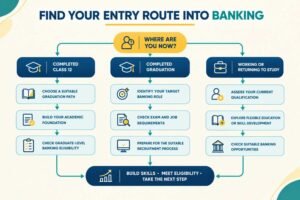 This route may suit working professionals who want to move into financial services without following the same competitive examination path as public-sector recruitment.
What Qualifications Do You Need to Enter Banking?
Educational eligibility depends on the position and the organisation. Some entry-level private-sector opportunities may accept candidates with different educational backgrounds, while many major public-sector recruitment examinations require a bachelor’s degree.
After Class 12
Students who have completed Class 12 can begin preparing for a future in banking, even if they are not yet eligible for many graduate-level recruitment examinations.
At this stage, the focus should be on choosing a suitable undergraduate programme and developing foundational skills.
Useful areas to work on include:
- Basic mathematics
- English communication
- General awareness
- Computer fundamentals
- Logical reasoning
- Financial awareness
Students should avoid assuming that every banking examination accepts 12th-pass candidates. Always check the qualification requirements for the specific position.
After graduation
A bachelor’s degree is a common educational requirement for several major banking recruitment examinations. Graduates from different academic streams may be eligible, depending on the relevant notification.
A BA, B.Com, BBA, B.Sc or another recognised degree may provide the educational foundation required for certain recruitment processes.
However, eligibility is not identical across all examinations. Age limits, minimum marks, nationality requirements and other conditions may apply.
After postgraduation
A postgraduate degree may support candidates who want to develop deeper knowledge or explore specialised professional opportunities. However, it is not compulsory for every banking position.
Some specialist and regulatory roles may have specific educational requirements. Candidates should read the official recruitment advertisement before deciding whether an additional qualification is necessary.
For example, RBI Grade B eligibility can include specific graduation or postgraduate marks requirements, depending on the category and recruitment rules. The official RBI opportunities and recruitment portal should be checked for the relevant notification.
Banking Exams Explained: Which One Should You Prepare For?
If you are interested in public-sector banking, understanding the major recruitment examinations is an important step. Each examination has its own purpose, eligibility requirements and selection process.
IBPS PO
The Institute of Banking Personnel Selection conducts the Common Recruitment Process for Probationary Officers and Management Trainees in participating banks.
This examination is intended for candidates seeking officer-level opportunities in participating public-sector banks. The selection process generally includes preliminary and main examinations, followed by further selection stages as specified in the notification.
IBPS Customer Service Associate (Clerk)
IBPS conducts recruitment for Customer Service Associate positions in participating banks. These roles generally involve customer service, branch support and routine banking activities.
Candidates should check the latest notification for the educational qualification, age criteria, local language requirements and selection process.
SBI PO
State Bank of India conducts its own recruitment process for Probationary Officers. The role offers exposure to different banking functions and responsibilities.
Graduation in a recognised discipline is an important academic requirement under the SBI PO eligibility rules, subject to the conditions in the relevant advertisement.
SBI Junior Associate
SBI Junior Associate recruitment is commonly associated with clerical and customer service responsibilities. Candidates should review the official advertisement for the required qualification, language conditions and examination stages.
You can check the official SBI Careers section for recruitment announcements and role-specific details.
RBI Grade B
The Reserve Bank of India recruits officers for Grade B positions. These roles are associated with the central bank’s responsibilities, which include financial regulation, supervision, research and other important functions.
The examination has specific eligibility conditions, including educational requirements and minimum marks. It is important to read the official notification carefully before beginning preparation.
IBPS RRB
IBPS also conducts recruitment for Regional Rural Banks. Opportunities include Office Assistant and Officer Scale I, II and III positions.
The eligibility requirements vary according to the post. Some positions may require specific educational qualifications or relevant experience.
Specialist Officer examinations
Specialist Officer recruitment is intended for candidates with relevant professional or technical qualifications. Depending on the vacancy, roles may be available in IT, law, agriculture, marketing, HR and other specialised areas.
For notifications, examination updates and recruitment details, candidates can refer to the official IBPS.
Understand the Exam Before You Start Preparing
Many candidates begin studying immediately after deciding to pursue banking. However, preparation becomes more effective when you first understand the examination structure.
Although the exact pattern differs between recruitment processes, several banking examinations assess similar abilities.
Preliminary examination
The preliminary examination is generally the first screening stage in many banking recruitment processes.
Common subjects include:
- English Language
- Quantitative Aptitude
- Reasoning Ability
The examination is usually time-bound, so candidates need to develop both accuracy and speed.
Main examination
The main examination generally tests a wider range of knowledge and problem-solving abilities.
Depending on the recruitment process, subjects may include:
- Reasoning and computer aptitude
- Quantitative aptitude or data analysis
- English language
- General awareness
- Banking and financial awareness
- Descriptive English
Not every examination follows the same pattern. Candidates should use the latest notification as their main reference.
Interview and other selection stages
Some officer-level recruitment processes include interviews or additional assessment stages. Certain recruitments may also have language proficiency tests, document verification or other requirements.
Do not rely only on older examination patterns. Selection rules can change between recruitment cycles.
Build a Preparation Routine That Fits Your Life
Banking examination preparation requires consistency. You do not necessarily need to study for extremely long hours every day, but you do need a routine that you can follow.
This is particularly important for working professionals, students attending college and people managing family responsibilities.
Step 1: Understand your starting level
Before creating a timetable, attempt a basic mock test or a set of practice questions. This will help you identify your stronger and weaker areas.
For example, you may be comfortable with English but need more practice in quantitative aptitude. Knowing this early helps you plan your study time.
Step 2: Divide the syllabus into manageable topics
Avoid trying to cover every subject at once. Break each section into smaller topics and complete them gradually.
A simple weekly plan could include:
- Quantitative aptitude practice on selected days.
- Reasoning exercises throughout the week.
- Regular English reading and grammar practice.
- Daily current affairs revision.
- Weekly mock tests and analysis.
Step 3: Practise with a timer
Speed matters in competitive examinations. Once you understand a topic, begin solving questions within a time limit.
This helps you become familiar with examination pressure and identify areas where you spend too much time.
Step 4: Analyse your mock tests
Attempting a mock test is only part of the preparation. Reviewing your mistakes is equally important.
Ask yourself:
- Did I misunderstand the question?
- Was my calculation too slow?
- Did I spend too much time on one problem?
- Was the mistake caused by a lack of knowledge or poor time management?
Use these observations to improve your next attempt.
Step 5: Keep track of current affairs
Banking and financial awareness can be important parts of recruitment examinations. Read reliable news sources and follow major developments in the economy, banking services, government schemes and financial institutions.
Make short notes so that you can revise important information regularly.
Common preparation mistakes to avoid
- Preparing for multiple examinations without understanding their differences.
- Ignoring the official syllabus.
- Studying only theory without solving questions.
- Taking mock tests but not reviewing mistakes.
- Depending entirely on old study material.
- Neglecting revision.
- Ignoring time management.
- Waiting until the notification is released to begin basic preparation.
A steady routine is more useful than an unrealistic timetable that becomes difficult to maintain.
What If You Are Starting After Class 12 or Returning to Education?
Not everyone begins their banking journey immediately after school or college. Some students may be unsure about their next academic step, while others may have taken a break because of work, family responsibilities or personal circumstances.
The important thing is to understand your current qualification and identify what you need to complete next.
For students who have completed Class 12
If you have finished Class 12, your next step may be to choose a bachelor’s degree that you can complete successfully.
A recognised undergraduate qualification can help you meet the academic requirement for many graduate-level banking examinations. You can also begin developing aptitude, reasoning and communication skills alongside your studies.
Students exploring a 12thPUC correspondence college in Bangalore may be looking for flexible educational support at the school or pre-university stage. Make sure the programme and institution are appropriate for your current qualification and future academic plans.
For graduates who want to prepare for bank exams
If you already hold a bachelor’s degree, check whether it meets the requirements of your target recruitment examination.
You can then focus on selecting an exam, understanding the syllabus and building a realistic preparation schedule.
Your graduation subject does not automatically decide your banking career. Many recruitment processes accept graduates from different disciplines, subject to the notification.
For working professionals
Working professionals may not have enough time for full-time classroom learning. Flexible education can help them continue their studies while managing employment responsibilities.
If you are considering a BA correspondence college in Bangalore, compare the available programmes, admission requirements, academic support and recognition before enrolling.
You can also explore other suitable degree options depending on your educational background and long-term plans.
For learners returning after a break
A break in education does not mean that you cannot work towards a new career goal. Start by checking your previous qualification records and identifying the next recognised programme you can pursue.
For learners considering flexible education, Traditional distance education in Bangalore may be worth exploring when the programme suits their circumstances and is offered by an appropriately recognised institution.
The most important point is to choose an academic route that supports your actual career goal rather than enrolling in a course simply because it sounds relevant.
Banking Jobs and Salary Expectations: What Can You Expect?
Salary is naturally an important consideration when choosing a career. However, banking salaries are not the same across every organisation or job role.
Public-sector banks generally follow defined pay structures and applicable allowances. Private banks may have different salary arrangements based on the position, location, experience and performance.
The following table gives a broad overview of common job categories.
| Job category |
Typical entry route |
What influences earnings |
| Clerical and customer service |
Bank recruitment examinations or private-bank hiring |
Institution, location, allowances and experience |
| Probationary Officer and officer roles |
Graduate-level competitive recruitment |
Bank, pay scale, allowances and career progression |
| Specialist and technical roles |
Relevant qualification and specialist recruitment |
Expertise, grade, responsibilities and experience |
What makes up a banking salary?
A banking employee’s overall compensation may include more than basic pay.
Depending on the institution and position, it may include:
- Basic salary.
- Dearness allowance.
- House rent allowance or applicable accommodation benefits.
- Special allowances.
- Medical or other employee benefits.
- Retirement-related benefits, where applicable.
The exact components depend on the employer and service conditions.
Does experience influence salary?
Yes. Experience, promotions, job responsibilities and professional specialisation can influence earnings over time.
An employee who moves into credit management, risk, compliance or senior operations may have a different compensation structure from someone in an entry-level role.
Candidates should compare the official salary details in the relevant recruitment advertisement rather than relying on general online estimates.
“Working professionals who wish to pursue a degree while building their banking careers can explore flexible learning options. Learn more about How Working Professionals Can Earn a Degree Without Leaving Their Job.”
Where Can a Banking Career Take You in the Long Run?
Banking is not limited to the position you join initially. With experience, training and suitable qualifications, employees may move into different responsibilities.
Growth in branch operations
Employees may progress from entry-level customer service and operational roles to supervisory and branch management responsibilities.
This path can suit people who enjoy managing teams, solving customer issues and coordinating daily banking activities.
Opportunities in credit and lending
Credit-related professionals may develop expertise in loan assessment, financial documentation, risk evaluation and lending decisions.
This area can be relevant to employees who enjoy analysing financial information and understanding business requirements.
Risk management and compliance
Banks must follow regulatory requirements and manage financial, operational and technology-related risks.
Professionals working in risk and compliance help institutions identify potential issues, maintain procedures and support responsible operations.
Digital banking and technology
Digital banking has changed how customers access financial services. Online transactions, mobile applications, cybersecurity and digital payment systems have created new areas of work.
Candidates with suitable technology skills may explore opportunities in IT operations, digital banking support, information security and related areas.
Relationship management and business development
Some banking professionals build careers by working closely with customers and businesses. They may manage relationships, understand financial needs and support the delivery of suitable banking services.
Continuous learning matters
The banking sector keeps changing. Employees who stay informed about technology, regulations, customer expectations and financial services can adapt more confidently to new responsibilities.
A willingness to learn is therefore valuable at every stage of a banking career.
How to Choose the Right Education Path for Your Banking Goal
Choosing the right course is not just about selecting a popular degree. It is about understanding your current qualification, the recruitment requirements you want to meet and the time you can realistically devote to studying.
Before enrolling in any programme, consider the following points.
Check the recognition and validity of the programme
Confirm that the university and programme meet the applicable recognition requirements. Also check the programme’s validity for the relevant academic session.
Do not assume that every distance or correspondence programme will automatically be accepted for every recruitment process. Review the eligibility conditions of your intended examination.
Match the course with your educational stage
A student who has completed Class 12 needs a different academic pathway from someone who already holds a bachelor’s degree.
For graduates considering further study, an MA correspondence college in India may be relevant if they want to continue academic learning in a suitable subject. However, an MA is not a compulsory qualification for most general banking recruitment examinations.
Consider your work and personal commitments
If you are employed or managing other responsibilities, flexible learning may help you continue your education without leaving your current commitments.
Learners comparing correspondence degree colleges in bangalore should look at course availability, admission procedures, academic guidance and the support offered during the programme.
Look beyond the course name
Before making a decision, ask:
- Is the institution appropriately recognised?
- Is the programme suitable for my educational background?
- Does it fit my future examination eligibility requirements?
- What learning support is available?
- Are admission details and programme information clearly explained?
- Can I manage the study schedule alongside my other responsibilities?
A suitable correspondence college in india should be evaluated on the actual programme, recognition, learning support and relevance to your academic goals.
For learners exploring flexible higher education, Indian College of Correspondence provides an opportunity to enquire about available programmes and understand which academic options may fit their education plans. You should always verify the specific programme details and its suitability for your intended recruitment requirements before making an admission decision.
A Practical Roadmap: Turn Your Banking Goal Into an Action Plan
After understanding the career options, qualifications and examinations, the next step is to turn your interest into a practical plan.
You do not need to figure out your entire career in one day. Start with a few clear decisions.
Step 1: Identify your current qualification
Are you a Class 12 student, a graduate, a postgraduate or someone returning to education after a break?
Your current qualification will help you understand which academic or recruitment options are available.
Step 2: Choose the kind of banking work that interests you
Think about whether you prefer customer service, officer-level responsibilities, financial analysis, technology or specialist roles.
You can explore more than one option initially, but having a primary goal will make your preparation more focused.
Step 3: Check the eligibility requirements
Visit the official recruitment website and read the latest notification.
Check the educational qualification, age limit, minimum marks, nationality requirements and selection stages. Do not depend only on information shared through coaching advertisements or social media posts.
Step 4: Complete the required education
If graduation is necessary for your intended examination, plan how you will complete a suitable recognised degree.
If you have already graduated, check whether your qualification meets the relevant requirements.
Step 5: Build your foundation skills
Start working on quantitative aptitude, reasoning, English, computer knowledge and general awareness.
You can improve these abilities gradually through practice and revision.
Step 6: Prepare according to the examination
Once you choose an examination, follow its syllabus and selection pattern. Use mock tests to measure your progress and identify areas that need improvement.
Step 7: Apply carefully and keep learning
Track official recruitment announcements, application deadlines and examination updates.
After entering the sector, continue developing your professional knowledge. Banking offers several directions for employees who are willing to learn and take on new responsibilities.
Conclusion: Your Banking Career Can Start With One Clear Decision
A career in banking can take you in several directions, from customer service and branch operations to officer-level responsibilities, credit management, technology and specialist financial roles. The right starting point depends on your current education, your interests and the type of position you want to pursue.
If you are still studying, focus on building a suitable academic foundation. If you have already graduated, explore the recruitment examinations that match your eligibility. If you are working or returning to education after a break, look for a learning path that allows you to continue developing your qualifications alongside your other responsibilities.
Remember that a banking career is built through a combination of education, preparation, practical skills and consistent effort. You do not need to have every detail figured out immediately. Start by identifying your goal, checking the requirements and taking the next realistic step.
At Indian College of Correspondence, learners can enquire about available educational programmes and explore flexible study options that may support their academic journey.
Commerce graduates interested in exploring finance-related career opportunities can also consider becoming a financial analyst after B.Com, a career path that offers opportunities in banking, investment management, and corporate finance.
“Read our guide on How to Become a Financial Analyst After B.Com to learn about the required skills, courses, and career opportunities.”
Frequently Asked Questions About Building a Career in Banking
1. Can I join a bank after completing Class 12?
Some private-sector entry-level opportunities may have different qualification requirements. However, many major public-sector banking examinations for clerical and officer positions require a bachelor’s degree. Class 12 students can use this stage to choose a suitable graduation programme and begin developing examination skills.
2. Is graduation compulsory for bank exams?
Graduation is required for many popular recruitment examinations, including several IBPS and SBI graduate-level positions. However, requirements differ by post and organisation. Always read the latest official notification before applying.
3. Which banking exam should a beginner prepare for?
Beginners can start by understanding the differences between IBPS PO, IBPS Customer Service Associate, SBI PO, SBI Junior Associate, RBI Grade B and IBPS RRB examinations. Choose based on your qualification, eligibility, interests and preferred job responsibilities.
4. Can I get a bank job without experience?
Yes, several bank recruitment processes are designed for fresh graduates and do not require previous banking work experience. However, candidates must meet the educational and other eligibility conditions specified in the recruitment notification.
5. Is a BA degree eligible for bank exams?
A BA degree from a recognised university may meet the graduation requirement for several general banking recruitment examinations, subject to the specific notification. Candidates should check the minimum marks, age criteria and other conditions for their chosen post.
6. Can working professionals prepare for banking exams?
Yes. Working professionals can prepare by following a realistic timetable, practising regularly and using mock tests. It is important to balance preparation with employment responsibilities and focus on the examination syllabus.
7. Is an MA required for a banking career?
No. An MA is not a general requirement for most clerical or probationary officer recruitment examinations. Some specialist or regulatory positions may have specific postgraduate qualification or marks requirements. Check the relevant recruitment advertisement.
8. What skills are important for a banking job?
Numerical ability, logical reasoning, communication, computer knowledge, attention to detail and customer-handling skills are useful in banking. The importance of each skill depends on the position.
9. Can students from Arts and Science backgrounds apply for banking jobs?
Yes. Many general banking recruitment examinations accept graduates from different academic streams, provided they meet the eligibility requirements. Some specialist positions may require a particular degree or professional qualification.
10. Is distance education suitable for someone planning a banking career?
It can be an option for learners who need flexibility while completing their education. However, candidates should confirm that the university and programme meet the applicable recognition requirements and are accepted under the eligibility conditions of their intended recruitment examination.
Planning your next step? Explore the available programmes at ICC and choose an educational path that fits your goals. You can also contact us for course-related guidance and further information.
“Your banking career may begin with one decision today. Make it an informed one.”