Admission opens for 2026-27 sessions for all university.

Blog Detail

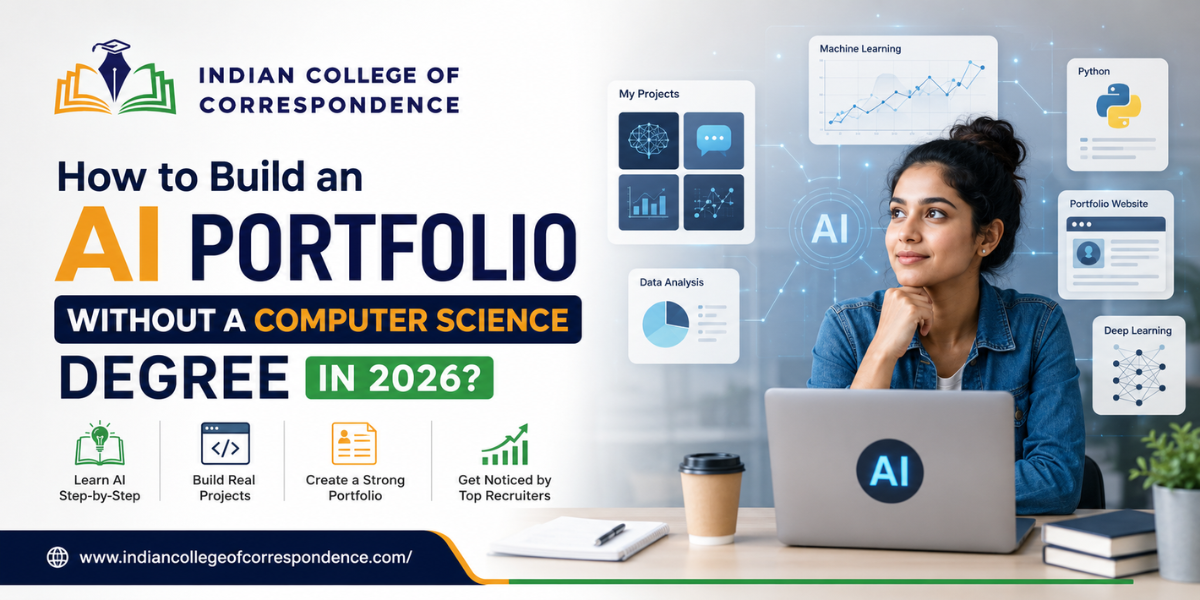
  • How to Build an AI Portfolio Without a Computer Science Degree in 2026?

    • 27,Jul 2026
    • Posted By : opsadsthrivein@gmail.com opsadsthrivein@gmail.com
    • 0 Comments
    • distance education in bangalore
    • Engineering distance education
    • IT distance education
    The development of Artificial Intelligence has paved the way for various career prospects for students with varied educational backgrounds. Currently, one of the most searched subjects is How to Build an AI Portfolio. If you are asking yourself how to build an AI portfolio without a Computer Science degree, then you are not the only one. There are many graduates from different streams who have been successful in making a career in AI by building their portfolios with projects rather than having a degree only. This article tells you about how to build an AI portfolio, the tools needed, projects to build, and ways to impress recruiters in 2026.

    Why Does an AI Portfolio Matters More Than Your Degree?

    There have been huge changes in the hiring process in recent times. No more do companies care about your degrees alone; they also want to know how you would solve problems in the real world. An AI portfolio proves that. As opposed to just naming programming languages and degrees you have on your CV, an AI portfolio lets recruiters know that you can make use of Artificial Intelligence in solving problems. Recruiters usually consider:
    • Real-life projects using AI
    • GitHub profiles
    • Quality of documentation
    • Problem-solving capability
    • Deployment capabilities
    • Communication skills
    A good AI portfolio leaves a much better first impression than one that just holds certificates. No matter whether you belong to the streams of engineering, commerce, management, or science, learning How to Build an AI Portfolio could help you immensely in getting shortlisted for internships and AI jobs. Distance education students in Bangalore should also be able to utilize their flexible schedules to pursue AI projects along with their studies.

    Can You Build an AI Career Without a Computer Science Degree?

    Absolutely There are many professionals who work in the field of Artificial Intelligence without being Computer Science graduates. They come from fields such as:
    • Mathematics
    • Physics
    • Statistics
    • Electronics
    • Mechanical Engineering
    • Civil Engineering
    • Commerce
    • Management
    • Biotechnology
    and many more that teach them skills to analyze data and apply them in the field of Artificial Intelligence. The only thing different in their case is the amount of effort required for understanding programming and basics of AI. In the current era, it is very easy to learn these skills through online portals. Science distance education students in Bangalore often have analytical and mathematical skills that are helpful in the field of Machine Learning and AI. 

    Degree vs AI Portfolio

    Traditional Degree AI Portfolio
    Shows academic learning Demonstrates practical skills
    Mostly theoretical Real-world applications
    Limited projects Multiple hands-on AI projects
    Static qualification Continuously updated
    Helps get interviews Helps secure jobs

    Step-by-Step Guide: How to Build an AI Portfolio

    Learning how to build an AI Portfolio is a lot easier when you have a roadmap to follow. Don’t try to master it all at once, build your portfolio slowly.

    Step 1: Learn Python

    Python is the most popular programming language in Artificial Intelligence. I don’t get it.
    • Variables 
    • Loops Functions 
    • Object-Oriented Programming 
    • Handling files
    When comfortable, start using AI libraries such as: NumPy Pandas Matplotlib  Scikit-learn Python is at the heart of almost every AI portfolio.

    Step 2: Learn the Basics of Machine Learning

    Master the basics before you start building AI projects. Main topics include:
    • Supervised learning
    • Unsupervised Learning Regression Classification 
    • Model Validation for Clustering
    Knowing these concepts will help you to be able to discuss your projects in the interviews.

    Step 3: Practice Data Analysis

    AI models rely on quality data. Practice:
    • Cleaning datasets
    • Handling missing values
    • Visualizing trends
    • Feature engineering
    • Exploratory Data Analysis
    Employers appreciate candidates who understand the complete AI workflow.

    Step 4: Build Small Projects First

    Don’t start with complex AI applications. Instead, create beginner-friendly projects like:
    • Spam Email Detector
    • Movie Recommendation System
    • House Price Prediction
    • Student Performance Predictor
    • Sentiment Analysis
    Completing several small projects is far more valuable than leaving one large project unfinished. Students pursuing Engineering distance education can strengthen classroom learning by applying engineering concepts to AI-based projects that solve practical industry problems.

    AI Portfolio for Beginners

    Every beginner should focus on quality rather than quantity. An effective beginner portfolio should include:
    • 5–8 completed projects
    • Clear documentation
    • Source code
    • Problem statement
    • AI model explanation
    • Dataset information
    • Screenshots
    • GitHub repository
    Each project should answer three questions:
    • What problem does it solve?
    • Which AI technique was used?
    • What results were achieved?
    Remember, recruiters are more interested in your thought process than simply seeing a finished project. Learning How to Build an AI Portfolio isn’t about creating the most complicated AI system—it’s about demonstrating consistent learning, practical implementation, and problem-solving ability. Students enrolled in bca distance education in Bangalore can gradually build strong AI portfolios by combining programming coursework with Machine Learning projects, GitHub contributions, and online AI certifications.

    AI Portfolio Projects

    Once you understand the basics of Artificial Intelligence, the next step is building projects that demonstrate your abilities. Recruiters don’t expect beginners to develop advanced AI systems immediately. Instead, they want evidence that you can solve practical problems using AI techniques. If you’re serious about How to Build an AI Portfolio, your projects should gradually increase in complexity. Some beginner-friendly AI projects include:

    Movie Recommendation System

    Learn collaborative filtering and recommendation algorithms while creating a personalized movie suggestion platform.

    Spam Email Detection

    Develop a Machine Learning model that classifies emails as spam or legitimate using Natural Language Processing.

    Student Performance Prediction

    Predict student performance using historical academic data and regression models.

    Resume Screening AI

    Create an AI application that automatically filters resumes based on job descriptions.

    Face Mask Detection

    Use Computer Vision to detect whether individuals are wearing face masks.

    House Price Prediction

    Train Machine Learning models to estimate property prices using real-world datasets.

    AI Chatbot

    Build a chatbot capable of answering frequently asked questions using NLP techniques.

    Sentiment Analysis

    Analyze customer reviews or social media posts to identify positive, neutral, or negative opinions. Each completed project adds credibility to your portfolio and demonstrates practical AI skills. Students pursuing IT distance education can use these projects to strengthen both programming expertise and problem-solving abilities while preparing for AI careers.

    AI Portfolio Maker

    Many students believe creating an impressive AI portfolio requires professional web development skills. Fortunately, that’s no longer true. Today, several AI Portfolio Maker platforms allow beginners to build attractive portfolios without extensive coding knowledge. Popular portfolio platforms include:
    • GitHub Pages
    • Notion
    • WordPress
    • Wix
    • Carrd
    • Framer
    • Google Sites
    Your portfolio should include:
    • Professional introduction
    • Technical skills
    • AI certifications
    • GitHub repository links
    • Project screenshots
    • Live project demos
    • Resume download
    • LinkedIn profile
    • Contact information
    A clean and well-organized portfolio creates a strong first impression for recruiters. When learning How to Build an AI Portfolio, presentation is almost as important as technical skills.

    AI Portfolio Generator Free

    Several free tools help students create professional portfolios quickly. Popular AI Portfolio Generator Free platforms include:
    • GitHub Pages
    • Notion AI
    • Canva Portfolio Templates
    • Google Sites
    • Wix Free
    • Framer Free
    • Carrd
    • Behance
    These platforms allow you to showcase:
    • AI projects
    • Certifications
    • Technical blogs
    • GitHub contributions
    • Research work
    Most recruiters simply want easy access to your projects and code. Keeping your portfolio simple and professional often produces better results than adding unnecessary design elements.

    Beginner Portfolio vs Job-Ready Portfolio

    Beginner Portfolio Job-Ready Portfolio
    3–5 basic projects 8–10 complete projects
    No live demos Deployed AI applications
    Limited GitHub activity Active GitHub profile
    Basic documentation Professional documentation
    Practice datasets Real-world datasets
    Few certifications Multiple AI certifications
    Resume only Resume + Portfolio + LinkedIn

    Best AI Tools Every Portfolio Should Showcase

    Recruiters appreciate candidates who are familiar with modern AI tools used across the industry. Useful tools include:

    Programming

    • Python
    • SQL

    Machine Learning

    • Scikit-learn
    • TensorFlow
    • PyTorch

    Development

    • VS Code
    • Jupyter Notebook
    • Google Colab

    Version Control

    • Git
    • GitHub

    Deployment

    • Streamlit
    • Hugging Face Spaces
    • Render

    AI Productivity

    • ChatGPT
    • Claude AI
    • Google Gemini
    Mentioning these tools within your projects demonstrates practical exposure to current AI technologies. Students pursuing Engineering distance education can combine these tools with academic learning to create industry-ready AI portfolios.

    Common Mistakes That Make AI Portfolios Weak

    Many beginners unintentionally reduce the impact of their portfolios by making avoidable mistakes. Some of the most common include:

    Copying GitHub Projects

    Recruiters can easily identify copied projects. Always build or customize projects yourself.

    Poor Documentation

    Every project should clearly explain:
    • Problem statement
    • Dataset
    • Methodology
    • Results
    • Future improvements

    Too Many Incomplete Projects

    Five complete projects are far more valuable than twenty unfinished ones.

    Ignoring GitHub

    GitHub acts as your technical resume. Maintain:
    • Clean repositories
    • Regular commits
    • ReadMe files
    • Organized folders

    No Live Demonstration

    Deploy your applications whenever possible using free hosting platforms. Live demos significantly improve recruiter engagement.

    Weak Problem Selection

    Choose projects that solve real-world business or social problems instead of random academic exercises.

    How Recruiters Evaluate AI Portfolios?

    Hiring managers typically spend only a few minutes reviewing each portfolio. They usually evaluate:
    • Project originality
    • Code quality
    • GitHub activity
    • Documentation
    • Deployment
    • Business impact
    • Technical explanations
    • Problem-solving ability
    A recruiter should quickly understand:
    • What problem you solved
    • Which AI methods you used
    • Why your solution matters
    Learning How to Build an AI Portfolio is not just about writing code—it is about communicating your technical abilities clearly and professionally.

    AI Engineer Portfolio

    A professional AI Engineer Portfolio is your digital proof of skills and one of the strongest assets when applying for internships or full-time AI roles. While resumes highlight qualifications, portfolios demonstrate what you can actually build. If you’ve learned How to Build an AI Portfolio, the next step is presenting your work in a way that attracts recruiters. A strong AI Engineer Portfolio should include:
    • Professional introduction
    • Technical skills
    • AI certifications
    • GitHub profile
    • Live AI project links
    • Case studies
    • Resume
    • LinkedIn profile
    • Contact details
    Each project should clearly explain:
    • The problem you solved
    • Dataset used
    • AI model implemented
    • Technologies used
    • Results achieved
    • Challenges faced
    • Future improvements
    Employers appreciate candidates who document their work professionally rather than simply uploading code. Students pursuing Science distance education in Bangalore can also build competitive AI portfolios by combining scientific thinking, programming skills, and practical Machine Learning projects that solve real-world problems.

    How to Keep Improving Your AI Portfolio?

    Building your portfolio is not a one-time task. The strongest AI professionals continuously update their work to reflect new skills and technologies. Here are a few ways to keep your portfolio relevant:

    Add One New Project Every Month

    Regular updates show recruiters that you are actively learning and improving.

    Learn Emerging AI Technologies

    Stay updated with:
    • Generative AI
    • Large Language Models
    • Prompt Engineering
    • Computer Vision
    • AI Automation
    • AI Agents

    Participate in Competitions

    Platforms like Kaggle and Hackathons help you solve practical problems while improving your portfolio.

    Publish Technical Blogs

    Writing about your AI projects demonstrates communication skills and technical understanding.

    Contribute to Open Source

    Contributing to AI-related GitHub repositories helps you collaborate with developers worldwide and strengthens your professional profile. The more consistently you improve, the more valuable your portfolio becomes.

    Future Scope of AI Careers

    Artificial Intelligence continues to reshape every industry, creating enormous career opportunities for skilled professionals. Some of the fastest-growing AI career paths include:
    • AI Engineer
    • Machine Learning Engineer
    • Data Scientist
    • NLP Engineer
    • Computer Vision Engineer
    • AI Product Manager
    • Prompt Engineer
    • AI Consultant
    • Robotics Engineer
    • AI Research Scientist
    Organizations across healthcare, banking, education, manufacturing, finance, cybersecurity, retail, and government sectors are actively recruiting AI professionals. Graduates who understand How to Build an AI Portfolio have a significant advantage because employers increasingly prioritize demonstrable skills over theoretical knowledge alone.

    Conclusion

    A Computer Science degree is no longer the only pathway into Artificial Intelligence. With the right learning strategy, practical projects, and consistent effort, students from various educational backgrounds can successfully build rewarding AI careers. Learning How to Build an AI Portfolio is about more than creating impressive projects—it’s about showcasing your ability to solve problems, think analytically, and continuously improve your technical skills. By mastering Python, Machine Learning, GitHub, and AI deployment tools, you can create a portfolio that stands out in today’s competitive job market. Whether you’re a student, graduate, or working professional, starting today with small, meaningful projects can open the door to exciting opportunities in Artificial Intelligence.
    Build Your AI Future with ICC
    The demand for Artificial Intelligence professionals continues to grow, and Indian College of Correspondence helps students prepare for future-ready careers through flexible and career-focused education. Whether you’re pursuing distance education in Bangalore, Engineering distance education, or other technology-oriented programs, ICC supports learners in combining academic knowledge with practical skills, AI certifications, and project-based learning. With expert guidance, flexible study options, and career-oriented support, ICC empowers students to build strong portfolios and confidently prepare for AI-driven careers. Start building your AI portfolio today with ICC and take the first step toward a successful technology career!

    FAQs

    1. Can I build an AI portfolio without a Computer Science degree?

    Yes. A Computer Science degree is helpful but not mandatory for building an AI portfolio. Students from engineering, science, commerce, mathematics, or management backgrounds can develop AI skills by learning Python, Machine Learning, data analysis, and AI frameworks. Employers increasingly value practical experience demonstrated through projects rather than academic specialization alone. Building GitHub repositories, participating in hackathons, and completing AI certifications significantly improve employability. Students pursuing Engineering distance education can strengthen their portfolios by combining flexible academic learning with real-world AI projects and professional certifications.

    2. What should an AI portfolio include?

    A strong AI portfolio should showcase practical projects, GitHub repositories, technical documentation, AI certifications, deployed applications, and problem-solving skills. Every project should explain the business problem, dataset, AI techniques, implementation process, and final results. Recruiters also appreciate portfolios that include LinkedIn profiles, resumes, and live project demonstrations. The goal is to demonstrate both technical expertise and communication skills. A well-organized portfolio significantly improves your chances of securing AI internships and entry-level job opportunities.

    3. How many AI projects should I build before applying for jobs?

    Quality is more important than quantity. Most recruiters recommend maintaining between six and ten complete AI projects instead of dozens of unfinished ones. Include beginner, intermediate, and slightly advanced projects to demonstrate continuous learning. Projects involving Machine Learning, Natural Language Processing, Computer Vision, and Generative AI create a well-balanced portfolio. Students pursuing IT distance education can gradually build these projects while completing their academic coursework, allowing them to develop practical skills alongside theoretical knowledge.

    4. Which programming language is best for AI beginners?

    Python is widely regarded as the best programming language for beginners entering Artificial Intelligence because of its simple syntax and extensive ecosystem of AI libraries. Frameworks such as TensorFlow, PyTorch, Scikit-learn, Pandas, and NumPy make Python the preferred language for Machine Learning and Deep Learning projects. Learning SQL alongside Python further strengthens your AI skill set by improving data management capabilities. Mastering Python provides an excellent foundation for almost every Artificial Intelligence career.

    5. Is GitHub important for AI jobs?

    Yes. GitHub has become one of the most valuable platforms for aspiring AI professionals because it allows recruiters to evaluate your coding style, project quality, documentation, and consistency. An active GitHub profile demonstrates continuous learning and practical implementation of Artificial Intelligence concepts. Employers often review GitHub repositories before scheduling technical interviews. Students pursuing Science distance education in Bangalore can use GitHub to showcase AI experiments, Machine Learning models, and research-based projects while building a strong professional profile.

    6. Can BCA students build an AI portfolio?

    Absolutely. BCA students possess strong foundations in programming, databases, operating systems, and software development, making the transition into Artificial Intelligence relatively smooth. By learning Python, Machine Learning, Deep Learning, and AI deployment tools, BCA graduates can build highly competitive AI portfolios. Students pursuing bca distance education in Bangalore can strengthen their academic learning by completing AI certifications, building GitHub projects, and participating in online coding competitions, significantly improving their career opportunities.

    7. Are AI certifications more important than a degree?

    Both academic qualifications and certifications have value, but practical skills remain the most important factor in AI recruitment. Certifications from Google, Microsoft, IBM, AWS, and DeepLearning.AI demonstrate current industry knowledge, while degrees provide strong theoretical foundations. Combining both with practical AI projects creates the strongest professional profile. Employers prefer candidates who continuously update their skills and demonstrate real-world problem-solving through active portfolios rather than relying solely on academic credentials.

    8. How long does it take to build a job-ready AI portfolio?

    The time required depends on your background, learning pace, and consistency. Beginners with no programming experience may need six to twelve months of regular practice to build a strong portfolio, while experienced programmers can often achieve the same within three to six months. Focus on mastering Python, Machine Learning, GitHub, and project deployment instead of rushing through tutorials. Students studying through a correspondence college in India can effectively balance flexible education with continuous AI skill development, making steady progress toward becoming job-ready AI professionals.

Leave A Comment