
Admission opens for 2026-27 sessions for all university.

Blog Detail

  • How to Use AI Responsibly for College Assignments Without Plagiarism in 2026?

    • 23,Jul 2026
    • Posted By : opsadsthrivein@gmail.com opsadsthrivein@gmail.com
    • 0 Comments
    • Bca distance education in bangalore
    • correspondence college in india
    • distance education in bangalore
    • MBA distance education in bangalore
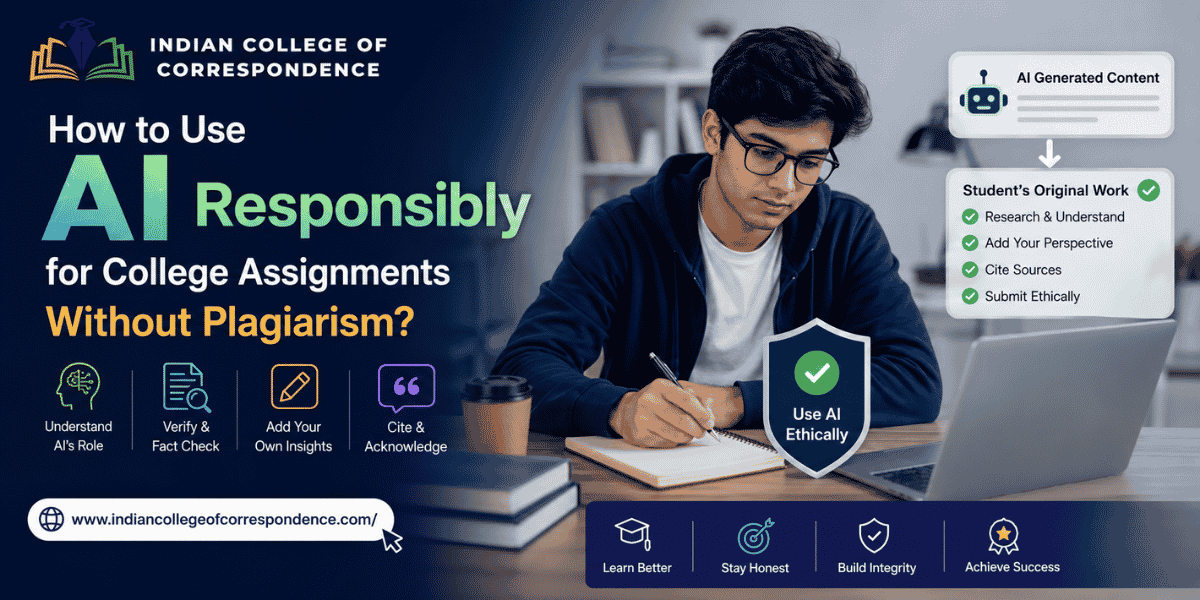
    Artificial Intelligence is transforming education, and AI Responsibly for College Assignments has become one of the most searched topics among students in 2026. Whether you’re using ChatGPT, Claude AI, Google Gemini, or other AI tools, learning AI Responsibly for College Assignments helps improve research, writing, and productivity while maintaining academic honesty. Instead of copying AI-generated content, students should use AI as a learning assistant to understand concepts, organize ideas, and enhance originality. When used correctly, AI Responsibly for College Assignments improves learning without violating college policies. Students pursuing flexible programs can also benefit from MBA distance education in bangalore and modern digital learning techniques while developing ethical AI skills for future careers.

    Why Students Are Using AI for College Assignments?

    Artificial Intelligence has become a valuable academic companion. Students today manage multiple assignments, projects, presentations, internships, and examinations simultaneously. AI tools help reduce workload while improving the quality of academic submissions. Rather than replacing learning, AI can simplify difficult concepts, explain technical topics, improve grammar, generate ideas, and organize information in a structured format. Students are increasingly using AI Responsibly for College Assignments because it offers several practical benefits:
    • Saves valuable study time
    • Improves research quality
    • Generates assignment outlines
    • Simplifies difficult concepts
    • Enhances grammar and writing
    • Helps prepare presentations
    • Supports coding practice
    • Improves productivity
    However, AI should never replace your own thinking. The goal is to learn with AI—not let AI do all the learning for you. Students pursuing distance education in Bangalore especially benefit from AI because flexible learning often requires greater self-discipline and independent study.

    What Is AI Plagiarism?

    Many students believe that if AI generated content, it automatically becomes original. Unfortunately, this is not always true. AI plagiarism occurs when students submit AI-generated text without editing, understanding, or adding their own ideas. Even though the wording may appear unique, submitting completely AI-written work can violate institutional academic integrity policies. Responsible AI usage means:
    • Understanding the generated information
    • Rewriting content in your own words
    • Adding personal analysis
    • Including references whenever necessary
    • Fact-checking AI responses
    Think of AI as a tutor instead of a ghostwriter. Using AI Responsibly for College Assignments helps students improve knowledge while maintaining originality.

    Why Responsible AI Matters More Than Ever?

    Colleges and universities are increasingly adopting AI policies that encourage ethical usage instead of banning AI completely. Educators understand that AI will become part of future workplaces. Therefore, they expect students to learn how to use these tools responsibly rather than misuse them. Benefits of ethical AI usage include:
    • Better critical thinking
    • Improved writing skills
    • Higher academic integrity
    • Stronger research abilities
    • Better understanding of concepts
    • Increased employability
    Students enrolled in correspondence colleges in India often rely on self-learning, making responsible AI usage particularly valuable for balancing flexibility with academic excellence.

    How to Use AI Tools?

    Artificial Intelligence becomes truly valuable when students use it to support learning rather than replace effort. Instead of asking AI to complete an assignment from beginning to end, use it throughout your learning journey. Here are practical ways to use AI effectively:

    1. Generate Assignment Ideas

    If you’re unsure how to begin, AI can suggest topics, research questions, or assignment structures.

    2. Understand Difficult Concepts

    Ask AI to explain technical or theoretical concepts in simple language before reading textbooks.

    3. Create Study Notes

    AI can summarize lengthy chapters into concise revision notes that are easier to remember.

    4. Improve Grammar

    Use AI to refine sentence structure, improve vocabulary, and correct grammatical errors after writing your own draft.

    5. Brainstorm Project Ideas

    Need presentation topics or research questions? AI can provide creative suggestions while you develop the final content yourself. Students pursuing MBA distance education in Bangalore frequently use AI to prepare case studies, SWOT analysis, business reports, and presentation outlines while maintaining originality.

    Wrong vs Right AI Usage

    ❌ Wrong AI Practice ✅ Responsible AI Practice
    Copy AI answers directly Rewrite in your own words
    Submit without editing Personalize every section
    Skip fact checking Verify using reliable sources
    Depend only on AI Combine AI with textbooks
    Ignore citations Add references where required
    Use AI to cheat Use AI to learn and improve
    Following these practices ensures you’re using AI Responsibly for College Assignments while strengthening your academic skills instead of depending entirely on technology.

    Why Original Thinking Still Wins?

    AI can generate information within seconds, but it cannot replace your unique perspective, classroom discussions, practical experiences, or critical thinking. Professors value assignments that include:
    • Personal interpretation
    • Independent analysis
    • Real-world examples
    • Logical reasoning
    • Proper citations
    • Clear understanding of the topic
    When students simply copy AI-generated content, they miss the opportunity to develop these essential skills. Those pursuing Science distance education in Bangalore can especially benefit by using AI to simplify scientific theories while continuing to perform independent research and practical learning.

    AI Is a Learning Partner, Not a Shortcut

    The biggest misconception among students is that AI guarantees better grades. In reality, AI improves results only when combined with genuine effort. Responsible students use AI to:
    • Learn faster
    • Understand concepts better
    • Organize assignments
    • Improve communication
    • Practice difficult subjects
    This balanced approach prepares students not only for examinations but also for future careers where AI literacy will become an essential workplace skill. Likewise, learners enrolled in bca distance education in bangalore can use AI for programming assistance, debugging, and project documentation while ensuring they understand every line of code they submit.

    Can Colleges Detect AI-Written Assignments?

    One of the biggest concerns among students today is whether colleges can identify assignments created using Artificial Intelligence. The answer is yes—but not always perfectly. Most universities no longer rely only on plagiarism checkers. They also use AI detection software, faculty reviews, writing pattern analysis, and originality reports to identify content that appears overly machine-generated. Popular tools include:
    • Turnitin AI Detection
    • Copyleaks AI Detector
    • GPTZero
    • Originality.ai
    However, these tools are not 100% accurate. False positives can occur, which is why professors also evaluate:
    • Writing style consistency
    • Subject understanding
    • Personal examples
    • Critical analysis
    • References used
    Instead of worrying about detection, students should focus on AI Responsibly for College Assignments by using AI as a guide rather than copying entire responses. Students pursuing distance education in Bangalore often complete assignments independently, making ethical AI usage even more important for maintaining academic credibility.

    Best Practices to Use AI Responsibly

    Artificial Intelligence works best when it enhances your knowledge instead of replacing your effort. Following a structured approach ensures better learning outcomes while avoiding plagiarism.

    1. Use AI for Brainstorming

    Ask AI for topic suggestions, assignment structures, and research ideas rather than complete answers.

    2. Understand Before Writing

    Always read and understand AI-generated explanations before including them in your assignment.

    3. Rewrite Everything Yourself

    Use your own writing style, examples, and understanding. This is the easiest way to maintain originality while using AI Responsibly for College Assignments.

    4. Verify Information

    AI occasionally provides outdated or incorrect information. Always verify facts through:
    • Books
    • Academic journals
    • Government websites
    • Research publications

    5. Add Personal Analysis

    Teachers value original thinking more than copied information. Include:
    • Your observations
    • Practical examples
    • Case studies
    • Real-world applications

    6. Mention References

    Whenever AI suggests research-based information, cross-check it and cite the original source if required.

    7. Proofread Before Submission

    Never submit AI-generated content immediately. Review:
    • Grammar
    • Flow
    • Facts
    • Originality
    • Formatting
    Students pursuing MBA distance education in Bangalore should especially follow this approach while preparing business reports, research assignments, and case studies, where analytical thinking is highly valued.

    Common Mistakes Students Should Avoid

    While AI offers numerous advantages, misuse can negatively impact both grades and learning. Avoid these common mistakes:

    Copy-Pasting Entire AI Responses

    Submitting AI-generated answers without modification can violate academic policies.

    Blindly Trusting AI

    AI can occasionally generate incorrect facts or fabricated references. Always verify information.

    Ignoring College Guidelines

    Many universities now have AI usage policies. Read them before using AI in assignments.

    Using AI for Every Task

    Students should still practice:
    • Writing
    • Problem-solving
    • Research
    • Critical thinking
    These skills remain essential in professional careers.

    Not Learning the Topic

    Remember: The goal is education—not simply completing assignments. Using AI Responsibly for College Assignments means understanding the subject before submitting any work. Students enrolled in correspondence college in India should particularly focus on independent learning because self-study forms a significant part of flexible education.

    How to Use AI for Study?

    Artificial Intelligence is much more than an assignment generator. It can become your daily study companion when used correctly. Here are practical ways students can study smarter using AI.

    Create Revision Notes

    Summarize long chapters into concise bullet points for faster revision.

    Practice Questions

    Generate:
    • MCQs
    • Short-answer questions
    • Mock interviews
    • Quiz questions

    Explain Difficult Topics

    Ask AI to explain concepts in simple language. For example: “Explain Machine Learning like I’m a beginner.”

    Improve Presentation Skills

    AI can help create:
    • Speech outlines
    • Presentation content
    • Slide summaries
    • Discussion points

    Coding Practice

    Programming students can:
    • Learn syntax
    • Debug programs
    • Understand algorithms
    • Practice interview coding
    Students pursuing IT distance education can especially benefit by using AI for programming practice while continuing to write and understand their own code.

    Language Improvement

    AI helps improve:
    • Vocabulary
    • Grammar
    • Writing clarity
    • Sentence structure
    This is particularly useful for report writing and academic communication.

    Best AI Usage for Different Students

    Student Category Best AI Usage
    MBA Students Business reports & case studies
    BCA Students Coding & debugging
    IT Students Programming practice
    Science Students Research summaries
    Commerce Students Financial analysis
    Arts Students Essay writing & content ideas
    Distance Learners Self-study assistance
    Beginners Concept explanations

    Best AI Tools Every Student Should Try

    Different AI tools serve different academic purposes. Using the right tool for the right task improves productivity while encouraging ethical learning.

    ChatGPT

    Best for:
    • Coding
    • Brainstorming
    • Writing
    • Presentations

    Claude AI

    Best for:
    • Long documents
    • Research papers
    • Academic writing
    • Summaries

    Google Gemini

    Best for:
    • Google Workspace integration
    • Real-time information
    • Research assistance

    Grammarly AI

    Best for:
    • Grammar correction
    • Professional writing
    • Tone improvement

    Perplexity AI

    Best for:
    • Research
    • Source-backed answers
    • Quick fact-checking

    NotebookLM

    Best for:
    • Study notes
    • PDF summarization
    • Research organization
    Students pursuing Science distance education in Bangalore can combine these AI tools with textbooks, practical learning, and faculty guidance to build a deeper understanding of scientific concepts while maintaining academic integrity. Using these strategies consistently allows students to practice AI Responsibly for College Assignments, improve learning outcomes, and prepare for an AI-driven future without compromising originality or ethics.

    Benefits of Using AI Responsibly for College Assignments

    Artificial Intelligence is most valuable when it enhances learning rather than replacing it. Students who practice AI Responsibly for College Assignments develop stronger academic and professional skills while maintaining integrity. Instead of depending entirely on AI-generated responses, they learn how to research, analyze information, and communicate ideas effectively. Some of the biggest advantages include:
    • Better time management
    • Improved writing quality
    • Faster research and note-making
    • Stronger critical thinking
    • Enhanced problem-solving skills
    • Better academic performance
    • Increased productivity
    • Improved digital literacy
    • Higher confidence during exams and presentations
    • Preparation for AI-driven workplaces
    When students combine AI with independent learning, they not only complete assignments more efficiently but also build long-term skills that employers value.

    The Future of AI in Education

    Artificial Intelligence is becoming a permanent part of modern education. Universities, schools, and organizations worldwide are adopting AI-powered technologies to personalize learning experiences and improve student outcomes. In the coming years, students can expect:
    • AI-powered virtual tutors
    • Personalized study plans
    • Smart revision assistants
    • Automated feedback systems
    • Interactive learning platforms
    • AI-supported research tools
    • Intelligent career guidance
    • Real-time language translation
    Despite these advancements, critical thinking, creativity, communication, and ethical decision-making will remain uniquely human skills. Students who learn to use AI Responsibly for College Assignments today will be better prepared for tomorrow’s workplaces.

    Conclusion

    Artificial Intelligence is transforming education, but responsible usage makes all the difference. Instead of viewing AI as a shortcut, students should treat it as a powerful learning companion that supports research, writing, coding, and problem-solving. The key to success is balancing AI assistance with independent thinking, academic honesty, and continuous skill development. Whether you’re preparing assignments, learning new concepts, or improving productivity, using AI Responsibly for College Assignments will help you become a smarter learner while maintaining originality and integrity. The future belongs to students who know how to combine technology with genuine knowledge.
    Learn Smarter with ICC
    Indian College of Correspondence empowers students with flexible, career-focused education designed for today’s digital world. Whether you’re pursuing distance education in bangalore, MBA distance education in bangalore, IT distance education, or other programs, ICC helps you combine quality education with practical skills and responsible AI learning to build a successful future.  Start your future-ready learning journey with ICC today and make technology your learning partner—not your shortcut.

    FAQs

    1. Is it okay to use AI for college assignments?

    Yes, using AI for college assignments is acceptable when it supports learning rather than replaces your own work. Students can use AI for brainstorming ideas, understanding concepts, improving grammar, creating outlines, and organizing research. However, submitting AI-generated content without editing or understanding may violate academic integrity policies. Always rewrite information in your own words, verify important facts, and include proper references where required. Students pursuing distance education in bangalore can particularly benefit from AI because it supports self-learning while helping them maintain originality in assignments and academic projects.

    2. Can colleges detect AI-generated assignments?

    Many universities now use AI detection software alongside plagiarism checkers to identify assignments that appear to be entirely machine-generated. Professors also evaluate writing style, critical thinking, originality, and subject understanding during assessment. Although AI detectors are improving, they are not completely accurate. Instead of trying to avoid detection, students should focus on using AI ethically by understanding, rewriting, and personalizing every assignment. Learners pursuing MBA distance education in bangalore should especially develop analytical writing skills alongside AI assistance for business reports, presentations, and case studies.

    3. Is using AI considered plagiarism?

    Using AI itself is not plagiarism; how you use it determines whether it becomes unethical. If students directly copy AI-generated content and submit it as their own work without modification or acknowledgment, it may be considered academic misconduct. Responsible AI usage involves understanding concepts, rewriting information, adding personal analysis, and citing reliable sources whenever necessary. Students enrolled in IT distance education can use AI responsibly for coding practice, technical explanations, and documentation while ensuring they understand every concept before submitting academic work.

    4. Which AI tool is best for college assignments?

    Different AI tools serve different purposes. ChatGPT is excellent for brainstorming, coding, presentations, and interactive learning, while Claude AI performs exceptionally well in academic writing, document summarization, and research. Google Gemini offers strong integration with Google’s ecosystem, and Grammarly improves grammar and writing quality. The best approach is selecting the tool based on the assignment requirements. Students pursuing bca distance education in bangalore can combine multiple AI tools to improve programming assignments, documentation, technical writing, and overall productivity without compromising originality.

    5. Can AI improve academic performance?

    Yes. When used responsibly, AI helps students improve productivity, writing quality, research skills, and understanding of difficult subjects. It simplifies complex concepts, generates practice questions, creates study notes, and assists with revision planning. However, AI should complement—not replace—independent learning and classroom education. Students pursuing Science distance education in Bangalore can use AI to summarize scientific theories, understand research papers, and prepare revision notes while continuing to rely on practical learning, faculty guidance, and trusted academic resources.

    6. What are the biggest mistakes students make while using AI?

    Common mistakes include copying AI-generated content without editing, relying entirely on AI for assignments, ignoring fact-checking, skipping citations, and failing to understand the subject. These practices reduce learning and may violate institutional policies. Students should always verify AI responses, rewrite content in their own words, and add original ideas or examples. Learners studying through a correspondence college in india can maximize the benefits of AI by using it as a study assistant while continuing to develop independent thinking and research abilities.

    7. How can students avoid plagiarism while using AI?

    Students can avoid plagiarism by using AI for idea generation, research assistance, grammar improvement, and concept explanations instead of copying complete answers. Always rewrite AI-generated text in your own language, verify facts through trusted academic resources, add personal analysis, and cite references whenever necessary. Reviewing assignments before submission also helps maintain originality. Ethical AI usage improves learning while ensuring compliance with academic standards and institutional guidelines, making students more confident and responsible learners.

    8. Why should students combine AI with quality education?

    Artificial Intelligence can improve productivity, research, writing, and learning efficiency, but it cannot replace structured education, experienced faculty, or practical knowledge. Combining AI with quality education allows students to build critical thinking, communication, technical expertise, and ethical decision-making skills. Institutions like ICC encourage students to use AI responsibly alongside flexible academic programs so they graduate with both subject knowledge and future-ready digital skills. This balanced approach prepares learners for success in higher education and today’s rapidly evolving professional world.

Leave A Comment