Admission opens for 2026-27 sessions for all university.

Blog Detail

  • Best Distance Education Courses After 12th for Career Growth Options

    • 26,Oct 2026
    • Posted By : uaeautomates@gmail.com
    • 0 Comments
    • B.Com correspondence course
    • BA correspondence college in Bangalore
    • BBA distance education
    • best distance education courses
    • career growth after 12th
    • correspondence college in india
    • distance education after 12th
    • distance education in bangalore
    • Indian College of Correspondence
    • management distance education in bangalore
    Completing Class 12 or PUC is an important milestone, but deciding what to study next can feel confusing. Some students want to start building a career quickly, while others need an affordable degree, time to prepare for competitive exams, or an opportunity to develop practical skills alongside their education. For students exploring distance education in bangalore, choosing the right undergraduate course can be a useful first step towards a flexible and career-focused future. The good news is that your career journey does not have to follow a single route. You can explore business, commerce, arts, administration, and other academic fields based on your interests and long-term goals. You may also consider studying while working, supporting your family, preparing for entrance examinations, or developing additional skills. The important thing is to select a course that matches your abilities, interests, budget, and future plans. A degree can provide an academic foundation, but the right combination of subject knowledge, practical experience, communication, and digital skills can help you make better career decisions. In this guide, we will explore some of the best courses after 12th, the career opportunities they may support, and the factors to consider before choosing a college. We will also look at how Indian College of Correspondence can help students explore undergraduate options such as BBA, B.Com, and BA.

    Before Choosing a Course, Understand Your Career Direction

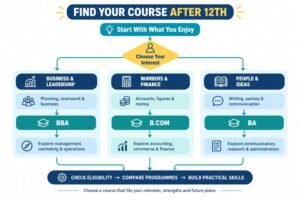
    Many students begin their search by asking which degree offers the highest salary or the most job opportunities. Although these questions are important, they should not be the only factors influencing your decision. A course that suits one student may not be the right fit for another. For example, a student who enjoys business discussions and organising activities may prefer management, while someone interested in accounts, numbers, and financial records may find commerce more suitable. A learner who enjoys reading, writing, social issues, or languages may prefer an arts degree. Flowchart helping students choose between BBA, B.Com and BA based on their interests and career goals. Before selecting a programme, ask yourself three questions.

    What subjects and activities interest you?

    Think about the subjects you enjoyed in school or PUC. Consider whether you prefer working with numbers, communicating with people, understanding society, organising tasks, or analysing business problems.

    What do you want your degree to help you achieve?

    Your goal might be to apply for entry-level jobs, continue towards postgraduate education, prepare for competitive examinations, develop a family business, or improve your qualifications while working.

    How much time can you dedicate to studying?

    If you have a job, family responsibilities, or other commitments, you may need a study arrangement that gives you more control over your schedule. If you can attend regular classes, a conventional programme may also be worth considering. Thinking through these questions first will make it easier to compare courses instead of choosing a degree simply because it is popular.

    Best Courses After 12th: Find the One That Fits You

    There is no single course that guarantees career success. The most suitable option depends on what you want to learn and how you plan to use that knowledge. The following comparison focuses on three undergraduate degrees that can provide different starting points for further education and employment.

    Match Your Interests to the Right Course

    Course Suitable for students who enjoy What you can learn Possible career directions
    Bachelor of Business Administration (BBA) Business, leadership, planning, and teamwork Management, marketing, business communication, and organisational behaviour Sales support, business development, HR support, marketing coordination, and operations
    Bachelor of Commerce (B.Com) Accounts, finance, business transactions, and numbers Accounting, taxation, business law, economics, and financial concepts Accounts assistant, finance support, billing executive, banking operations, and junior tax support
    Bachelor of Arts (BA) Languages, humanities, social sciences, and communication Critical thinking, research, writing, and understanding social and cultural issues Content support, administrative roles, customer relations, research assistance, and suitable public-sector exam pathways
    These are broad career directions rather than guaranteed outcomes. Job eligibility varies by employer, role, location, and additional qualifications.

    BBA: Build a Foundation in Business and Management

    A Bachelor of Business Administration is worth considering if you want to understand how businesses operate and how teams work towards organisational goals. During a BBA programme, students may study subjects such as principles of management, marketing, business communication, human resources, business economics, and financial management. The exact syllabus depends on the university and programme structure. This knowledge can be useful in organisations that need people to support daily operations, communicate with customers, coordinate teams, assist sales activities, or help managers organise projects. For example, a student interested in marketing could build skills in communication, presentation design, social media planning, and customer research alongside the degree. Someone interested in human resources could learn spreadsheet management, recruitment coordination, and professional communication. A BBA may also provide a foundation for further study, such as an MBA, subject to the admission requirements of the institution offering the postgraduate programme.

    B.Com: Develop Your Understanding of Commerce and Finance

    If you enjoy working with figures, understanding transactions, or learning how businesses manage money, a Bachelor of Commerce may be a strong option. B.Com programmes commonly cover accounting, economics, taxation, business law, and related commerce subjects. Some programmes may offer specialised subjects or electives, so it is worth reviewing the curriculum before enrolling. The degree may support applications for junior accounting, billing, finance administration, banking operations, and other commerce-related positions. However, specialised roles may require additional certifications, professional examinations, software knowledge, or relevant experience. Students can strengthen their employability by learning spreadsheet tools, accounting software, business documentation, and basic financial reporting. These practical skills help connect academic concepts with tasks that organisations perform every day. B.Com may also be a suitable starting point for further study in commerce, finance, management, or professional qualifications, depending on the relevant eligibility criteria.

    BA: Explore Arts, Humanities, and Social Sciences

    A Bachelor of Arts offers students an opportunity to develop knowledge in areas such as English, history, economics, political science, sociology, and other humanities or social science subjects, depending on the programme. Students who enjoy reading, writing, communication, research, and understanding people may find this degree particularly interesting. A BA can help develop transferable skills such as analytical thinking, written communication, interpreting information, and presenting ideas clearly. These abilities can be valuable in administrative work, content-related roles, customer support, research assistance, and other positions that match a graduate’s subject knowledge and experience. A BA may also be relevant for students preparing for certain competitive examinations. However, the required degree, subject combinations, age limits, and other conditions vary by examination, so candidates should check the official notification for each opportunity. If you are searching for a BA correspondence college in Bangalore, compare the available subjects, programme structure, admission requirements, study support, and the recognition status of the degree-awarding university before making a decision.

    Why Flexible Learning Can Make a Difference

    Not every student can follow a traditional classroom schedule. Some need to work while studying, some live far from a suitable college, and others want to continue their education after taking a break. This is where flexible learning can be helpful. Depending on the programme, distance or open learning may allow students to organise much of their study time around other responsibilities. However, flexibility does not mean that a degree requires no effort. Students still need to study consistently, complete assignments where applicable, prepare for examinations, and meet the programme’s academic requirements.

    For students who have just completed 12th or PUC

    You may want to pursue a degree while developing practical skills, exploring career interests, or preparing for other examinations. A flexible programme may help you organise these activities, provided you can manage your study schedule responsibly.

    For working professionals

    If you already have a job, returning to education can help you build formal qualifications and expand your understanding of business or commerce. A flexible learning arrangement may make it easier to balance work and study, although examination schedules and attendance requirements should be checked in advance.

    For students restarting their education

    A break in education does not automatically mean that your academic journey has ended. You can explore your eligibility for undergraduate study, review the available learning formats, and plan a realistic route towards completing a degree.

    For learners managing family or financial responsibilities

    Some students need to balance education with caregiving, household responsibilities, or limited budgets. Comparing total programme fees, examination expenses, travel requirements, and study resources can help you choose a practical option. Before enrolling, read the programme details carefully. The learning mode, schedule, assessment method, and available support can differ across institutions.

    Turn Your Degree Into a Career Plan

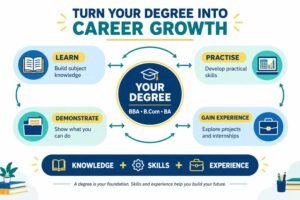
    Choosing a course is only the beginning. Career growth often depends on how you apply what you learn, whether you gain relevant experience, and how well you communicate your abilities to potential employers. Career-growth infographic showing how a distance-learning degree, practical skills, projects and experience can support career opportunities. For example, a BBA student may understand marketing concepts academically, but building a sample marketing plan can demonstrate the ability to apply those concepts. A B.Com student may study accounting, but practising spreadsheet-based financial records can make the knowledge more practical. A BA student may study communication or economics and build a portfolio of writing, research, or analytical work.

    Connect Your Degree With Practical Career Preparation

    Degree Practical skills to develop Experience-building idea Possible starting roles
    BBA Presentation, spreadsheets, communication, teamwork, and basic marketing Create a sample marketing plan or organise a small business project Sales coordinator, business development support, HR assistant, or operations support
    B.Com Spreadsheet formulas, bookkeeping, accounting software, and documentation Prepare sample invoices, expense records, or a basic financial report Accounts assistant, billing executive, finance support, or junior accounting roles
    BA Writing, research, critical thinking, communication, and digital tools Create a writing portfolio, research summary, or community project report Content assistant, administrative support, customer relations, or research assistance
    These examples are starting points, not promises of employment. Some roles may require internships, specific technical skills, professional certifications, or prior experience.

    Build skills alongside your degree

    Try to develop one or two practical skills each semester. You could learn spreadsheet applications, professional email writing, presentation tools, basic data handling, business communication, or industry-specific software relevant to your preferred career. “Explore the in-demand IT skills for freshers  to understand which technical skills can help you improve your employability and build a successful career.”

    Gain experience where possible

    Look for internships, part-time work, volunteering opportunities, short projects, or responsibilities within a family business. Even a small project can help you explain what you learned and how you solved a problem.

    Create evidence of your abilities

    Keep samples of your work, such as presentations, reports, marketing plans, writing samples, or bookkeeping exercises. Do not include confidential information from an employer or client. A simple portfolio can help you discuss your skills more confidently during interviews.

    Use reliable career resources

    Students who are exploring employment options can visit India’s National Career Service portal for career-related services, job-search support, and career guidance resources. Use such resources alongside your own research into employers, job descriptions, and eligibility criteria.

    How to Choose a Correspondence College Carefully

    Once you have shortlisted a course, the next decision is where to study. Searching for a correspondence college in India can bring up many options, but advertisements alone cannot tell you whether a particular programme is suitable. The college or guidance provider, the university awarding the degree, and the approval status of the specific programme are important considerations. Read the details rather than relying only on general claims about recognition or career outcomes.

    Check the degree-awarding university

    Confirm which university will award your degree. Understand whether the organisation you contact is the university itself, an authorised support centre, or an education guidance provider. Do not assume that a college or consultancy can independently award a recognised university degree simply because it assists with admissions.

    Verify the programme’s current recognition status

    For programmes offered through Open and Distance Learning (ODL) or online mode, check the official University Grants Commission Distance Education Bureau website for the relevant university, programme, learning mode, and admission session. Recognition can depend on the academic session and the specific programme. Approval in an earlier year should not automatically be treated as proof of approval for a later admission cycle. You should also confirm the programme’s eligibility conditions, duration, fees, examination arrangements, and any applicable subject-specific requirements before paying.

    Review the learning and examination arrangements

    Find out how study materials are provided, how assignments are completed, how examinations are conducted, and whether academic or administrative support is available. Ask whether you will need to attend any compulsory sessions or travel to an examination centre. This is particularly important if you intend to work while studying.

    Understand the complete cost

    Tuition fees are only one part of your education expenses. Depending on the programme, you may also need to budget for examination fees, registration, study resources, travel, internet access, and additional learning materials. Ask for a clear fee breakdown and payment schedule before making a commitment.

    Look beyond broad promises about jobs

    A degree may help you meet educational requirements for certain positions, but no responsible course comparison should promise a guaranteed job or salary. Employment depends on many factors, including skills, experience, location, hiring conditions, and the requirements of individual employers. Choose a programme because it supports your educational and career goals, not solely because an advertisement promises quick results.

    Exploring Opportunities in Bangalore and Beyond

    Bangalore is home to businesses, service organisations, start-ups, educational institutions, and many other employers. Students may therefore explore a wide range of career directions depending on their qualifications and interests. When comparing correspondence degree colleges in Bangalore, do not focus only on location. Consider the degree-awarding institution, the programme’s current approval status, affordability, study requirements, and the support available throughout the course. The right course can help you build an academic foundation while you gradually develop workplace skills. A commerce graduate may focus on accounting and financial administration, a management student may explore sales or operations, and an arts graduate may develop communication, research, or administrative capabilities. Your options are not limited to one city, either. Depending on the job and employer requirements, you may explore opportunities in other Indian cities or apply for roles that support remote or hybrid work.

    Is management distance education in Bangalore worth considering?

    If you are interested in business operations, marketing, human resources, or entrepreneurship, management-related study may be worth exploring. A BBA can introduce you to business fundamentals, while later postgraduate study may help you deepen your management knowledge. The key is to check the actual programme being offered. A course’s title, syllabus, eligibility, and learning mode matter more than the general label of management education. Students should also remember that management knowledge becomes more useful when supported by practical skills. Communication, spreadsheet proficiency, project coordination, teamwork, and problem-solving can help connect classroom concepts with workplace expectations.

    A Practical Checklist Before You Enrol

    You do not need to decide everything in one day. Instead, compare a small number of suitable programmes and work through the questions below.

    Your Course-Selection Checklist

    What to check Questions to ask Why it matters
    Career direction Does this course support my interests and long-term plans? Helps you choose with purpose rather than following a trend
    Eligibility Am I eligible based on my Class 12 or PUC qualification and subjects? Prevents avoidable admission problems
    Recognition Is the degree-awarding university and specific programme appropriately recognised for my admission session and learning mode? Helps protect the value of your qualification
    Fees What is the total cost, including examinations and other charges? Makes financial planning easier
    Study schedule Can I manage the workload alongside my job or family responsibilities? Helps you stay consistent
    Learning support Are study materials, academic guidance, and administrative support explained clearly? Makes it easier to resolve questions during the programme
    Practical skills What additional skills should I build while studying? Helps connect your degree with employment needs
    Next step Do I want a job, postgraduate study, competitive examinations, or entrepreneurship? Gives you a clear direction after graduation
    Once you have compared these factors, shortlist the programmes that best match your priorities. Contact the relevant institution to clarify any remaining questions before completing your application. “Learn how distance education helps working professionals  balance their jobs, personal commitments, and higher education while building better career opportunities.”

    Explore BBA, B.Com and BA Options With ICC

    For students who want to compare undergraduate pathways, Indian College of Correspondence (ICC) offers a starting point for exploring course options and admission guidance. The most suitable programme depends on what you want to learn. If you are interested in business operations, marketing, or management, explore the available BBA options. If you prefer accounting, finance, and commerce-related subjects, review B.Com opportunities. If you are interested in humanities, languages, or social sciences, consider the available BA programmes. You can explore the course information on the ICC, including the published details for BBA, B.Com, and BA. Before applying, confirm the degree-awarding university, the exact programme, the current recognition status for the relevant admission session, eligibility, fees, examination arrangements, and the support available. These details should guide your final decision. Students looking for a 12thPUC correspondence college in Bangalore should also distinguish between completing school-level qualifications and enrolling in an undergraduate degree. If you have already completed Class 12 or PUC, your next step may be an undergraduate programme, subject to eligibility. If you have not completed that level, check the applicable schooling pathway and admission rules first. The goal is to make an informed decision that fits your current situation and future plans. Whether you are a recent school leaver, a working professional, or someone returning to education after a break, compare your options carefully and choose a realistic path forward.

    Frequently Asked Questions

    1. Which is the best course after 12th for career growth?

    The best course depends on your interests and career plans. BBA may suit students interested in management and business, B.Com may suit those interested in accounts and finance, and BA may suit learners interested in humanities, communication, and social sciences. Compare the curriculum and career requirements before choosing.

    2. Can I pursue a degree through distance learning after 12th?

    Yes, eligible students can pursue undergraduate programmes through distance or online learning when the relevant university and programme are appropriately recognised or entitled for that mode and admission session. Always verify the current details through official sources before enrolling.

    3. Is a distance degree useful for getting a job?

    A degree can help meet the educational requirements for some jobs. Your employment prospects will also depend on practical skills, experience, communication, the employer’s requirements, and the job market. Building a portfolio or gaining relevant experience can strengthen your applications.

    4. Can I study while working full-time?

    Many distance-learning arrangements are designed to provide greater flexibility than conventional classroom programmes. However, you still need to meet academic requirements and examination schedules. Review the timetable, assessment rules, and study workload before enrolling.

    5. Is BBA or B.Com better after 12th?

    Neither course is universally better. BBA focuses more directly on management and business concepts, while B.Com focuses on commerce, accounting, finance, and related subjects. Consider your strengths, preferred subjects, and intended career path before deciding.

    6. What can I do after completing a BA?

    Depending on your subjects and skills, you may explore administrative work, content-related roles, customer relations, research assistance, further study, or eligible competitive examinations. Your options will depend on the job requirements and any additional qualifications needed.

    7. How do I choose a correspondence college in Bangalore?

    Check the degree-awarding university, programme-specific recognition, eligibility, syllabus, fees, examination arrangements, learning support, and admission terms. Verify the relevant programme and session through official sources rather than relying on general advertising claims.

    8. Can I pursue management distance education in Bangalore after PUC?

    Students who have completed PUC or Class 12 may be eligible for undergraduate management programmes such as BBA, depending on the institution’s admission criteria. Check the exact programme requirements and current approval status before applying.

    9. Is a BA from a correspondence college suitable for further studies?

    It can be suitable if the degree is awarded by an appropriately recognised university and meets the admission requirements of the postgraduate programme you wish to pursue. Always check the eligibility rules of the institution offering your intended next course.

    10. What should I do if I took a break after Class 12?

    Start by checking your educational documents and eligibility for the programmes you are considering. Compare fees, study requirements, and support arrangements, then choose a manageable schedule. A break does not mean you cannot explore further education, but individual admission rules still apply.

    Conclusion: Choose a Course That Moves You Forward

    Your first degree is an opportunity to build knowledge, discover your strengths, and prepare for the next stage of your career. Rather than choosing a course only because it is popular, think about the work you may want to do, the skills you need to develop, and the study arrangement that fits your life. BBA, B.Com, and BA can each provide a different academic foundation. Their value depends on your commitment, the quality and recognition of the programme, the skills you build, and how you use what you learn. If you are comparing your options, take time to review the curriculum, confirm eligibility, check the relevant recognition status, and understand the full cost before applying. Ready to explore your next academic step? Visit the ICC website to review available BBA, B.Com, and BA options, clarify admission requirements, and identify a programme that aligns with your career goals. Make your decision with confidence and start building a practical plan for your future.

Leave A Comment