

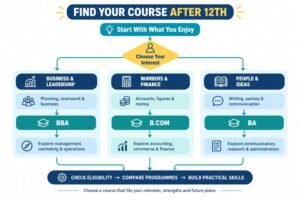
 Before selecting a programme, ask yourself three questions.
| Course | Suitable for students who enjoy | What you can learn | Possible career directions |
| Bachelor of Business Administration (BBA) | Business, leadership, planning, and teamwork | Management, marketing, business communication, and organisational behaviour | Sales support, business development, HR support, marketing coordination, and operations |
| Bachelor of Commerce (B.Com) | Accounts, finance, business transactions, and numbers | Accounting, taxation, business law, economics, and financial concepts | Accounts assistant, finance support, billing executive, banking operations, and junior tax support |
| Bachelor of Arts (BA) | Languages, humanities, social sciences, and communication | Critical thinking, research, writing, and understanding social and cultural issues | Content support, administrative roles, customer relations, research assistance, and suitable public-sector exam pathways |
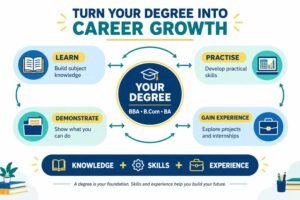 For example, a BBA student may understand marketing concepts academically, but building a sample marketing plan can demonstrate the ability to apply those concepts. A B.Com student may study accounting, but practising spreadsheet-based financial records can make the knowledge more practical. A BA student may study communication or economics and build a portfolio of writing, research, or analytical work.
| Degree | Practical skills to develop | Experience-building idea | Possible starting roles |
| BBA | Presentation, spreadsheets, communication, teamwork, and basic marketing | Create a sample marketing plan or organise a small business project | Sales coordinator, business development support, HR assistant, or operations support |
| B.Com | Spreadsheet formulas, bookkeeping, accounting software, and documentation | Prepare sample invoices, expense records, or a basic financial report | Accounts assistant, billing executive, finance support, or junior accounting roles |
| BA | Writing, research, critical thinking, communication, and digital tools | Create a writing portfolio, research summary, or community project report | Content assistant, administrative support, customer relations, or research assistance |
| What to check | Questions to ask | Why it matters |
| Career direction | Does this course support my interests and long-term plans? | Helps you choose with purpose rather than following a trend |
| Eligibility | Am I eligible based on my Class 12 or PUC qualification and subjects? | Prevents avoidable admission problems |
| Recognition | Is the degree-awarding university and specific programme appropriately recognised for my admission session and learning mode? | Helps protect the value of your qualification |
| Fees | What is the total cost, including examinations and other charges? | Makes financial planning easier |
| Study schedule | Can I manage the workload alongside my job or family responsibilities? | Helps you stay consistent |
| Learning support | Are study materials, academic guidance, and administrative support explained clearly? | Makes it easier to resolve questions during the programme |
| Practical skills | What additional skills should I build while studying? | Helps connect your degree with employment needs |
| Next step | Do I want a job, postgraduate study, competitive examinations, or entrepreneurship? | Gives you a clear direction after graduation |