Admission opens for 2026-27 sessions for all university.

Blog Detail

  • ESG and Sustainability Careers in India: Courses, Skills and Job Roles

    • 22,Oct 2026
    • Posted By : uaeautomates@gmail.com
    • 0 Comments
    • environmental sustainability jobs
    • ESG analyst career
    • ESG careers in India
    • ESG courses in India
    • ESG reporting careers
    • ESG skills
    • green jobs in India
    • sustainability careers
    • sustainability job roles
    • sustainability management courses
    Imagine a company planning to build a new factory. It must consider more than its production targets. It also needs to think about water consumption, waste management, employee safety, energy use, and how responsibly it operates. These decisions explain why ESG and sustainability have become important areas for businesses and professionals. For students exploring a distance Msc degree college in Bangalore, sustainability can open up an interesting direction that connects science, management, research, data, and business decision-making. You do not necessarily need an environmental science degree for every role. Depending on the position, people with backgrounds in management, commerce, science, economics, and social sciences may find relevant pathways. The key is to understand what ESG professionals actually do, which skills employers value, and what kind of qualification fits your career goals. This guide explores the opportunities, courses, job roles, and practical steps that can help you begin planning a career in this evolving field.

    What Is ESG and Why Is It Becoming Important?

    ESG stands for Environmental, Social, and Governance. It is a framework used to understand how an organisation manages environmental responsibilities, relationships with people, and its internal decision-making practices. Rather than looking only at a company’s financial performance, ESG considers a wider set of factors that may affect its risks, operations, reputation, and long-term performance. Here is what each part means in practical terms.
    • Environmental: How does an organisation manage energy consumption, pollution, waste, water, emissions, and natural resources?
    • Social: How does it treat employees, protect worker safety, engage with communities, and manage issues involving customers and human rights?
    • Governance: How are decisions made? Does the organisation maintain accountability, ethical business practices, transparency, and appropriate oversight?
    Consider a manufacturing company that wants to improve its environmental performance. An ESG team might help collect information about electricity use, review waste-management practices, assess employee safety indicators, and prepare reports for management. The work is not limited to identifying problems. It also involves analysing information, recommending improvements, monitoring progress, and communicating results accurately. For learners interested in a distance Msc degree college in bangalore, understanding this connection between environmental knowledge and organisational decision-making can help clarify which courses and skills to pursue.

    ESG vs Sustainability: What Is the Difference?

    The terms ESG and sustainability are closely connected, but they are not exactly the same. Sustainability is a broader concept concerned with meeting present needs while considering long-term environmental, social, and economic well-being. ESG is often used as a structured way to assess and report specific environmental, social, and governance factors within an organisation.
    Aspect ESG Sustainability
    Main focus Assessing and managing environmental, social, and governance factors Supporting long-term environmental, social, and economic well-being
    Typical activities ESG data collection, risk assessment, governance reviews, and reporting Resource conservation, waste reduction, climate initiatives, and responsible operations
    Common work settings Corporates, financial services, consulting, and reporting teams Businesses, environmental projects, research, public programmes, and community initiatives
    Useful skills Data analysis, reporting, business understanding, and compliance awareness Environmental knowledge, project management, research, and stakeholder engagement
    Career examples ESG analyst, ESG reporting associate, sustainability analyst Sustainability coordinator, environmental project associate, resource-efficiency specialist
    The two areas overlap considerably. A sustainability initiative may generate environmental data that is later used in an ESG report. Similarly, ESG findings can help an organisation identify where sustainability improvements are needed. Understanding both concepts can help you explore a wider range of career options rather than focusing on one job title alone.

    Why Are ESG and Sustainability Careers Worth Exploring in India?

    Sustainability is relevant across many sectors because organisations need to manage resources, understand environmental risks, maintain responsible business practices, and respond to changing expectations from customers, investors, regulators, and other stakeholders. India’s environmental and climate priorities also involve areas such as renewable energy, energy efficiency, water management, sustainable agriculture, and ecosystem restoration. The Government of India’s National Action Plan on Climate Change includes missions addressing areas such as solar energy, energy efficiency, sustainable habitats, water, and sustainable agriculture. These priorities illustrate how sustainability connects with multiple industries and public initiatives. You can explore the Department of Science and Technology’s Climate Change Programme for further background. Here are some ways this creates potential career pathways.

    Businesses Need Better Environmental Information

    Companies may need to measure energy use, water consumption, waste generation, and greenhouse gas emissions. Professionals who can organise data, check its accuracy, and communicate findings can support these activities.

    Sustainability Is Connected to Business Decisions

    A company may need to assess the environmental impact of a proposed project, improve resource efficiency, review suppliers, or develop a sustainability strategy. These tasks require a combination of analytical thinking and business understanding.

    Reporting Requires People Who Understand Data

    ESG reports depend on reliable information. Collecting data from different departments, checking calculations, maintaining documentation, and preparing clear summaries are important responsibilities.

    Projects Require Coordination

    Renewable energy projects, waste-reduction programmes, community initiatives, and environmental improvement plans often involve several teams. People who can coordinate tasks and track progress may find opportunities in project-related roles.

    Different Academic Backgrounds Can Be Relevant

    A science graduate may understand environmental measurements, while a management graduate may be comfortable with budgets and operations. A commerce graduate may bring financial analysis skills, and a social science graduate may understand community engagement or social impact. The best route depends on the role. Technical environmental positions may require specialised qualifications, while some reporting, coordination, and business-support roles may accept broader educational backgrounds.

    Where Do ESG and Sustainability Professionals Work?

    One advantage of this field is that it is not restricted to environmental organisations. ESG and sustainability activities can be part of business operations, finance, consulting, manufacturing, infrastructure, research, and public programmes. Renewable Energy and Energy Efficiency Professionals may support project documentation, energy-use analysis, environmental assessments, sustainability reporting, and monitoring of resource-efficiency initiatives. Manufacturing and Infrastructure Work may involve waste reduction, resource tracking, environmental compliance support, supplier assessments, and operational improvement projects. Corporate ESG and Consulting Teams may collect ESG information, prepare reports, assess risks, support client projects, and help organisations improve sustainability practices. Environmental Research and Conservation Depending on qualifications, work may include field studies, environmental monitoring, research support, biodiversity projects, or conservation initiatives. These settings involve different responsibilities. Someone interested in corporate reporting may need stronger spreadsheet and documentation skills, while an environmental field role may require scientific knowledge, field methods, and technical training.

    What Does an ESG or Sustainability Professional Actually Do?

    The job title may sound broad, so it helps to picture the work behind it. ESG professional analysing carbon emissions, sustainability performance, and responsible business data in a corporate workplace. Suppose an organisation wants to understand its environmental performance across several offices. An ESG or sustainability team might begin by identifying which information needs to be collected. It could then request electricity bills, water-use records, waste data, and information about employee-related initiatives. After collecting the information, the team may check whether the figures are complete, organise the data, calculate relevant indicators, and investigate unusual results. It may prepare charts and summaries for managers, help coordinate improvement plans, and maintain supporting documentation. Depending on the role, daily tasks may include:
    • Collecting and organising ESG or environmental data.
    • Preparing spreadsheets, charts, and progress reports.
    • Researching environmental regulations or reporting requirements relevant to the organisation.
    • Coordinating with finance, human resources, operations, procurement, or external consultants.
    • Supporting sustainability audits and internal reviews.
    • Tracking waste, energy, water, or emissions-related indicators.
    • Documenting social initiatives, worker safety information, or governance processes.
    • Helping prepare presentations for management or clients.
    • Monitoring the progress of sustainability projects.
    Not every professional performs all these activities. Entry-level employees often assist with data collection, research, documentation, or project coordination before taking on more complex responsibilities. A useful way to understand the field is to remember that sustainability knowledge identifies what matters, while data and management skills help organisations act on it.

    Which Skills Do You Need for ESG and Sustainability Careers?

    There is no single skill set that applies to every ESG role. However, most opportunities combine some level of subject knowledge, analytical ability, communication, and organisation. You can think of these skills in three groups.

    A. Environmental and Sustainability Knowledge

    You should understand basic environmental concepts and how organisations affect natural resources and communities. Useful topics include:
    • Climate change and greenhouse gas emissions.
    • Energy efficiency and renewable energy.
    • Water conservation and waste management.
    • Pollution prevention and resource efficiency.
    • Biodiversity and ecosystem protection.
    • Sustainable supply chains and responsible sourcing.
    • Social impact, worker safety, and community engagement.
    • The purpose of ESG reporting and sustainability targets.
    You do not need to master every topic before beginning. Start with the areas most relevant to the job you want. For example, a role in energy management may require stronger knowledge of energy consumption and efficiency, while a social impact role may focus more on community programmes and stakeholder engagement.

    B. Data, Reporting, and Digital Skills

    ESG-related work often involves information gathered from multiple sources. Knowing how to organise, verify, analyse, and present that information can make you more useful to a team. Focus on developing:
    • Spreadsheet skills, including formulas, sorting, filtering, and charts.
    • Basic data analysis and numerical reasoning.
    • Report writing and presentation preparation.
    • Data checking and documentation.
    • Research skills and source verification.
    • Familiarity with dashboards and reporting tools when relevant.
    • Basic understanding of emissions, resource-use, or sustainability indicators.
    Advanced programming is not necessary for every entry-level role. However, data analytics, statistical methods, or specialised software may be valuable for technical positions.

    C. Business, Communication, and Project Skills

    Sustainability initiatives rarely happen within one department alone. Professionals often need to explain findings, coordinate activities, and follow up on work. Important skills include:
    • Written and verbal communication.
    • Research and critical thinking.
    • Project planning and time management.
    • Teamwork and stakeholder coordination.
    • Presentation and report-writing skills.
    • Attention to detail.
    • Ethical judgement and responsible handling of information.
    • Problem-solving and continuous improvement.
    For instance, identifying excessive electricity consumption is only the first step. An employee may also need to explain the finding, coordinate with facilities teams, document proposed actions, and track whether consumption changes.

    How Can You Start Building These Skills?

    You can begin with small, practical exercises rather than waiting until you finish an entire degree. Try these activities:
    1. Create a spreadsheet comparing monthly electricity or water use using fictional data.
    2. Build a simple chart that shows changes over time.
    3. Prepare a short report suggesting ways to reduce resource consumption.
    4. Review a public sustainability report and identify its main environmental and social indicators.
    5. Research a local environmental issue and summarise possible solutions using credible sources.
    6. Practise presenting your findings in a short, well-organised slide deck.
    These projects can help demonstrate your approach to a problem. They do not replace professional qualifications or field experience, but they can support your learning and provide examples to discuss during interviews.

    Which Courses Can Help You Enter ESG and Sustainability?

    The most suitable course depends on the type of work you want to do. Some careers require a strong scientific or environmental foundation, while others focus on management, finance, reporting, or social impact. A specialised ESG certificate may introduce the framework and reporting concepts, while a degree in science or management can provide broader academic preparation. Neither route automatically qualifies you for every job.

    Course Options and the Career Paths They May Support

    Course or qualification Knowledge it can develop Potential career direction
    B.Sc. in Environmental Science or a related discipline Ecology, pollution, environmental monitoring, and scientific methods Environmental project assistant, research support, environmental monitoring
    M.Sc. in Environmental Science or a related field Advanced subject knowledge, research, environmental assessment, and technical methods Environmental analyst, project specialist, research roles, subject-specific consultancy
    M.Sc. in a relevant science discipline Scientific analysis, research methods, and technical subject knowledge Technical sustainability or environmental roles where the discipline matches
    BBA or another relevant management degree Business operations, accounting, communication, and organisational management Sustainability coordinator, reporting support, operations-related roles
    MBA in a relevant management specialisation Strategy, operations, finance, project management, and leadership ESG consulting support, sustainability management, business operations
    M.Com, finance, or accounting-related postgraduate study Financial analysis, reporting, accounting, and business information ESG data or reporting support, sustainable finance-related roles where suitable
    MA in a relevant social science discipline Research, policy, society, development, and community-related issues Social impact projects, community engagement, sustainability research support
    Short-term ESG or sustainability certificate Introductory ESG concepts, reporting, implementation, or monitoring Skill development for relevant entry-level or existing professional roles
    Training in data analysis or sustainability reporting Spreadsheets, dashboards, reporting methods, and data interpretation ESG reporting support, sustainability data coordination
    The table presents possible pathways, not guaranteed job eligibility. Always compare the course curriculum with the requirements of actual vacancies. “Readers interested in science-based career pathways can also explore our guide to BSc Biotechnology in 2026  to learn about eligibility, subjects, career opportunities, and future study options.”

    Is an M.Sc. A Good Option for Sustainability Careers?

    An M.Sc. can be useful if you want a scientific, environmental, or research-oriented career. Depending on the specialisation, it may help you develop knowledge of environmental systems, climate-related topics, pollution, conservation, research methods, or environmental assessment. If you are comparing a distance Msc degree college in Bangalore, first identify which subject you want to study. An M.Sc. in Environmental Science may suit a different career path from an M.Sc. in another scientific discipline. Check the programme’s eligibility, recognition, curriculum, assessment format, and practical requirements. Some science-based roles may involve laboratory work, field studies, or technical assessments. A distance-learning programme may not be appropriate for every such position if practical training is required.

    Can Management Students Work in ESG?

    Yes, some ESG and sustainability roles involve business operations, reporting, project coordination, finance, supply chains, and strategy. Management students can explore these areas by adding relevant sustainability knowledge and practical data skills. If you are researching MBA distance education in bangalore, look at how the course supports your intended role. General management subjects may provide a useful foundation, but an ESG-focused position could also require knowledge of sustainability frameworks, environmental indicators, or reporting requirements. Students interested in management distance education in bangalore can compare general management pathways with specialised sustainability courses. Choose according to the skills and qualifications requested by employers, rather than assuming that one qualification fits every role.

    Are Short-Term ESG Courses Useful?

    Short courses can provide an introduction to ESG concepts and help learners understand the language used in reporting and sustainability work. They may be particularly useful for professionals who already have relevant business, finance, science, or environmental experience. For example, the National Stock Exchange of India offers an Environmental, Social and Governance course covering ESG concepts, implementation, monitoring, reporting, and related frameworks. Before enrolling in any certificate programme, check the syllabus, assessment method, total cost, provider credibility, and whether the course offers practical assignments. A certificate can complement a relevant degree or experience, but it should not be treated as a guarantee of employment.

    How Can Students From Different Backgrounds Enter This Field?

    One of the most useful things to understand about ESG is that the field includes several kinds of work. Your existing academic background can influence which roles are the most realistic starting points.
    Academic background Possible strengths Areas to explore
    Science or environmental studies Scientific concepts, research, environmental systems Environmental monitoring, sustainability projects, research, technical analysis
    Commerce or accounting Financial information, numerical analysis, documentation ESG reporting support, data coordination, sustainable finance-related work
    Management or business Operations, communication, project coordination, organisational processes Sustainability coordination, consulting support, ESG project work
    Economics or statistics Data interpretation, research, quantitative analysis ESG data analysis, research, performance indicators
    Arts or social sciences Writing, research, social issues, community engagement Social impact projects, stakeholder engagement, sustainability communication
    Engineering or technology Technical systems, process improvement, energy or resource-related knowledge Energy efficiency, environmental technology, technical sustainability projects
    These are starting points rather than strict rules. Additional qualifications or experience may be required, particularly for specialised technical or senior positions. If you are considering Science distance education in Bangalore, look for programmes that match your intended technical direction and check whether their learning format provides the practical exposure you need. Likewise, a learner researching an MA correspondence college in India may find relevant routes through subjects such as economics, public policy, development studies, or other disciplines connected to social impact and research. The usefulness of the qualification will depend on the role and employer requirements.

    How to Gain Practical Experience Before Applying for Jobs

    Employers may want to know how you apply your knowledge, not just which subjects you have studied. Practical experience can help you understand how sustainability work is carried out and demonstrate your ability to complete tasks. Here are several ways to begin.

    Create a Small Sustainability Project

    Choose a topic that interests you, such as energy use, plastic waste, water conservation, or sustainable packaging. Use publicly available or fictional data to develop a small project. For example, create a spreadsheet showing monthly electricity consumption for a fictional office. Identify patterns, prepare a chart, and write a short summary of possible efficiency improvements. Be clear about which information is hypothetical and which comes from an external source.

    Study a Public Sustainability Report

    Read a company’s publicly available sustainability or annual report. Identify the environmental and social indicators it discusses, how it describes its goals, and what evidence it provides about progress. Write a short summary of your findings. This exercise can help you understand the relationship between ESG information and business decisions.

    Look for Internships or Project Opportunities

    Depending on your qualifications, you may explore internships or supervised projects with environmental organisations, sustainability consultancies, research teams, social impact initiatives, or companies with sustainability departments. Review the duties and eligibility criteria carefully. A field-based environmental role may require different training from an office-based reporting position.

    Learn to Explain Your Work

    Prepare a short presentation about your project. Explain the question you investigated, the information you used, the findings, and the limitations of your analysis. Clear communication matters because ESG professionals often need to explain complex information to colleagues who may not have a technical background.

    Build a Small Portfolio

    A portfolio could include:
    • A spreadsheet and chart based on a sample sustainability dataset.
    • A brief review of a public sustainability report.
    • A research summary about an environmental issue.
    • A short presentation describing an improvement proposal.
    • A sample project plan with milestones and indicators.
    Do not include confidential company information or personal data. A small, honest portfolio is more useful than exaggerated claims about experience.

    ESG and Sustainability Job Roles in India

    Once you understand the field and have started developing relevant skills, you can begin comparing job roles. Job titles are not always consistent across employers, so read the responsibilities rather than relying only on the title.

    ESG Analyst

    An ESG analyst may help collect and review environmental, social, and governance information. The role can involve researching companies, checking data, preparing summaries, and supporting internal or client reporting. Skills in spreadsheets, research, data interpretation, and report writing can be useful.

    Sustainability Coordinator

    A sustainability coordinator may support projects related to waste reduction, energy efficiency, water conservation, employee engagement, or sustainability reporting. The role often requires coordination between departments, documentation, progress tracking, and communication.

    ESG Reporting Associate

    Reporting associates help organise information used in ESG or sustainability reports. They may maintain data records, request information from departments, check consistency, and support the preparation of tables, charts, and written summaries. Attention to detail and reliable documentation are especially important.

    Environmental Analyst

    Environmental analysts may assess environmental information, support monitoring, review environmental impacts, or assist with technical reports. Requirements depend on the specific role, and many positions require relevant science or environmental qualifications.

    Sustainability Consultant

    Sustainability consultants support organisations with environmental performance, reporting, risk assessment, improvement projects, or sustainability strategy. Entry-level employees may assist with research, data analysis, presentations, and client documentation. More specialised consulting positions may require relevant experience or advanced knowledge.

    Carbon Accounting or Emissions Data Associate

    These professionals may help organise information about greenhouse gas emissions, energy consumption, fuel use, or other relevant activities. The work may involve calculations, data verification, documentation, and reporting. Training in emissions accounting and relevant reporting methods may be helpful.

    Environmental Project Coordinator

    Project coordinators may support environmental improvement programmes, conservation projects, waste management, resource efficiency, or community initiatives. Their responsibilities may include scheduling, documentation, stakeholder communication, and progress tracking.

    Social Impact or Sustainability Research Associate

    These roles may involve researching social initiatives, community programmes, worker-related topics, or development outcomes. Research, writing, data interpretation, and stakeholder engagement can be important.

    Sustainability Operations Executive

    This role may focus on practical initiatives within an organisation, such as monitoring resource use, coordinating waste management, tracking targets, or supporting operational improvements. The exact requirements vary according to the industry and employer.

    What Salary Can You Expect in ESG and Sustainability Careers?

    Salary is an important consideration when choosing a career, but ESG and sustainability roles do not have one standard pay scale. Compensation can vary by location, employer, qualification, experience, technical expertise, and job responsibilities. The following figures are broad illustrative estimates for career planning, not verified market averages or guaranteed salaries. Check current job advertisements and salary information for your chosen location before making a decision.
    Role Illustrative annual salary range in India What may influence pay
    Sustainability or ESG Intern ₹1–3 lakh equivalent annualised compensation, where paid Employer, internship structure, duration, and responsibilities
    ESG Reporting Associate ₹3–6 lakh Reporting knowledge, spreadsheet skills, and relevant experience
    Sustainability Coordinator ₹3–7 lakh Project responsibilities, industry, and experience
    Junior ESG Analyst ₹3.5–7 lakh Data skills, research ability, reporting knowledge, and employer
    Environmental Analyst ₹3–7 lakh Technical qualifications, field or laboratory experience, and location
    Carbon Accounting or Emissions Associate ₹4–8 lakh Emissions-data skills, reporting knowledge, and relevant experience
    Sustainability Consultant ₹4–10 lakh Client exposure, analytical skills, project complexity, and experience
    Experienced ESG or Sustainability Manager ₹10–25 lakh or more Leadership, sector expertise, reporting responsibility, and organisation size
    The ranges are indicative and may differ substantially from actual offers. Some internships are unpaid or provide stipends rather than salaries. Entry-level roles may pay less, while specialised roles in larger organisations may pay more.

    What Can Help You Improve Your Career Prospects?

    Rather than choosing a course solely because of its advertised salary outcomes, focus on developing skills that match your preferred role.
    • Learn spreadsheet analysis and clear report writing.
    • Build an understanding of ESG concepts and relevant reporting requirements.
    • Develop sector knowledge, such as energy, manufacturing, finance, or environmental services.
    • Complete practical projects that demonstrate your analytical approach.
    • Improve communication and presentation skills.
    • Seek relevant internships or supervised work experience.
    • Continue learning as reporting expectations and industry practices evolve.
    A qualification can support your career, but it is only one part of your profile. Relevant skills, experience, and the requirements of each employer also matter.

    A Simple Six-Month Roadmap for Beginners

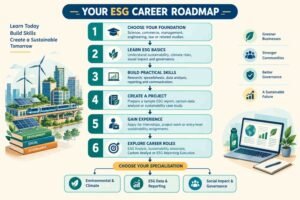
    If you are new to ESG and sustainability, it can be difficult to decide what to learn first. A structured plan helps you develop knowledge gradually without trying to master everything at once. ESG career roadmap flowchart showing education, sustainability skills, practical projects, entry-level experience, and career specialisation.
    Period Main focus Practical outcome
    Month 1 Learn ESG fundamentals and sustainability concepts Explain the environmental, social, and governance pillars in your own words
    Month 2 Explore one sector, such as energy, manufacturing, or finance Identify common sustainability issues in that industry
    Month 3 Build spreadsheet, research, and report-writing skills Create a small data-based sustainability report
    Month 4 Study public ESG or sustainability reports Prepare a short review of indicators, goals, and reported progress
    Month 5 Complete a practical project and explore relevant training Add a project to your portfolio and identify any skill gaps
    Month 6 Review job descriptions and prepare applications Create a targeted resume and shortlist suitable entry-level roles
    This is a flexible learning plan, not a promise that you will be job-ready within six months. Your timeline may be longer if you need a degree, technical training, or practical experience for your target role. The most important step is to keep your learning connected to the work you want to do. If you prefer environmental fieldwork, prioritise relevant science and field methods. If you prefer corporate reporting, focus more on data, business processes, and ESG documentation. “Students exploring advanced science qualifications can read our guide on career opportunities after a distance M.Sc to understand potential job roles, career pathways, and further study options.”

    How to Choose the Right College or Learning Path

    Your course should match both your educational background and your intended career direction. A general degree may provide useful foundations, but a specialised position may require particular subjects, practical training, or professional experience. If you are comparing a distance Msc degree college in bangalore, use the following checklist before applying. Check the exact qualification. Confirm the degree title, specialisation, admission requirements, and duration. Do not assume that every M.Sc. programme covers environmental science or sustainability. Review the curriculum. Look for subjects relevant to your goal, such as environmental science, research methods, data analysis, business management, sustainability, or related technical topics. Verify recognition and eligibility. Confirm the institution’s and programme’s recognition status through appropriate official sources. Also check whether the qualification meets the eligibility requirements for further study or jobs you may pursue. Understand the learning format. Review class delivery, study materials, assessments, examinations, and any practical or laboratory requirements. Ask about practical exposure. For technical or field-based careers, check whether the programme provides suitable practical learning or whether additional experience will be necessary. Compare costs and schedules. Consider total fees, examination requirements, travel if applicable, and the time you can realistically dedicate to study. Connect the course with job descriptions. Review current vacancies for your preferred roles and note the qualifications, software, technical skills, and experience employers request. If you are considering correspondence college in india options, remember that the delivery mode alone does not determine whether a programme is suitable. Course recognition, curriculum, practical requirements, and your career objective are all important. Indian College of Correspondence can be one starting point when exploring educational options. Review the available programme information and confirm the details directly before making an enrolment decision.

    The Future of ESG and Sustainability Careers in India

    ESG and sustainability work spans multiple sectors, so career opportunities are influenced by business needs, policy developments, investment decisions, environmental priorities, and reporting practices. Some areas to watch include: Climate and energy: Organisations may need people to support energy-efficiency projects, renewable energy initiatives, emissions data, and climate-related assessments. Sustainability reporting: Businesses may require employees who can collect reliable information, maintain documentation, and prepare reports in line with applicable requirements. Resource efficiency and circular economy: Waste reduction, material reuse, recycling, and efficient resource use can create project and operational responsibilities. Responsible supply chains: Some organisations assess suppliers and procurement practices for environmental, social, and governance-related considerations. Environmental research and monitoring: Technical work may involve environmental measurements, research, impact assessment, and conservation, depending on qualifications. Social impact: Community initiatives, worker welfare, and social research may create opportunities for professionals with relevant research, programme, or stakeholder-engagement skills. India’s environmental and climate programmes provide useful context for understanding these areas. For example, the National Mission for a Green India focuses on forest and tree cover, ecosystem restoration, and related livelihood considerations. These developments do not guarantee jobs in a particular role or location. Instead, they help explain why sustainability knowledge can be relevant across environmental, technical, operational, financial, and management functions. For students and working professionals, the practical approach is to choose a direction, understand its requirements, and develop skills that can be demonstrated through coursework or projects.

    Conclusion: Build a Career That Connects Knowledge With Impact

    ESG and sustainability careers bring together environmental responsibility, social considerations, business decisions, data, and organisational practices. The field includes different types of work, from environmental research and resource efficiency to ESG reporting, consulting, project coordination, and sustainability management. There is no single educational route for every role. Science-based qualifications may be suitable for technical or environmental work, while management, commerce, economics, and social science backgrounds may support other pathways when combined with relevant knowledge and experience. If you are comparing courses or looking at a distance Msc degree college in bangalore, start by identifying the kind of work you want to do. Then compare qualifications, check recognition and eligibility, and build practical skills that match your chosen career direction. A thoughtful course choice, hands-on projects, and a willingness to keep learning can help you prepare for opportunities in this evolving field. Focus on developing useful capabilities rather than chasing a particular job title alone.

    Frequently Asked Questions

    1. What is ESG in simple words?

    ESG stands for Environmental, Social, and Governance. It is a framework used to understand how an organisation manages environmental responsibilities, people-related issues, and its governance practices.

    2. Is sustainability a good career option in India?

    It can be a worthwhile area to explore if you are interested in environmental issues, responsible business practices, research, data, or project management. Opportunities and eligibility depend on the role, sector, location, and your qualifications.

    3. Which course is best for an ESG career?

    There is no single best course for everyone. Environmental science may suit technical roles, management can support business-oriented work, and finance or economics may be relevant to data and reporting roles. Specialised ESG training can complement an appropriate academic background.

    4. Can I enter ESG with a management degree?

    Yes, some ESG roles involve reporting, operations, consulting support, project coordination, and business analysis. You may need additional knowledge of ESG concepts, reporting practices, and environmental or social indicators.

    5. Is an M.Sc. useful for sustainability careers?

    An M.Sc. in a relevant discipline can be useful for scientific, environmental, technical, or research-oriented positions. Check the specialisation and the eligibility criteria for the jobs you intend to pursue.

    6. Can I study a relevant M.Sc. through distance education?

    Availability depends on the subject, institution, and programme. Some scientific disciplines require practical or laboratory training, so confirm the learning format, recognition, and suitability of the qualification before enrolling.

    7. What skills do ESG professionals need?

    Useful skills include research, spreadsheet analysis, report writing, communication, data checking, project coordination, environmental awareness, and an understanding of ESG concepts. More technical positions may require specialised scientific or analytical skills.

    8. What is the salary of an ESG analyst in India?

    Salary varies by employer, experience, location, and skill set. Use current job advertisements and reliable salary sources to assess realistic ranges for your preferred role rather than relying on a single estimated figure.

    9. Can arts or commerce graduates work in sustainability?

    Potentially, yes. Depending on their skills and further training, they may explore social impact, research, communication, reporting support, or business-related sustainability roles. Some technical positions require specific science or environmental qualifications.

    10. How can I gain experience without an ESG job?

    Start with a small sustainability project, review a public ESG report, practise spreadsheet analysis, prepare a research summary, or look for suitable internships and supervised projects. Clearly document your methods and findings.

    Ready to Explore Your Education Options?

    If you are interested in ESG and sustainability, the next step is to choose a learning path that matches your background and career goals. Compare course content, verify recognition and eligibility, and consider how you will develop practical skills alongside your studies. Indian College of Correspondence can help you begin exploring available educational pathways and identify options worth reviewing. Check the programme details and contact the institution if you need clarification before applying. Explore your options through ICC.

Leave A Comment