

| Comparison point | PGDM | MBA |
| Qualification type | Postgraduate diploma | Postgraduate degree |
| Awarding institution | Eligible management institute | University or authorised degree-awarding institution |
| Curriculum | Depends on the institute and applicable requirements | Depends on the university and programme |
| Learning approach | May include case studies, projects and practical assignments | May include theory, projects, internships and applied learning |
| Recognition checks | Verify applicable approval and programme details | Verify university status and applicable programme requirements |
| Further study | Check the receiving institution’s eligibility rules | Check the receiving institution’s eligibility rules |

| Subject area | What it helps you understand |
| Principles of Management | Planning, organising, leading and controlling work |
| Marketing Management | Customers, markets, branding and sales strategies |
| Financial Management | Budgets, financial decisions and resource allocation |
| Human Resource Management | Recruitment, training, performance and employee relations |
| Operations Management | Processes, productivity, quality and delivery |
| Business Economics | How markets, costs and economic conditions affect decisions |
| Business Communication | Reports, presentations, professional writing and meetings |
| Business Research and Analytics | Collecting, interpreting and applying information |
| Business Strategy | Setting goals and evaluating competitive choices |
| Career area | Possible roles | Useful capabilities |
| Marketing | Marketing executive, sales executive | Communication, research and customer understanding |
| Finance | Finance executive, analyst trainee | Numerical reasoning and financial interpretation |
| Human resources | HR executive, recruitment coordinator | Communication, organisation and people skills |
| Operations | Operations executive, logistics coordinator | Planning, process management and problem-solving |
| Analytics | Business analyst trainee, reporting analyst | Data interpretation, spreadsheets and structured thinking |
| Business development | Business development executive | Relationship building, negotiation and market awareness |
| General management | Management trainee, team coordinator | Coordination, decision-making and teamwork |
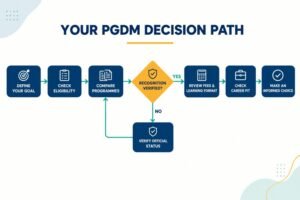 Curriculum quality: Review the subjects, electives, practical assignments and opportunities to work on business problems. Check whether the curriculum matches your career interests.
Faculty and academic support: Find out who teaches the programme, what academic guidance is available and how students can get help when they face difficulties.
Career preparation: Look for credible information about internships, employer interactions, career services and placement outcomes. Ask how the figures are calculated and which student groups they cover.
Total fees: Request a complete fee breakdown and read the refund policy before paying.
Study format: Confirm the actual schedule, attendance requirements, examinations and learning platform where relevant.
Qualification details: Make sure you understand whether you will receive a degree, postgraduate diploma or certificate, and how that credential relates to your intended next step.
Student experience: Where possible, speak with current or former students and ask about teaching quality, responsiveness and practical learning.
If you are researching a correspondence college in India, do not judge the institution solely by the word “correspondence” in its marketing. Verify the awarding body, the exact qualification and the approved mode of study.
Similarly, learners comparing correspondence degree colleges in Bangalore should check the status of each specific programme rather than assuming that all courses offered by the same institution have identical recognition.