Admission opens for 2026-27 sessions for all university.

Blog Detail

  • Career Options After B.Sc: Jobs, Professional Courses and Higher Studies

    • 29,Oct 2026
    • Posted By : uaeautomates@gmail.com
    • 0 Comments
    • B.Sc career opportunities
    • B.Sc Career Options
    • B.Sc correspondence college in Karnataka
    • Career Guidance for Science Graduates
    • distance education in bangalore
    • Higher Studies After B.Sc
    • Jobs After B.Sc
    • M.Sc After B.Sc
    • Professional Courses After B.Sc
    • Science distance education in Bangalore
    Completing a B.Sc is an important milestone, but it often brings a new question: what should you do next? If you are exploring career opportunities or searching for a B.Sc correspondence college in Karnataka to continue your education, understanding the available pathways can help you make a confident decision. You may want to start earning, learn an industry-specific skill, prepare for competitive examinations or pursue higher studies. The good news is that a Bachelor of Science degree can lead in several directions. Your next step does not have to be limited to a laboratory or a research career. Depending on your specialisation, interests and additional skills, you may explore opportunities in technology, analytics, healthcare support, environmental services, quality control, education and other fields. However, choosing a path simply because it is popular may not be the best approach. The more useful question is: what kind of work do you want to do, and what qualification or skill will help you move towards it? This guide explores jobs, professional courses, higher studies and flexible education options after B.Sc so that you can identify a realistic next step.

    Before Choosing Your Next Step, Understand What Your B.Sc Has Given You

    A B.Sc provides more than subject knowledge. Depending on your specialisation and practical training, you may have developed skills in observation, research, experimentation, calculations, problem-solving and interpreting information. These abilities can be useful across different industries. For example, a Chemistry graduate may be familiar with laboratory procedures and analytical thinking. A Mathematics graduate may be comfortable working with numerical information. A Computer Science graduate may have experience with programming and logical problem-solving. A Biology graduate may understand scientific observation, biological processes and research methods. The important point is that your undergraduate specialisation is a starting point, not necessarily the limit of your future career.

    How can you identify your strongest starting point?

    Begin by looking at the activities you enjoyed during your degree.
    • If you like practical experiments, explore laboratory-related work and quality testing.
    • If you enjoyed calculations and identifying patterns, consider analytical or data-related roles.
    • If you like computers, investigate programming, IT support or technology-related training.
    • If you are interested in living organisms and the environment, explore relevant biological and environmental fields.
    • If you enjoyed explaining concepts, consider education-related pathways, subject to the necessary qualifications.
    • If you prefer coordinating people and projects, you may also explore business-oriented courses and suitable entry-level roles.
    You should also consider the difference between what you enjoy studying and what you would enjoy doing professionally. Someone who likes Biology may prefer environmental research rather than laboratory work. A Mathematics graduate may enjoy business reporting more than academic research. Your career decision becomes clearer when you connect your subject knowledge with the work environment you prefer.

    Route One: Start Working and Gain Professional Experience

    For many graduates, employment is the most immediate next step. Starting work can help you understand an industry, develop practical skills and gain financial independence while deciding whether further education is necessary. The roles available to you depend on your B.Sc specialisation, practical experience, location and the employer’s requirements. Some positions accept fresh graduates, while others require additional qualifications, certifications or specific technical skills.

    Job opportunities after B.Sc

    Job role Possible work responsibilities
    Laboratory Assistant Supporting routine laboratory activities and maintaining records
    Quality Control Trainee Assisting with product testing and quality checks
    Research Assistant Supporting research projects, data collection and documentation
    Data Analyst Trainee Organising data, preparing reports and identifying patterns
    IT Support Executive Helping users resolve basic technical problems
    Technical Sales Executive Explaining technical products and assisting customers
    Environmental Field Assistant Supporting environmental surveys and field data collection
    Clinical Data Support Assistant Helping maintain and organise research or healthcare-related records, where eligible
    Production or Process Trainee Supporting production monitoring and process documentation
    Science Content Assistant Helping prepare educational or scientific content
    These are possible starting points rather than guaranteed outcomes. Employers may require specific subject combinations, practical knowledge, software skills or additional qualifications. For example, a laboratory-related position may require familiarity with laboratory safety and testing procedures. An entry-level analytics role may require spreadsheet skills, logical reasoning and experience with reporting tools. Technical sales may require communication skills alongside an understanding of the product.

    What if you want to start earning immediately?

    You do not always need to complete another degree before applying for work. Start by identifying vacancies that accept graduates with your qualification and build your application around the requirements listed. A practical approach is to:
    1. Prepare a résumé that highlights your B.Sc specialisation, projects and practical experience.
    2. Identify entry-level positions that match your academic background.
    3. Learn the basic tools used in your chosen field.
    4. Apply for internships, trainee roles and suitable graduate openings.
    5. Keep track of the skills employers repeatedly request.
    You may discover that a short, targeted course is sufficient for some roles, while others require a postgraduate qualification. Starting work can also help you make a better decision about further study because you gain a clearer understanding of the skills and responsibilities involved in your preferred industry.

    Route Two: Add a Professional Skill That Makes You More Employable

    Sometimes, the challenge is not your degree but the gap between academic learning and the practical skills expected for a particular role. A professional course can help address that gap. The right choice depends on your existing knowledge, the type of work you want to do and the credibility of the training provider. Before enrolling, ask what you will be able to do after completing the course. A programme with practical exercises, recognised certification where relevant and useful project work may be more valuable than one that offers only general theory.

    Professional courses to consider after B.Sc

    Data analytics and business reporting This pathway may suit graduates who enjoy working with numbers, finding patterns and interpreting information. Depending on the course, you may learn spreadsheets, data visualisation, SQL or introductory programming. A practical portfolio could include a sales report, a basic dashboard or an analysis of a sample dataset. Programming and software fundamentals Computer Science graduates may deepen their existing knowledge, while graduates from other streams can explore introductory programming if they are interested in technology. The best starting point depends on your current skill level. Learn the fundamentals before choosing a specialised area, and practise by building small projects. Laboratory techniques and quality management Graduates in relevant science disciplines may consider training in laboratory procedures, documentation, testing methods, safety practices or quality systems. Always check the course’s practical components and whether employers in your intended sector value the qualification. Regulated occupations may require specific recognised qualifications beyond a short course. GIS and environmental data Geographic Information Systems can be useful in fields involving maps, location-based information, environmental studies and spatial analysis. Students interested in geography, environmental science or related subjects may explore GIS tools and introductory mapping projects. Scientific writing and technical communication Graduates who enjoy research and explaining complex information may develop skills in technical writing, scientific documentation, educational content or report preparation. A portfolio containing well-written sample articles or technical reports can help demonstrate ability. Business and management skills Some science graduates want to move towards operations, sales, project coordination or business functions. Relevant management training can help them understand communication, planning, customer needs and organisational processes. However, a course should be selected because it fits a specific goal, not simply because it is advertised as a popular career option.

    How do you decide whether a professional course is worth the investment?

    Consider the following questions before paying for training:
    • Does the course teach a skill relevant to the jobs you want?
    • Does it include practical assignments or projects?
    • Are the course provider and certification credible?
    • Do employers request this skill in current job advertisements?
    • Can you learn the skill within your available time and budget?
    • Will the course complement your B.Sc or help you transition to a new field?
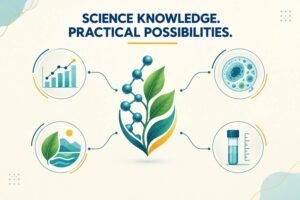
    A professional course is most useful when it helps you demonstrate a capability that your existing qualification alone may not show. Visual illustration of how scientific knowledge connects with data analysis, research, environmental science and quality testing. “Students interested in technology-oriented careers can also explore our guide on career opportunities after a B.Sc. in Information Systems and Management to learn about potential job roles, essential skills, and future career prospects.”

    Route Three: Continue Higher Studies and Develop Subject Expertise

    If you enjoy your academic subject and want to explore it in greater depth, higher studies may be the right choice. Postgraduate education can help you specialise, prepare for research-oriented opportunities or meet the qualification requirements for particular careers. The decision should depend on the type of work you want to pursue rather than the assumption that every graduate must immediately enrol in another degree.

    Is M.Sc the natural next step after B.Sc?

    For students who want to deepen their scientific knowledge, an M.Sc can be a relevant option. It provides an opportunity to study a particular subject or specialisation in greater depth. Possible choices depend on your undergraduate discipline and the admission requirements of the institution.
    B.Sc background Possible higher-study directions
    Physics M.Sc Physics, Applied Physics or relevant interdisciplinary fields
    Chemistry M.Sc Chemistry, Analytical Chemistry or related specialisations
    Mathematics M.Sc Mathematics, Statistics or Applied Mathematics
    Computer Science M.Sc Computer Science, Information Technology or related fields
    Biology M.Sc Zoology, Botany or other relevant biological sciences
    Biotechnology M.Sc Biotechnology, Molecular Biology or related disciplines
    Microbiology M.Sc Microbiology or relevant life-science specialisations
    Environmental Science M.Sc Environmental Science or related environmental disciplines
    These are examples, not universal eligibility guarantees. Some programmes require particular undergraduate subjects, minimum marks or entrance examinations. Always review the current admission notice.

    What can you do after an M.Sc?

    Depending on the specialisation, practical experience and additional qualifications, postgraduate science learners may explore research support, laboratory analysis, technical roles, scientific documentation, quality-related work or further academic study. Students interested in research may later investigate Ph.D. opportunities and relevant fellowship or entrance requirements. For example, candidates considering research or academic careers in eligible science disciplines can review the official Joint CSIR–UGC NET information portal. The examination has specific eligibility criteria, which vary according to the purpose of application and the applicable rules. An M.Sc is not a guarantee of employment, but it can provide the deeper subject knowledge required for opportunities that expect postgraduate-level expertise.

    What if you want to change your career direction?

    Not every B.Sc graduate wants to continue in the same subject. Depending on eligibility and career goals, you may consider other postgraduate qualifications in areas such as management, computer applications or related professional fields. Before making a change, check whether your existing degree meets the admission requirements. Also consider whether you need additional foundational knowledge to succeed in the new subject. A career change is easier to plan when you understand both the entry requirements and the work you hope to do after completing the qualification.

    Match Your Interests With the Right Career Direction

    When you have several options, it can be difficult to identify the most suitable one. Instead of comparing every course and job available, start with the type of work that appeals to you. The following table can help you narrow your search.
    If you enjoy… Career directions to explore
    Experiments and practical testing Laboratory work, testing and quality control
    Numbers, patterns and reports Data analytics, statistics and reporting
    Computers and logical problem-solving Programming, IT support and software-related work
    Nature and environmental issues Environmental services, fieldwork and GIS
    Research and scientific discovery Research assistance, M.Sc. and further study
    Explaining ideas to others Science communication and eligible teaching pathways
    People, customers and business activities Technical sales, business development and management training
    Think about the work environment too. Do you prefer working in a laboratory, sitting at a computer, travelling for fieldwork, collaborating with customers or conducting academic research? These preferences may be as important as the subject you studied. For example, a graduate who enjoys Chemistry but dislikes laboratory routines may explore technical sales or scientific communication. A Mathematics graduate who enjoys working with people may prefer a business-oriented role that uses analytical skills rather than a purely technical position. The aim is not to select a career based on a table alone. Use it to create a shortlist, then research the qualifications and actual responsibilities associated with each option. “Students exploring higher education options after graduation can also read our guide on Degree Certificate vs Diploma to understand the key differences and choose the right qualification for their career goals.”

    Government Jobs and Competitive Examinations After B.Sc

    Government employment is another route some graduates consider. Depending on the recruitment notice, a recognised bachelor’s degree may satisfy the educational requirement for certain graduate-level examinations and positions. However, eligibility varies considerably. Some vacancies accept graduates from any discipline, while others require a specific science subject, technical qualification, professional registration or additional experience. Potential areas to investigate include:
    • Graduate-level administrative and civil-service examinations.
    • Eligible scientific or technical recruitment.
    • Certain laboratory and research-support vacancies.
    • Public-sector recruitment that accepts the candidate’s specific degree.
    • State-level recruitment and other government examinations.
    Do not assume that every government science-related role accepts all B.Sc graduates. Read the official notification carefully and check the subject requirements, age limits, experience conditions, examination stages and application deadlines. For civil-service and other central recruitment information, consult the Union Public Service Commission (UPSC). For state-level opportunities, refer to the relevant state recruitment commission or official government department. Preparation also requires planning. Identify the examination syllabus, understand the selection process and build a realistic study timetable. If you are working while preparing, allocate time for revision and practice tests rather than relying on last-minute preparation. Government examinations can be competitive, so consider applying for suitable private-sector roles or developing professional skills alongside preparation if that fits your circumstances.

    How Your B.Sc Specialisation Can Shape Your Options

    Although several careers are open to science graduates, your subject background can influence the most direct routes available to you.

    Career options after B.Sc Physics

    Physics graduates may explore technical support, testing, instrumentation-related assistance, data-oriented roles and further study in specialised scientific fields. Some positions require additional training or a postgraduate qualification. Students interested in research should investigate the relevant academic and research pathways.

    Career options after B.Sc Chemistry

    Chemistry graduates may explore eligible laboratory roles, quality testing, production support, technical sales and further study. Roles involving specialised chemical analysis or regulated activities may require additional practical competence, safety training or specific qualifications.

    Career options after B.Sc Mathematics

    Mathematics graduates may consider data reporting, statistical support, finance-related entry-level roles, analytics and postgraduate study. Developing spreadsheet proficiency, statistical reasoning and relevant analytical tools can help demonstrate practical ability.

    Career options after B.Sc Computer Science

    Computer Science graduates may explore software-related roles, IT support, application testing, technical assistance, data analytics and further study. Practical projects, programming knowledge and familiarity with relevant tools can strengthen an application. The requirements depend on the specific position.

    Career options after B.Sc Biology, Biotechnology or Microbiology

    Graduates in relevant biological disciplines may investigate laboratory support, quality-related work, research assistance, biotechnology-related opportunities and further study. Clinical, diagnostic and other regulated roles may have specific educational and professional requirements. A general science degree should not be assumed to qualify someone for every healthcare profession.

    Career options after B.Sc Environmental Science

    Graduates may investigate environmental monitoring, field surveys, sustainability-related support, environmental data and postgraduate study. GIS, technical reporting, fieldwork experience and knowledge of relevant environmental standards may be useful depending on the role. The key is to connect your specialisation with actual vacancy requirements and the training needed to meet them.

    Compare Jobs, Professional Courses and Higher Studies Before Deciding

    At this stage, you may have identified several possible directions. The next step is to compare them realistically.
    Pathway Main purpose What to check
    Start working Gain experience and begin earning Entry requirements, skills and available vacancies
    Professional course Develop a targeted capability Practical learning, cost and employer relevance
    M.Sc. or other postgraduate study Develop deeper subject knowledge Eligibility, curriculum and future pathways
    Competitive examinations Apply for eligible government or other roles Official rules, syllabus and selection stages
    Career-change qualification Move towards another professional field Admission requirements, total cost and career fit
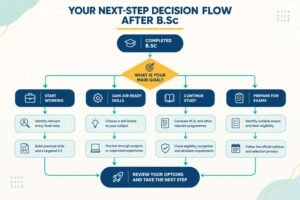
    You do not have to treat these options as mutually exclusive. Some graduates work before pursuing higher studies. Others complete a short course while applying for jobs. Working professionals may return to formal education when a new role requires additional qualifications. The right sequence depends on your finances, responsibilities and goals. For instance, if you need an income immediately, applying for suitable entry-level jobs while learning a relevant tool may be more practical than committing to an expensive full-time course. If your preferred career requires a postgraduate qualification, further study may be the necessary next step. Flowchart helping B.Sc graduates choose between employment, professional skill development, postgraduate study and competitive examinations.

    Can You Continue Studying While Working?

    Yes, some learners can combine employment with further education, provided they choose a suitable programme and meet its academic requirements. Flexible study options can be helpful for working professionals, graduates with family responsibilities and learners returning after a break. However, the availability and recognition of programmes depend on the institution, qualification and mode of delivery. Students researching Science distance education in Bangalore should check the exact programme, the awarding institution and the current recognition status before enrolling. Similarly, if you are looking for a distance Msc degree college in bangalore, verify that the intended M.Sc programme is offered through an authorised mode for the relevant academic session. Not every science specialisation is available through distance or online learning, and practical or laboratory requirements may affect delivery. Those comparing distance education in bangalore should also examine the assessment method, contact sessions, examination arrangements, study materials and academic support. Some learners may search for Traditional distance education in bangalore because they prefer a structured correspondence-based learning arrangement. Whatever the format, confirm what the programme actually offers instead of relying on a label used in advertising. Before applying, check the official University Grants Commission and its Distance Education Bureau information to verify the recognition status relevant to the institution, programme and academic session. This step is important because recognition in one year does not automatically establish recognition for a later admission session.

    How can working professionals manage their studies?

    • Choose a programme that fits your available study time.
    • Set aside consistent weekly hours for reading and assignments.
    • Check examination dates and attendance requirements in advance.
    • Keep your professional goals in mind while selecting subjects.
    • Avoid enrolling in a programme without understanding its total workload and fees.
    For learners who have taken a break from education, begin with a realistic plan. Review your foundational knowledge, identify the skills you need to refresh and contact the institution if you need clarification about eligibility. Flexible education can make further study more manageable, but the programme still needs to meet your academic and professional needs.

    How to Build a Practical Career Plan After B.Sc

    A career plan does not need to cover the next ten years. It should help you decide what to do next and how to evaluate whether that decision is working.

    Step 1: Define your immediate priority

    Decide whether you need employment, want to specialise, plan to prepare for examinations or intend to change fields.

    Step 2: Identify your strongest skills

    List your subject knowledge, practical experience, academic projects, communication abilities and technical skills.

    Step 3: Research actual opportunities

    Read current job descriptions and course admission requirements. Note the qualifications, tools and experience that appear repeatedly.

    Step 4: Compare the cost and time involved

    Calculate the total fees and study commitment. Consider whether you can work while studying and whether the expected learning outcomes justify the investment.

    Step 5: Choose one immediate action

    Your next action might be applying for five suitable jobs, completing a small analytics project, preparing for an entrance examination or shortlisting recognised postgraduate programmes.

    Step 6: Review your progress

    After a few weeks, assess whether the plan is helping you move forward. If you discover that your target roles require a different skill or qualification, adjust the plan. A practical approach prevents you from collecting certificates without a clear purpose. It also gives you room to change direction as you learn more about the opportunities available.

    What Should You Check Before Choosing a College or Course?

    The institution you choose can influence your learning experience, the qualification you receive and your future options. Whether you plan to study in a classroom or through a flexible format, examine the details carefully. Recognition and qualification: Confirm the institution’s status and the recognition or approval required for the specific programme. Curriculum: Check whether the subjects align with your interests and career goals. Practical learning: Look for projects, laboratory work, assignments or other activities relevant to the field. Eligibility: Make sure your B.Sc specialisation and academic record meet the entry requirements. Total fees: Request a complete fee breakdown and understand the refund policy. Learning support: Check how academic questions, assessments and study materials are handled. Career relevance: Research the skills and qualifications employers expect instead of relying on general placement claims. Students searching for a correspondence college in india should also verify the awarding institution and approved mode of delivery. A flexible format can be useful, but it does not replace the need to check academic recognition. Likewise, learners considering a B.Sc correspondence college in Karnataka should verify the exact programme and whether the chosen institution is authorised to offer it in the intended format. Make your decision based on reliable information, not just advertisements, rankings or promises about future employment.

    Frequently Asked Questions About Career Options After B.Sc

    1. What are the best career options after B.Sc?

    Suitable options depend on your specialisation and interests. Graduates may explore laboratory support, quality control, data analytics, IT-related work, technical sales, environmental services, research support, professional courses or higher studies.

    2. Can I get a job immediately after B.Sc?

    Yes, some employers recruit fresh graduates for entry-level and trainee positions. Eligibility depends on the job, your subject background, practical skills and the employer’s requirements.

    3. Which professional course is useful after B.Sc?

    Data analytics, programming, laboratory techniques, quality management, GIS and technical communication are possible options. Choose a course that addresses a specific skill gap and offers relevant practical learning.

    4. Is M.Sc necessary after B.Sc?

    No, not for every career. An M.Sc can be important for certain specialist, research or academic pathways, while other entry-level jobs may accept a B.Sc. Check the requirements of your intended career.

    5. Can B.Sc graduates apply for government jobs?

    Graduates may apply for government vacancies when they meet the stated educational and other eligibility criteria. Some positions accept any recognised bachelor’s degree, while others require particular subjects, experience or qualifications.

    6. Can I pursue higher studies after taking a career break?

    A career break does not automatically prevent admission. You must meet the institution’s eligibility requirements for the intended programme. Check the application rules and refresh relevant academic knowledge if necessary.

    7. Can I study M.Sc through distance education?

    Availability depends on the subject, institution and applicable regulations. Science programmes may have practical or laboratory requirements, so verify whether the exact programme is authorised in the intended mode.

    8. Is distance education suitable for working professionals?

    It may be suitable for learners who need greater scheduling flexibility, provided the programme is recognised and the workload fits their routine. Review examinations, assignments, practical requirements and academic support before enrolling.

    9. Can I change fields after B.Sc?

    Yes, depending on the field and its entry requirements. Some transitions require only targeted skills, while others require a specific postgraduate qualification or professional credential.

    10. How do I choose between a job and higher studies?

    Compare your immediate financial needs, preferred career, admission eligibility, course cost and the qualifications required for your intended role. If possible, speak with professionals working in that field before making a decision.

    Conclusion: Your B.Sc Is a Starting Point, Not the Finish Line

    Completing a B.Sc gives you a foundation from which you can explore several career directions. You may begin working, develop a professional skill, pursue an M.Sc, prepare for competitive examinations or investigate another qualification that fits your interests. The most effective next step is the one that connects your existing strengths with a realistic opportunity. Take time to understand job requirements, compare courses, verify recognition and evaluate the cost of further education before committing. If you need flexibility because of work or personal responsibilities, explore suitable recognised study options and confirm that the programme matches your future plans. At Indian College of Correspondence, learners can explore educational pathways and consider options that align with their academic background and professional goals. Ready to plan your next step? Visit ICC to explore educational options and learn more about possible pathways for continuing your education. Choose a course that suits your goals, verify its details and move forward with a clear plan.

Leave A Comment