
Admission opens for 2026-27 sessions for all university.

Blog Detail

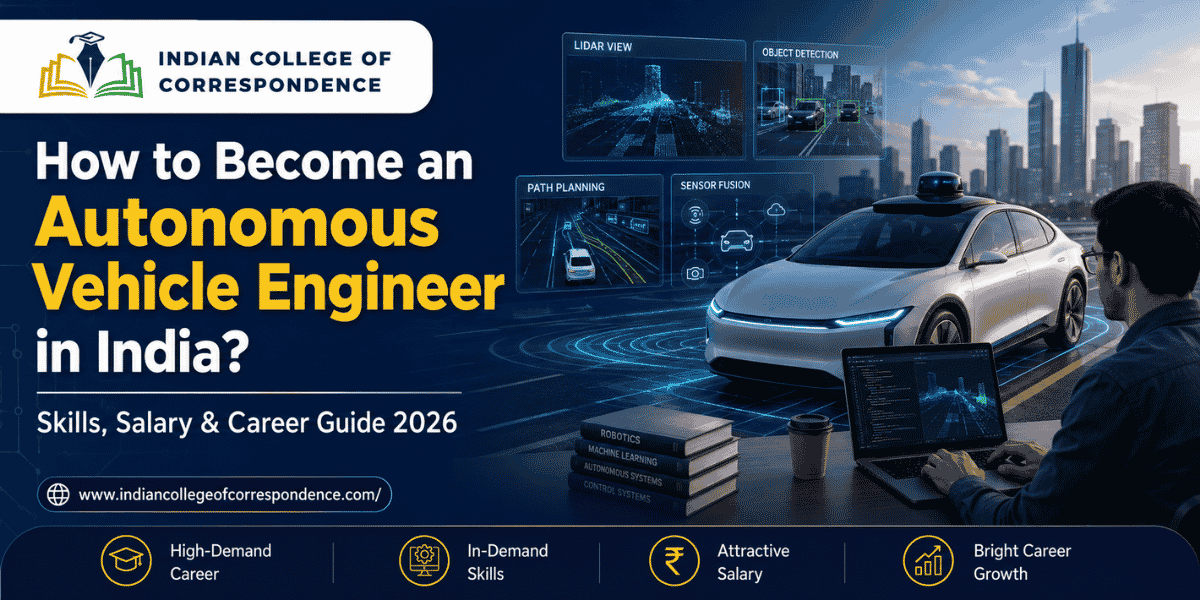
  • How to Become an Autonomous Vehicle Engineer in India?: Skills, Salary & Career Guide 2026

    • 10,Jul 2026
    • Posted By : opsadsthrivein@gmail.com opsadsthrivein@gmail.com
    • 0 Comments
    • B.Tech correspondence college in India
    • Engineering distance education
    • M.Tech correspondence college in Karnataka
    • Science distance education in Bangalore
    The Autonomous Vehicle Engineer profession is transforming the future of transportation as artificial intelligence, robotics, and smart mobility technologies continue to evolve. Self-driving vehicles are no longer limited to research labs—they are becoming a reality across logistics, public transportation, agriculture, and passenger vehicles. India is also investing heavily in intelligent transportation systems, electric vehicles, and AI-powered mobility solutions, creating exciting opportunities for aspiring engineers. Choosing an Autonomous Vehicle Engineer career allows students to work on cutting-edge technologies while contributing to safer, smarter, and more sustainable transportation. If you’re passionate about innovation, automation, and engineering, this guide will help you understand the skills, career path, salary, and future scope of becoming an Autonomous Vehicle Engineer in India.

    What is an Autonomous Vehicle Engineer?

    An Autonomous Vehicle Engineer is a technology professional responsible for designing, developing, testing, and improving self-driving vehicle systems. They combine engineering principles with Artificial Intelligence (AI), Machine Learning (ML), robotics, computer vision, sensors, and embedded systems to create vehicles capable of navigating without human intervention. These professionals work on technologies that allow vehicles to detect road conditions, recognize obstacles, make driving decisions, and ensure passenger safety. An Autonomous Vehicle Engineer collaborates with software developers, automotive engineers, electronics experts, and AI specialists to build intelligent transportation systems.

    Major Responsibilities

    • Develop autonomous driving software
    • Design intelligent navigation systems
    • Integrate LiDAR, Radar, and Camera Sensors
    • Build Computer Vision algorithms
    • Improve vehicle safety systems
    • Test autonomous driving simulations
    • Analyze driving data
    • Develop AI decision-making models
    • Ensure compliance with automotive safety standards
    As the automotive industry rapidly adopts automation, the demand for skilled Autonomous Vehicle Engineer professionals is increasing across India and globally.

    Why Autonomous Vehicles Are the Future of Transportation?

    The transportation industry is experiencing one of its biggest technological transformations. Self-driving vehicles promise safer roads, reduced traffic congestion, lower emissions, and improved mobility for people worldwide. Governments, automotive companies, and technology organizations are investing billions into autonomous mobility because of its enormous future potential. Some major reasons behind this growth include:
    • AI-powered transportation
    • Smart City Development
    • Electric Vehicle Adoption
    • Connected Vehicle Technology
    • Road Safety Improvements
    • Reduced Human Errors
    • Sustainable Transportation
    • Intelligent Traffic Management
    • Logistics Automation
    • Commercial Vehicle Innovation
    India is gradually adopting smart transportation technologies, creating significant employment opportunities for future-ready engineers. A career as an Autonomous Vehicle Engineer offers excellent opportunities to work with cutting-edge innovations that will define the future of mobility.

    Autonomous Vehicle Meaning

    An autonomous vehicle, commonly known as a self-driving car, is a vehicle capable of sensing its surroundings and operating with little or no human intervention. These vehicles use Artificial Intelligence, Machine Learning, cameras, sensors, LiDAR, GPS, radar, and high-definition maps to understand road conditions and make driving decisions independently. The autonomous vehicle meaning extends beyond passenger cars. Autonomous technologies are now used in:
    • Trucks
    • Public Buses
    • Agricultural Equipment
    • Mining Vehicles
    • Warehouse Robots
    • Delivery Vehicles
    • Military Transportation
    • Smart Logistics
    Modern autonomous vehicles continuously collect data from their surroundings, process it using AI algorithms, and respond to changing traffic situations in real time. As this technology advances, the role of an Autonomous Vehicle Engineer becomes increasingly important in designing reliable and safe intelligent transportation systems.

    Core Technologies Used by Autonomous Vehicle Engineers

    Technology Purpose
    Artificial Intelligence Vehicle decision making
    Computer Vision Road & object recognition
    LiDAR 3D environment mapping
    Radar Obstacle detection
    GPS Navigation Route planning
    Embedded Systems Vehicle control

    Automotive Engineering Courses

    Choosing the right educational pathway is the first step toward becoming an Autonomous Vehicle Engineer. Since autonomous vehicles combine automotive engineering with AI, software, robotics, and electronics, students should build a strong engineering foundation before specializing in autonomous technologies. Several undergraduate, postgraduate, and certification programs can prepare learners for this exciting career. Popular degree options include:
    • B.Tech in Mechanical Engineering
    • B.Tech in Automobile Engineering
    • B.Tech in Computer Science
    • B.Tech in Electronics & Communication
    • B.Tech in Artificial Intelligence
    • Robotics Engineering
    • Mechatronics Engineering
    • Electrical Engineering
    Students pursuing Engineering distance education can strengthen their engineering knowledge while balancing personal or professional commitments. Flexible learning combined with practical projects can help build the technical foundation required for emerging automotive technologies. For students beginning their engineering journey through a B.Tech correspondence college in India, gaining additional certifications in Artificial Intelligence, Embedded Systems, Robotics, Python programming, and Computer Vision significantly improves career opportunities. Professionals looking for advanced specialization can pursue M.Tech correspondence college in Karnataka in fields such as Robotics, Artificial Intelligence, Automotive Engineering, or Embedded Systems to prepare for senior engineering and research positions. In addition, learners who have completed a Diploma in Engr correspondence college in India can continue upgrading their qualifications through higher studies and industry-recognized certifications to remain competitive in the autonomous vehicle industry. Students with strong scientific backgrounds from Science distance education in Bangalore programs can also pursue engineering specializations and research opportunities that support careers in intelligent transportation, robotics, and smart mobility systems. The automotive industry values professionals who continuously update their technical knowledge, making lifelong learning an essential part of becoming a successful Autonomous Vehicle Engineer.

    How to Become an Autonomous Vehicle Engineer in India?

    Building a successful Autonomous Vehicle Engineer career requires a combination of engineering knowledge, software development skills, Artificial Intelligence expertise, and practical industry experience. Since autonomous vehicles combine multiple technologies into one intelligent system, aspiring professionals should follow a structured learning path to become industry-ready.

    Step 1: Complete Higher Secondary Education

    Choose the Science stream (PCM) after Class 10. Subjects should include:
    • Physics
    • Chemistry
    • Mathematics
    • Computer Science (Optional)
    These subjects build the analytical and mathematical foundation required for engineering studies.

    Step 2: Earn an Engineering Degree

    Pursue an undergraduate degree in:
    • Automobile Engineering
    • Mechanical Engineering
    • Electronics Engineering
    • Computer Science Engineering
    • Artificial Intelligence
    • Robotics Engineering
    • Mechatronics
    Students completing a Diploma in Engr correspondence college in India can also continue their education through lateral entry programs and specialized automotive certifications.

    Step 3: Learn Programming Languages

    Programming is one of the most important skills for every Autonomous Vehicle Engineer. Recommended languages include:
    • Python
    • C++
    • Java
    • MATLAB
    • ROS Programming
    Programming enables engineers to build intelligent driving systems, automation software, and machine learning algorithms.

    Step 4: Master AI & Machine Learning

    Autonomous vehicles rely heavily on AI. Learn topics such as:
    • Machine Learning
    • Deep Learning
    • Neural Networks
    • Computer Vision
    • Reinforcement Learning
    • Natural Language Processing (Basic)

    Step 5: Understand Vehicle Technologies

    Develop knowledge of:
    • LiDAR
    • Radar
    • GPS Navigation
    • Sensor Fusion
    • Embedded Systems
    • Vehicle Communication
    • Electronic Control Units (ECUs)

    Step 6: Gain Practical Experience

    Employers highly value hands-on experience. Participate in:
    • Internships
    • Robotics Competitions
    • Automotive Projects
    • AI Research
    • Hackathons
    • Self-driving Vehicle Simulations
    Practical exposure helps students understand real-world automotive challenges.

    Step 7: Continue Higher Studies

    Professionals aiming for research or leadership roles can pursue M.Tech correspondence college in Karnataka in Artificial Intelligence, Robotics, Automotive Engineering, Embedded Systems, or Machine Learning. Advanced education helps engineers specialize in intelligent transportation technologies and qualify for high-paying research and development positions.

    Autonomous Vehicle Engineer Skills

    A successful Autonomous Vehicle Engineer must possess both engineering expertise and advanced software development skills. Since autonomous vehicles integrate hardware and software, professionals need multidisciplinary knowledge.

    Technical Skills

    • Artificial Intelligence
    • Machine Learning
    • Computer Vision
    • Python Programming
    • C++
    • Embedded Systems
    • Robotics
    • ROS (Robot Operating System)
    • LiDAR Technology
    • Radar Systems
    • Sensor Fusion
    • GPS Navigation
    • Automotive Electronics
    • Cloud Computing
    • Linux
    • Deep Learning
    • Data Analytics
    • Vehicle Simulation
    Students pursuing IT distance education can strengthen programming knowledge while simultaneously learning AI, cloud computing, software development, and automation technologies that support careers in autonomous mobility.

    Soft Skills

    Apart from technical expertise, employers also look for:
    • Communication Skills
    • Leadership
    • Critical Thinking
    • Problem Solving
    • Team Collaboration
    • Time Management
    • Innovation
    • Creativity
    • Decision Making
    • Adaptability
    These skills enable engineers to work effectively across multidisciplinary automotive development teams.

    Autonomous Vehicle Manufacturer

    The autonomous vehicle industry is expanding rapidly, with leading automobile manufacturers investing billions of dollars in self-driving technologies. These companies develop advanced driver assistance systems (ADAS), intelligent navigation platforms, electric vehicles, and AI-powered transportation solutions.

    Global Autonomous Vehicle Manufacturers

    • Tesla
    • Waymo
    • Mercedes-Benz
    • BMW
    • Toyota
    • Volvo
    • Ford
    • General Motors (Cruise)
    • Audi
    • Nissan

    Indian Companies Investing in Autonomous Technologies

    • Tata Motors
    • Mahindra Electric
    • Ashok Leyland
    • Ola Electric
    • Ather Energy
    • Bosch India
    • Tata Technologies
    • KPIT Technologies

    Technology Companies Hiring Autonomous Vehicle Engineers

    • NVIDIA
    • Qualcomm
    • Intel
    • Microsoft
    • Google
    • Amazon
    • TCS
    • Infosys
    • Accenture
    • Capgemini
    These organizations recruit professionals with expertise in AI, robotics, software engineering, automotive electronics, and intelligent transportation systems. As investments in smart mobility continue to grow, opportunities for an Autonomous Vehicle Engineer are expected to increase significantly.

    Autonomous Vehicle Engineer Salary by Experience

    Experience Job Position Average Salary
    0–2 Years Graduate Engineer ₹6–10 LPA
    2–5 Years Autonomous Vehicle Engineer ₹10–18 LPA
    5–8 Years Senior Autonomous Engineer ₹18–30 LPA
    8–12 Years Technical Lead ₹30–45 LPA
    12+ Years Engineering Manager ₹45–70 LPA+

    Autonomous Vehicle Engineer salary

    The Autonomous Vehicle Engineer salary is among the highest in emerging engineering careers because companies require professionals with specialized expertise in AI, robotics, automotive engineering, and software development.

    Salary Based on Experience

    Freshers
    • ₹6–10 LPA
    2–5 Years
    • ₹10–18 LPA
    5–8 Years
    • ₹18–30 LPA
    Senior Engineers
    • ₹30–50 LPA+
    International Opportunities
    • ₹60 LPA to ₹1 Crore+ (depending on country and experience)
    Apart from annual salary, professionals often receive:
    • Performance Bonuses
    • ESOPs
    • Research Incentives
    • International Assignments
    • Leadership Benefits
    • Skill Development Programs
    The earning potential continues to rise as autonomous transportation becomes mainstream, making Autonomous Vehicle Engineer one of the highest-paying future engineering careers.

    Future Scope of Autonomous Vehicle Engineer in India

    The future of an Autonomous Vehicle Engineer is exceptionally bright as India embraces intelligent transportation, Artificial Intelligence, electric mobility, and smart infrastructure. While fully autonomous passenger vehicles are still evolving in India, technologies such as Advanced Driver Assistance Systems (ADAS), autonomous logistics, warehouse automation, connected vehicles, and smart mobility solutions are already transforming the automotive sector. Government initiatives like Digital India, Smart Cities Mission, and increasing investments in electric vehicles have encouraged automotive manufacturers and technology companies to invest in autonomous mobility. Global automobile brands are also expanding their research and development (R&D) centers in India, creating excellent career opportunities for skilled engineers. The future demand for an Autonomous Vehicle Engineer will continue growing because of:
    • Expansion of Electric Vehicles (EVs)
    • AI-powered transportation systems
    • Smart City infrastructure
    • Intelligent Traffic Management
    • Connected Vehicle Technologies
    • Advanced Driver Assistance Systems (ADAS)
    • Autonomous Logistics
    • Industrial Robotics
    • Defense Applications
    • Agricultural Automation
    Industry experts predict that autonomous mobility will become one of the largest engineering employment sectors over the next decade. Professionals with expertise in AI, embedded systems, robotics, and automotive software can expect excellent salaries, international opportunities, and long-term career stability.

    Why Choose ICC?

    Choosing the right educational guidance is one of the most important steps toward building a successful engineering career. ICC helps students and working professionals identify flexible educational pathways that match current industry requirements and future technologies. Whether you’re beginning your engineering journey or planning higher education, ICC provides guidance on admissions, career planning, course selection, and professional development. Students are encouraged to combine academic qualifications with certifications, internships, technical projects, and industry-oriented learning to become future-ready professionals. Learners pursuing Engineering distance education can strengthen their technical foundation while balancing personal and professional commitments. Those interested in advanced studies can also receive guidance on specialized engineering programs that support careers in Artificial Intelligence, Robotics, Embedded Systems, and Autonomous Vehicle Engineering. With expert academic counseling and flexible learning support, ICC prepares students for emerging careers that demand innovation, technical excellence, and continuous skill development.

    Conclusion

    An Autonomous Vehicle Engineer career represents one of the most exciting opportunities in today’s technology-driven world. As autonomous driving, Artificial Intelligence, robotics, and smart mobility continue reshaping the automotive industry, the demand for skilled engineers will only increase. Professionals entering this field have the opportunity to work on groundbreaking innovations that improve transportation safety, efficiency, and sustainability. By developing expertise in AI, computer vision, embedded systems, and intelligent vehicle technologies, aspiring engineers can build rewarding careers with attractive salaries and global employment opportunities. Whether you are beginning with a diploma, bachelor’s degree, or higher education, continuous learning and practical experience are the keys to succeeding as an Autonomous Vehicle Engineer. With dedication and the right educational guidance, you can become part of the next generation of engineers transforming the future of mobility.
    Ready to Start Your Journey as an Autonomous Vehicle Engineer?
    The future of transportation is driven by innovation, Artificial Intelligence, and smart mobility. Indian Correspondence of College helps students and working professionals explore flexible engineering education, understand career pathways, and prepare for emerging technology roles. Build your technical expertise, gain industry-relevant knowledge, and take the first step toward becoming a successful Autonomous Vehicle Engineer. Connect with ICC today and prepare yourself for tomorrow’s engineering careers.

    FAQs

    1. What does an Autonomous Vehicle Engineer do?

    An Autonomous Vehicle Engineer designs, develops, tests, and improves intelligent vehicle systems that allow cars to drive with minimal or no human intervention. They work with cutting-edge technologies such as Artificial Intelligence, Machine Learning, Computer Vision, LiDAR, radar, GPS, embedded systems, and sensor fusion to ensure vehicles can navigate safely and efficiently. Their responsibilities include software development, autonomous navigation, vehicle simulation, safety testing, and system optimization. They collaborate with software developers, electronics engineers, and automotive experts to create reliable mobility solutions. Students pursuing Engineering distance education can build strong engineering fundamentals while gaining practical skills through certifications, projects, and internships to prepare for this future-focused career.

    2. Is Autonomous Vehicle Engineering a good career in India?

    Yes, Autonomous Vehicle Engineering is one of the most promising engineering careers in India due to increasing investments in Artificial Intelligence, electric vehicles, smart transportation, and intelligent mobility solutions. Government initiatives and global automotive companies are accelerating research and development in autonomous technologies, creating strong demand for skilled engineers. The profession offers attractive salary packages, international career opportunities, and long-term job stability. Students studying through a B.Tech correspondence college in India can strengthen their engineering knowledge while gaining practical experience in AI, robotics, and automotive technologies. Combining academic education with industry certifications significantly improves employability in this rapidly growing sector.

    3. What skills are required to become an Autonomous Vehicle Engineer?

    A successful Autonomous Vehicle Engineer requires expertise in Artificial Intelligence, Machine Learning, Robotics, Computer Vision, Deep Learning, Embedded Systems, Python, C++, ROS, Sensor Fusion, and Automotive Electronics. Engineers should also understand GPS navigation, LiDAR, radar systems, cloud computing, and software testing. Alongside technical knowledge, professionals need analytical thinking, communication, teamwork, creativity, and problem-solving abilities to handle complex engineering challenges. Since autonomous technology evolves continuously, learning new tools and frameworks is essential. Students pursuing IT distance education can strengthen their programming and software development skills while building the technical foundation required for careers in autonomous vehicles and intelligent transportation systems.

    4. What is the average Autonomous Vehicle Engineer salary in India?

    The salary of an Autonomous Vehicle Engineer depends on qualifications, technical expertise, employer, and years of experience. Fresh graduates generally earn between ₹6–10 LPA, while professionals with two to five years of experience can receive ₹10–18 LPA. Senior engineers, AI specialists, and technical leads often earn ₹18–50 LPA or more, especially in multinational companies and research organizations. Additional benefits such as bonuses, ESOPs, international assignments, and performance incentives further increase earnings. Students pursuing M.Tech correspondence college in Karnataka can enhance their technical expertise through advanced education, improving their chances of securing high-paying engineering and research positions in autonomous mobility.

    5. Which companies hire Autonomous Vehicle Engineers?

    Autonomous Vehicle Engineers are recruited by leading automobile manufacturers, Artificial Intelligence companies, robotics firms, semiconductor companies, and research organizations. Major employers include Tesla, Waymo, NVIDIA, Qualcomm, Bosch, Mercedes-Benz R&D, Tata Motors, Mahindra Electric, Continental, Google, Microsoft, TCS, Infosys, Capgemini, and Accenture. These organizations seek professionals skilled in autonomous driving software, embedded systems, AI, computer vision, and intelligent transportation technologies. Students completing a Diploma in Engr correspondence college in India can strengthen their technical foundation and improve employability by combining academic education with practical internships, certifications, and real-world automotive engineering projects.

    6. Which degree is best for Autonomous Vehicle Engineering?

    Students interested in Autonomous Vehicle Engineering should pursue degrees in Automobile Engineering, Mechanical Engineering, Computer Science Engineering, Electronics and Communication Engineering, Artificial Intelligence, Robotics, Electrical Engineering, or Mechatronics. These disciplines provide essential knowledge in programming, automation, electronics, and vehicle systems. Higher education such as an M.Tech or specialized certifications in robotics, AI, and embedded systems further enhances career opportunities. Students pursuing Science distance education in Bangalore can develop a strong scientific and analytical foundation before specializing in engineering fields related to autonomous vehicles, robotics, intelligent transportation, and future mobility technologies.

    7. Is AI necessary for Autonomous Vehicle Engineering?

    Yes. Artificial Intelligence is the backbone of autonomous vehicle technology because it enables vehicles to recognize road conditions, identify obstacles, analyze traffic patterns, and make driving decisions without human intervention. AI works together with Machine Learning, Deep Learning, Computer Vision, and Sensor Fusion to ensure safe and intelligent navigation. Engineers with expertise in AI frameworks, neural networks, and automation tools are highly valued by automotive and technology companies. Professionals who continuously update their AI knowledge enjoy better career opportunities, higher salaries, and greater job security as the autonomous vehicle industry continues expanding.

    8. Why should students choose ICC for educational guidance?

    ICC supports students and working professionals by providing expert educational guidance tailored to future engineering careers. The institution assists learners with admission counseling, course selection, higher education planning, and career development while encouraging practical learning through certifications, internships, and technical projects. Students interested in Engineering distance education can benefit from flexible learning opportunities that allow them to balance education with personal or professional commitments. By combining academic qualifications with industry-relevant skills, ICC helps learners prepare for careers in Artificial Intelligence, Robotics, Embedded Systems, Autonomous Vehicles, and other emerging technology sectors, ensuring long-term professional growth and employability.

Leave A Comment