
Admission opens for 2026-27 sessions for all university.

Blog Detail

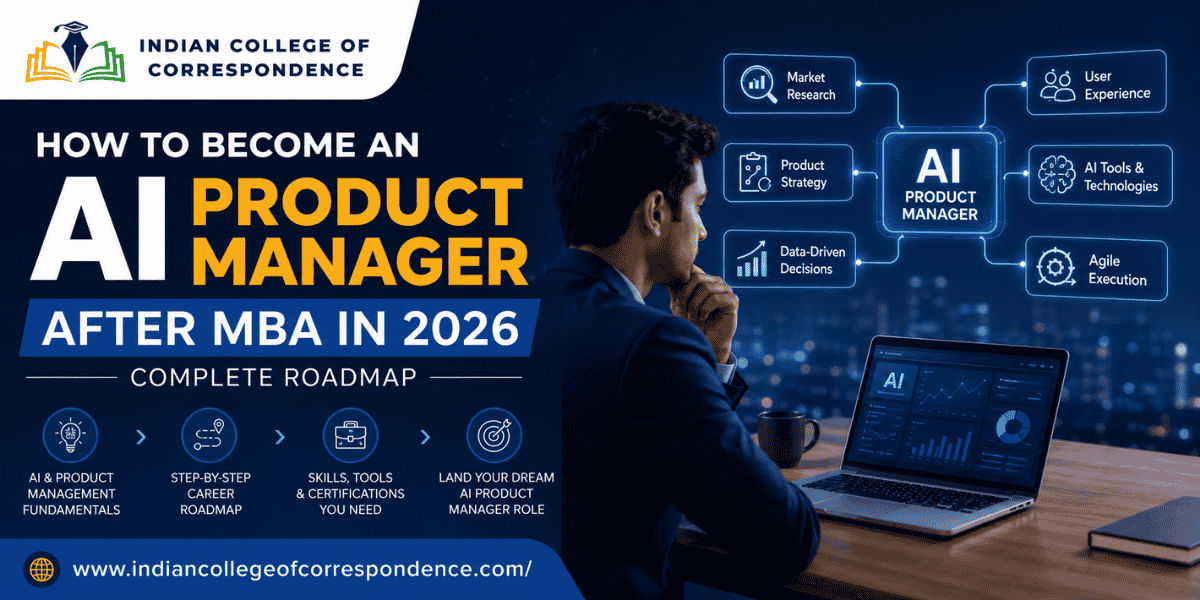
  • How to Become an AI Product Manager After MBA in 2026: Complete Roadmap?

    • 07,Aug 2026
    • Posted By : opsadsthrivein@gmail.com opsadsthrivein@gmail.com
    • 0 Comments
    • correspondence degree colleges in bangalore
    • management distance education in bangalore
    • MBA distance education in bangalore
    Artificial Intelligence (AI) is no longer the exclusive domain of the technical teams. It is transforming how companies design, deliver and discover products and is fundamentally reshaping customer relationships, automating processes and driving new revenues. This creates a unique opportunity for MBA graduates who want to go beyond business school and actively engage with technology teams. AI Product Manager After MBA is an emerging role that combines business, customer discovery, product design, analytics and technical AI competencies. An MBA graduate does not have to become a full-stack programmer to be able to transition into this space – but understanding the mechanics of how AI products work is now a must. With the right skills, projects and certifications, making the leap into AI Product Manager After MBA is a realistic possibility for 2026.

    Core Responsibilities of an AI Product Manager

    Before diving into learning tracks and salary ranges, it is important to understand the core responsibilities of the role. An AI PM is responsible for identifying customer problems that can be solved by AI and articulating how these can be addressed through a certain product or feature. They serve as a link between executives, customers, designers, developers, data scientists, and other stakeholders. The life-cycle of an AI product typically takes the following form: Customer problem → Discovery → AI opportunity → Product strategy → Prototyping → Development → Testing → Launch → Feedback → Iteration While many believe that an AI product manager only has to apply ChatGPT or other large language models to whatever use-case they have, the reality is more nuanced. An effective product manager understands what can and cannot be solved with AI, the data needed to train a model, what signals to measure for success, and potential pitfalls. For anybody considering an AI PM After MBA career-track, this is the most important lesson: how to bridge the business and technical sides of the equation. An AI PM can work on any product and industry vertical, with the use-case varying depending on the domain and company: AI search → Recommendation engines → Customer service assistants → Fraud detection → Personalisation → Education AI → Generative AI → Automation → Analytics AI → Intelligent workflows This is the essence of product management: solving a business problem for a particular audience.

    Why MBA Graduates are Well Positioned to Transition to AI Product Management?

    An MBA gives prospective product managers a solid foundation that can be built upon with additional skills to transition into an AI PM role. Business school students learn marketing, finance, operations, strategy, and leadership – disciplines that provide a strong basis for any product manager, including AI PMs. What an MBA candidate might lack is technical depth – an understanding of how exactly AI works and how to effectively collaborate with engineers. This is an important consideration when assessing whether an MBA is the right foundation for an AI PM career-track. An MBA graduate is not expected to know all the technical nuances of an ML engineer. Rather, they should be able to ask the right technical questions and understand the implications of design and technical decisions on the product’s business goals. This is why many AI PM After MBA candidates pursue additional learning in AI while completing an MBA through distance education, or apply their product knowledge and experience working on AI products to their career.

    The AI PM Skill Gap:

    Think of an AI PM as a traditional product manager with an additional technology layer of expertise. kills You Already Have as an MBA Candidate: Business strategy Marketing Financial literacy Presentation Leadership Negotiation Project management Market analysis Skills You Need to Learn as an AI PM: AI basics ML basics GenAI basics LLMs basics Prompt engineering APIs Data basics Product analytics AI evaluation Responsible AI Technical documentation SQL basics These combined skills allow you to occupy a rarified space as an AI PM with a comprehensive understanding of business and technology on both sides of the equation.

    AI Product Manager Course

    When choosing an AI Product Manager Course it is important to think beyond the certificate and focus on the core learning outcomes: An effective AI PM Course should cover product discovery, product strategy, AI basics, customer discovery, analytics, experimentation, AI evaluation, prototyping and product launch. Modern programs are focusing less on AI theory and more on product management with an emphasis on analytics, road-mapping and practical application. For example, an AI-integrated product management program from EICTA recently launched, covering product strategy, analytics, AI across the product lifecycle and a portfolio centric capstone. When comparing an AI Product Manager Course, check whether it includes: 
    1. Product management basics
    2. AI & ML basics
    3. GenAI & LLMs
    4. Product analytics
    5. User research
    6. Product roadmap
    7. AI product case studies
    8. Projects
    9. AI evaluation
    10. Responsible AI
    Having a certificate is not what makes one a competent AI PM. Demonstrated practical application of knowledge is far more important.

    AI Product Manager Roadmap in 2026

    An effective AI Product Manager Roadmap can be split into 6 stages.

    Step 1: Master Product Management Fundamentals

    Learn the basics before moving on to more complex topics. Product discovery User personas Customer interviews Product-market fit MVP planning Product roadmap User stories Product requirements Agile methodology Metrics As a candidate aiming to transition into an AI PM role after an MBA, being able to explain why a product should exist is more important than being able to design the technology stack behind it.

    Step 2: Get up to Speed on AI Fundamentals

    While an AI PM does not have to become an ML engineer, it is useful to understand the fundamentals of the field: Machine Learning Deep Learning GenAI LLMs NLP Computer vision Training & Inference Fine-tuning Embeddings RAG AI agents For an AI Product Manager After MBA the goal is practical application of knowledge. Knowing what a certain technology can and cannot do is more important than memorizing mathematical foundations.

    Step 3: Get Hands-On With Data

    Modern PMs are expected to be somewhat technically proficient. This usually means having working knowledge of: Excel SQL Power BI Product analytics A/B testing Conversion rates Retention Customer acquisition Analytical fluency will allow you to make informed decisions when building AI products.

    Step 4: Understand How AI Products Are Built

    An effective AI PM should understand the general technology stack of an AI product: User-interface → application → API → AI → data → response → evaluation Additionally, one should have a basic understanding of: Data quality Model accuracy Hallucinations Latency Costs Privacy Security Scalability Monitoring IT distance education can be helpful in this stage for anybody considering an AI PM After MBA transition, although it is not strictly necessary. The goal is to have an appreciation for the technical depth of the field without necessarily having to master all the complexities.

    Step 5: Build an AI Product Portfolio

    This is where many candidates fail. While having certificates is useful, it is even more important to be able to demonstrate tangible application of one’s skills. As an AI PM, you can build a portfolio around real-world applications and use-cases. Aim for 2-3 projects as an AI Product Manager After MBA candidate. Here are a few ideas: AI resume screening AI student learning AI customer-support AI financial planning AI recommendation AI market research AI healthcare scheduling For each project showcase: Customer problem → target audience → research → AI opportunity → product requirements → prototype → metrics → risks → next steps

    Step 6: Get a Job as an AI Product Manager

    Unless you are already employed as an AI PM, your first position is unlikely to use this exact title. Entry-level roles can include: Product analyst Business analyst Associate Product Manager Product operations analyst AI product associate Product owner Junior product manager Product manager This is a much more realistic goal for many AI Product Manager After MBA candidates.

    Most Important Skills for an AI Product Manager

    The most effective AI Product Manager After MBA candidates are usually multi-disciplinary: a combination of the following four areas.
    Skill Area What to Learn Why It Matters
    AI GenAI, ML, LLMs, RAG Understand AI capabilities
    Product Roadmaps, MVP, PRD Build useful products
    Data SQL, Excel, Analytics Measure performance
    Leadership Communication, Strategy Align teams

    How to Build an AI Product Manager Portfolio?

    Your portfolio can become your most persuasive asset if you know how to leverage it. Say, for example, you decide to build an AI customer-support product. Instead of merely listing your achievements on a LinkedIn post, you can go beyond and structure your thinking around the project, showcasing your actual product management skills: Problem Statement Target audience Competitive analysis Proposed solution Research & development Prototype Metrics Risk assessment Business Model For an AI Product Manager After MBA this is a much more valuable exercise than listing out random certificates. You can publish your findings on a linkedin post or page, create a website, document your product decisions, or store relevant files in a repository.

    What To Learn Alongside Your MBA?

    If you are an MBA candidate enrolled in correspondence colleges in Bangalore you can take advantage of the flexibility and build additional skills that will give you an edge over competitors. Here is one potential weekly breakdown:
    • Mon/Tue: AI Fundamentals
    • Wed: Product management
    • Thu: Data analytics
    • Fri: AI Tools
    • Sat: Project work
    • Sun: Reading & research
    It is much more realistic to build on your product management knowledge little-by-little rather than trying to squeeze in 10 certificate programs at once. Students who are considering distance education in Bangalore can also supplement their core management studies with additional certificates, internships, case studies, and projects.

    AI Product Manager Jobs

    The domain of AI is exploding, with products being developed across industries and geographies. These are some of the common AI Product Manager Jobs: AI Product Manager Associate Product Manager AI Product Analyst Product Manager – Generative AI AI Product Owner Product Strategy Manager AI Solutions Product Manager Technical Product Manager Product Operations Manager In practice, job titles often vary widely between companies and regions. It is more useful to focus on the core responsibilities and see if your skills-set is applicable rather than chasing a certain job title. For an AI Product Manager After MBA candidate it might be helpful to start with similar product roles across industries.

    Where Can AI Product Managers Work?

    AI product opportunities are not limited to software companies.
    Industry AI Product Examples
    Banking Fraud detection, AI assistants
    Healthcare Diagnostics, patient platforms
    Education AI tutors, learning systems
    Retail Recommendations, demand prediction
    FinTech Risk analysis, automation
    Marketing Personalisation, campaign analytics
    Logistics Route optimisation
    SaaS AI productivity tools

    AI Product Manager Salary in India in 2026

    Salaries for AI Product Manager Jobs vary significantly and depend on experience, company, location, product focus, and technical proficiency. Glassdoor’s June 2026 India compensation report showed an approximate range of ₹19.5L – ₹42.4L for AI Product Managers, with other credible sources pointing towards similar figures for experienced professionals. These are rough estimates and should be taken as context, not a guarantee. An AI Product Manager After MBA should have realistic expectations when it comes to compensation. This is what a typical salary progression could look like: Entry-level roles: Lower end of the spectrum Associate Product Manager: Mid-range Product Manager: Higher end Senior AI PM: Premium roles Product leadership: Very competitive compensation Compensation depends on skill-sets and ability to demonstrate expertise.

    Can Distance Education Students Become AI Product Managers?

    Students enrolled in distance education programs can absolutely make the transition into AI product management. They can take advantage of extra time to build necessary skills. Distance education students can begin working on AI-integrated product projects, pursue product certifications, gain work-experience, network in relevant communities, and build a portfolio. Similarly, students considering correspondence degree colleges in Bangalore should understand that the quality of their skills and project experience matters much more than the degree itself. The same applies to those interested in a correspondence college in India. In many ways, your degree is only one part of the equation. The other, often more important, part is your ability to demonstrate your skills, experience, projects, networking, and communication abilities. For an AI Product Manager After MBA candidate, the flexibility of a distance education program might be crucial in allowing the time and resources to gain additional product management expertise.

    Common Pitfalls to Avoid When Transitioning to AI Product Manager

    Avoid these common pitfalls on your path to becoming an AI PM.
    • Pitfall 1: Certifications Over Projects –Multiple certificates cannot make up for one strong product case study.
    • Pitfall 2: Prompt Engineering is All You Need-Prompting is only one area of AI PM. Focus on product discovery, strategy, analytics, and experimentation.
    • Pitfall 3: Neglect Technical Foundations-You do not have to know how to code, but you should know your APIs, data, models, RAG, evaluation, and infrastructure.
    • Pitfall 4: Forget About Customers-AI cannot solve problems on its own. Always think about how your product addresses a business challenge.
    • Pitfall 5: Apply Only for Senior Positions-Your experience level should dictate your targeting strategy. As an entry-level candidate, you should focus on entry-level positions.
    • Pitfall 6: Underestimate Communication-Effective communication is vital for an AI PM since they usually operate at the intersection of multiple departments.

    How Long Does It Take to Become an AI Product Manager?

    How long it takes to become an AI PM depends on your experience, skills, and the amount of time you can dedicate to the transition process. If you already have a background in product management, only a few months of focused learning may be needed. If you are an MBA candidate with limited product management experience, it may take 6-12 months to gain the necessary skills and build a strong portfolio. A 2026 roadmap for AI PM suggested by a practitioner can serve as a useful guide. The emphasis should be on mastering core product management competencies, gaining practical knowledge of artificial intelligence, launching an AI product, understanding evaluation and infrastructure, and building a network. When transitioning to an AI PM role, focus on your capabilities rather than the number of certificates you have accumulated. As an AI PM, you should be confident in your ability to explain what you are building, who your target audience is, what requirements your product should meet, what technology stack to use, potential risks, and relevant performance metrics.

    Is AI Product Management a Good Career in 2026?

    If you are considering a career as an AI Product Manager it is important to understand the context within which this role operates. Artificial Intelligence is quickly becoming one of the most important technologies of our time. AI PMs operate at the intersection of business, customers, data, and technology, making this one of the most compelling roles of the decade. Additionally, AI products and services are set to become significantly more sophisticated over the next few years. This means that apart from traditional product management competencies, AI PMs will need to acquire a deep understanding of evaluation, model limitations, agents, RAG, responsible AI, and other related concepts. In this respect, AI PMs are likely to evolve beyond simply “enhancing” products with AI. For an AI Product Manager After MBA this will be an ongoing process that requires continuous learning. The role will increasingly rely on people who intuitively understand the technology without getting bogged down in theory.

    Why Choose UCC for Your Management Education?

    Building a technology career, or transitioning into a different one, requires not only a solid educational background but also the ability to apply this knowledge in practice. UCC aims to provide students with the flexibility and opportunities they need to pursue their professional goals. Students can take their studies one step further and complement their primary field with additional expertise in product management, analytics, AI, and other areas. If you are considering MBA distance education in Bangalore, it is useful to think about what additional knowledge and experience you would like to gain alongside your degree. The goal should be to get the most out of the time and resource investment by obtaining an education that provides you with multiple opportunities.

    Conclusion

    The transition to an AI Product Manager After MBA is not about replacing your MBA with technology; instead, it is about adding technological and product management knowledge to your existing managerial skills. Learn about products, study AI, and develop data skills, create something, document your learning and decisions, gain experience, and apply strategically. Your combination of these abilities can help you achieve AI product management jobs in the future.

    Start Your AI Product Management Career

    For MBA students and graduates interested in transitioning from management to technology, the critical question is where to start. There is no need to try to consume everything at once. First, learn the basics of product management, acquire AI literacy, understand data, create something, document your decisions, and gain experience. Then, you will be in a powerful position to apply strategically. An AI Product Manager After MBA career is not something that can be achieved overnight, but the right approach will make the transition much smoother. Explore the best executive education options, learn more about AI, and start creating a product portfolio that will help you stand out to potential employers. Are you ready to embark on this journey? Explore United College of Correspondence excellent alternatives for flexible education and start preparing for AI-driven product careers in 2026 and beyond.

    FAQs

    1.Can I become an AI Product Manager after an MBA?

    Anyone can become an AI product manager, but it takes time and effort to develop the required combination of business, product management, and technical skills. Some technical experience is necessary, but there are many areas where an MBA can help. Most AI Product Managers after MBA require technical literacy but not necessarily coding skills. It is vital to develop product management skills, such as understanding customer problems, articulating requirements, selecting appropriate performance indicators, managing stakeholders, and making decisions based on evidence.

    2.Do I need an MBA to become an AI Product Manager?

    An MBA is an excellent foundation for an AI Product Manager After MBA career but is rarely sufficient on its own.Supplement your management knowledge with practical AI literacy, product management skills, and experience. Becoming proficient in Generative AI, Large Language Models, product analytics, and model assessment will make you a better AI product manager, and a portfolio that demonstrates your practical skills will get you a job. Your MBA will give you a competitive advantage if you combine it with the right technical expertise and evidence of your ability to lead AI product development projects.

    3.What is the best AI Product Manager Course for 2026?

    The best AI Product Manager Course should provide you with a solid understanding of the fundamentals of AI, large language models, and analytics. However, it is essential to choose an AI Product Manager Course that will also teach you practical skills and help you build a portfolio. In 2026, the focus is on product-led AI, so look for programs that provide you with hands-on experience with prompt engineering, prototyping, roadmapping, and experimentation. A portfolio-based AI Product Manager Course can be a good option worth considering because it will give you specific materials to discuss during your job interviews.

    4.What skills should I learn for an AI Product Manager job after an MBA?

    For AI Product Manager Jobs, it is essential to gain product management skills while studying AI fundamentals. Focus on learning AI product strategy, customer discovery, analytics, SQL, and product metrics, experimenting, and communicating with technical and non-technical stakeholders. You should also understand generative AI models, large language models, RAG, model assessment, and API basics. An AI Product Manager needs technical knowledge comparable to technical specialists’ (e.g., ML engineers) but not necessarily deep expertise. Two or three practical AI product development projects can help you learn and demonstrate your skills.

    5.How much does an AI Product Manager earn in India in 2026?

    An AI Product Manager’s salary depends on many factors, including experience, company, location, and seniority. According to reports by Glassdoor published in 2026, in India, the average salary for an AI Product Manager ranges from ₹19.5 lakhs to ₹42.4 lakhs per year, with significant variation between listings. More senior professionals can make substantially more depending on their qualifications and the company they work for. An MBA itself is unlikely to influence your salary directly, but the combination of product and AI expertise will play a crucial role in determining what and how much you can earn in AI product management.

    6.Can I get an AI Product Manager job after an MBA?

    It is possible to get an AI Product Manager job after an MBA, but it is unlikely that you will be able to secure a high-level position right after graduation. Instead, consider lower-level AI product management roles as a potential career entry point. However, it is also helpful to gain experience in product management, analytics, or related fields while completing your MBA or after graduation. This experience, combined with AI-specific knowledge, will enable you to transition to an AI Product Manager role.

    7.What projects should I build for an AI Product Manager portfolio?

    When building an AI Product Manager portfolio, focus on showcasing your decision-making skills rather than technical implementations. Use real-world use cases, such as building an AI assistant for customer service, students, or financial planning. Describe your proposed solution’s target audience, the problem it would solve, and your approach to discovering customer requirements. Explain what technology (LLMs, RAG, or other) you would use, develop a prototype, determine key performance indicators, evaluate risks, and discuss future improvements. A well-documented project can demonstrate your product management skills in-depth even if you have limited product development experience. For an AI Product Manager After MBA, such a portfolio can be critical in getting a job because it demonstrates real-world application of knowledge beyond academic studies.

    8.Can students pursue a career as an AI Product Manager after distance education?

    Students who have pursued distance education in Bangalore or elsewhere can build careers as AI Product Managers if they acquire the necessary skills. Those who have studied through distance education in Bangalore or at a correspondence college in India should seek opportunities to gain experience working with AI products outside their field of study. This might include obtaining certifications in AI and product management, developing relevant skills, gaining experience, and participating in product development communities. Students from distance education institutions should look for internships and other opportunities to demonstrate their practical skills. A flexible schedule offered by some distance education programs can be beneficial in this regard.

Leave A Comment