

| Your academic background | What you need to verify | Recommended next step |
| B.Com with Mathematics in Class 12 | Whether the programme accepts Mathematics at 10+2 level and whether other conditions apply | Check the current eligibility section of the programme brochure |
| B.Com with Mathematics or a specified mathematical subject during graduation | Whether the exact subject satisfies the published requirement | Compare the subject name on your transcript with the admission criteria |
| B.Com without Mathematics at either level | Whether the programme offers a formally permitted alternative route | Ask the university; do not assume a bridge course will make you eligible |
| B.Com with Business Mathematics or Statistics | Whether the university recognises the subject for MCA eligibility | Submit the subject details and request written clarification |
| B.Com with Computer Applications but no Mathematics | Whether Computer Applications meets the programme’s academic requirements | Check whether Mathematics remains compulsory |
| Final-year B.Com student | Whether provisional or final-year applications are permitted | Confirm the application deadline and documentation rules |
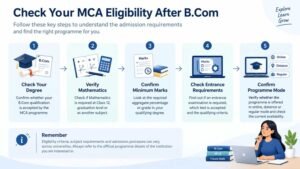 Step 1: Identify the exact programme. Record the university name, MCA programme title, delivery mode and intended admission session.
Step 2: Read the current official admission brochure. Do not depend solely on an old blog, a third-party course listing or a short promotional description.
Step 3: Check the qualifying-degree requirement. Confirm whether a B.Com degree is accepted and whether any restrictions apply to the type of bachelor’s degree.
Step 4: Check the Mathematics rule. Look for the exact reference to Class 12, graduation-level Mathematics, Statistics, Computer Science or other named subjects.
Step 5: Confirm minimum marks and selection requirements. Note the aggregate percentage, any applicable relaxation, entrance examination and other selection conditions.
Step 6: Verify the learning format. Ensure that the eligibility information relates to the online, ODL or regular programme you actually want to pursue.
Step 7: Ask if any point is unclear. Send the admissions team your degree details and the exact subjects you studied. Request written confirmation rather than relying on an informal general answer.
For students comparing options through a correspondence college in India, the same checks still apply. A college or education adviser can help you understand available pathways, but the awarding university’s published admission rules determine whether your qualifications meet the programme’s requirements.
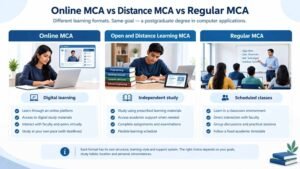
| Factor | Online MCA | Open and distance learning MCA | Regular MCA |
| Learning format | Primarily digital learning arrangements as defined by the programme | Independent study using the institution’s prescribed learning materials and support | Scheduled classroom and campus-based learning |
| Interaction | May include virtual classes, discussion forums or faculty sessions | Depends on the university’s learning and support arrangements | Typically includes face-to-face interaction |
| Study routine | May offer flexibility, but deadlines and scheduled activities still apply | Requires consistent independent study and attention to assessment schedules | Usually follows a more structured timetable |
| Assessment | May involve online or designated examination arrangements, as officially specified | Examination arrangements depend on the programme | Generally follows the institution’s regular examination system |
| Work-study balance | May suit some working students if the workload is manageable | May suit independent learners who can organise their time | May be harder to combine with full-time work, depending on the timetable |
| Eligibility | Must be checked for the exact online programme | Must be checked for the exact ODL programme | Must be checked for the exact regular programme |
| Main consideration | Digital access, academic support and assessment rules | Study discipline, support and examination requirements | Attendance, campus access and scheduled academic activities |
 For a student exploring IT distance education, flexibility may be important, especially if they are working. However, flexibility alone is not enough to determine whether a programme is suitable. The curriculum, technical practice, assessment requirements and recognition status matter just as much.
| What to check | Where to verify it | Why it matters |
| B.Com accepted as a qualifying degree | Official admission brochure | Confirms whether your undergraduate qualification is eligible |
| Mathematics requirement | Programme eligibility section | Clarifies which level and subject combination is accepted |
| Minimum marks | Current admission rules | Helps determine whether you meet the academic threshold |
| Entrance examination | Official admission notice or test authority | Confirms the test, score and selection process, if required |
| Delivery mode | Official programme page | Ensures the rules apply to the online, ODL or regular course you want |
| Recognition or approval | Official institution and programme information | Helps verify the status of the intended qualification |
| Complete fees | Official fee schedule | Prevents unexpected compulsory costs |
| Application documents | Official checklist | Helps avoid incomplete or delayed applications |
| Final-year conditions | Current admission notice | Clarifies whether provisional applications are permitted |