
Admission opens for 2026-27 sessions for all university.

Blog Detail

  • How to Become a Data Privacy Analyst After B.Sc in 2026: Skills & Career Path?

    • 21,Aug 2026
    • Posted By : opsadsthrivein@gmail.com opsadsthrivein@gmail.com
    • 0 Comments
    • B.Sc correspondence college in Karnataka
    • distance Msc degree college in bangalore
    • Science distance education in Bangalore
    In a world where businesses capture customer data, employee information, financial records, medical history, and digital footprints, the need for privacy and protection of personal or sensitive data has become critical. That is why a Data Privacy Analyst After B.Sc can carve out a fascinating career by blending scientific skills and analytical knowledge with technology and privacy expertise. For B.Sc students looking to venture into this field, becoming a Data Privacy Analyst After B.Sc may not be an uphill slope. With your science background, you already have some analytical expertise that will be useful and make you stand out from other candidates without a science background. The key is to combine your scientific skills with data privacy knowledge, technical know-how, practical exposure, and industry knowledge to grow your career in data privacy, cybersecurity, and related fields. Furthermore, a career in data privacy is increasingly evolving and crossing borders, and analysts work in multidisciplinary environments. In addition to working in privacy, regulation, and compliance teams, data privacy analysts also collaborate with various stakeholders such as IT, cybersecurity, legal counsel, enterprise product management, data management, and business operations departments. Current data privacy job descriptions also include technical aspects such as data privacy governance, data mapping, and privacy risk assessment, technical and regulatory aspects of privacy law, auditing, cyber security training, and incident response.

    Why Is Data Privacy Becoming a Career Opportunity in 2026?

    Consider how much data individual people and businesses have on individuals. An online retailer can store customer data like names, addresses, email, phone numbers, payment information, and the products they purchase. Other entities such as hospitals, banks, and educational institutions hold much more sensitive data on individuals. Someone must determine what information is collected, why it is collected, how and where it is stored, who should have access to it, how long it is kept, and how secure it is. In addition, an analyst must ensure that an entity is compliant with applicable data privacy laws. That is why there is a need for a Data Privacy Analyst after B.Sc. The position requires professionals who can operate in a field that involves data, technology, risk management, compliance, and responsible data handling.

    What Does a Data Privacy Analyst Actually Do?

    A Data Privacy Analyst After B.Sc can be much more involved than one expects. There is a lot of variety depending on the industry you are in, but common responsibilities include:
    • Review personal information processing practices
    • Privacy assessments
    • Data flow mapping
    • Privacy documentation maintenance
    • Assist with data inventories
    • Respond to data-subject requests
    • Privacy risk assessments
    • Vendor or third-party assessments
    • Privacy compliance reporting
    • Support privacy audits
    • Monitor privacy requirements
    • Collaborate with IT, cybersecurity, legal, and business teams
    For example, when a company launches a new mobile application, it must understand what personal information the application collects. A privacy professional can work with the organization to identify the information and evaluate the associated risks to determine if there are any security controls or privacy-related risks that should be addressed. Privacy analyst job descriptions frequently include conducting privacy impact assessments, data mapping, risk analysis, auditing, incident response, and technical liaison services.

    Can a B.Sc Graduate Become a Data Privacy Analyst?

    Yes, a data privacy analyst after B.Sc is a valid pursuit if one is willing to put in the effort to gain the necessary knowledge and experience beyond their degree. A B.Sc degree can provide a strong foundation of research, analytical, logical reasoning, and data-handling skills, but it is unlikely that one would have the exact qualifications needed to pursue a position as a data privacy analyst right away. Therefore, it is crucial to obtain additional knowledge in:
    • Data fundamentals
    • Privacy concepts
    • Cybersecurity basics
    • Database knowledge
    • Risk management
    • Compliance awareness
    • Documentation skills
    • Analytical tools
    • Privacy-related work experience
    It is hard to tell which qualifications are the most desirable for the position as it may differ from one company to another. The current job market demonstrates that professionals who occupy privacy-related positions have come from a variety of fields, including technology, cybersecurity, compliance, auditing, data governance, operations, legal, and many others. 

    Which B.Sc Backgrounds Can Be Useful?

    A Data Privacy Analyst After B.Sc can be a great choice for people who graduate from tech and data science-oriented degrees. Some of the relevant backgrounds include:
    • B.Sc Computer Science
    • B.Sc Information Technology
    • B.Sc Mathematics
    • B.Sc Statistics
    • B.Sc Data Science
    • B.Sc Physics
    • B.Sc Biotechnology
    • B.Sc Chemistry
    • Other science stream specialisation 
    Having said that, it is important to note that a specialization on its own will not guarantee you a lucrative data privacy analyst job. The key is to build the necessary skills in privacy, data, technical, and analytical areas. The students in correspondence college Karnataka can also consider their options before deciding on whether their specialization will provide them with the much-needed flexibility to develop the necessary skill set alongside their academic qualifications.

    The Core Skills You Need

    A competent Data Privacy Analyst After B.Sc is typically not defined by a singular skill. There is a broad range of expertise that may be required, including but not limited to:

    1. Privacy Fundamentals

    The first area of expertise that a Data Privacy Analyst After B.Sc must possess is a foundational knowledge of privacy principles. Some of these principles include:
    • Personal data
    • Sensitive information
    • Data minimization
    • Purpose limitation
    • Data retention
    • Consent
    • Data access
    • Data deletion
    • Privacy notices
    • Data subject rights
    While there is a substantial amount of information to be learned about privacy laws, it is best to first learn the underlying principles that guide responsible data processing.

    2. Data and Database Knowledge

    The next area of expertise that a Data Privacy Analyst After B.Sc must possess is a comprehensive understanding of how data is processed within an organization. This includes:
    • Database fundamentals 
    • Tables and records
    • Data classification
    • Data lifecycle
    • Data flows
    • Data storage
    • Basic SQL
    • Data access controls
    SQL is a particularly important skill to learn, as it enables a Data Privacy Analyst After B.Sc to have more control over querying databases, rather than relying on others to extract data for them. Additionally, many career guides highlight SQL proficiency and data auditing as important technical skills for privacy analysts.

    3. Cybersecurity Awareness

    The fields of cybersecurity and privacy are closely intertwined, and while they have their distinctions, a Data Privacy Analyst After B.Sc should have a foundational understanding of cybersecurity concepts such as:
    • Encryption
    • Authentication
    • Authorization
    • Access control
    • Data breaches
    • Secure storage
    • Data loss prevention
    • Incident response
    A Data Privacy Analyst After B.Sc is not expected to know how to be an ethical hacker, but they must know enough about cybersecurity to be able to communicate effectively with an organization’s cybersecurity teams.

    4. Risk and Compliance

    A Data Privacy Analyst After B.Sc is responsible for assessing an organization’s privacy-related risks and ensuring that appropriate safeguards are in place. In order to do so, they must have an in-depth knowledge of:
    • Privacy 
    • Risk assessment
    • Compliance management
    • Control environment
    • Audit trails
    • Policy documentation
    • Regulatory requirements
    This is one of the primary reasons why many privacy analysts come from an auditing background, as the skills required for both fields often overlap.

    Privacy Tools Worth Exploring

    You do not need to be an expert in all the privacy tools before landing your first job. Instead, it is important to understand what privacy technology is intended to do. A Data Privacy Analyst after B.Sc can consider learning and mastering the following tools and technologies:
    • Data discovery
    • Data mapping
    • Consent management
    • Privacy assessments
    • Data governance
    • Compliance management 
    • Workflow management
    • Reporting
    Privacy-management platforms such as One Trust, Trust Arc, Big ID and similar privacy-management tools are mentioned in the career guide. Additionally, spreadsheet programs such as Excel, project management tools such as Jira, Confluence, and reporting tools such as Power BI can be utilized for documentation, workflow management and reporting.

    Privacy Regulations You Should Know

    A Data Privacy Analyst after B.Sc should familiarize himself with the significant privacy regulations and standards. However, it does not mean that one should strive to become an expert in law. According to the privacy job market needs, one might stumble upon the following privacy-related regulations:
    • GDPR
    • India’s Digital Personal Data Protection framework
    • CCPA/CPRA
    • Industry-specific privacy requirements
    • The company’s privacy policies
    Therefore, when you focus on the India-specific field, it is essential to be aware of the data privacy rules and regulations peculiar to the territory. In addition, when you work with various overseas clients, you may come across the Data Protection laws of other countries and regions. Moreover, it is vital to remember that regulatory compliance requirements shape many privacy-related aspects of business operations.

    What About the Digital Personal Data Protection Framework in India?

    For an individual embarking on the career of a Data Privacy Analyst after B.Sc., it is essential to stay updated regarding the data protection developments in India. The privacy professional is a liaison between the regulatory requirements and the business practices, which involves data inventory, assessments, documentation, controls, and other activities, necessitating continuous learning and professional development for students. Moreover, since the regulatory landscape and business practices are ever-evolving, one must approach the education process as an ongoing endeavour.

    Do You Need Coding to Become a Data Privacy Analyst?

    One of the most frequent questions concerning career options in data privacy concerns the relationship between programming knowledge and the Data Privacy Analyst After B.Sc. In general, advanced skills in computer programming are not required for entry-level positions in this field. However, they are beneficial for solving specific technological challenges and stand to make your career prospects more diverse in the long run. To give you an idea of what exactly falls under this umbrella term, here is a (non-exhaustive) list of relevant skills:
    • Basic proficiency in SQL
    • Database technology
    • Spreadsheet analysis
    • Data visualization tools
    • Plus some exposure to scripting 
    • And cloud technologies
    • Can be advantageous, and 
    familiarity with the principles of API and application design is also a plus. In other words, you do not need to know how to code apps from scratch, but you should be able to grasp their underlying technological workings on a theoretical level.

    Build Practical Projects Before Looking for Jobs

    A Data Privacy Analyst after B.Sc. can present practical work experience instead of certifications to prove competency in the field. Here are some entry-level projects for a data privacy analyst:

    Project 1: Data Inventory

    Create a sample inventory that includes the following details.
    • Data type
    • Source
    • Purpose
    • Storage location
    • Access level
    • Retention period
    • Potential risk

    Project 2: Privacy Impact Assessment

    Choose an imaginary mobile application and conduct a privacy impact assessment. The result should include the following:
    • What personal information is processed
    • The purpose of processing 
    • Who receives the information 
    • Privacy risks involved 
    • Recommended controls

    Project 3: Data Flow Map

    Create a sample of the data flow of a customer from visiting the website and provide information to the application database, from there to internal staff, and to a third party. Additionally, identify potential privacy risks at each step.

    Project 4: Privacy Compliance Dashboard

    Create an excel sheet or power BI dashboard that displays privacy request statistics, assessment progress, risk levels, and percentages of completed activities. The described practical projects will prove that the candidate has a sufficient understanding of how data privacy principles operate.

    A Simple 90-Day Learning Plan

    If you are serious about becoming a Data Privacy Analyst After B.Sc, avoid trying to learn everything in one month.
    Period Learning Focus What You Should Achieve
    Days 1–30 Privacy + data fundamentals Understand personal data and privacy principles
    Days 31–60 SQL + cybersecurity + compliance Build technical and risk awareness
    Days 61–90 Projects + tools + resume Create evidence of practical skills
    This approach is more manageable than collecting random courses without a clear direction.

    Where Can You Study While Building This Career?

    There is a lot you can learn online while being on your professional journey. Searches like correspondence college in India and distance education in Bangalore are among the many ways people are looking out to advance their skills and knowledge even when they have to manage a career or internship alongside their studies. Others look out for correspondence degree colleges in Bangalore, Science distance education in Bangalore, B.Sc correspondence college in Karnataka, etc., as they seek more flexible alternatives to conventional classroom-based learning. In a similar way, those looking out for Teaching distance education, a B.Ed course for working professionals, an M.Ed correspondence college in Bangalore, B.Tech correspondence, etc., would find what they are looking for here. However, it is essential to note that due diligence is required before choosing to pursue any of these options as the reputation of the organization, accreditation and certification you will receive upon completion, syllabus, support systems, and whether the course aligns with your professional objectives are vital considerations that should not be overlooked. So, for those looking out for flexible learning options while building their careers, ICC is among the institutions you can consider enrolling with.

    What Jobs Can You Target After Learning Data Privacy?

    A Data Privacy Analyst After B.Sc is not limited to one post. Based on your skills and experience, you can also target:
    • Junior Privacy Analyst
    • Privacy Analyst
    • Data Protection Analyst
    • Privacy Operations Associate
    • Data Governance Associate
    • Compliance Analyst
    • GRC Analyst
    • Risk and Compliance Associate
    • Data Protection Associate
    • Privacy Compliance Analyst
    The job titles may vary from one organization to another. For instance, a Privacy Analyst job in Bengaluru at Deutsche Bank requires one to have knowledge of data-breach notification procedures, outsourcing controls, and GDPR and regulatory compliance. On the other hand, a Bengaluru Privacy Analyst – Technology position at Ather includes responsibilities such as working with privacy-enhancing technologies, data discovery and mapping, consent management, encryption, anonymization, and privacy impact assessments. This indicates that the job role can vary between technology and compliance areas.

    Which Industries Hire Privacy Professionals?

    A Data Privacy Analyst After B.Sc can work in a wide range of industries since most of them handle personal data of their clients. Some of the main areas include:
    • Banking & finance
    • IT & software
    • Healthcare
    • E-commerce
    • Telecom
    • Education
    • Consultancy
    • SaaS
    • Manufacturing
    • Government & public services
    These are just a few examples, but the list includes many other fields. Moreover, you can change it several times during your career. This flexibility attracts many people to the job, since they get an opportunity to find a niche that they are really passionate about.

    Career Growth After Becoming a Privacy Analyst

    There are several career growth options for a Data Privacy Analyst after Graduation from B.Sc. One such trajectory is as follows: B.Sc Graduate → Privacy/Compliance Intern → Junior Privacy Analyst → Privacy Analyst → Senior Privacy Analyst → Privacy Manager → Privacy Lead Other specializations could include:
    • Data Governance
    • GRC(Governance Risk Compliance)
    • Cybersecurity Compliance
    • Risk Management
    • Data Protection
    • Privacy Operations
    • Privacy Engineering
    The current career website suggests that entry-level Privacy Analysts typically assist with compliance, documentation, data mapping, and assessments. In more senior roles, one could be involved in driving strategic initiatives, overseeing complex projects, providing counsel, and leading privacy programs.

    Certifications: Are They Necessary?

    A Data Privacy Analyst After B.Sc does not require much to start learning this career path. However, there is an added advantage that comes with certifications. You can look up relevant credentials in the following areas:
    • Information privacy
    • Privacy management
    • Data protection
    • GRC
    • Cybersecurity
    • Data governance
    For instance, many career guides highlight privacy credentials like CIPP and CIPM as a good place to start building your knowledge. Instead, the emphasis is on:
    • learning
    • practice
    • projects
    • and experience
    with certifications considered as the final step and not the first.

    Mistakes B.Sc Graduates Should Avoid

    When building a Data Privacy Analyst After B.Sc career, individuals must be wary of several mistakes associated with privacy and avoid them. Some of the mistakes that one should avoid when embarking on a career in data privacy include assuming that the concept of privacy is purely legal, paying no attention to technical and database aspects, learning regulations without being aware of the working of data systems, accumulating certificates while ignoring the need to develop projects, applying only for jobs that use the title ‘Data Privacy Analyst’, failing to document and communicate, trying to memorize all the privacy regulations, and ignoring changes in technologies and policies. In addition, top candidates can discuss a privacy challenge, take part in researching the issue, and offer solutions to the problems.

    Is Data Privacy a Good Career Choice After B.Sc in 2026?

    For someone who wants to be involved in data, technology, compliance, and sensitivity, becoming a data privacy analyst after B.Sc. is a good option. The position is neither pure tech nor pure law but something in between. It has elements of both plus the aspects of management and documentation. As such, it is good for people who want to comprehend the technical processes at a deep level while also engaging in analytical, documenting, and policy-related activities. However, one should be aware that privacy, as a concept, is a constantly evolving field that requires continuous learning and the enhancement of one’s practical knowledge.

    Your Career Roadmap at a Glance

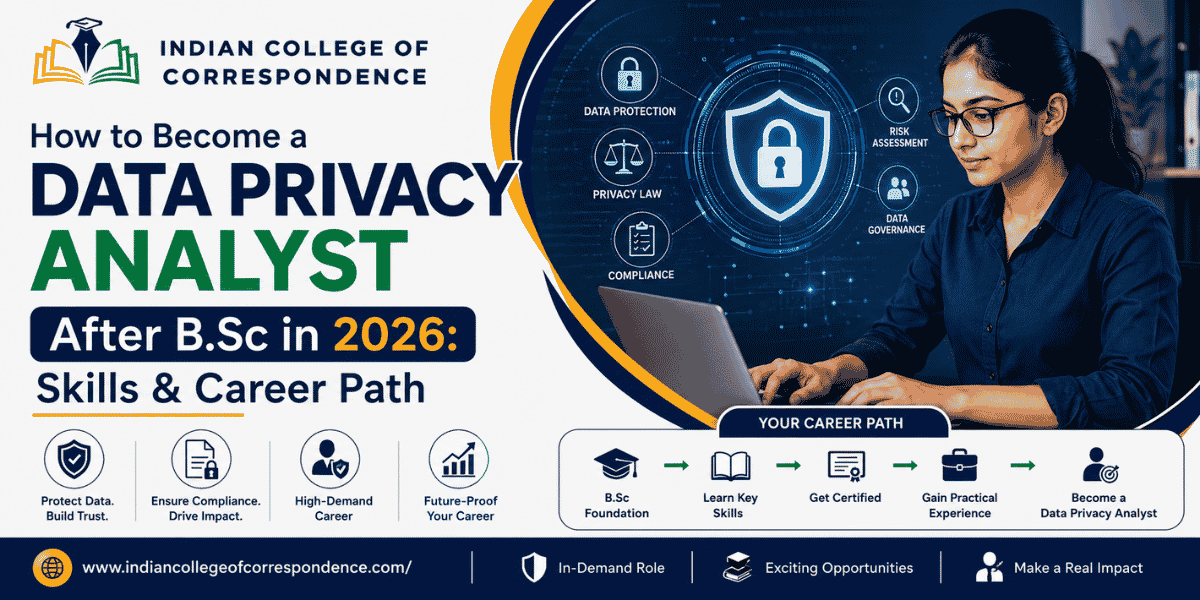
    A Data Privacy Analyst After B.Sc is a process that follows these steps: B.Sc Degree Learn Data Fundamentals Understand Privacy Principles Build SQL & Cybersecurity Basics Learn Risk & Compliance Practice Data Mapping & Privacy Assessments Build 2–4 Practical Projects Explore Relevant Certifications Apply for Entry-Level Privacy, GRC & Compliance Roles Grow Into Senior Privacy or Data Protection Positions

    Why Choose ICC for Your Education Journey?

    Considered for your educational needs, if you are preparing to pursue a promising career. A smart choice should take into account your own academic needs beyond the course title, for instance the syllabus, class structure, academic support, entry requirements, accreditation, and relevance to your future professional development. Therefore, a B.Sc looking to pivot their career towards data, privacy, technology or compliance needs to think of ways to enhance their academic qualifications with relevant practical skills to secure their desired job.

    Conclusion

    Building a Data Privacy Analyst after B.Sc is less about choosing the particular course and more about building the combination of education, technical awareness, privacy knowledge, and experience. It is essential to begin the process by learning the basics of data privacy. This should include learning about the fundamentals of data movement, privacy risk assessment, and data mapping. It also entails developing skills such as writing SQL code and gaining some cybersecurity knowledge. Furthermore, one might consider broadening their expertise through other means such as certifications or even entry-level jobs. It is critical to begin working on one’s experience and not wait for the right moment. This is because the best way to learn data privacy is by working on some of the actual use cases. One will only advance their career if they are able to take an existing B.Sc degree and turn it into a successful data privacy analyst career.

    Ready to Build Your Next Career Step?

    If you are a B.Sc student at the crossroads of education seeking to pursue a career in data, technology, privacy or similar fields of work, consider the learning opportunities at the Indian College of Correspondence, and choose the track that allows you to combine your educational background with your professional aspirations.

    FAQs

    1. Can I become a Data Privacy Analyst after B.Sc?

    Yes, A candidate with B.Sc can pursue a Data Privacy Analyst After B.Sc career by building their privacy fundamentals, data-set knowledge, cyber-security acumen, risk-management expertise, and hands-on experience.

    2. Is coding mandatory for a Data Privacy Analyst?

    Not mandatory, In several cases, coding is not required. Having basic knowledge of SQL, databases, cyber-security, cloud, and technical aspects can help you stand out.

    3. Which skills are most important for a Data Privacy Analyst?

    Some of these skills include knowledge of privacy principles, data mapping, PIAs, risk analysis, audits, documentation, cyber-security basics, communication, and analytical and problem-solving skills.

    4. Can freshers apply for privacy jobs?

    Yes, In several cases, entry-level positions are available. However, the job titles may differ, including Privacy Operations Associate, Compliance Analyst, GRC Analyst, Junior Privacy Analyst, and Data Governance Associate.

    5. Should I learn SQL for a privacy career?

    It is recommended to have basic knowledge of SQL because of your interaction with databases throughout your career. Moreover, you may need to understand the data structure, flow of data, and data pipelines to know if someone’s information is safe in an organization’s system.

    6. Are privacy certifications necessary?

    Not mandatory, However, certifications make you eligible for several renowned positions. But apart from certifications, technical skills, communication, and analytical skills, along with practical exposure, are required.

Leave A Comment