
Admission opens for 2026-27 sessions for all university.

Blog Detail

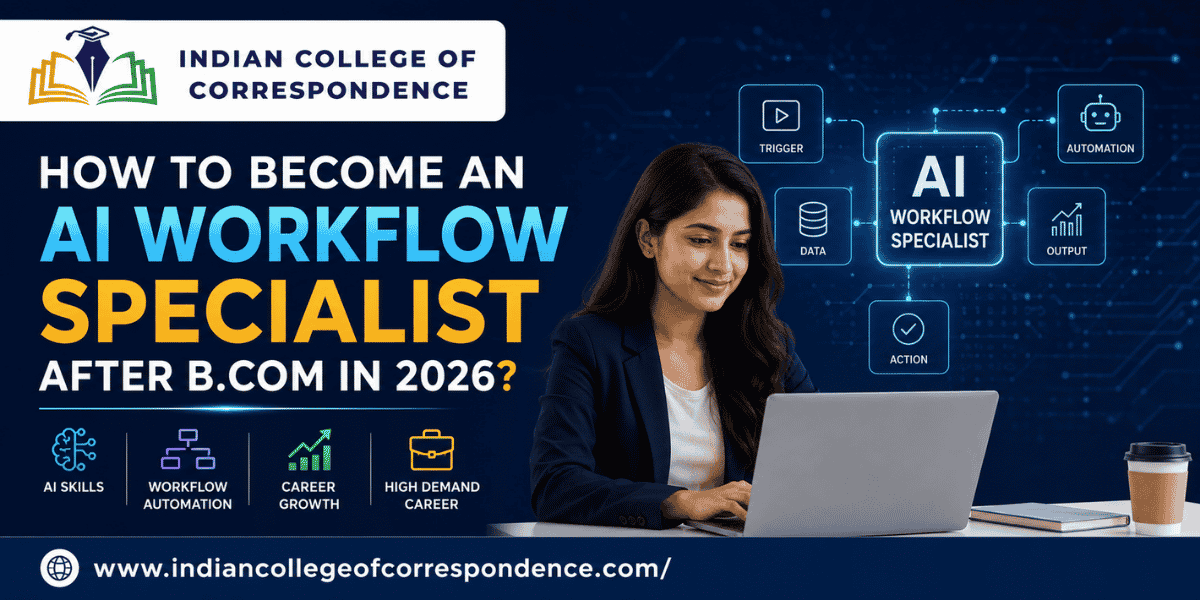
  • How to Become an AI Workflow Specialist After B.Com in 2026?

    • 22,Aug 2026
    • Posted By : opsadsthrivein@gmail.com opsadsthrivein@gmail.com
    • 0 Comments
    • BBA correspondence college in Karnataka
    • management distance education in bangalore
    • MBA distance education in bangalore
    Becoming An AI Workflow Specialist After B.com Can you imagine graduating from your B.Com course and landing up in a corporate world where most of the mundane report writing, customer follow-ups, data entry, lead qualifying, and other such tasks are automated using AI technologies? Instead of fighting for a lesser pool of commerce-related jobs, you could instead think of becoming an AI workflow specialist and being on the cutting edge of automation. Organizations are already starting to hire people with domain knowledge about business processes and operations who can understand how different kinds of AI technologies can fit into the existing setup to make workflows more efficient and productive. Some of the common skills listed for AI-related jobs that involve prompt engineering, workflow design, automation, documentation, monitoring, and other similar tasks include process analysis, prompt engineering, workflow design, integrations, documentation, monitoring, and communication. But if you have a B.com degree, there is an advantage that you already possess over several others, and it is understanding business processes, finances, and management. The only thing left for you to do is to learn about how AI can help you automate and optimize these to become a certified AI workflow specialist. This guide will help you understand how to become an AI workflow specialist after your B.com, including the skills needed, tools, projects, jobs, and other relevant information.

    What Does an AI Workflow Specialist Actually Do?

    Prior to discussing the learning tools, it is essential to define the role that an AI workflow specialist plays. An AI workflow specialist designs and optimizes the processes in which AI, automation systems, business programs, and humans interact. For instance, there is a customer support department that handles 500 customer inquiries weekly.  In a traditional setup, the process could look like this: Customer inquiry → Employee reads the inquiry → Data entry → Categorizing leads → Notifying the salespersons → Following up on the leads. However, with the implementation of an AI workflow, the process could transform into: Customer inquiry → AI reads the inquiry → Categorizing leads → Leads enter the CRM system → Following up on the leads → Notifying the salespersons The person who designed this process is an AI workflow specialist. This is why those considering what an AI workflow specialist does are advised to note that they would not simply be learning how to operate ChatGPT. Instead, they would be developing skills to solve business problems with AI. Modern-day AI specialists are also trained to track metrics such as decreased manual labor, optimized workflows, adoption rates, and much more.

    Why Can B.Com Graduates Become an AI Workflow Specialist?

    A B.Com graduate might think that AI-related fields are not suitable and primarily meant for B.Tech, BCA, or MCA graduates. This is totally wrong! A lot of workflow jobs take place between technical and non-technical departments. The employer often looks for people with knowledge of how the company works and how they can improve their current process with a digital one. You can become an AI workflow specialist with a B.com degree and have a major edge over others in areas like:
    • Finance & Accounts
    • Sales 
    • Customer Relation
    • Business Reports
    • Inventory 
    • Employee Management 
    • Documentation
    • Data 
    • Business Communication
    • Process improvement
    The trick is to not rely on your old degree but add your B.com skills in AI and automation.

    Your B.Com Knowledge vs Your New AI Skills

    You do not have to start your career journey from zero. Your degree already gives you useful business knowledge.
    B.Com Knowledge AI Workflow Application
    Accounting Invoice and finance automation
    Business management Process automation
    Marketing AI lead workflows
    Statistics Data-driven decisions
    Communication AI-assisted customer communication
    Excel Automated reporting
    Business processes Workflow design
    This combination can help you Become an AI Workflow Specialist with a business-oriented perspective. For example, a person who understands accounting may identify repetitive invoice processing tasks more easily than someone who only understands the technical side of automation. That is where domain knowledge becomes valuable.

    What Skills Do You Need to Become an AI Workflow Specialist?

    While there is no universal list of skills, since the position depends on the company, current AI workflow and automation job descriptions seem to have a common pattern. It includes a set of skills in process, AI fluency, automation, integrations, documentation, and problem-solving.

    1. Business Process Understanding

    To begin with, one should learn to understand what processes in the company are suitable for automation.  You need to ask yourself the following questions:
    • What triggers the process?
    • Who is responsible for it?
    • What information is required?
    • Are there repetitive steps?
    • Are there bottlenecks?
    • Are there steps where mistakes are made?
    • Are there any approvals required?
    • What happens if a process fails?
    This is a basic skill every workflow specialist should possess.

    2. AI Fluency

    The good news is you do not need to be a math genius to work in AI. However, you should be familiar with concepts such as:
    • Generative AI
    • Large language models
    • AI agents
    • Prompt engineering
    • Context
    • Structured outputs
    • AI limitations
    • Hallucinations
    • Human-in-the-loop 
    The key is to understand how AI can be applied in a business process.

    3. Prompt Engineering

    Prompt engineering is about designing reliable prompts for AI. You should be able to define what information the AI should provide, what roles it should perform, what rules it should follow, what data it should accept and reject, what examples it should use, what exceptions should be mentioned, and what validation it should perform. This skill is even more critical when designing prompts for a business process rather than a simple QA task.

    4. Workflow Automation

    The most critical skill in the AI workflow specialist is automation. There are several tools for building automated workflows, such as:
    • n8n
    • Make
    • Zapier
    • Microsoft Power Automate and many others. 
    However, one should not be a generalist and try to learn all tools at once. It is better to pick one, learn its fundamentals, and understand how to perform basic actions: triggers and actions. One should also learn how data is passed from one application to another. The current trend in the field is to have hands-on experience with at least one tool rather than be theoretically sound in all of them.

    5. API and Integrations

    Once you have at least a basic understanding of automation tools, you should familiarize yourself with the concepts of:
    • APIs
    • Webhooks
    • JSON
    • Authentication
    • HTTP requests
    • Data mapping
    At this point, you may not be ready to become a developer and start coding. However, a working understanding of APIs is essential to build integrations, which is the basis of any business process.

    6. Data and Spreadsheet Skills

    Spreadsheets are often the backbone of business processes. Therefore, your B.Com background will be useful when working on processes that involve:
    • Excel
    • Google Sheets
    • Data cleaning
    • Filtering
    • Sorting
    • Basic formulas
    • Data validation
    • Reporting
    It is also essential to understand how this data can be used in AI workflows. 

    7. Communication and Documentation

    Finally, one should be able to document the processes clearly.  This includes describing the steps, procedures, guidelines, processes, and checklists. This way, the workflow can be easily maintained and followed by others.

    Which AI Tools Should You Learn in 2026?

    You do not need an enormous list of tools. Start with one AI assistant and one automation platform. For example:
    Purpose Tools to Explore
    AI assistance ChatGPT, Gemini, Claude
    Workflow automation n8n, Make, Zapier
    Data Excel, Google Sheets, Airtable
    CRM HubSpot, Salesforce
    Reporting Power BI, Looker Studio
    Business communication Email and messaging automation
    The objective is not to become an expert in every platform. The objective is to understand how different systems can work together. For someone trying to Become an AI Workflow Specialist, practical integration knowledge is usually more valuable than a long list of certificates.

    5 Practical AI Workflow Projects to Build

    There is nothing better than creating projects to learn about the career path ahead. Here are five practical ideas for an AI workflow specialist:

    Project 1: AI Lead Qualification Workflow

    Develop a process when a person asks a question and an AI scans it, assesses it, gives a lead score, updates CRM, and notifies a salesperson. This process will showcase your understanding of AI, business, automation, and CRM.

    Project 2: Automated Customer Follow-Up

    Propose a process which will identify unanswered questions by customers and follow up appropriately.

    Project 3: Invoice Processor

    Make a workflow that will be able to take information from an invoice, extract data, update Excel, and send it to a person for processing.

    Project 4: Report Generator with AI

    Connect your data to AI and make weekly reports that will be manageable by upper management.

    Project 5: Employee Onboarding Workflow

    Design a process where the system will collect data from employees, generate documents, send emails, make tasks, and notify various departments. These projects will allow you to demonstrate your skills better than just stating that you have AI knowledge.

    Do You Need Coding to Become an AI Workflow Specialist?

    This Is the Question That Most Commerce Graduates Ask It depends on the level you want to achieve. At the entry-level, you can begin with no-code and low-code tools for workflow automation. At the middle-level, you need to learn the basics of API’s, JSON, webhooks, and scripting to be able to design more complex business processes. To master the art of automation, you have to learn advanced scripting (Python or JavaScript). A typical skill development path looks like this: No-code → Low-code → API’s 101 → Scripting 101 → Scripting (advanced) Thus, in theory, anyone can become a workflow specialist without prior coding experience. In practice, however, you will quickly realize that you need at least some programming knowledge to be able to customize no-code platforms and make the most out of your automation solutions. The up-to-date approach to building an automation career is to start with no-code and low-code tools and gradually acquire coding skills to advance your career.

    How to Become an AI Workflow Specialist in 6 Months?

    Aim for success. To become a successful AI Workflow specialist within six months, there is a certain amount of preparation needed.

    Month 1: Learn about AI and Business Processes

    Learn:
    • Generative AI fundamentals
    • AI use cases
    • Business process mapping
    • Prompt fundamentals
    Don’t get ahead of yourself and try to learn advanced tools yet.

    Month 2: Get started with Workflow Automation

    Pick a tool like n8n, Make, Zapier, or Power Automate and start to build simple workflows using triggers and actions.

    Month 3: Learn the fundamentals of Integrations

    Start learning about:
    • APIs
    • Webhooks
    • JSON
    • Authentication
    • Data mapping

    Month 4: Build AI-Powered Workflows

    Combine what you have learned about business processes, automation, and AI to build at least 2 projects

    Month 5: Build Your Portfolio

    Document each of your projects by describing the business problem, the existing manual process, your new workflow, the tools you used, the AI component, any automation you implemented, and the expected outcome. Use screenshots or a demo to show off your work.

    Month 6: Prepare for the Job Market

    Update your resume, LinkedIn, and portfolio. Then, start looking for jobs using AI related terms. Rather than searching for “AI Workflow Specialist”, try searching for a few different related positions. This will help you become an AI Workflow Specialist while still being able to leverage your existing commerce knowledge.

    Which Jobs Can You Target?

    The title can vary depending on the company, as AI workflow responsibilities can fall under several different positions. Some of these titles are as follows:
    • AI Workflow Specialist
    • AI Automation Specialist
    • Workflow Automation Analyst
    • AI Operations Associate
    • Business Process Automation Analyst
    • AI Implementation Specialist
    • Automation Consultant
    • AI Operations Specialist
    • Business Automation Analyst
    • AI Solutions Coordinator
    As you can see in the list above, there are a variety of different job titles relating to AI workflow. It is also notable that these jobs can fall under business operations, analysts, automation specializations, AI implementations, or technology fields. This is why, if you decide to become an AI workflow specialist, you should not limit yourself to only one job title.

    Where Can B.Com Graduates Use AI Workflow Skills?

    Commerce graduates can apply AI workflow skills in business-centric fields.
    • Banking and Financial Services
    • Sales
    • Accounting and Finance
    • Human Resources
    • Marketing
    • E-commerce
    • Education
    These are just a few of the fields where AI automation can be integrated. The versatility of the AI automation tools and the breadth of applications is why becoming an AI Workflow Specialist is a good choice for someone who wants to work in multiple industries rather than learning the skills specific to one workplace or field.

    How to Build an AI Workflow Portfolio Without Work Experience?

    You do not need work experience to start creating pieces of evidence of your solution design capabilities. Pick a real-life use case. For example: Scenario: A small business gets inquiries from different channels. Current process: People manually enter the information from these channels into a spreadsheet and follow up on leads. Your idea: Make a workflow that would collect these incoming requests, sort them, score the leads based on specific criteria, store the data, and notify people about new leads. Document the process. Your portfolio should show:
    Portfolio Element What to Show
    Problem What was inefficient?
    Solution What did you automate?
    Tools AI + automation platforms
    Workflow Step-by-step process
    Result Time/error reduction or expected improvement
    Demo Screenshots/video
    Explanation Why the workflow matters
    This is a stronger way to demonstrate that you can Become an AI Workflow Specialist than simply displaying a certificate.

    B.Com + AI: Why This Combination Can Be Powerful

    B.Com qualification provides a business-centric perspective, AI provides an avenue for new tools, automation provides a set of technologies that allows the application of these tools in daily operations and this triad ultimately provides a unique combination that can be leveraged to build an impressive professional profile. For example: B.Com + Excel can be used for business reporting, B.Com + AI can be used for AI-based business analysis, B.Com + Automation can be used for business process automation, and finally, B.com + AI + Automation can be used for AI-driven workflow and business automation – which ultimately makes the rationale for the B.Com student to become an AI Workflow Specialist quite evident.

    How Management Education Can Support This Career?

    Students studying the business aspects of AI could benefit from the management distance education in Bangalore that provides insight into operations, decision making, marketing, finance, and management. An MBA will help those looking to steer their career towards:
    • Managing AI operations 
    • Digital transformation
    • Business process consulting
    • AI project management
    • Automation strategy
    • Business transformation
    Those considering an MBA distance education in Bangalore should evaluate how such a program could supplement their business skills with automation specific knowledge. Students researching a BBA correspondence college in Karnataka can begin to develop an understanding of AI that they can build upon in tandem with their business studies. In short, this article highlights why management and AI skills are mutually beneficial, rather than alternatives, for those considering business automation education or distance learning programs.

    Can Correspondence Education Help You Build an AI Career?

    Correspondence education can be valuable to students seeking to balance their academic needs with technology-based skill development. While considering an online college in India, one may find it necessary to compare the following features:
    • Curriculum structure
    • Flexibility
    • Accreditation and eligibility
    • Learning resources
    • Support system
    • Examination pattern
    • Opportunity to pursue other skills
    Similarly, when short-listing management colleges in Bangalore, the emphasis may be on the relevance and specialization options available in the chosen field. In case of existing professional commitments, the option of flexible learning can be explored to gain qualifications while dedicating extra effort to AI process development. For a learner looking to make the most of a flexible learning option, comparing ICC with other such institutes may be advisable.

    How to Make Your Resume AI-Ready?

    A resume should demonstrate your ability to perform. Rather than stating: “Knowledge of AI tools.” Use a project-focused statement such as: “Built an AI-powered lead qualification workflow that categorized customer enquiries, recorded lead information, and triggered automated follow-ups.” You can highlights your:
    • AI tools
    • Automation platforms
    • Business projects
    • APIs
    • Excel/data 
    • Portfolio links
    • Certifications
    • Process improvement 
    • Experience and much more to demonstrate to potential employers why you should be considered for a role involving AI and automation.
    If you want to become an AI Workflow Specialist, think of your resume as a demonstration of your problem-solving abilities rather than a simple list of qualifications.

    Common Mistakes to Avoid

    Learning Too Many Tools

    Do not try to learn 10 different platforms this week. Learn one workflow platform, and master your first project in that platform.

    Collecting Certificates Without Building Projects

    While certificates may boost your resume, building projects will help you demonstrate your value

    Ignoring Business Knowledge

    AI tools do not make you valuable. You must learn to understand the business problem that the tool is helping to solve.

    Avoiding Technical Basics

    You may not need to know how to code, but APIs, JSON, webhooks, and some basic scripting will likely be necessary as you progress.

    Building Processes Without Human Guardrails 

    Despite the potential of AI, it can still make mistakes. If the process is important enough, it likely needs human review, approvals, auditing, and escalations.

    Applying for Only One AI Job Title

    AI automation, automation, AI operations, business process, and implementation roles, are all viable options. Look into several different titles.

    What Can You Expect From an AI Workflow Career?

    It is better not to fixate on one number because the role is evolving, and compensation varies depending on the company, location, experience, and technical expertise. Most of the figures that can be seen today in the job market are just an average reference, whereas specific job openings have different requirements and remuneration rules. Focus on building long-term equity by stacking business sense with AI fluency and developing automation, integration, and communication competencies to advance from an entry-level automation programmer to a trusted advisor, implementation expert, or operations manager specializing in process mining and robotic process automation.

    A Simple Career Roadmap

    If this seems overwhelming, here’s a possible sequence: B.Com Understand Business Processes Learn AI Basics Learn Prompting Pick One Automation Platform Understand APIs & Integrations Build 3–5 Real-world Projects Build Portfolio Apply for AI/Automation Roles Become AI workflow specialist/automations professional This is a realistic plan that will let you become an AI workflow specialist without burning yourself out trying to learn AI and business at the same time.

    Why Start Building These Skills in 2026?

    AI is becoming deeply ingrained into our business processes, and the emphasis of learning it is shifting from simply being knowledgeable about it, to actually knowing how to use it. Most current career resources describe AI workflow jobs as a cross between business processes, AI, integration, documentation, monitoring, and improvement. This makes AI an incredibly compelling field for B.Com graduates to get into, as you now have the opportunity to take what you know about business, and apply it to building and re-working processes with AI. This is the crux of why learning to Become an AI Workflow Specialist is a phenomenal choice.

    How ICC Can Support Your Career Direction?

    If your goal is to complement business expertise with knowledge of new technologies, a versatile academic program will allow you to proceed with your professional transformation. ICC can be your choice if you are a student who wants to obtain a traditional correspondence education and simultaneously acquire skills in the field of artificial intelligence, robotics, or digitalization. Nevertheless, your transformation should not be limited to the lecture hall. It is essential to implement your own practice, learn automation technologies, keep track of developments in the industry, and collect useful information about the use cases of artificial intelligence in different spheres. This way, you will provide your own practical improvement with cutting-edge solutions in the field.

    Conclusion

    You do not have to see your B.Com qualification as something that has nothing to do with technology. Your knowledge of accounting, management, business processes, communication, and data can serve as the foundation for an AI-enabled career. To Become an AI Workflow Specialist, you will need to take small steps. First, familiarize yourself with the fundamentals of AI. Next, learn about business processes and pick an automation platform to begin learning. Create projects, learn how to make simple integrations, and build a portfolio. Finally, you can start looking for jobs that involve AI, automation, operations, and business processes. The ultimate aim is not to become an expert in AI but to be the person who can look at a business process and say, “This could be automated, and I know how to make it happen.” This approach should enable you to become an AI Workflow Specialist and leverage your B.Com qualification to build a successful career.

    Ready to Build Your AI-Enabled Career?

    Your B.Com degree can be just the beginning of your career. If you are looking to become an AI Workflow Specialist, now is the time to begin developing your skills in AI and automation. Start now to develop, build and improve your skill set. You can also build a portfolio with projects to help you further your career. See what Indian College of Correspondence has to offer to assist you in furthering your career with AI-enabled technologies. Explore flexible learning options with ICC and take the next step toward an AI-focused career.

    FAQs

    1. Can I Become an AI Workflow Specialist after B.Com?

    Yes! With a combination of business knowledge and AI basics, along with prompt engineering, automation, and integration, you can become an AI Workflow Specialist. You can start by learning no-code or low-code automation.

    2. Which tools should I learn first?

    Focus on one AI and one workflow automation tool. You can start with tools like ChatGPT, Gemini, Claude, n8n, Make, Zapier, or Power Automate. It’s important to get hands-on experience.

    3. What projects can help me Become an AI Workflow Specialist?

    Lead Qualification, Customer Follow-Up Automation, Invoice Processing, AI Reporting, Employee Onboarding, and Customer-Support Workflows are some of the best first projects.

    4. Can a B.Com graduate work in AI without doing B.Tech or BCA?

    It depends on the job description. Some AI specializations need technical expertise, while others focus on business processes. Business AI Automation & Operations typically require less technical expertise but need fluency and proficiency in processes, AI tools, and communication.

    5. Is an MBA useful for an AI workflow career?

    An MBA or specialization in operations can help you advance your career in AI Automation, Management, Consulting, Analytics, or Digital Transformation. However, it’s important to have hands-on experience with actual projects and real-world problems.

    6. How long does it take to learn AI workflow automation?

    It depends on the individual. If you’re already familiar with project management concepts, you could build simple AI workflows within a few weeks. However, it may take a few months to prepare for more advanced and higher-paying jobs.

    7. Can I study while building AI workflow skills?

    Yes, you can. If you’re already a student, enrolling for a part-time course and allocating extra hours to practicing and perfecting your automation skills can be the way to go. When considering a Distance Education Course in Bangalore, you must evaluate your options and what you hope to achieve.

    8. What is the most important skill for an AI Workflow Specialist?

    The secret ingredient is the ability to understand the business process and build reliable and scalable workflows. This would require you to learn AI tools, but your process-building and analytical skills would help you stand out in the long run.

Leave A Comment