Admission opens for 2026-27 sessions for all university.

Blog Detail

  • Can You Pursue MCA After BCom? Eligibility and Mathematics Requirements

    • 15,Oct 2026
    • Posted By : uaeautomates@gmail.com
    • 0 Comments
    • correspondence college in india
    • Distance MCA Eligibility
    • IT distance education
    • Mathematics Requirements for MCA
    • MCA Admission Eligibility
    • MCA After BCom
    • MCA Eligibility After BCom
    • MCA for Commerce Graduates
    • MCA Without Mathematics
    • Online MCA Admission
    If you have completed B.Com and are considering a career in information technology, you may be wondering whether a Master of Computer Applications (MCA) is open to commerce graduates. The answer depends on the university, the programme’s eligibility rules and the subjects you studied before graduation. For many students, the biggest concern is Mathematics. Some MCA programmes accept graduates from different academic backgrounds if they meet specific Mathematics requirements, while others set more specialised conditions. The rules can also differ between regular, online and distance-learning programmes. This means that choosing an MCA is not simply about finding a college that offers the course. You first need to establish whether your academic background meets its current admission criteria. This guide explains MCA eligibility after B.Com, what Mathematics requirements can mean in practice, how to evaluate different learning formats and what alternatives to consider if you do not qualify for a particular programme.

    Can you do MCA after B.Com?

    Yes, a B.Com graduate may be eligible for MCA admission, but eligibility is not universal across all universities. An MCA is a postgraduate degree focused on computer applications and related areas of computing. Depending on the curriculum, students may study programming, algorithms, databases, software engineering, computer networks, web technologies and other computing subjects. A commerce graduate may consider this route to develop technical knowledge and explore IT-related career options. However, an interest in technology alone does not establish admission eligibility. Universities can specify requirements relating to:
    • The recognised bachelor’s degree required for admission.
    • Mathematics at Class 12 or graduation level.
    • Minimum marks in the qualifying degree.
    • Entrance examinations or selection procedures.
    • Additional academic requirements or bridge courses, where applicable.
    • The particular delivery mode and academic session.
    The first step is to check the exact MCA programme rather than assume that all institutions follow the same admission rules. It is also useful to distinguish between being eligible to apply and being selected for admission. A student may satisfy the minimum academic criteria but still need to qualify for an entrance examination, meet merit requirements or complete another selection process.

    MCA eligibility after B.Com: What do universities look for?

    The eligibility process generally begins with your undergraduate qualification and then considers the additional conditions specified by the institution. A recognised B.Com degree may satisfy the basic graduation requirement for some programmes. That does not automatically mean that every B.Com graduate meets the Mathematics or minimum-mark requirements.

    1. Your bachelor’s degree

    Check whether the programme accepts graduates from any discipline or restricts admission to applicants with a background in computer applications, computer science, engineering or another specified subject. A university that accepts graduates from different disciplines may still require Mathematics or evidence of relevant academic preparation.

    2. Minimum marks

    Some institutions specify an aggregate percentage or equivalent grade in the qualifying degree. The required marks and any category-based relaxation must be checked in the current admission information. Do not assume that one university’s minimum percentage applies to another institution.

    3. Mathematics or related subjects

    Mathematics can be an important eligibility condition because MCA programmes may include topics such as discrete mathematics, algorithms, data structures and quantitative problem-solving. However, the way a university defines the Mathematics requirement matters. It may refer to Mathematics at Class 12, Mathematics during graduation, specified mathematical subjects or another formally stated condition.

    4. Entrance examinations

    Some programmes use an entrance examination, while others may have different selection procedures. Students should confirm whether an examination is compulsory, which test is accepted and whether a qualifying score is required.

    5. Programme-specific conditions

    The academic session, delivery format and university regulations can affect eligibility. Always read the latest official admission brochure for the programme you intend to apply to.

    Is Mathematics compulsory for MCA after B.Com?

    Mathematics is a key point to check, but there is no single answer that applies to every MCA programme. A university may require Mathematics at the 10+2 level, accept Mathematics studied during graduation, specify other mathematical subjects or set conditions for applicants from particular academic backgrounds. Some programmes may also prescribe bridge courses for eligible students. The distinction is especially important for commerce graduates because not every B.Com curriculum includes the same subjects.

    Can you pursue MCA after B.Com without Mathematics in Class 12?

    Possibly, depending on the university and the subjects you studied during graduation. Some institutions may consider Mathematics at graduation level, while others may require it at the 10+2 level. For example, IGNOU’s official MCA programme information states that applicants with a B.Sc., B.Com. or B.A. may qualify if they studied Mathematics at the 10+2 level or at graduation level, subject to its stated conditions and bridge-course requirements. It also specifies that applicants without Mathematics at either level are not eligible for its ODL/online MCA. This is an example of one university’s rules, not a universal eligibility policy. You should check the current requirements of the institution you want to join.

    Can you pursue MCA after B.Com without Mathematics in graduation?

    Not having Mathematics in your B.Com does not automatically settle the question. Some programmes may consider Mathematics studied in Class 12, while others may require particular subjects at graduation or set different conditions. Before applying, confirm:
    • Whether Mathematics in Class 12 meets the requirement.
    • Whether the programme requires Mathematics at graduation level.
    • Whether another subject is accepted under the published criteria.
    • Whether any bridge courses are formally permitted.
    • Whether the same conditions apply to the online or distance version of the programme.
    Do not assume that a short Mathematics course or certificate will replace an eligibility requirement. It counts only if the institution explicitly accepts it for that purpose.

    Does Business Mathematics or Statistics count?

    It depends on the programme’s stated subject criteria. Business Mathematics, Statistics, Mathematics and Computer Applications may have different roles in a university’s eligibility rules. Even where these subjects develop useful quantitative skills, they are not automatically interchangeable for admission purposes. If your B.Com included Business Mathematics, Statistics or Computer Applications, check the exact subject name on your transcript and ask the university whether it satisfies the requirement. Keep your mark sheets and syllabus descriptions available when seeking clarification. A specific answer based on your actual subjects is more useful than a general assurance that commerce graduates can apply.

    How can different universities interpret MCA eligibility?

    The easiest way to avoid confusion is to compare the published criteria for specific programmes. For instance, the University of Delhi’s Department of Computer Science MCA admission page describes Mathematics-related subject requirements for its entrance category. Its published criteria refer to mathematical sciences, including Mathematics, Computer Science, Statistics and Operational Research, with requirements that depend on the study pattern. That illustrates why students should read the detailed subject rules instead of relying on a headline such as “graduates from any stream eligible”. Use the following table to identify what to verify for your academic background. MCA eligibility and Mathematics requirements
    Your academic background What you need to verify Recommended next step
    B.Com with Mathematics in Class 12 Whether the programme accepts Mathematics at 10+2 level and whether other conditions apply Check the current eligibility section of the programme brochure
    B.Com with Mathematics or a specified mathematical subject during graduation Whether the exact subject satisfies the published requirement Compare the subject name on your transcript with the admission criteria
    B.Com without Mathematics at either level Whether the programme offers a formally permitted alternative route Ask the university; do not assume a bridge course will make you eligible
    B.Com with Business Mathematics or Statistics Whether the university recognises the subject for MCA eligibility Submit the subject details and request written clarification
    B.Com with Computer Applications but no Mathematics Whether Computer Applications meets the programme’s academic requirements Check whether Mathematics remains compulsory
    Final-year B.Com student Whether provisional or final-year applications are permitted Confirm the application deadline and documentation rules
    The table is a verification guide, not a declaration that any particular background guarantees admission. Your eligibility must be assessed against the specific university’s current rules.

    How to check whether you qualify for MCA admission

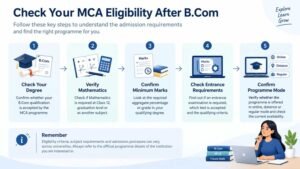
    Instead of applying to several institutions and hoping that one accepts your qualifications, use a structured process. MCA eligibility checklist showing degree qualification, Mathematics, minimum marks, entrance exam and programme mode. Step 1: Identify the exact programme. Record the university name, MCA programme title, delivery mode and intended admission session. Step 2: Read the current official admission brochure. Do not depend solely on an old blog, a third-party course listing or a short promotional description. Step 3: Check the qualifying-degree requirement. Confirm whether a B.Com degree is accepted and whether any restrictions apply to the type of bachelor’s degree. Step 4: Check the Mathematics rule. Look for the exact reference to Class 12, graduation-level Mathematics, Statistics, Computer Science or other named subjects. Step 5: Confirm minimum marks and selection requirements. Note the aggregate percentage, any applicable relaxation, entrance examination and other selection conditions. Step 6: Verify the learning format. Ensure that the eligibility information relates to the online, ODL or regular programme you actually want to pursue. Step 7: Ask if any point is unclear. Send the admissions team your degree details and the exact subjects you studied. Request written confirmation rather than relying on an informal general answer. For students comparing options through a correspondence college in India, the same checks still apply. A college or education adviser can help you understand available pathways, but the awarding university’s published admission rules determine whether your qualifications meet the programme’s requirements.

    What if you do not meet MCA eligibility requirements?

    If your preferred programme requires Mathematics that you have not studied, do not assume that your IT plans must end. First establish whether the requirement is specific to that programme or applies to the alternative courses you are considering. There are several practical steps you can take.

    Ask the university for clarification

    Explain your academic background clearly. Include your B.Com specialisation, the subjects studied in Class 12 and graduation, and the marks or grades relevant to eligibility. Ask whether the programme accepts your background and whether any officially permitted additional study can satisfy its criteria.

    Compare other MCA programmes

    Different institutions can have different eligibility conditions. Compare their official criteria, but do not choose a programme simply because its advertising appears less restrictive. If Mathematics is required, make sure you understand whether it must be studied at Class 12, graduation level or both.

    Consider a formally accepted bridge course

    Some programmes prescribe bridge courses for applicants who satisfy their entry conditions but need additional preparation in specified areas. Such courses are not a universal workaround. Confirm the exact subjects, timing, fees and eligibility conditions, and ask whether successful completion changes your admission eligibility or is required after admission.

    Explore related learning before committing to another degree

    If your immediate goal is to develop technical skills, you could explore introductory programming, databases, web development or other IT subjects while investigating formal postgraduate options. ICC’s article on IT courses and career-focused learning options may help you compare areas of interest. Short courses can support skill development, but they do not automatically replace a recognised degree or a university’s formal MCA admission requirements.

    Online MCA vs distance MCA vs regular MCA

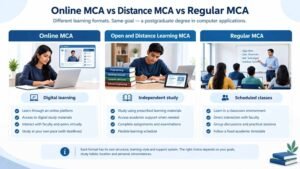
    If you meet the eligibility criteria, the next question is which learning format fits your circumstances. An online MCA, an open and distance learning (ODL) MCA and a regular classroom programme may differ in teaching arrangements, interaction, assessment and the amount of independent study expected. The exact details depend on the institution and the approved programme. Table 2: Online MCA vs distance MCA vs regular MCA
    Factor Online MCA Open and distance learning MCA Regular MCA
    Learning format Primarily digital learning arrangements as defined by the programme Independent study using the institution’s prescribed learning materials and support Scheduled classroom and campus-based learning
    Interaction May include virtual classes, discussion forums or faculty sessions Depends on the university’s learning and support arrangements Typically includes face-to-face interaction
    Study routine May offer flexibility, but deadlines and scheduled activities still apply Requires consistent independent study and attention to assessment schedules Usually follows a more structured timetable
    Assessment May involve online or designated examination arrangements, as officially specified Examination arrangements depend on the programme Generally follows the institution’s regular examination system
    Work-study balance May suit some working students if the workload is manageable May suit independent learners who can organise their time May be harder to combine with full-time work, depending on the timetable
    Eligibility Must be checked for the exact online programme Must be checked for the exact ODL programme Must be checked for the exact regular programme
    Main consideration Digital access, academic support and assessment rules Study discipline, support and examination requirements Attendance, campus access and scheduled academic activities
    The words “online” and “distance” should not be treated as interchangeable. Check the exact learning format, required attendance, examinations, project work and support arrangements before enrolling. Online, open and distance learning, and regular classroom study formats for MCA students. For a student exploring IT distance education, flexibility may be important, especially if they are working. However, flexibility alone is not enough to determine whether a programme is suitable. The curriculum, technical practice, assessment requirements and recognition status matter just as much.

    How to choose an MCA programme after B.Com

    Once you understand the eligibility requirements, compare the programme’s academic value and practical arrangements.

    Review the curriculum

    Check which programming languages, computing subjects, databases, software engineering topics and practical projects are included. The programme should align with the knowledge you want to develop, while also giving you a realistic view of the work required. Commerce graduates who are new to programming may need additional time to build foundational knowledge. Review introductory material and identify any prerequisite learning before the course begins.

    Understand the total cost

    Look beyond the advertised tuition amount. Ask about registration, examination, project, learning-resource and other compulsory charges. Check the payment schedule and refund rules.

    Check academic support

    Find out how students can raise questions, get help with technical subjects and receive guidance on projects or examinations. This is particularly relevant if you are transitioning from commerce into computing.

    Evaluate practical work

    A programme that includes practical assignments or project work can give you opportunities to apply concepts. Ask how practical work is assessed and what resources students need.

    Verify the institution and programme

    Confirm who awards the degree and whether the specific programme is recognised or approved for the intended delivery mode and admission session, where applicable. Do not rely only on the reputation of a college, a partner logo or a general claim on a website. Students looking at correspondence degree colleges in Bangalore should apply the same checks to each option. Location can help with access to counselling or support, but it does not determine whether a programme is academically suitable or whether a student meets its admission conditions.

    What career paths can you explore after MCA?

    An MCA may help graduates develop knowledge relevant to a range of computing and IT roles. The actual opportunities available depend on the curriculum, technical ability, projects, experience and employer requirements. Possible career directions include:
    • Software development: Building, testing and maintaining software applications.
    • Web development: Working on website interfaces, server-side functionality or full-stack applications.
    • Application development: Creating or maintaining software for specific business or user needs.
    • Database-related roles: Supporting data storage, querying, maintenance and database operations.
    • Systems analysis: Understanding business requirements and helping design or improve technical systems.
    • Quality assurance and software testing: Checking whether applications behave as expected and documenting defects.
    • IT support and systems operations: Helping maintain technology services and resolve technical issues.
    These are possible directions, not guaranteed outcomes. Some employers accept fresh graduates for entry-level roles, while others expect prior experience, a portfolio, specific programming skills or knowledge of particular tools. A student transitioning from B.Com can strengthen their preparation by practising programming, building small projects, learning to use version control and becoming comfortable with debugging and technical documentation. For additional reading, ICC’s article on IT courses and career preparation discusses ways learners can explore IT-related skills. Treat career articles as starting points for research, not as a promise of employment or salary.

    Can you explore IT distance education options in Bangalore?

    Students in Bangalore may compare local counselling support with programmes offered by universities in other parts of India. The important distinction is between the location of an education adviser and the institution that awards the degree. If you are considering traditional distance education in Bangalore, check whether the programme is actually offered in the required mode and whether any compulsory in-person activities or examinations need to be attended at a designated centre. Before shortlisting an option, ask:
    • Which university awards the qualification?
    • Is the MCA available in the advertised mode for the intended academic session?
    • Are B.Com graduates eligible under the current criteria?
    • What Mathematics requirements apply?
    • Are there entrance examinations or other selection steps?
    • Where are examinations and practical activities conducted?
    • What are the complete fees and payment conditions?
    • What academic support is available to learners?
    If you are comparing an institution with a correspondence college in India or looking for local guidance, use the same checklist for every option. A familiar location or a convenient application process should not replace verification of eligibility and programme details. ICC’s website discusses flexible education pathways and IT-related learning options. Before relying on any specific course listing, confirm the current programme availability, awarding institution, mode and eligibility conditions directly. You can visit ICC to explore the information available on its website.

    MCA admission documents: What should you prepare?

    The documents required for MCA admission vary by institution and applicant category. Preparing the likely documents in advance can make the application process easier, but the official checklist remains the final authority. Commonly requested documents may include:
    • Class 10 mark sheet or certificate.
    • Class 12 mark sheet.
    • B.Com semester-wise mark sheets or consolidated transcript.
    • Degree certificate or provisional certificate, where applicable.
    • Identity document.
    • Recent photograph and signature in the required format.
    • Entrance examination scorecard, if applicable.
    • Category or other supporting certificates, where relevant.
    • Any additional documents requested by the university.
    If you are in the final year of B.Com, check whether the university permits you to apply before your final results are declared. It may allow provisional applications subject to specific conditions, or it may require the degree to be completed by a stated date. Keep digital copies readable and consistent with the information entered in the application form. If the university asks for original documents, verification or specific file formats, follow its instructions. “You can explore the latest in-demand IT skills for freshers and learn which technical skills can help you build a successful career in the IT industry. Read more about the demand for IT skills among freshers.”

    MCA admission checklist for B.Com graduates

    Use this checklist before paying an application fee or accepting an offer.
    What to check Where to verify it Why it matters
    B.Com accepted as a qualifying degree Official admission brochure Confirms whether your undergraduate qualification is eligible
    Mathematics requirement Programme eligibility section Clarifies which level and subject combination is accepted
    Minimum marks Current admission rules Helps determine whether you meet the academic threshold
    Entrance examination Official admission notice or test authority Confirms the test, score and selection process, if required
    Delivery mode Official programme page Ensures the rules apply to the online, ODL or regular course you want
    Recognition or approval Official institution and programme information Helps verify the status of the intended qualification
    Complete fees Official fee schedule Prevents unexpected compulsory costs
    Application documents Official checklist Helps avoid incomplete or delayed applications
    Final-year conditions Current admission notice Clarifies whether provisional applications are permitted
    Save the relevant official pages or admission brochure when you complete these checks. This gives you a clear reference if you need to ask the institution to clarify a condition.

    Frequently asked questions about MCA after B.Com

    1. Can I do MCA after B.Com?

    Yes, some MCA programmes accept B.Com graduates, subject to their eligibility conditions. Mathematics, minimum marks, entrance tests and other requirements can vary, so check the exact programme before applying.

    2. Can I pursue MCA after B.Com without Mathematics?

    It depends on the institution. Some programmes require Mathematics at Class 12 or graduation level, while others may have different rules. Do not assume that a bridge course or a related subject will automatically meet the requirement.

    3. Is Mathematics compulsory for MCA admission?

    Mathematics is required by many MCA programmes, but the precise rule varies. Check whether the university specifies Mathematics at 10+2, graduation level or another accepted subject combination.

    4. Can I pursue an online MCA after B.Com?

    You may be able to, if you meet the eligibility conditions for the specific online programme. Verify the awarding institution, subject prerequisites, learning format and current programme status before enrolling.

    5. Can a B.Com graduate apply for MCA without Computer Science in graduation?

    Some programmes may accept graduates from disciplines other than Computer Science, provided they satisfy the stated eligibility requirements. Others may restrict entry to specified backgrounds. Check the programme’s rules rather than assuming that Computer Science is always mandatory—or never required.

    6. Is an entrance exam required for MCA after B.Com?

    Some MCA programmes require an entrance examination or a specified selection process; others may follow different procedures. Check the latest admission notice for the university and course you intend to pursue. For national-level MCA admissions through participating NITs and IIITs, consult the official NIMCET admission portal for the current test information, eligibility criteria and admission process.

    7. Can I study MCA while working?

    It may be possible, depending on the programme’s schedule, assessment requirements and workload. Online or ODL learning can offer a different arrangement from regular classroom study, but students still need to complete coursework, examinations and projects according to the institution’s rules.

    8. What should I do if I do not meet MCA eligibility requirements?

    Ask the university to confirm which condition you do not meet and whether any formally accepted alternative exists. You can also compare other eligible programmes or build introductory IT skills while deciding on your next academic step.

    Conclusion: Choose your MCA pathway after checking the details

    Pursuing MCA after B.Com can be a route worth exploring for commerce graduates interested in computing, but admission depends on the programme’s exact eligibility rules. Mathematics is one of the most important points to verify, particularly if you did not study it in Class 12 or during graduation. Before applying, confirm the qualifying degree, subject requirements, minimum marks, entrance examination, delivery mode and current programme status. If you are considering an online or distance option, check its specific rules rather than assuming that they match those of a regular programme. Students exploring IT distance education should also consider whether the course offers the right academic foundation, practical learning opportunities and support for their goals. A thoughtful comparison now can help you avoid unsuitable applications and make a more informed decision about your next step. If you need clarification about the educational options listed by ICC, contact us to ask about current availability and the details that need to be confirmed before you apply.

Leave A Comment