

| Aspect | ESG | Sustainability |
| Main focus | Assessing and managing environmental, social, and governance factors | Supporting long-term environmental, social, and economic well-being |
| Typical activities | ESG data collection, risk assessment, governance reviews, and reporting | Resource conservation, waste reduction, climate initiatives, and responsible operations |
| Common work settings | Corporates, financial services, consulting, and reporting teams | Businesses, environmental projects, research, public programmes, and community initiatives |
| Useful skills | Data analysis, reporting, business understanding, and compliance awareness | Environmental knowledge, project management, research, and stakeholder engagement |
| Career examples | ESG analyst, ESG reporting associate, sustainability analyst | Sustainability coordinator, environmental project associate, resource-efficiency specialist |
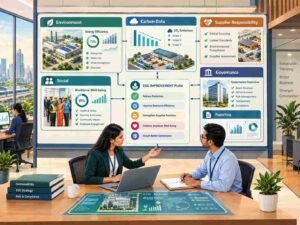 Suppose an organisation wants to understand its environmental performance across several offices. An ESG or sustainability team might begin by identifying which information needs to be collected. It could then request electricity bills, water-use records, waste data, and information about employee-related initiatives.
After collecting the information, the team may check whether the figures are complete, organise the data, calculate relevant indicators, and investigate unusual results. It may prepare charts and summaries for managers, help coordinate improvement plans, and maintain supporting documentation.
Depending on the role, daily tasks may include:
| Course or qualification | Knowledge it can develop | Potential career direction |
| B.Sc. in Environmental Science or a related discipline | Ecology, pollution, environmental monitoring, and scientific methods | Environmental project assistant, research support, environmental monitoring |
| M.Sc. in Environmental Science or a related field | Advanced subject knowledge, research, environmental assessment, and technical methods | Environmental analyst, project specialist, research roles, subject-specific consultancy |
| M.Sc. in a relevant science discipline | Scientific analysis, research methods, and technical subject knowledge | Technical sustainability or environmental roles where the discipline matches |
| BBA or another relevant management degree | Business operations, accounting, communication, and organisational management | Sustainability coordinator, reporting support, operations-related roles |
| MBA in a relevant management specialisation | Strategy, operations, finance, project management, and leadership | ESG consulting support, sustainability management, business operations |
| M.Com, finance, or accounting-related postgraduate study | Financial analysis, reporting, accounting, and business information | ESG data or reporting support, sustainable finance-related roles where suitable |
| MA in a relevant social science discipline | Research, policy, society, development, and community-related issues | Social impact projects, community engagement, sustainability research support |
| Short-term ESG or sustainability certificate | Introductory ESG concepts, reporting, implementation, or monitoring | Skill development for relevant entry-level or existing professional roles |
| Training in data analysis or sustainability reporting | Spreadsheets, dashboards, reporting methods, and data interpretation | ESG reporting support, sustainability data coordination |
| Academic background | Possible strengths | Areas to explore |
| Science or environmental studies | Scientific concepts, research, environmental systems | Environmental monitoring, sustainability projects, research, technical analysis |
| Commerce or accounting | Financial information, numerical analysis, documentation | ESG reporting support, data coordination, sustainable finance-related work |
| Management or business | Operations, communication, project coordination, organisational processes | Sustainability coordination, consulting support, ESG project work |
| Economics or statistics | Data interpretation, research, quantitative analysis | ESG data analysis, research, performance indicators |
| Arts or social sciences | Writing, research, social issues, community engagement | Social impact projects, stakeholder engagement, sustainability communication |
| Engineering or technology | Technical systems, process improvement, energy or resource-related knowledge | Energy efficiency, environmental technology, technical sustainability projects |
| Role | Illustrative annual salary range in India | What may influence pay |
| Sustainability or ESG Intern | ₹1–3 lakh equivalent annualised compensation, where paid | Employer, internship structure, duration, and responsibilities |
| ESG Reporting Associate | ₹3–6 lakh | Reporting knowledge, spreadsheet skills, and relevant experience |
| Sustainability Coordinator | ₹3–7 lakh | Project responsibilities, industry, and experience |
| Junior ESG Analyst | ₹3.5–7 lakh | Data skills, research ability, reporting knowledge, and employer |
| Environmental Analyst | ₹3–7 lakh | Technical qualifications, field or laboratory experience, and location |
| Carbon Accounting or Emissions Associate | ₹4–8 lakh | Emissions-data skills, reporting knowledge, and relevant experience |
| Sustainability Consultant | ₹4–10 lakh | Client exposure, analytical skills, project complexity, and experience |
| Experienced ESG or Sustainability Manager | ₹10–25 lakh or more | Leadership, sector expertise, reporting responsibility, and organisation size |
| Period | Main focus | Practical outcome |
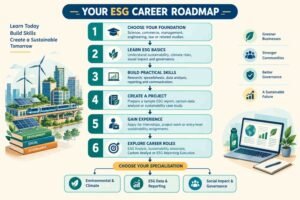
| Month 1 | Learn ESG fundamentals and sustainability concepts | Explain the environmental, social, and governance pillars in your own words |
| Month 2 | Explore one sector, such as energy, manufacturing, or finance | Identify common sustainability issues in that industry |
| Month 3 | Build spreadsheet, research, and report-writing skills | Create a small data-based sustainability report |
| Month 4 | Study public ESG or sustainability reports | Prepare a short review of indicators, goals, and reported progress |
| Month 5 | Complete a practical project and explore relevant training | Add a project to your portfolio and identify any skill gaps |
| Month 6 | Review job descriptions and prepare applications | Create a targeted resume and shortlist suitable entry-level roles |