Admission opens for 2026-27 sessions for all university.

Blog Detail

  • Diploma in Engineering After 10th: Courses, Eligibility and Career Options

    • 23,Oct 2026
    • Posted By : uaeautomates@gmail.com
    • 0 Comments
    • 10th/SSLC correspondence college in India
    • Diploma in Engineering
    • Diploma in Engineering after 10th
    • Diploma in Engr correspondence college in India
    • engineering career options
    • engineering diploma courses
    • engineering diploma eligibility
    • Engineering distance education
    • Indian College of Correspondence
    • polytechnic courses after 10th
    Choosing a career after Class 10 can feel like standing at a crossroads. Some students want to start earning early, while others enjoy science, technology, machines, computers, or construction and want to turn those interests into a profession. A Diploma in Engineering can be a practical route for students who want technical knowledge, hands-on learning, and opportunities to enter the workforce or continue their education. Students searching for a Diploma in Engr correspondence college in India should understand one important point before making a decision: engineering programmes involving technical and practical training have specific recognition requirements, and engineering programmes are not permitted through ordinary open and distance learning (ODL) or online modes under current UGC regulations. Choosing a recognised programme and an appropriate learning mode is just as important as selecting the right branch. In this guide, we will explore popular engineering diploma courses after Class 10, eligibility requirements, admission procedures, course duration, career opportunities, higher-study options, and the important checks students should complete before enrolling.

    What Is a Diploma in Engineering After 10th?

    A diploma in engineering is a technical qualification designed to introduce students to engineering principles, practical applications, industry tools, and problem-solving methods. Unlike a purely academic programme, it generally combines classroom learning with laboratory sessions, workshops, technical drawing, projects, and practical assignments. For students who have completed Class 10, a diploma can provide an early introduction to a technical field without requiring them to complete Class 12 first. The qualification can help learners develop foundational knowledge for entry-level technical positions and, subject to the applicable rules, further education. For example, a student interested in buildings might explore civil engineering, while someone who enjoys machines could consider mechanical engineering. A student fascinated by computers, software, and digital systems may find computer science or information technology more suitable. However, a course should not be selected simply because a particular branch sounds popular. Students should consider their interests, strengths in mathematics and science, preferred work environment, financial circumstances, and long-term career plans.

    Why do students choose an engineering diploma after Class 10?

    There are several reasons students consider this route:
    • Early technical exposure: Students begin learning about their chosen field soon after secondary school.
    • Practical learning: Many programmes include laboratory work, workshops, projects, and industry-oriented assignments.
    • Multiple career directions: Graduates may explore technician, junior technical, maintenance, production, drafting, or support roles, depending on their branch and employer requirements.
    • Further-study opportunities: Eligible diploma holders may be able to pursue relevant undergraduate engineering programmes through approved admission routes.
    • Focused learning: Students can begin developing technical skills in a particular area instead of studying a broad range of senior-secondary subjects.
    The key is to view a diploma as the beginning of a career pathway rather than a guarantee of immediate employment or a fixed salary.

    Popular Engineering Diploma Courses After 10th

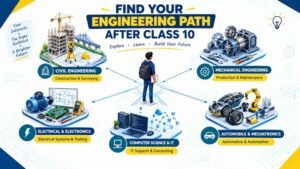
    The right branch depends on what a student enjoys learning and the type of work they may want to do in the future. Below are some common options offered by technical institutions, although availability, admission criteria, and course names vary by state and institution. Engineering diploma branches after Class 10, including civil, mechanical, electrical, electronics, and computer engineering.
    Diploma branch What students learn Possible career directions
    Civil Engineering Construction methods, surveying, materials, drawings, and site practices Site supervisor, junior technician, surveying assistant
    Mechanical Engineering Machines, manufacturing, workshop practices, maintenance, and production Maintenance technician, production assistant, machine operator
    Electrical Engineering Electrical circuits, motors, power systems, safety, and maintenance Electrical technician, maintenance assistant, testing support
    Electronics Engineering Electronic circuits, components, instrumentation, and testing Electronics technician, testing assistant, service technician
    Computer Science Engineering Programming fundamentals, computing systems, databases, and networking basics Technical support, junior programmer trainee, IT support
    Information Technology Computer applications, networking, systems, and information management IT support associate, network support trainee
    Automobile Engineering Vehicle systems, engines, diagnostics, and maintenance Automobile service technician, workshop technician
    Chemical Engineering Industrial processes, materials, process equipment, and safety Process technician, production support assistant
    Mechatronics Engineering Mechanical systems, electronics, automation, and control Automation technician, maintenance support technician
    These roles are examples, not guaranteed placements. Actual eligibility for a job depends on the employer, technical skills, practical experience, local demand, and any additional qualifications required.

    How can you choose the right branch?

    Start by asking yourself three simple questions:
    1. What do I enjoy? Do you prefer machines, electrical systems, construction, computers, vehicles, or industrial processes?
    2. What am I good at? Review your performance and comfort level in mathematics, science, logical reasoning, and practical tasks.
    3. What kind of work interests me? Think about whether you would enjoy a construction site, factory, workshop, laboratory, office, or computer-based environment.
    Students who are unsure can compare the subjects taught in different branches and speak to teachers, career counselors, or current students before making a final choice.

    Eligibility for Diploma Courses After 10th

    Eligibility is one of the first things to verify when exploring technical education. Although many polytechnic programmes accept students after Class 10, requirements differ across states, institutions, branches, and admission categories. Common eligibility conditions may include:
    • Successful completion of Class 10 or an equivalent recognised examination.
    • Mathematics and science as required subjects.
    • Minimum marks specified by the relevant state authority or institution.
    • Completion of the prescribed admission application.
    • Participation in an entrance examination or merit-based selection process, where applicable.
    • Fulfilment of any additional document, domicile, reservation, or category requirements under the relevant admission rules.
    For instance, the Directorate of Training and Technical Education in Delhi publishes eligibility criteria for full-time diploma courses, including academic requirements for several engineering branches. Students can review the official Delhi diploma eligibility guidelines rather than relying only on general information shared online.

    Can students from different education boards apply?

    Students who have completed Class 10 through a recognised board may be eligible, subject to the admission authority’s equivalence and subject requirements. Those who have completed SSLC or an equivalent secondary-school qualification should check whether their certificate meets the criteria for their chosen institution and state. Do not assume that the same minimum percentage applies throughout India. One institution may specify a minimum aggregate, while another may use subject-wise marks, entrance scores, merit lists, or additional conditions.

    What if you have a gap after Class 10?

    A gap in education does not automatically mean that technical education is no longer an option. Students who took time away from studies should check the age rules, admission conditions, document requirements, and any restrictions applicable to their chosen programme. Working professionals who want to move into a technical field should also distinguish between a recognised engineering diploma and a short-term skill-development certificate. Both may be useful, but they serve different purposes and should not be treated as interchangeable qualifications.

    Duration and Admission Process

    Many full-time engineering diploma programmes entered after Class 10 have a duration of approximately three years. However, the exact duration, academic calendar, semester structure, and examination pattern depend on the relevant technical board and institution. Admission usually follows a structured process.

    Step 1: Identify suitable branches

    Shortlist two or three branches based on your interests, strengths, preferred industry, and long-term goals. Review the syllabus rather than choosing a course solely on the basis of its name.

    Step 2: Check the eligibility criteria

    Read the official admission notification for the academic year in which you plan to enrol. Confirm minimum marks, required subjects, age criteria if applicable, and any entrance examination requirements.

    Step 3: Verify the institution and programme

    Check the institution’s affiliation, the applicable technical education board, programme approval requirements, and the validity of the qualification for your intended career or further studies.

    Step 4: Understand the admission method

    Depending on the state and institution, admission may be based on Class 10 marks, a state-level entrance test, counselling, or another authorised selection procedure.

    Step 5: Review fees and practical facilities

    Compare tuition fees, examination charges, laboratory access, workshop facilities, transport, accommodation, and other expenses. Ask for a written fee structure and understand the refund policy before paying.

    Step 6: Complete the application

    Submit the application and required documents within the notified deadline. Keep copies of your application, payment receipt, admission confirmation, and relevant academic records. Planning these steps early can reduce confusion and help students avoid missing important deadlines.

    Regular, Part-Time and Distance Learning: Understand the Difference

    Students often search for flexible study options because they may be working, helping their families, living far from a college, or returning to education after a break. It is understandable to look for a way to study without completely disrupting daily responsibilities. However, flexibility should never come at the cost of qualification validity. A regular engineering diploma typically includes structured teaching, practical laboratory sessions, workshop training, assessments, and other activities required by the approved curriculum. Some institutions may provide authorised part-time or alternative arrangements for particular programmes, but students must confirm that the exact course and mode are permitted by the relevant authorities. Important: The UGC Distance Education Bureau lists engineering among the disciplines prohibited through ODL and online education. Students should not assume that a correspondence or online engineering diploma advertised on a website is a valid substitute for an approved technical programme.

    What about engineering distance education?

    The phrase engineering distance education is often used in online searches by learners who need a flexible way to study. Yet search popularity does not establish that a particular qualification is recognised. For a professional engineering diploma, students should investigate approved study modes, mandatory practical training, examination arrangements, and the authority responsible for the qualification. If a provider promises an engineering diploma entirely through correspondence, without the required approval, treat the claim cautiously. Students who need flexibility may instead investigate permitted technical skill courses, vocational training, apprenticeships, or other recognised qualifications that match their goals. These alternatives may help build employable skills, but they should not be presented as equivalent to an engineering diploma unless the relevant authority confirms that equivalence.

    How is a B.Tech different from a diploma?

    A diploma generally provides foundational technical education, whereas a Bachelor of Technology (B.Tech) is an undergraduate degree with broader and more advanced engineering study. Some eligible diploma holders may enter the second year of a relevant engineering degree through a lateral-entry route. Availability depends on state regulations, entrance or counselling requirements, the chosen branch, and the admitting institution. Students searching for a B.Tech correspondence college in India should apply the same recognition checks. Engineering degrees offered entirely through ordinary distance or online modes are also subject to restrictions. Always confirm the exact programme and mode with the relevant authorities before enrolling.

    Compare Learning Options Before You Enrol

    The most suitable learning route depends on your educational background, availability, financial circumstances, and the qualification you need. Use the following comparison as a starting point, then verify the specific course requirements with the relevant authority.
    Learning option Best suited for What to check before enrolling
    Regular engineering diploma Students who can attend structured classes and practical sessions Institution recognition, branch availability, laboratories, fees, and admission rules
    Authorised part-time technical programme Learners who need to balance work and education, where such a programme is permitted Whether the exact programme and study mode are approved
    Vocational or skill-development course Learners seeking job-related practical skills Training quality, assessment, certificate validity, and employer relevance
    Apprenticeship or workplace training Eligible candidates seeking supervised practical experience Eligibility, employer conditions, stipend if applicable, and training requirements
    Further study after a diploma Graduates seeking a degree or advanced qualification Lateral-entry eligibility, entrance requirements, and recognition of the next qualification
    This comparison highlights an important distinction: a flexible learning option may be useful without being equivalent to a formal engineering diploma. Choose the route according to the outcome you want to achieve.

    How can students check recognition?

    Start with the official website of the institution and the relevant state technical education board or regulatory authority. Verify the institution, exact course, mode of study, campus or learning centre, and applicable academic session. Do not rely solely on a logo, marketing brochure, counsellor’s verbal assurance, or the statement that a provider is registered as a business. Registration of an organisation does not automatically mean that every course it advertises is approved. This is particularly important for learners looking at a correspondence college in India. Check whether the qualification is legally permitted in the proposed mode, and obtain written clarification when the provider’s claims are unclear. “Students interested in emerging technologies can also explore our guide to the top 10 engineering courses to build a career in Robotics, AI, and Cloud Computing  to learn about future-focused engineering specializations and potential career paths.”

    Fees, Practical Training and Recognition

    The total cost of a diploma is not limited to tuition fees. Students should account for admission charges, examination fees, books, tools, uniforms where required, transport, accommodation, laboratory expenses, and other institutional charges. Government polytechnics may have different fee structures from private institutions. Costs also vary by state, branch, facilities, and student category. Rather than relying on a single national estimate, compare the official fee schedules of institutions you are considering. Practical training deserves equal attention. Engineering education is designed to develop the ability to apply technical knowledge, work safely with equipment, interpret drawings, solve problems, and understand real-world processes. Before enrolling, ask:
    • Does the programme include laboratories and workshops relevant to the branch?
    • Are practical sessions conducted at the institution or an approved facility?
    • What examinations and project work are required?
    • Is industrial training or an internship included?
    • Which authority awards or recognises the qualification?
    • Will the qualification meet the entry requirements for your intended job or higher-study programme?
    A recognised programme with suitable facilities can provide a stronger foundation for technical work than a course chosen solely because it appears convenient or inexpensive.

    Career Options After an Engineering Diploma

    After completing a recognised diploma, graduates can explore technical employment, apprenticeships, further studies, or skill specialisations. Their opportunities depend on their branch, practical ability, employer requirements, and experience.

    Civil engineering career options

    Civil diploma holders may find opportunities with construction companies, infrastructure contractors, surveying firms, building maintenance teams, and engineering consultancies. Potential roles include:
    • Junior site supervisor.
    • Surveying assistant.
    • Civil engineering technician.
    • Construction quality assistant.
    • CAD drafting assistant, where the required software skills are available.
    Site-based work may involve measurements, drawing interpretation, coordination with contractors, safety procedures, and monitoring construction activities.

    Mechanical engineering career options

    Mechanical diploma holders can explore manufacturing, industrial maintenance, production, fabrication, automotive, and equipment-service environments. Potential roles include:
    • Production technician.
    • Maintenance technician.
    • Workshop supervisor trainee.
    • Quality inspection assistant.
    • Mechanical drafting assistant.
    Knowledge of workshop safety, measurement instruments, technical drawings, and preventive maintenance can be valuable in these roles.

    Electrical and electronics career options

    Electrical and electronics graduates may work in equipment maintenance, electrical installation support, testing, manufacturing, service centres, or industrial operations, depending on the role’s requirements. Possible roles include electrical technician, electronics service technician, testing assistant, and maintenance support staff. Electrical work may require specific licences, safety training, or other authorisations depending on the activity and jurisdiction. A diploma alone should not be assumed to satisfy every licensing requirement.

    Computer science and IT career options

    Students from computing-related branches may consider IT support, network support, software testing assistance, technical customer support, or junior development opportunities where their skills match the employer’s needs. Employers may assess practical knowledge of programming, databases, operating systems, networking, troubleshooting, and communication. Personal projects and relevant certifications can help candidates demonstrate their abilities.

    Automobile and chemical engineering career options

    Automobile diploma holders may explore vehicle servicing, diagnostics, workshop operations, spare-parts support, and automotive manufacturing. Chemical engineering diploma holders may pursue process support, production operations, laboratory assistance, and quality-related work where the employer’s requirements are met. These examples show why branch selection matters. A course should connect your interests with the type of work you are willing to learn and perform.

    Salary Expectations and Career Growth

    Salary is a common concern for students and families, but there is no single salary that applies to every diploma holder. Entry-level pay can vary significantly according to the city, employer, industry, branch, practical skills, recruitment process, and prevailing labour-market conditions. A candidate working in a small workshop may receive a different offer from someone joining a large manufacturing company or a specialised technical services provider. Instead of selecting a course based only on a salary figure advertised online, compare actual job descriptions and vacancies. The Government of India’s National Career Service portal can help jobseekers explore employment opportunities and career-related services. Review the qualifications, experience, and skills employers request for roles relevant to your chosen branch.

    What can improve career prospects?

    • Practical competence: Become comfortable with tools, equipment, safety procedures, and technical tasks relevant to your course.
    • Digital skills: Learn industry-relevant software, such as CAD tools for drafting-related work or appropriate programming tools for computing roles.
    • Communication: Practise writing clear reports, explaining problems, and working effectively with teams.
    • Work experience: Explore legitimate internships, apprenticeships, or supervised industry exposure where eligible.
    • Continuous learning: Keep your technical knowledge current and investigate relevant short courses from recognised providers.
    • Professional discipline: Develop punctuality, attention to detail, documentation skills, and a willingness to follow safety standards.
    Your first job is one stage of your career. With experience, suitable training, and demonstrated ability, you may be able to progress towards more specialised technical responsibilities or supervisory roles.

    Higher Studies After a Diploma

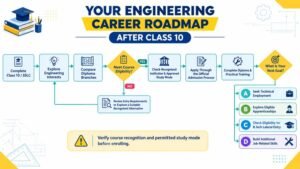
    A diploma does not have to be the final step in your education. Depending on eligibility and the applicable rules, graduates may pursue higher studies to deepen their technical knowledge or broaden their career options. Flowchart showing the pathway from Class 10 to engineering diploma admission, technical skills, employment, apprenticeships, and eligible higher studies.

    Option 1: B.Tech through lateral entry

    Eligible diploma holders may apply for lateral entry into the second year of an engineering degree where the relevant university, state authority, and programme permit it. Before applying, verify the accepted diploma branches, minimum marks, entrance requirements, counselling procedure, and institution-specific rules. Admission is not automatic merely because a student holds a diploma.

    Option 2: Specialised technical certifications

    Graduates may pursue relevant certifications in areas such as CAD, networking, industrial automation, quality systems, maintenance, or programming. The value of a certificate depends on the provider, the skills taught, practical assessment, and employer recognition. A short course can complement a diploma, but it does not automatically replace a formal qualification required for regulated or technical roles.

    Option 3: Apprenticeships and workplace learning

    Eligible candidates can investigate apprenticeships and employer-based training opportunities. These can provide practical exposure and help learners understand workplace expectations. The availability and conditions of each opportunity should be checked with the employer or authorised programme provider.

    Option 4: Further technical or vocational education

    Some students may prefer to strengthen a specific skill rather than immediately pursue a degree. Depending on their goals, recognised vocational programmes and technical training may help them prepare for a particular job family. The most suitable next step depends on whether you want to enter employment quickly, specialise in a technical area, or pursue a higher qualification.

    Choosing the Right Route for Different Students

    Not every learner has the same circumstances. A good education plan should take into account academic preparation, available time, financial resources, and future goals.

    For students who have just completed Class 10

    Begin by comparing approved full-time diploma programmes, their branches, admission deadlines, practical facilities, and fees. Discuss your options with parents or a trusted teacher, but make sure your decision reflects your interests as well as family expectations.

    For working professionals

    If you are already employed, consider what qualification or skill your intended role actually requires. An approved part-time arrangement, where available for the specific programme, or a permitted vocational course may be more suitable than leaving work immediately. Before paying for any advertised programme, verify whether the qualification and mode are officially permitted. Flexibility should support your career plan, not create problems when an employer checks your documents.

    For school dropouts and learners returning to education

    Start by confirming your existing educational qualifications and the entry requirements of potential programmes. If you have not completed Class 10, you may first need to explore an appropriate recognised secondary-school completion route. Learners who have already completed Class 10 should review the available technical and vocational options and seek guidance if they are unsure which admission rules apply to them.

    For students considering correspondence-based study

    Searching for a 10th/SSLC correspondence college in India may lead to different kinds of programmes, including secondary education, vocational learning, and other qualifications. These categories have different eligibility and recognition requirements. Similarly, people searching for correspondence degree colleges in bangalore should verify the precise qualification, awarding institution, approved learning mode, and intended career outcome. The city or the word “correspondence” alone does not establish that a course is valid. If you are specifically looking for a Diploma in Engr correspondence college in India, make recognition and permitted study mode your first checks. An advertised course should never be assumed to be an approved engineering qualification simply because a provider offers flexible learning. Choose a learning route based on the qualification you need, not simply on the flexibility a provider advertises.

    How Indian College of Correspondence Can Fit into Your Education Planning

    Choosing a course is easier when you begin with a clear understanding of your current qualifications and future goals. Indian College of Correspondence is a name learners may come across while researching education options and flexible learning pathways. If you are exploring available programmes, review the information on the ICC and identify the courses that match your educational background and objectives. Confirm the qualification awarded, eligibility conditions, learning mode, and recognition status directly before making a decision. Students looking for a technical engineering qualification should remember that ordinary distance and online engineering programmes are restricted under the applicable rules. Do not assume that a correspondence-based option is an approved engineering diploma simply because it is listed by a provider. For working professionals, school leavers, and learners returning to education, the most useful first step is to identify the exact qualification needed for the intended career and then verify which recognised pathways are available.

    Frequently Asked Questions (FAQs)

    1. Can I do a diploma in engineering after Class 10?

    Yes. Many recognised polytechnic programmes admit eligible students after Class 10. Requirements differ by state, institution, and branch, so check the official admission notification before applying.

    2. What is the usual duration of an engineering diploma after 10th?

    Many full-time programmes entered after Class 10 take approximately three years. The actual duration and course structure depend on the institution and relevant technical education board.

    3. Which engineering diploma branch is best after 10th?

    There is no single best branch for every student. Civil, mechanical, electrical, electronics, computer science, information technology, automobile, and chemical engineering each lead towards different kinds of work. Choose based on your interests, abilities, and career plans.

    4. Can I study engineering through correspondence in India?

    Engineering programmes are restricted under current UGC rules for open and distance learning and online education. Students should verify the exact qualification and mode with the relevant authorities and should not assume that a correspondence advertisement makes an engineering diploma valid.

    5. Is mathematics compulsory for a diploma after 10th?

    Mathematics is a requirement for many engineering diploma branches, often alongside science. Exact subject and marks requirements depend on the course and admission authority.

    6. Can I get a job after completing an engineering diploma?

    Eligible graduates may apply for technical, maintenance, production, service, drafting, and support positions related to their branch. Employment depends on the validity of the qualification, practical skills, vacancies, and employer requirements.

    7. Can I pursue B.Tech after a diploma?

    Eligible diploma holders may apply for B.Tech lateral-entry admission where the relevant state, university, and programme permit it. Students must meet the prescribed eligibility and selection requirements.

    8. Is an engineering diploma equivalent to a B.Tech degree?

    No. A diploma and a B.Tech are different qualifications with different course structures and academic requirements. A diploma may provide a route towards further study, but it should not be treated as equivalent to an engineering degree.

    9. How do I check whether an engineering college is recognised?

    Check the official website of the institution, the relevant state technical education board, and the applicable regulatory authorities. Verify the exact course, campus, mode, academic session, and qualification awarded before enrolling.

    10. Can working professionals pursue technical education?

    Yes, working professionals can investigate recognised technical and vocational learning options that fit their circumstances. The permitted study mode depends on the exact qualification, and learners should verify eligibility and approval before enrolling.

    Conclusion: Make Your Next Education Decision with Confidence

    Choosing an engineering pathway after Class 10 is an important decision, but it does not have to be confusing. Start with your interests, compare available branches, understand the eligibility requirements, and research the practical training each programme offers. Next, review the admission process, fees, recognition status, and career possibilities. If you plan to pursue higher studies, check the rules for lateral entry and other progression routes before selecting your course. If you are already working or returning to education after a break, make sure the learning option you choose is appropriate for your existing qualifications and future goals. The right decision is not necessarily the course with the most attractive advertisement. It is the recognised, suitable, and realistic pathway that helps you develop useful skills and move towards your long-term ambitions. Ready to explore your education options? Visit ICC to review the available information and identify programmes relevant to your background. If you need clarification about a course, its eligibility, or its recognition, contact us before making your final decision.

Leave A Comment