Admission opens for 2026-27 sessions for all university.

Blog Detail

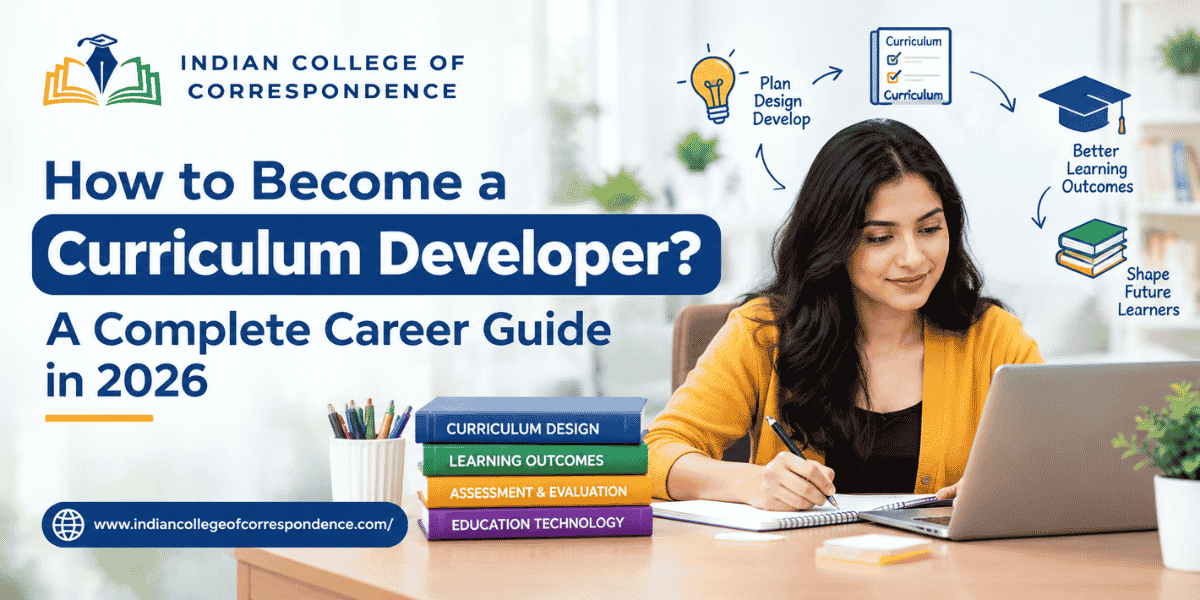
  • How to Become a Curriculum Developer? A Complete Career Guide in 2026

    • 21,Sep 2026
    • Posted By : opsadsthrivein@gmail.com opsadsthrivein@gmail.com
    • 0 Comments
    Education is no longer limited to textbooks, classrooms, and traditional teaching methods. Today, students learn through online courses, digital platforms, blended programmes, skill-based modules, and interactive learning resources. Behind many of these learning experiences are professionals who decide what students should learn, how topics should be organised, and whether the curriculum actually meets learner needs. If you enjoy education, research, writing, planning, and creating meaningful learning experiences, you may want to explore how to Become a Curriculum Developer. To Become a Curriculum Developer, you need more than an interest in teaching. The role combines educational knowledge, communication, research, content planning, assessment development, and technology. This guide explains how to Become a Curriculum Developer, what qualifications can help, which skills matter, where you can work, and how to build practical experience in 2026.

    What Is a Curriculum Developer?

    A curriculum developer creates, reviews, and improves educational programmes. Their work can include planning course structures, developing learning objectives, organising subjects into logical units, preparing learning materials, designing assessment approaches, and working with teachers or subject experts. When you Become a Curriculum Developer, you may work on an entire programme rather than only one lesson. The work is often focused on the bigger learning journey: what learners should know, what skills they should develop, how subjects connect, and how learning outcomes can be evaluated. Modern curriculum development can also involve digital learning. Online education providers, schools, colleges, universities, training organisations, and EdTech companies may require professionals who understand both educational content and changing learner expectations. Current career resources similarly describe curriculum developers as professionals involved in creating structured learning programmes and working with educators and subject-matter experts.

    Why Consider a Curriculum Development Career in 2026?

    The education sector is continuously changing. Digital learning, professional upskilling, online programmes, workplace training, and technology-supported education have created new ways for people to learn. This makes a curriculum development career interesting for people who prefer shaping learning programmes rather than spending all their working hours in direct classroom teaching. If you Become a Curriculum Developer, your work may connect education with technology, research, communication, and industry requirements. Depending on the organisation, you could contribute to school programmes, university courses, professional training, online education, or corporate learning. Another reason this field attracts professionals is variety. One project may involve creating a new course, while another may involve reviewing an existing programme and identifying areas that need improvement.

    What Does a Curriculum Developer Do?

    Before you Become a Curriculum Developer, it is important to understand what the actual work looks like. A curriculum developer may be responsible for:
    • Researching learner and programme requirements
    • Defining learning objectives
    • Planning course structures
    • Organising topics into units or modules
    • Developing curriculum frameworks
    • Reviewing educational content
    • Creating assessment plans
    • Collaborating with teachers and subject experts
    • Checking whether learning outcomes are being achieved
    • Updating outdated or less relevant content
    • Supporting curriculum implementation
    • Using learner feedback to improve programmes
    The exact responsibilities vary by employer. In some organisations, the role may overlap with instructional design, academic content development, or learning and development.

    What Qualifications Help You Become a Curriculum Developer?

    One of the most common questions students ask is whether a particular degree is compulsory. The answer depends on the organisation, level of responsibility, and type of curriculum being developed. However, an education-related or subject-specific academic background can provide a useful foundation. If you want to Become a Curriculum Developer, relevant educational backgrounds may include:
    • Education
    • English
    • Psychology
    • Subject-specific degrees
    • Arts and humanities
    • Social sciences
    • Management
    • Instructional design or related fields
    For education-focused roles, qualifications such as a B.Ed or M.Ed can be particularly relevant. A person interested in teaching and curriculum planning may also explore a B.Ed course for working professionals if they need a flexible route for continuing their education. Similarly, people who already have an education background may explore an M.Ed correspondence college in Bangalore when looking for advanced academic knowledge related to teaching, education, curriculum, and learning. A degree alone, however, does not automatically make someone a curriculum developer. Practical exposure, communication, research ability, subject knowledge, and curriculum-related projects can also be important.

    Can Teaching Experience Help You Become a Curriculum Developer?

    Teaching experience can give you something valuable: direct knowledge of how learners respond to educational content. A teacher sees which topics students understand quickly, where they struggle, which activities create engagement, and where a lesson may need adjustment. That classroom experience can become useful when designing or reviewing a curriculum. If you Become a Curriculum Developer after working in teaching, you can use this experience to understand the practical side of education. For someone currently exploring Teaching distance education, the transition can also involve learning how curriculum planning works beyond the classroom. Teaching and curriculum development are connected, but they involve different responsibilities. You do not necessarily need to spend your entire career as a teacher before entering curriculum development. However, understanding learners, educators, assessment, and classroom realities can strengthen your perspective.

    Six Skills You Need to Become a Curriculum Developer

    Strong curriculum development skills combine educational knowledge with practical workplace abilities.

    1. Research Skills

    Curriculum developers need to research subjects, learner needs, educational trends, standards, and relevant resources. Good research helps ensure that a programme is based on accurate and relevant information.

    2. Communication Skills

    You may work with teachers, administrators, subject experts, designers, students, and other stakeholders. Clear communication helps everyone understand the purpose and structure of a programme.

    3. Writing Skills

    Curriculum work involves writing learning objectives, course descriptions, module outlines, instructions, assessments, and educational materials.

    4. Planning Skills

    A curriculum needs structure. You should be able to arrange topics logically and ensure that one learning stage connects with the next.

    5. Assessment Knowledge

    Learning is not complete simply because content has been delivered. Curriculum developers also need to consider how students will demonstrate their understanding.

    6. Digital Skills

    Technology is increasingly part of education. Familiarity with Learning Management Systems, digital content tools, online learning platforms, presentations, and AI-supported education tools can be useful. Developing these curriculum development skills can make it easier to Become a Curriculum Developer and handle real-world projects confidently.

    Your Step-by-Step Roadmap to Become a Curriculum Developer

    There is no single route that every professional follows. Instead, think of the journey as a combination of education, practical exposure, skill development, and portfolio building.

    Step 1: Build Your Academic Foundation

    Start by developing strong knowledge in a subject or education-related field. Your academic background can influence the type of curriculum projects you later work on. A student interested in education may consider an undergraduate programme first and then pursue specialised qualifications. For example, someone looking for a BA correspondence college in Bangalore may choose a flexible undergraduate route while developing writing, communication, research, and subject knowledge.

    Step 2: Understand How Learning Works

    To Become a Curriculum Developer, you should understand more than the subject itself. Learn about:
    • Learning objectives
    • Lesson planning
    • Student engagement
    • Assessment
    • Learning outcomes
    • Curriculum frameworks
    • Different learner requirements
    This knowledge helps you think from the learner’s perspective rather than simply collecting information.

    Step 3: Practise Creating Learning Materials

    Do not wait for your first job to start practising. Create sample:
    • Lesson plans
    • Course outlines
    • Syllabi
    • Worksheets
    • Quizzes
    • Module structures
    • Assignment briefs
    • Learning activities
    These projects can later become part of your portfolio.

    Step 4: Learn Curriculum Mapping

    Curriculum mapping helps you understand how individual topics contribute to broader programme outcomes. For example, imagine a six-month professional course. You might need to decide:
    1. What students should learn first
    2. Which concepts require previous knowledge
    3. Where practical activities should appear
    4. When assessments should happen
    5. How the final learning outcomes will be measured
    Learning to think this way is an important part of the process to Become a Curriculum Developer.

    Step 5: Gain Practical Experience

    Look for opportunities where you can work with educational content. Possible starting roles include:
    • Academic Content Writer
    • Content Developer
    • Academic Coordinator
    • Learning Content Specialist
    • Teaching Assistant
    • Instructional Design Assistant
    • Training Content Associate
    These roles can help you understand how educational programmes are created and delivered.

    Step 6: Build a Curriculum Portfolio

    A portfolio can show employers what you can actually create. A beginner’s portfolio could include:
    • One complete course outline
    • A sample curriculum map
    • Two lesson plans
    • A sample assessment
    • A learner activity
    • A short digital learning module
    • A curriculum improvement case study
    A practical portfolio can be particularly helpful when your professional experience is still limited.

    Step 7: Apply for Curriculum Developer Jobs

    Once you have suitable qualifications, skills, and examples of your work, begin searching for curriculum developer jobs. Read job descriptions carefully because different employers may use different titles for similar responsibilities. Some positions may combine curriculum development with instructional design, academic coordination, content development, or learning and development.

    A Simple Curriculum Developer Roadmap

    Here is a quick way to visualise how you can Become a Curriculum Developer:
    Stage Main Focus Practical Action
    Education Build subject knowledge Complete a relevant degree
    Skill Building Learn curriculum principles Study learning and assessment
    Practice Develop content Create sample modules
    Experience Understand real projects Work in education/content roles
    Portfolio Show your abilities Add curriculum samples
    Career Find relevant roles Apply for suitable positions
    This roadmap is flexible. Your route may look different depending on your existing education and experience.

    How Can Distance Education Support This Career?

    Flexible education can be useful for learners who want to continue studying while managing work or other responsibilities. Students researching distance education in Bangalore may find programmes that allow them to continue their academic journey without following the same routine as a conventional full-time programme. For a working professional, a B.Ed course for working professionals may provide an opportunity to strengthen educational knowledge while continuing professional responsibilities, subject to the programme’s eligibility and recognition requirements. Similarly, professionals interested in advanced education may explore an M.Ed correspondence college in Bangalore to deepen their understanding of education-related concepts. The important point is to choose a recognised programme that matches your career goals rather than selecting a course only because it has a convenient format.

    Curriculum Developer vs Instructional Designer: What Is the Difference?

    The terms can sound similar, and some organisations even use them interchangeably. However, there is a useful distinction. A curriculum developer generally works more on the what of learning: what learners need to know, which topics should be included, how the programme should be structured, and how learning outcomes connect. An instructional designer often focuses more on the how: how content is delivered, how activities are designed, how digital learning experiences are created, and how learners interact with course material.
    Area Curriculum Developer Instructional Designer
    Main focus Curriculum and programme structure Learning experience
    Key question What should learners learn? How should they learn it?
    Typical work Curriculum maps and course plans Modules and learning activities
    Collaboration Educators and subject experts SMEs, educators and digital teams
    Common environment Schools, colleges, EdTech and training EdTech, corporate learning and education
    Understanding this distinction can help you choose the type of role you want after you Become a Curriculum Developer.

    Where Can a Curriculum Developer Work?

    The career is not limited to traditional schools. After you Become a Curriculum Developer, possible work environments include:

    Schools

    Curriculum professionals may contribute to subject planning, learning materials, assessments, and programme improvements.

    Colleges and Universities

    Higher education institutions may require professionals to support course development, academic programmes, learning outcomes, and educational resources.

    EdTech Companies

    Online education companies create courses for learners across different locations. Curriculum professionals can help organise these programmes and ensure that content follows a logical learning path.

    Corporate Training

    Businesses also need structured learning programmes for employee development, onboarding, compliance, and skill building.

    Non-Profit and Educational Organisations

    Education-focused organisations may develop learning programmes, training materials, and community education initiatives.

    Publishing and Content Organisations

    Educational publishers may also need professionals who understand curriculum structure, learning outcomes, and student-focused content.

    What Does a Curriculum Developer’s Day Look Like?

    A typical day may not look the same every day, which is one reason the role can involve varied work. You might begin the morning reviewing feedback on an existing course. Later, you could attend a meeting with a subject expert to discuss learning objectives. After that, you might revise a module, check an assessment, or organise content into a new course structure. Another day could involve researching a new subject, comparing existing curricula, preparing a curriculum map, or working with a digital learning team. When you Become a Curriculum Developer, you are essentially helping transform educational goals into a structured learning journey.

    What Challenges Can You Expect?

    It is useful to understand the less visible side of the profession before choosing this career.

    Keeping Content Updated

    Subjects and industries change. Curriculum professionals need to review content regularly and identify information that needs updating.

    Managing Different Opinions

    Teachers, subject experts, administrators, and learners may have different expectations. Strong communication is needed to bring these perspectives together.

    Balancing Theory and Practice

    A curriculum should provide knowledge while also helping learners understand how that knowledge can be applied.

    Designing for Different Learners

    Students do not all learn in the same way or at the same pace. Curriculum planning needs to consider accessibility, engagement, and different learning requirements.

    Working With Technology

    Digital education is developing quickly. Professionals need to remain comfortable with new platforms and tools rather than treating technology as a separate part of education.

    How Can You Prepare for Curriculum Developer Jobs?

    If your goal is to Become a Curriculum Developer, start preparing before you begin applying. First, improve your resume so it highlights education, content creation, research, project work, teaching, training, and relevant digital skills. Next, create a portfolio. Even if you have never held the exact job title, a strong sample project can demonstrate how you think. You can also study job descriptions for curriculum developer jobs and identify recurring requirements. This can help you understand which skills employers are asking for and where you need additional development. If your academic background is different, do not automatically assume you cannot enter the field. Look for related positions where your existing experience can transfer.

    Can You Build a Career Through Flexible Education?

    For many learners, education and employment happen at the same time. Flexible study formats can therefore be useful when someone wants to continue learning without completely stepping away from work. Learners researching a MA correspondence college in India may be interested in flexible postgraduate study that strengthens their subject knowledge and academic background. Similarly, people comparing BA correspondence college in Bangalore options may look for programmes that support their educational and professional plans. If you are already working in education, teaching, content, or training, continuing education can be combined with practical projects. That combination can help you gradually Become a Curriculum Developer rather than relying only on theoretical learning.

    Why Does Portfolio Experience Matters?

    Imagine two candidates applying for the same role. One candidate lists “curriculum planning” as a skill. The other candidate shows a curriculum map, a sample syllabus, a lesson plan, an assessment framework, and a short explanation of why each component was designed. The second approach gives an employer something concrete to review. That is why portfolio development should be part of your plan to Become a Curriculum Developer. Your portfolio does not need to contain ten large projects. Start with two or three well-developed examples and explain:
    • Who the learners are
    • What they need to learn
    • What the learning objectives are
    • How the content is structured
    • How learning will be assessed
    • Why you selected the particular approach

    How AI Is Changing Curriculum Development?

    AI tools are becoming increasingly visible in education and content workflows. They can assist with tasks such as brainstorming, organising information, generating draft activities, and reviewing content. However, curriculum development still requires human judgement. Someone needs to determine whether information is accurate, whether learning objectives make sense, whether an activity is appropriate for learners, and whether the overall programme is educationally coherent. For someone planning to Become a Curriculum Developer in 2026, learning to use AI responsibly can therefore complement—not replace—core curriculum development skills. The most useful approach is to treat technology as a tool while keeping educational purpose, accuracy, learner needs, and quality control at the centre.

    How ICC Can Support Your Academic Journey?

    If you are exploring a flexible route toward your education and career goals, Indian College of Correspondence (ICC) can be considered as part of your academic research. A relevant academic programme can help build subject knowledge and strengthen the foundation needed for education-related career paths. However, your development should go beyond the degree itself. Combine academic learning with curriculum projects, writing practice, research, digital skills, and practical experience. This combination can give you a clearer pathway as you work toward your goal to Become a Curriculum Developer.

    Start Your Journey Toward Curriculum Development

    There is no single formula for entering curriculum development. Your pathway may begin with teaching, an academic degree, content development, training, subject expertise, or other education-related role. What matters is gradually building the combination of education + curriculum knowledge + communication + technology + practical experience. If you are serious about your goal to Become a Curriculum Developer, start small. Choose a subject you understand, create a sample curriculum, design a lesson plan, develop an assessment, and keep improving your work. Over time, these small projects can become a portfolio that demonstrates your abilities. For learners looking to strengthen their academic foundation through flexible education, ICC can be explored alongside practical skill development.

    Conclusion

    To Become a Curriculum Developer is to step into a career where education meets planning, creativity, research, communication, and technology. The role goes beyond writing lessons. It involves thinking about the complete learning journey and making sure that content, objectives, activities, and assessments work together. If you are interested in education but want to explore opportunities beyond traditional classroom teaching, curriculum development can be an area worth researching. Build your academic foundation, develop practical curriculum development skills, create a portfolio, gain relevant experience, and keep learning as education evolves. Your first curriculum project does not need to be perfect. Start with one subject, one learner group, and one clear learning goal. From there, keep improving your work and gradually build the experience needed to Become a Curriculum Developer in 2026.

    FAQs

    1. What qualifications do I need to become a curriculum developer?

    There is no single qualification for every curriculum development role. Education, subject-specific degrees, teaching experience, instructional design knowledge, and related academic backgrounds can all be relevant depending on the employer. Relevant postgraduate study can also support career progression.

    2. Can a teacher become a curriculum developer?

    Yes. Teaching experience can provide useful knowledge about learners, classroom challenges, lesson planning, and educational content. Teachers can build additional curriculum planning, research, assessment, and digital skills to move toward curriculum-focused roles.

    3. What are the most important curriculum development skills?

    Important curriculum development skills include research, communication, writing, planning, assessment design, collaboration, analytical thinking, and digital literacy.

    4. Where can curriculum developers work?

    They may work in schools, colleges, universities, EdTech companies, corporate learning and development, educational publishing, training organisations, and other education-focused institutions.

    5. How can I create a curriculum developer portfolio?

    Start with a sample curriculum map, course outline, lesson plan, assessment, and learning activity. Explain the learner profile, objectives, structure, and reasoning behind your choices.

    Take the Next Step Toward Your Career

    Ready to Become a Curriculum Developer and build a career in the evolving education sector? Strengthen your academic foundation with a flexible learning option that fits your professional goals and continue developing practical skills alongside your studies. Explore the right course for your career journey with Indian College of Correspondence (ICC) and take the next step toward your future in education and curriculum development. Start Your Academic Journey Today with ICC!

Leave A Comment