Admission opens for 2026-27 sessions for all university.

Blog Detail

  • Software Testing vs Full Stack Development: Which Career Is Better in 2026?

    • 19,Jun 2026
    • Posted By : opsadsthrivein@gmail.com opsadsthrivein@gmail.com
    • 0 Comments
    • B.Tech correspondence college in India
    • distance education in bangalore
    • Engineering distance education
    • IT distance education
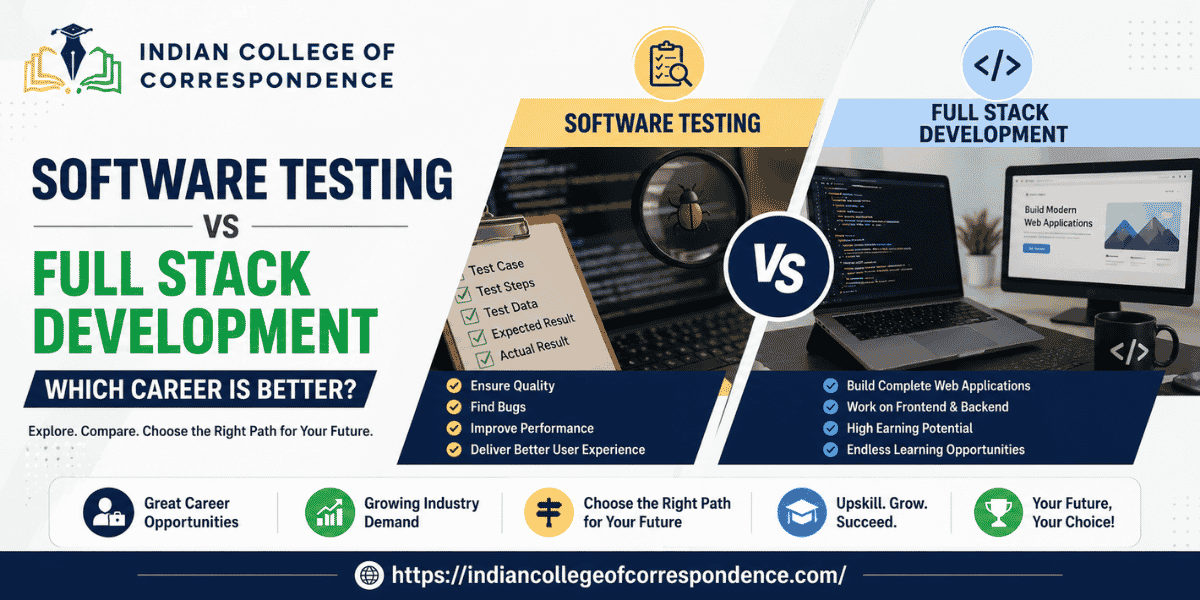
    Software Testing vs Full Stack is one of the biggest career debates among IT students in 2026. With the rapid growth of technology, cloud computing, artificial intelligence, and digital transformation, organizations are actively hiring both software testers and full stack developers. As a result, students often struggle to decide which path offers better opportunities, salary growth, and long-term career stability. When comparing Software Testing vs Full Stack, it is important to understand that both careers play critical roles in software development. Full stack developers build applications, while software testers ensure those applications work efficiently and securely. This guide explores Software Testing vs Full Stack from every angle, including skills, responsibilities, salaries, future scope, and educational pathways, helping students make an informed decision for 2026 and beyond.

    Why Are Technology Careers Growing Rapidly in 2026?

    Technology continues to transform every industry. From healthcare and banking to e-commerce and education, organizations rely heavily on software solutions to improve operations and customer experiences. As businesses invest more in digital transformation, the demand for skilled technology professionals continues to increase. This has made both software testing and full stack development attractive career choices for students pursuing IT-related qualifications. The discussion around Software Testing vs Full Stack has become more relevant because both professions are experiencing strong demand and offer promising career prospects.

    Understanding Software Testing

    Software Testing is the process of evaluating software applications to identify bugs, performance issues, and security vulnerabilities before products are released to users.

    Key Responsibilities of a Software Tester

    • Creating test cases
    • Executing manual tests
    • Performing automation testing
    • Reporting software defects
    • Verifying bug fixes
    • Ensuring software quality
    Software testers help organizations deliver reliable products while reducing risks and improving user satisfaction.

    Understanding Full Stack Development

    Full Stack Development involves creating both the front-end and back-end components of web applications.

    Key Responsibilities of a Full Stack Developer

    • Developing user interfaces
    • Creating databases
    • Building APIs
    • Writing application logic
    • Deploying applications
    • Maintaining software systems
    A full stack developer participates throughout the software development lifecycle, making this role highly versatile.

    Software Testing vs Full Stack Development: Quick Comparison

    Factor Software Testing Full Stack Development
    Primary Focus Quality Assurance Application Development
    Coding Requirement Moderate High
    Problem Solving Testing & Validation Development & Design
    Entry Difficulty Moderate Higher
    Demand in 2026 High Very High
    This comparison highlights the fundamental differences in the Software Testing vs Full Stack discussion.

    Which Career Path Matches Your Personality?

    One of the best ways to decide between Software Testing vs Full Stack is to evaluate your interests and strengths.

    Software Testing May Be Better If You:

    • Enjoy finding errors
    • Have strong attention to detail
    • Like structured processes
    • Prefer analytical work

    Full Stack Development May Be Better If You:

    • Enjoy coding
    • Like building applications
    • Prefer creative problem-solving
    • Enjoy learning new technologies
    Understanding your natural interests can help you select the right career path.

    Skills Required for Software Testing

    Software testing professionals need a combination of technical and analytical skills.

    Technical Skills

    • Manual Testing
    • Automation Testing
    • Selenium
    • API Testing
    • Performance Testing
    • Agile Methodologies

    Soft Skills

    • Communication
    • Documentation
    • Critical Thinking
    • Problem Solving
    As automation continues to evolve, software testers with technical expertise are becoming increasingly valuable.

    Skills Required for Full Stack Development

    Full stack developers require a broader range of technical skills.

    Front-End Technologies

    • HTML
    • CSS
    • JavaScript
    • React

    Back-End Technologies

    • Node.js
    • Python
    • Java
    • PHP

    Additional Skills

    • Database Management
    • Cloud Computing
    • DevOps Fundamentals
    • Git and Version Control
    Because of these requirements, many students pursuing Software Testing vs Full Stack consider full stack development more technically demanding.

    Educational Pathways for IT Careers

    A strong educational foundation plays an important role in building successful technology careers. Many students begin with bca distance education in bangalore, which provides foundational knowledge in programming, databases, networking, and software development. Similarly, IT distance education programs help students develop technical skills while offering flexibility for working professionals and learners balancing other commitments. Students seeking engineering qualifications often explore options through a B.Tech correspondence college in India, allowing them to continue learning while managing personal and professional responsibilities. For advanced studies, programs offered through an M.Tech correspondence college in Karnataka can help learners deepen their technical expertise and improve career opportunities. Flexible learning options such as distance education in bangalore have become increasingly popular because they allow students to gain qualifications without interrupting their careers.

    Career Opportunities in Software Testing

    The future of software testing remains bright as organizations prioritize quality assurance.

    Popular Job Roles

    • QA Engineer
    • Software Tester
    • Automation Tester
    • Test Analyst
    • QA Lead
    • Performance Tester

    Industries Hiring Software Testers

    • IT Services
    • Banking
    • Healthcare
    • E-commerce
    • FinTech
    • Telecommunications
    The demand for skilled testers continues to grow as businesses launch increasingly complex applications.

    Career Opportunities in Full Stack Development

    Full stack developers enjoy diverse opportunities across industries.

    Popular Job Roles

    • Full Stack Developer
    • Web Developer
    • Software Engineer
    • Application Developer
    • Technical Architect
    • Product Engineer

    Industries Hiring Full Stack Developers

    • Technology Companies
    • Startups
    • SaaS Organizations
    • E-commerce Platforms
    • Consulting Firms
    The versatility of full stack development contributes significantly to the ongoing popularity of Software Testing vs Full Stack discussions.

    Salary Comparison in 2026

    Software Testing vs Full Stack Salary Comparison

    Role Average Salary Range
    Manual Tester ₹4–8 LPA
    Automation Tester ₹6–15 LPA
    QA Lead ₹10–20 LPA
    Full Stack Developer ₹6–18 LPA
    Senior Full Stack Developer ₹12–30 LPA
    Technical Architect ₹20–45 LPA
    While both careers offer competitive salaries, experienced full stack developers often enjoy higher earning potential due to their broader technical responsibilities.Salary figures are approximate and may vary based on experience, location, employer, skills, certifications, and industry demand.

    Future Scope: Software Testing vs Full Stack

    The future outlook for both careers remains strong.

    Software Testing Trends

    • AI-driven testing
    • Test automation
    • Continuous integration
    • Security testing

    Full Stack Development Trends

    • Cloud-native applications
    • Artificial Intelligence integration
    • Web application expansion
    • Microservices architecture
    When evaluating Software Testing vs Full Stack, it is important to recognize that neither field is disappearing. Instead, both are evolving alongside technological advancements.

    How ICC Helps Students Build IT Careers?

    Choosing the right educational pathway is essential for long-term career success. ICC helps students understand available technology programs, eligibility requirements, and flexible learning options. Whether learners are exploring IT distance education, pursuing bca distance education in bangalore, or considering advanced programs, ICC provides guidance that helps students make informed educational decisions. Many learners trust ICC because of its commitment to supporting career-focused education and helping students prepare for the demands of the technology industry.

    Conclusion

    The debate around Software Testing vs Full Stack will continue as technology careers evolve. Both professions offer excellent opportunities, strong salary potential, and long-term career growth. If you enjoy identifying issues, ensuring quality, and working with testing frameworks, software testing may be the ideal path. If you enjoy coding, application development, and solving complex technical challenges, full stack development could be the better choice. Ultimately, the right choice depends on your interests, strengths, learning preferences, and long-term career goals. With proper education, practical experience, and continuous learning, both paths can lead to rewarding careers in 2026 and beyond.   Connect with Indian College of Correspondence today to explore flexible technology programs, industry-focused guidance, and educational pathways designed to help students succeed in software testing, full stack development, and other emerging IT careers.

    FAQs

    1. Which is better: Software Testing or Full Stack Development?

    Both Software Testing and Full Stack Development offer excellent career opportunities in 2026. The better choice depends on your interests and strengths. Software Testing is ideal for individuals who enjoy quality assurance, bug detection, and process-oriented work. Full Stack Development is better suited for those who enjoy coding, designing applications, and working with both front-end and back-end technologies. As businesses continue investing in digital transformation, demand for both roles remains strong. Students pursuing IT distance education can build successful careers in either field by developing relevant technical skills and gaining practical experience through projects and certifications.

    2. Is Software Testing a good career in 2026?

    Yes, Software Testing remains a highly valuable career path in 2026. As software applications become more complex, organizations need skilled professionals to ensure quality, security, and performance before deployment. The growth of automation testing, AI-driven testing tools, and DevOps practices has further increased demand for qualified testers. Professionals who learn automation frameworks and testing methodologies can enjoy excellent career growth and salary potential. Many students pursuing bca distance education in bangalore choose software testing as a career because it offers multiple specialization opportunities and strong demand across industries such as banking, healthcare, e-commerce, and technology.

    3. Does Full Stack Development offer higher salaries?

    In many cases, Full Stack Development offers higher salary potential because professionals work across multiple layers of software development. Full stack developers possess expertise in front-end technologies, back-end programming, databases, APIs, and deployment processes, making them highly valuable to employers. Their ability to manage complete application development often leads to faster career progression and leadership opportunities. However, salaries ultimately depend on skills, certifications, and experience rather than job titles alone. Students graduating from a B.Tech correspondence college in India often pursue full stack development because of its strong earning potential and growing demand across technology-driven industries.

    4. Can BCA students become Full Stack Developers?

    Absolutely. BCA students can successfully build careers as Full Stack Developers by learning programming languages, databases, frameworks, and web development technologies. Many successful developers begin their careers with a BCA degree and enhance their skills through certifications, internships, and real-world projects. Knowledge of HTML, CSS, JavaScript, React, Node.js, and database management systems is particularly important. Students enrolled in bca distance education in bangalore can also pursue this path by focusing on hands-on learning and continuously updating their technical skills to meet evolving industry requirements and employer expectations.

    5. What skills are required for Software Testing careers?

    Software Testing professionals require a blend of technical knowledge and analytical thinking. Important skills include manual testing, automation testing, Selenium, API testing, performance testing, defect tracking, and quality assurance methodologies. Strong attention to detail, communication skills, and problem-solving abilities are equally important because testers must identify issues and communicate them effectively to development teams. As automation continues to expand, testers who learn modern testing tools gain a significant advantage in the job market. Students pursuing IT distance education can develop these skills through practical projects, online training, and industry-recognized certification programs.

    6. Is distance education useful for technology careers?

    Yes, distance education can be highly beneficial for technology careers when obtained from recognized institutions. Employers increasingly focus on practical skills, certifications, and project experience rather than learning mode alone. Distance education offers flexibility, allowing students and working professionals to gain qualifications while managing other responsibilities. Programs in Information Technology, Computer Applications, and Software Development help learners build a strong technical foundation. Many students choose distance education in bangalore because it provides access to quality learning opportunities while supporting career advancement, skill development, and professional growth in the competitive technology industry.

    7. Which field has better future scope in India?

    Both Software Testing and Full Stack Development have strong future prospects in India. Software Testing continues evolving through automation, AI-powered testing, and security testing, ensuring sustained demand for skilled professionals. Meanwhile, Full Stack Development remains critical as organizations increasingly build web applications, cloud-based solutions, and digital platforms. While Full Stack Development may offer broader technical exposure and higher salary potential, Software Testing provides excellent specialization opportunities and career stability. Students pursuing advanced qualifications through an M.Tech correspondence college in Karnataka can explore either field and benefit from growing demand across technology-focused industries.

    8. Why choose ICC for IT education guidance?

    ICC helps students identify suitable educational pathways that align with their career goals and industry requirements. Whether someone wants to pursue Software Testing, Full Stack Development, Cybersecurity, Cloud Computing, or other technology careers, ICC provides guidance on admissions, program selection, and flexible learning opportunities. The institution supports learners in understanding modern industry trends and choosing qualifications that enhance employability. Students exploring distance education in bangalore often rely on ICC to make informed decisions about their education and career planning while balancing professional and personal commitments effectively.

Leave A Comment