
Admission opens for 2026-27 sessions for all university.

Blog Detail

  • Online BBA After Class 12: A Flexible Pathway to Business Education

    • 14,Oct 2026
    • Posted By : uaeautomates@gmail.com
    • 0 Comments
    • BBA After Class 12
    • BBA Career Options
    • BBA correspondence college in Karnataka
    • Business Education
    • correspondence college in india
    • distance education in bangalore
    • management distance education in bangalore
    • Online BBA
    • Online Management Courses
    • Undergraduate Courses After 12th
    Choosing a degree after Class 12 is not just about deciding what to study for the next three years. It is also about considering the kind of work you may want to do, the skills you want to develop and the learning environment that suits your circumstances. For students interested in business, marketing, finance, entrepreneurship or management, a Bachelor of Business Administration (BBA) can be one undergraduate option to explore. It introduces learners to how organisations operate, how teams work towards common goals and how businesses make decisions. However, a regular college is not the only learning format students may consider. Some explore online or distance learning because of location, affordability, family responsibilities or the need to manage other commitments alongside education. An online BBA after Class 12 can therefore be worth considering—but the programme’s recognition, teaching format, academic support and suitability for the student’s goals matter as much as the convenience it offers. This guide explains what students should understand before choosing a BBA, how it compares with other undergraduate degrees, which career directions it may support and what to check before enrolling.

    Why Are Students Interested in Business Education After Class 12?

    Business education appeals to students who want to understand how organisations function rather than focus on a single technical or academic subject from the beginning. A business administration programme typically introduces learners to different functions within an organisation. This can help students understand how sales, marketing, finance, human resources and operations contribute to business performance. There are several reasons a student might consider a BBA. It offers an introduction to different business functions. Students can explore several areas before deciding whether they want to specialise in marketing, finance, human resources, operations or another field. It connects concepts with everyday business decisions. Topics such as pricing, customer behaviour, budgeting and team management can help students understand decisions that businesses make regularly. It can support further study. A recognised bachelor’s degree may provide a foundation for postgraduate education, subject to the admission rules of the institution and programme chosen. It can help students explore different career directions. A BBA may be relevant to entry-level roles in sales, business development, marketing coordination, operations and administration. Opportunities depend on skills, experience, employer requirements and the local job market. It offers a starting point for entrepreneurial learning. Students interested in starting a business can use management concepts to understand customers, costs, planning and business operations. A degree alone, however, does not replace practical experience or market knowledge. The important point is that a BBA is not automatically the best choice for every student. It is most useful when its subjects and learning approach match the student’s interests and longer-term plans.

    What Does a BBA Help Students Understand?

    A BBA is generally designed to introduce students to the major functions of business. The exact subjects, names of papers and semester structure vary by university, so applicants should review the current syllabus of the specific programme they intend to join. Common subject areas may include:
    • Principles of management: How organisations plan work, allocate resources and coordinate people.
    • Marketing: How businesses understand customers, position products and communicate value.
    • Financial and management accounting: How financial information supports business planning and decisions.
    • Business economics: How demand, supply, costs and market conditions affect organisations.
    • Human resource management: How organisations recruit, develop and manage employees.
    • Business communication: How to communicate information clearly in professional settings.
    • Business statistics and research: How to interpret information and use evidence to support decisions.
    • Operations management: How organisations coordinate processes, resources and service delivery.
    • Business law and ethics: How legal responsibilities and ethical considerations affect business activities.
    • Entrepreneurship: How business ideas are evaluated, planned and developed.
    These are illustrative subject areas, not a guaranteed syllabus for every BBA. Before enrolling, students should compare the actual curriculum, assessment method and academic requirements. The value of studying these areas lies in understanding how they connect. A marketing decision, for example, can affect revenue, customer service, inventory and staffing. Business education helps students examine such decisions from more than one perspective.

    What Skills Can Students Develop During a BBA?

    The degree title alone does not determine what a student can do after graduation. Learning outcomes depend on the curriculum, teaching quality, assignments, independent effort and opportunities to apply concepts. A student can make business education more practical by building the following skills during the programme. Communication: Writing clear emails, presenting ideas, preparing reports and explaining information to different audiences. Analytical thinking: Comparing alternatives, interpreting basic data and identifying the reasons behind a business problem. Teamwork: Sharing responsibilities, coordinating tasks and responding constructively to different viewpoints. Digital proficiency: Becoming comfortable with spreadsheets, presentations, online collaboration tools and relevant business software. Problem-solving: Breaking a problem into smaller parts, assessing available information and proposing realistic solutions. Commercial awareness: Understanding customers, competitors, costs, revenue and the factors that influence business decisions. Professional discipline: Meeting deadlines, documenting work accurately and communicating progress. Students can strengthen these capabilities through case studies, group assignments, presentations, internships, volunteering, project work and relevant short courses. For example, a student interested in marketing could prepare a simple market research report for a local business. Someone interested in finance could practise spreadsheet-based budgeting. A student considering entrepreneurship could develop a basic business plan and test its assumptions with potential customers. These activities help turn academic concepts into evidence of practical ability.

    What Career Directions Can a BBA Graduate Explore?

    A BBA can provide a starting point for several business-related career directions. However, students should distinguish between a role that may be accessible to a fresher and a position that usually requires substantial experience or further qualifications. The following table outlines possible directions and what students may need to strengthen for each one.
    Career direction Example entry-level roles Skills worth developing
    Marketing Marketing assistant, campaign coordinator Communication, research, digital marketing
    Sales and business development Sales executive, business development associate Customer communication, negotiation, product knowledge
    Human resources HR assistant, recruitment coordinator Organisation, communication, documentation
    Operations Operations assistant, process coordinator Planning, reporting, problem-solving
    Finance and administration Accounts or finance support, administrative executive Excel, accuracy, basic accounting knowledge
    Customer relations Customer support executive, client service associate Listening, written communication, issue resolution
    Entrepreneurship Small-business or startup support roles; developing a venture Market research, budgeting, sales and planning
    These are examples, not promised outcomes. Employers may require specific software skills, prior experience, relevant certifications or a different academic background. Students should also understand that a BBA does not automatically qualify them for specialised professional roles in accounting, investment, taxation or other regulated areas. Such roles may require additional education, professional credentials or employer-specific qualifications.

    How Can Students Explore Actual Opportunities?

    Instead of relying only on broad career lists, students can examine current vacancies and work backwards from the requirements. The Government of India’s National Career Service portal provides employment-related services, including job search, career guidance and related resources. Try searching for several entry-level titles rather than only “BBA jobs”. Compare the qualifications, experience, software knowledge and communication skills listed across different employers. This creates a more realistic picture of the work available in a chosen location.

    Is BBA a Better Choice Than B.Com or BA?

    There is no single degree that is best for everyone. The right choice depends on the student’s interests, preferred subjects and intended career direction. BBA is generally oriented towards business administration and management. B.Com typically gives greater attention to commerce-related areas such as accounting, taxation, finance and business law, although the exact balance depends on the institution. BA programmes cover a broad range of arts, humanities and social science disciplines, with the subject chosen by the student shaping the academic focus.
    Factor BBA B.Com BA
    Main orientation Management and business functions Commerce, accounting and finance-related areas Arts, humanities or social sciences
    May suit students interested in Marketing, operations, management, business development Accounting, commerce, taxation, finance A chosen humanities or social science subject
    Practical preparation Can include business projects and case studies Can include accounting, commerce and financial exercises Depends on the chosen subject and programme
    Further-study options MBA and other eligible postgraduate programmes M.Com, MBA and other eligible postgraduate programmes Master’s study in the chosen or related discipline, subject to admission rules
    What to compare Management subjects, projects and specialisations Accounting depth, commerce subjects and professional pathways Subject depth, electives and future academic options
    This is a general comparison, not a universal rule. Some BBA programmes include substantial finance content, some B.Com programmes offer management electives, and some BA programmes develop valuable research, communication or analytical skills. A student who enjoys working with numbers and wants to explore accounting may prefer B.Com. Someone interested in how teams, marketing and business operations work may lean towards BBA. A student with a strong interest in psychology, economics, political science, English or another humanities or social science subject may prefer a relevant BA. Before deciding, compare the actual syllabi rather than relying only on the degree names.

    Where Does Online BBA Fit Into the Decision?

    An online BBA may appeal to students who need a different learning arrangement from a conventional classroom-based degree. For example, a student living far from a suitable college may prefer online study to reduce travel. A student with family responsibilities may need greater flexibility in organising study time. Someone who wants to work while studying may consider an online format if the programme’s schedule, assessment rules and workload are compatible with employment. Students exploring management distance education in Bangalore should compare the actual programme structure, awarding university, eligibility requirements and academic support before choosing an institution. Similarly, students considering distance education in Bangalore for undergraduate study should evaluate whether the learning format suits their circumstances without compromising their academic and career plans. The format should be evaluated carefully, however. “Online”, “distance” and “correspondence” are not automatically interchangeable terms.

    Online, Distance and Regular BBA: What Is the Difference?

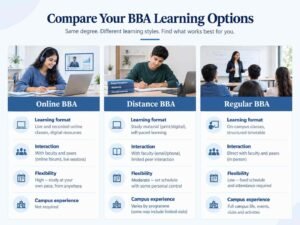
    The details vary by institution, but the following comparison provides a starting point. Comparison infographic showing online, distance, and regular BBA learning formats and considerations.
    Feature Online learning Open and Distance Learning (ODL) Regular classroom learning
    Typical learning arrangement Digital learning platform, online resources and programme-specific virtual activities Self-study resources, learning materials and academic support as defined by the institution Scheduled classroom teaching and campus-based academic activities
    Flexibility May offer flexibility, depending on live sessions and deadlines Often designed to support independent study, subject to programme requirements Usually follows a fixed timetable
    Interaction May include online classes, forums and virtual discussions Depends on the institution’s support arrangements Typically includes face-to-face interaction
    Assessment May be online, centre-based or a combination, as officially specified May include examinations or other assessments under the approved arrangement Usually follows the institution’s regular assessment structure
    Main consideration Internet access, digital learning and online engagement Self-discipline, learning resources and required academic or examination arrangements Travel, attendance and campus schedule
    Do not assume that every online programme is fully self-paced or that every distance programme has the same examination arrangements. Ask the institution to explain the actual delivery method, attendance expectations, assessment process and support available. India’s higher-education framework recognises online education and Open and Distance Learning as ways to broaden access while emphasising quality and institutional accountability. The National Education Policy 2020 provides broader context on access, multidisciplinary education and flexible learning opportunities. The policy is useful background, but it does not establish that every online BBA or every provider is recognised. That must be checked separately.

    Who May Benefit From an Online BBA – and Who May Prefer a Classroom Degree?

    An online BBA may be worth exploring if a student:
    • Needs to study from a location with limited access to suitable campus options.
    • Has work, family or other commitments to manage.
    • Is comfortable using digital platforms and organising independent study.
    • Can meet deadlines without relying on a fixed daily classroom schedule.
    • Has confirmed that the programme’s recognition, curriculum and assessment arrangements suit their goals.
    A regular programme may be a better fit for a student who prefers daily face-to-face interaction, structured routines, campus activities or more immediate access to faculty and classmates. The choice should also account for the student’s learning habits. Flexibility can be helpful, but it places greater responsibility on the learner to keep up with readings, assignments, revision and deadlines. Parents and students should discuss practical questions such as access to a laptop, internet reliability, study space, travel requirements and the availability of academic support before making a decision. Students planning their long-term careers in business and management can also explore the career path to becoming a Product Manager after an MBA to understand how postgraduate management education can open doors to specialised roles.

    What Should You Check Before Choosing a BBA Programme?

    The most important step is to evaluate the programme itself, rather than choosing solely on the basis of a convenient schedule or attractive marketing message.

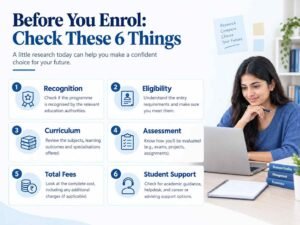
    1. Verify the Awarding University and Programme Status

    Find out which university awards the degree. Then verify that the institution and the specific programme are approved or recognised for the relevant mode and academic session, where applicable. For online and ODL programmes, begin with the official University Grants Commission Distance Education Bureau. It publishes information about recognised or entitled higher education institutions and their programmes. The UGC also advises students to check the recognition status relevant to the session in which they plan to enrol. Do not rely only on a general statement that a university is recognised. Check the specific programme, mode and applicable session.

    2. Read the Eligibility Criteria Carefully

    Many undergraduate BBA programmes consider applicants who have completed Class 12 or an equivalent qualification, but eligibility conditions differ. Check whether the programme specifies a minimum percentage, subject requirements, entrance examination, age-related condition or other admission criteria. Students should confirm these requirements from the current official programme information.

    3. Understand the Complete Fee Structure

    Compare the full cost, not just the advertised first instalment. Ask for details of tuition fees, registration charges, examination fees, study materials, re-examination fees and other compulsory payments. Also check the payment schedule, refund policy and whether fees can change during the programme. A lower advertised price is not necessarily the lowest overall cost.

    4. Review the Syllabus and Learning Resources

    Check the subjects covered in each semester, the availability of learning materials, the assessment format and whether the curriculum aligns with your interests. If you want to explore marketing, for example, look for relevant subjects and practical activities. If finance interests you, review the accounting and finance content. A programme title by itself does not reveal the depth or quality of the curriculum.

    5. Ask How Academic Support Works

    Find out how students can ask questions, obtain clarification, access learning materials and receive information about examinations. Ask whether support is available through faculty interactions, scheduled sessions, email, a learning platform or another defined process. A clear explanation of academic support is especially important for learners who may be studying independently.

    6. Understand Examinations and Deadlines

    Ask where examinations take place, how they are scheduled, whether attendance is required for any sessions and what happens if a student misses an assessment. These practical details can affect the feasibility of studying while working.

    7. Consider the Next Step After Graduation

    If you intend to pursue an MBA or another postgraduate programme, review its eligibility criteria before enrolling in a BBA. Admission requirements can differ by institution and may include minimum marks, entrance tests, work experience or other conditions. Do not assume that every bachelor’s degree automatically meets every postgraduate programme’s entry requirements.

    A Checklist for Comparing BBA Programmes

    What to verify Question to ask Why it matters
    Awarding institution Which university awards the degree? Establishes who is responsible for the qualification
    Recognition Is this specific programme recognised for the relevant mode and session? Helps avoid relying on outdated or incomplete claims
    Eligibility What are the current admission requirements? Prevents eligibility surprises
    Total fees What is the complete cost for the programme? Makes comparisons more realistic
    Curriculum Which subjects and practical activities are included? Helps determine academic fit
    Assessment How and where are examinations conducted? Clarifies logistical requirements
    Support What academic help is available to enrolled learners? Sets expectations about the learning experience
    Further study Will the degree meet the entry rules of the next programme I am considering? Helps with long-term planning

    How Should Students Compare Colleges in Karnataka and Bangalore?

    Students searching for a BBA correspondence college in Karnataka should begin by identifying the awarding university and verifying the programme’s recognition for the intended mode and academic session. A provider’s location or use of the word “correspondence” does not, by itself, establish that a programme is recognised. Students should review official university information, the current syllabus, eligibility requirements, examination arrangements and the complete fee structure before applying. Those comparing a correspondence college in India should use the same checks across institutions instead of relying only on advertisements, convenience or fee comparisons. Students looking at correspondence degree colleges in Bangalore can compare available learning formats, academic support and programme costs. However, they should distinguish between an institution that provides admission or learning support and the university that formally awards the degree. The following questions can help narrow the options:
    • Which university awards the degree?
    • Is the specific BBA programme recognised for the intended academic session and mode?
    • What are the eligibility requirements?
    • What is the complete programme fee?
    • How are teaching, examinations and academic support organised?
    • Will the qualification meet the eligibility requirements for the student’s intended postgraduate programme?
    These checks help students compare options on academic suitability rather than convenience alone.

    Can Students Pursue an MBA After a BBA?

    A BBA can be a relevant undergraduate foundation for students who want to explore management education at postgraduate level. However, admission to an MBA is determined by the rules of the institution and programme offering it. Some programmes may require a bachelor’s degree with a specified minimum percentage. Others may require entrance-test scores, interviews or additional eligibility conditions. Students should check the current requirements of the MBA programmes they may wish to apply to. Students researching MBA distance education in Bangalore should also verify the awarding university, the programme’s recognition for the relevant session, the learning format and the assessment requirements. These checks help applicants understand whether a particular programme fits their academic background and future plans. A BBA can also help students identify which areas of management they enjoy before specialising. For example, someone interested in marketing may later explore marketing management, while someone drawn to operations may investigate supply chain or operations-related study. An MBA is not the only possible next step. Depending on the student’s interests and eligibility, other postgraduate courses, professional learning, relevant work experience or entrepreneurship may also be considered. Students who want to explore entrepreneurship can use the Government of India’s Startup India Learning and Development resources. These resources can provide additional exposure to topics such as idea validation, business planning and finance, but they are not a substitute for a recognised degree.

    How Can Students Make a BBA More Valuable?

    Choosing a programme is only one part of undergraduate planning. Students can improve the practical value of their learning by building experience alongside their studies. Checklist infographic showing six factors to verify before enrolling in an online BBA programme. Explore a business function early. Try small projects in marketing, accounting, customer service or operations to understand which work you enjoy. Practice with relevant tools. Spreadsheet skills, presentation software, online collaboration platforms and basic data interpretation can be useful across many business roles. Build a portfolio of work. Keep examples of projects, reports, presentations or market research that demonstrate what you have learned. Do not include confidential information from an employer or client. Look for appropriate work experience. Internships, volunteering and supervised project work can help students understand workplace expectations. Availability and eligibility will vary. Review real job descriptions. Identify recurring skills in entry-level roles and make a plan to develop those skills during the degree. Improve professional communication. Clear writing, thoughtful questions, reliable follow-up and organised work are valuable in many business settings. Keep learning after graduation. Some career paths require further qualifications, specialised software knowledge or professional certification. Students should research these requirements rather than assuming that a BBA covers everything. For Indian students, the National Career Service portal can be a useful starting point for exploring employment resources, job opportunities and career guidance. Check current listings and eligibility conditions rather than treating a general career description as a guarantee of employment.

    How Should Students Decide Whether an Online BBA Is Right for Them?

    There is no need to choose a degree simply because it is popular or a learning format simply because it appears convenient. The better approach is to compare personal goals with the practical requirements of the programme.
    If your main priority is… What to evaluate first
    Learning about business and management BBA curriculum, subject coverage and practical projects
    Building a foundation in accounting and commerce Compare BBA with B.Com syllabi and future-study options
    Studying while working Timetable, assignment deadlines, exam arrangements and workload
    Reducing travel Online or ODL delivery details and any compulsory in-person requirements
    Pursuing an MBA later Eligibility rules for the MBA programmes you may target
    Starting a business Business fundamentals, practical projects, market research and additional entrepreneurship learning
    Keeping future options open Degree recognition, curriculum breadth and progression requirements
    For students searching for a BBA correspondence college in Karnataka, the key is to verify what the institution actually offers. Check whether the programme is online, ODL or another format, which university awards the degree, and whether the programme is recognised for the intended admission session. Do not assume that a provider’s location, a programme’s name or the use of the word “correspondence” establishes recognition. The official details of the awarding institution and programme are what matter.

    Frequently Asked Questions

    1. Can I pursue a BBA after Class 12?

    Yes, many BBA programmes admit students who have completed Class 12 or an equivalent qualification. The exact eligibility conditions vary by institution, so check the current admission requirements before applying.

    2. Is an online BBA the same as a regular BBA?

    They can lead to different learning experiences. Online programmes use digital learning arrangements, while regular programmes generally involve scheduled classroom learning. Curriculum, assessment, student interaction and recognition depend on the particular programme and institution.

    3. Is a correspondence BBA recognised in India?

    Recognition depends on the awarding institution, programme, mode and applicable academic session. For online and Open and Distance Learning programmes, students should verify the relevant details through the official UGC Distance Education Bureau and the institution’s current programme documentation.

    4. What subjects are taught in a BBA?

    Depending on the university, subjects may include management principles, marketing, accounting, economics, human resource management, business communication, operations and entrepreneurship. The exact syllabus should be checked in the programme’s official curriculum.

    5. What jobs can I explore after a BBA?

    Possible entry-level directions include sales, business development, marketing support, HR coordination, operations, customer relations and administration. Job eligibility depends on the employer, role, skills, experience and any additional qualifications required.

    6. Can I pursue an MBA after an online BBA?

    Possibly, provided the bachelor’s degree and the applicant meet the MBA programme’s eligibility requirements. Confirm recognition and check the target institution’s admission rules, including any minimum marks or entrance-test requirements.

    7. How much does an online BBA cost?

    Fees vary by university and programme. Compare the complete cost, including tuition, registration, examinations, study materials and other compulsory charges. Use the institution’s current official fee schedule rather than relying on a general online estimate.

    8. How do I choose a BBA correspondence college in Karnataka?

    Start by verifying the awarding university, the specific programme’s recognition for the relevant session, eligibility, syllabus, total fees, assessment method and academic support. Compare programmes using the same criteria so that convenience or advertising does not outweigh essential academic details.

    Conclusion

    An online BBA after Class 12 may be a useful option for students who want to study business administration and need a learning format that fits their circumstances. It can introduce them to areas such as marketing, finance, human resources, operations and entrepreneurship, while helping them explore possible directions for work or further study. But the best decision is not simply to choose an online degree. It is to select a programme whose recognition, curriculum, costs, learning arrangements and academic support match the student’s goals. Students considering a BBA correspondence college in Karnataka should verify the awarding institution and the programme’s status for the intended session before paying fees. They should also compare BBA with alternatives such as B.Com or BA, review actual career requirements and plan to develop practical skills alongside academic learning. A well-informed decision after Class 12 begins with asking the right questions—and checking the answers through reliable, official sources.

Leave A Comment