Admission opens for 2026-27 sessions for all university.

Blog Detail

  • Digital Librarian Career in 2026: Skills, Courses, Salary & Job Opportunities

    • 08,Aug 2026
    • Posted By : opsadsthrivein@gmail.com opsadsthrivein@gmail.com
    • 0 Comments
    • BA correspondence college in Bangalore
    • MA correspondence college in India
    • Traditional distance education in bangalore
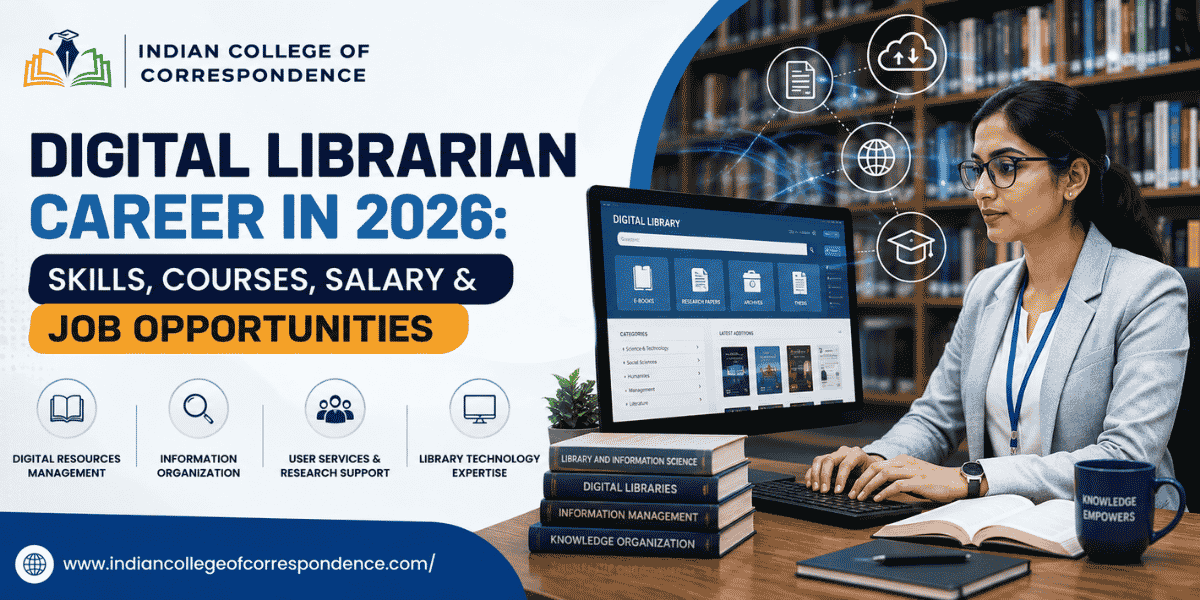
    Information is no longer confined to shelves. Presently, universities, research institutes, corporations, museums, and archives manage an extensive amount of e-books, research material, databases, photographs, reports, and records in digital formats. This has created a new avenue for people passionate about research, organisation, and technology. A Digital Librarian Career in 2026 can provide an exciting opportunity for postgraduates interested in making a difference in people’s lives by enabling them to find the right information. A Digital Librarian Career in 2026 also opens up beyond the traditional library and includes working with repositories, databases, digitisation, research services, and new-age information technologies. 

    What Is a Digital Librarian?

    A digital librarian manages electronic information resources. Unlike a traditional librarian, their work extends beyond maintaining and managing print material. They also deal with:
    • E-books
    • Electronic journals
    • Computer-based repositories
    • Institutional repositories (IR)
    • Online databases
    • Research publications
    • Digital photos and documents
    • Metadata
    • Digital preservation
    • Information retrieval
    • Library automation
    • Online and virtual services
    The rise in information technology has significantly influenced the scope and domain of Library and Information Science (LIS). IGNOU’s current syllabus for BLIS clearly states how computer, communication, storage, and multimedia technologies have transformed the nature of library and information work. Therefore, it is important to view a Digital Librarian Career in 2026 from the perspective of information-and-technology rather than the traditional librarian.

    Why Is the Digital Librarian Role Changing in 2026?

    Modern-day students and researchers use digital resources for their studies. They may search an online journal from their home, access an institutional repository from their phones, read an e-book, use an online research database, or look through digital archives. Someone has to manage these resources, organise the information, and make it available to researchers. Librarians are expected to facilitate their users’ access to the increasing number of online resources. This includes:
    • Online academic resources
    • Digital collections
    • Institutional repositories
    • Research data
    • Digitised archives
    • Open-access resources
    • Cloud-based systems
    • AI-assisted search
    • Digital preservation
    The National Digital Library of India project deals with an extensive range of digital content, user services, and advanced digital-library technologies, indicating the significant role of information professionals.  A Digital Librarian Career in 2026 will be rewarding for students and professionals willing to update their skills in the latest trends. 

    Traditional Librarian vs Digital Librarian

    The easiest way to understand the change is to compare the two roles.
    Traditional Library Work Digital Library Work
    Physical books E-books and electronic resources
    Manual records Digital metadata
    Physical catalogue Online discovery systems
    Printed archives Digital archives
    In-person assistance Online information support
    Physical preservation Digital preservation
    Local access Remote access
    Manual organisation Automated and technology-assisted systems
    The two roles are not completely separate. Many professionals still work with physical and digital collections together. However, the digital environment requires additional technical and information-management knowledge. This is one reason a Digital Librarian Career in 2026 can be attractive to learners who want a career that combines information science with technology.

    Digital Librarian Skills You Should Learn

    A digital librarian should possess a blend of information and technological skills. The top skills for a digital librarian position include:

    1. Information Organisation

    A digital librarian’s role requires them to classify, organise, catalogue, retrieve, and store information in digital or physical formats.  They have to understand:
    • Classification systems
    • Cataloguing
    • Metadata
    • Information architecture
    • Indexing
    • Information retrieval

    2. Digital Technology

    The librarian has to develop skills in:
    • Library management systems
    • Digital repositories
    • Databases
    • Content management
    • Digitisation tools
    • Basic HTML
    • Search systems
    • Cloud-based platforms

    3. Research Skills

    A digital librarian facilitates the research work of students, teachers, and researchers. Therefore, besides technological proficiency, they have to develop skills such as:
    • Finding relevant sources 
    • Evaluating information 
    • Searching online databases 
    • Assisting in literature search 
    • Identifying research sources 
    • Organising research information 

    4. Communication Skills

    Technology cannot replace the human touch in many fields, and library science is one of them. A digital librarian has to communicate with people regarding various aspects, such as explaining searching strategies, recommending resources, or teaching people how to use a specific database.

    5. AI Literacy

    The role of artificial intelligence (AI) in a digital librarian’s career is growing by the day. While one may not need to be an expert in coding, understanding AI-assisted information discovery, organisation, and verification can be beneficial. Skills such as automated metadata, summarising, recommending, and information extraction can help get ahead in a competitive environment. Many educational institutes already offer relevant courses. For instance, TISS’s 2026–27 PG Diploma in Digital Library & Information Management covers digital libraries, information management, AI in libraries, digital preservation, and digital content development. Similarly, a Digital Librarian Career in 2026 will now involve an understanding of AI basics and its application in libraries.

    Digital Librarian Courses

    When searching for a digital librarian course, remember that it is not enough to look for the words “digital librarian.” A qualified academic programme will teach students the necessary digital expertise to be successful in the field. The following courses can be a great way to start a Digital Librarian Career in 2026: 
    • Bachelor of Library and Information Science
    • Master of Library and Information Science
    • Postgraduate Diploma in Digital Library Management 
    • Digital Archiving
    • Information Management
    • Knowledge Management
    • Research Information Management
    A digital library course can also supplement a career in traditional libraries. For instance, IGNOU’s BLIS course offers eligibility for postgraduate library science courses and develops competencies in emerging library and information technologies. At the postgraduate level, IGNOU’s MLIS course requires a candidate to have a BLIS degree or an equivalent qualification and focuses on information access, processing, organisation, and dissemination. One can view a Digital Librarian Career in 2026 from the perspective of academic excellence by pursuing the right Library Science degree.

    Who Can Become a Digital Librarian?

    A Digital Librarian Career in 2026 is open to many students and professionals. The role does not have specific eligibility criteria, and depending on the educational institute, a graduate can pursue a career in digital library with the following qualifications:
    • Graduates interested in library science
    • Professionals from the field of library science 
    • Career changers
    • Research-oriented graduates
    • Anyone interested in digital archives 
    • Information centre professionals 
    A student wishing to pursue a career in library science can consult a BA correspondence college in Bangalore about eligibility for library science courses after completing a BA degree. Similarly, someone interested in a Digital Librarian Career in 2026 can explore the eligibility criteria for an MA correspondence college in India before enrolling.  Eligibility criteria may vary depending on the educational institute, and students must conduct further research before applying to their chosen institution. 

    Can You Study Library Science Through Distance Learning?

    Distance learning is a flexible mode of education that can be crucial for students interested in pursuing an alternate career. For instance, people researching a distance education in Bangalore may find several options to pursue their studies while managing their other responsibilities. However, distance learning should not be viewed as an option to simply acquire theoretical knowledge. If someone wishes to develop a career in Digital Librarian in 2026, it is essential to utilise the available resources to gain practical exposure in addition to formal education. For instance, students can study:
    • Digital repository basics
    • Metadata
    • Research databases
    • Library automation
    • Digital preservation
    • Information-search techniques
    • Basic data management
    The same can apply to students of Traditional distance education in Bangalore. A flexible mode of education can enable students to combine theoretical knowledge with practical skills to enhance their employability potential. 

    What Is Digital Library Management?

    Digital library management refers to the organisation of digital resources in an effective manner so that the information is easily accessible to the user. It encompasses:
    • Collection development
    • Metadata management
    • Digital cataloguing
    • User access
    • Repository management
    • Digital preservation
    • Organisation and categorisation of digital resources 
    • Searching and optimisation 
    • Copyright and usage
    This is an important consideration for a Digital Librarian Career in 2026 since simply uploading information on the web will not facilitate easy access to the target audience. 

    How to Become a Digital Librarian: Step-by-Step Roadmap?

    The following roadmap can help students pursuing a Digital Librarian Career in 2026:

    Step 1: Complete Your Academic Foundation

    Begin with a suitable undergraduate or Library and Information Science qualification based on your eligibility.

    Step 2: Learn Library Fundamentals

    Understand classification, cataloguing, information sources and research services.

    Step 3: Develop Technology Skills

    Learn library automation, digital repositories, databases and basic web technologies.

    Step 4: Learn Digital Preservation

    Understand how digital materials are stored, protected and maintained for long-term access.

    Step 5: Explore AI and Data

    Develop basic knowledge of AI-assisted information discovery, data management and automated workflows.

    Step 6: Gain Practical Experience

    Internships, library projects, digitisation work or research-support activities can help you understand how the profession works.

    Step 7: Build a Professional Profile

    Create a resume that highlights both academic qualifications and practical digital skills. This approach makes a Digital Librarian Career in 2026 more realistic than simply completing a course and immediately expecting a specialised job.

    Digital Librarian Career in 2026: Six-Month Skill Plan

    If you want a simple starting point, use this plan.
    Month Main Focus Practical Goal
    Month 1 Library fundamentals Understand cataloguing and classification
    Month 2 Metadata Create sample metadata records
    Month 3 Digital repositories Explore repository workflows
    Month 4 Digitisation Understand scanning and preservation
    Month 5 AI and research tools Learn modern information tools
    Month 6 Portfolio Complete one digital-library project
    You do not need to master everything in six months. The purpose is to create a strong foundation that you can continue building.

    Digital Librarian Jobs in 2026

    The phrase digital librarian job includes various opportunities beyond the conventional library setup. Some of the top recruiters of digital librarians include:
    • Universities
    • Colleges
    • Research institutions
    • Museums
    • Archives
    • Government organisations
    • Corporate knowledge centres
    • Publishing organisations
    • Digital repositories
    • Information centres
    • Non-profit organisations
    Possible job titles include:
    • Digital Librarian
    • Library Information Specialist
    • Digital Library Assistant
    • Digital Archivist
    • Metadata Specialist
    • Repository Manager
    • Information Analyst
    • Knowledge Management Executive
    • Research Support Specialist
    • Library Technology Assistant
    The National Digital Library of India also publishes opportunities for professionals working on its digital-library project, demonstrating that digital information initiatives can require specialised staff beyond traditional library settings. Therefore, a Digital Librarian Career in 2026 does not necessarily mean working only inside a conventional library building.

    Digital Librarian Career Opportunities Beyond Libraries

    This is one of the most interesting parts of the field. Your skills can potentially transfer into related areas such as:

    Knowledge Management

    Companies need professionals who can organise internal information and make knowledge easier to discover.

    Digital Archives

    Museums, cultural organisations and institutions need specialists to digitise and preserve historical material.

    Research Support

    Universities and research organisations require professionals who can help researchers discover and manage information.

    Metadata

    Publishers, repositories and digital platforms need accurate metadata to organise large collections.

    Information Services

    Organisations need people who can evaluate, organise and communicate information effectively. This broader view is important because a Digital Librarian Career in 2026 can lead toward information-management roles rather than one fixed job title.

    Digital Librarian Salary in India in 2026

    Salary can vary significantly depending on qualification, experience, employer, location and specialisation. Instead of assuming that every digital librarian will receive the same package, think about career progression.
    Career Stage Typical Role Main Salary Influencers
    Entry Level Library Assistant / Trainee Qualification and basic skills
    Early Career Digital Library Assistant Digital tools and experience
    Mid Career Digital Librarian / Information Specialist Specialisation and responsibility
    Senior Senior Librarian / Repository Specialist Experience and leadership
    Specialist Knowledge or Research Information Professional Advanced expertise
    For example, a 2025 ICTS-TIFR recruitment notice for a Library Trainee in Bengaluru listed consolidated monthly emoluments of ₹22,000 and required graduation plus B.Lib. That example should not be treated as a universal salary benchmark. It simply shows why qualification, organisation and role level matter. If you are researching digital librarian salary in India, compare current vacancies and employer-specific requirements instead of relying on one generic figure.

    How AI Is Changing the Digital Librarian Role?

    AI is not simply another software tool for libraries. It can influence how professionals discover, organise and manage information. Potential applications include:
    • Automated metadata generation
    • Intelligent search
    • Recommendation systems
    • Document summarisation
    • Research assistance
    • Text classification
    • Information extraction
    • User-support chatbots
    However, there is an important warning. AI-generated information can be inaccurate. It may also create problems involving privacy, copyright, bias and source verification. A digital librarian therefore needs to understand not only how to use AI but also when not to trust its output without checking the underlying source. This makes AI literacy particularly valuable for a Digital Librarian Career in 2026.

    What Does a Digital Librarian Do During a Typical Day?

    A typical day can vary considerably depending on the organisation. For example: 9:00 AM: Review digital resource requests. 10:00 AM: Update metadata for newly added documents. 11:30 AM: Help a researcher locate relevant information. 1:00 PM: Review repository records. 2:30 PM: Work on a digitisation project. 4:00 PM: Check digital-resource usage and prepare reports. 5:00 PM: Respond to user questions and plan the next day’s tasks. This shows why the profession can suit people who enjoy a combination of technology, organisation, research and communication.

    Digital Librarian Career in 2026: Qualification vs Skills

    A qualification gives you an academic foundation. Skills show what you can actually do. Experience demonstrates how you apply those skills. The strongest candidates therefore try to build all three. Think of it this way: Qualification → Knowledge → Practical Skills → Experience → Career Growth For someone pursuing a Digital Librarian Career in 2026, simply adding certificates to a resume may not be enough. A stronger profile might include:
    • Library Science qualification
    • Digital library knowledge
    • Metadata experience
    • Research skills
    • Repository exposure
    • AI literacy
    • Digital preservation knowledge
    • Communication skills

    How to Build a Digital Librarian Portfolio?

    A portfolio is particularly useful if you are a fresher. You could create a small sample digital-library project containing:
    1. A sample digital collection
    2. Metadata records
    3. A simple classification structure
    4. Search categories
    5. A preservation plan
    6. A short user guide
    You could also document a digitisation project or explain how you would organise an institutional repository. The objective is not to create a huge professional system. The objective is to demonstrate that you understand how digital information should be organised and made accessible. This can make your Digital Librarian Career in 2026 preparation more practical.

    Common Mistakes to Avoid

    Mistake 1: Thinking Librarians Only Work With Books

    Digital information has expanded the profession considerably.

    Mistake 2: Ignoring Technology

    Library Science and technology are increasingly connected.

    Mistake 3: Choosing a Course Without Checking Its Curriculum

    Look for relevant content rather than choosing based only on the course name.

    Mistake 4: Learning Only Theory

    Practical projects can make your knowledge much easier to demonstrate.

    Mistake 5: Ignoring Research Skills

    Research support remains an important part of information work.

    Mistake 6: Treating AI as a Replacement for Professional Judgement

    AI can assist with information workflows, but verification remains essential.

    Mistake 7: Stopping Learning After Graduation

    Digital systems change continuously, so professionals need to keep updating their skills.

    Is Digital Librarian a Good Career in 2026?

    For the right person, yes. A Digital Librarian Career in 2026 can be a good option if you enjoy information, research, technology, organisation and helping others access reliable resources. It may be particularly suitable for people who want a career connected to:
    • Education
    • Research
    • Technology
    • Archives
    • Information management
    • Knowledge management
    • Digital preservation
    It is also important to have realistic expectations. Not every role will be highly technical, and not every digital-library position will offer the same salary or career progression. The best approach is to identify the part of the field you enjoy and build specialised skills around it.

    Why Choose ICC for Flexible Education?

    For many students, the prospect of an alternate career option can be exciting, especially when it allows them to continue working while pursuing their studies.  Flexible education can be a potential solution, and ICC can be one’s preferred academic institution. For instance, a student researching a correspondence college in India can find several career avenues after their studies.  This is especially true for someone exploring alternate modes of education, such as the ones provided by a correspondence degree college in Bangalore. However, it is important to understand that the value of such qualifications can be enhanced only when one gains practical knowledge alongside theoretical expertise. This is an important consideration when planning a Digital Librarian Career in 2026.

    Where Can Your Career Go After Digital Library Experience?

    One’s first job is unlikely to define their entire career. For instance, working in a digital library can provide one with a solid foundation to build a career in the following areas: Digital Library → Information Specialist → Knowledge Management or Library Science → Digital Archives → Digital Preservation or Library Science → Research Support → Information Management Apart from these options, one can also consider integrating information science with various other fields, including data, AI, and technology. This can be another reason why a Digital Librarian Career in 2026 can be rewarding for people not interested in a traditional career in library science. 

    Conclusion

    The future of the librarian profession will not involve a book and a shelf. It will comprise digital libraries, repositories, information systems, and technology-assisted information discovery and organisation. This does not mean that traditional library knowledge is not important; instead, it can be much more relevant when combined with digital expertise. A Career As A Digital Librarian In 2026 will be rewarding for people willing to pursue a combination of the following:
    1. Academic knowledge of library and information science.
    2. Digital expertise to handle information systems, repositories, and databases.
    3. Continuing education to update one’s skills.
    Starting with Library Science and moving towards digital preservation can provide one with the required knowledge to pursue a variety of career options. One can gain practical exposure in a digital library to bolster their qualifications. This will make someone eligible for a Digital Librarian Career in 2026. Start Your Digital Librarian Journey With ICC Are you interested in building a successful career with the help of flexible education? Indian College of Correspondence can be a great place to start. Students can explore their career options while gaining additional expertise in the chosen field. Whether it is an educational pathway or career support, taking small steps with a clear vision can lead to great outcomes. Consider your options and begin your academic journey with ICC today. Explore your education options today and start building the academic foundation and digital skills needed for tomorrow’s information careers.

    FAQs

    1. What qualification is required to become a digital librarian?

    The eligibility criteria depend on the vacant positions and the organisations offering the recruitment. Most digital librarian jobs require a degree in Library and Information Science (BLIS), BLIS, or similar qualifications. You can also consider additional skills such as digital repositories, metadata specialisation, database management, digitisation and information retrieval. There are also digital librarianship courses that offer specialisation in digital library and information management. The best way is to research the eligibility criteria of targeted institutions before pursuing any of the digital librarian courses in Bangalore. Apart from the academic qualifications, it is important to have relevant technology skills alongside theoretical competence to become a digital librarian. This will increase your chances of landing technology-based jobs in universities, research organisations, and other related institutions.

    2. Can I become a digital librarian after BA?

    It is possible to pursue a library science course after BA if the eligibility criteria align with your academic profile. Completing a degree in library and information science enables you to gain vital professional skills and knowledge required to manage libraries and their resources. However, it is important for students considering a career in digital libraries to specialise in additional skills such as cataloguing, and metadata, digital repositories, information management, and digital information retrieval. While searching for the best BA correspondence college in Bangalore, it is important to focus on the relevance of the course to your career needs instead of taking it for a short-term purpose. The right library science qualifications enable students to gain a wide range of practical and technological skills to prepare them for a career in digital libraries, academic libraries, information centres, and other related institutions.

    3. What are the most important digital librarian skills?

    In the current developments in the library field, a digital librarian requires more than just library science knowledge. The most important digital librarian skills include metadata, cataloguing, digital repositories, information retrieval, library database management, digitisation, and digital preservation. Additionally, like other professional librarians, digital librarians need research skills to help students and other researchers locate study materials. In 2026, an added advantage is the digital librarian skills set related to artificial intelligence (AI) and information search technologies. However, despite the sophistication of AI tools and search engines, librarians still rely on their research skills to ensure the accuracy, authenticity, integrity, and validity of the information. Therefore, it is important for students considering a career in digital libraries to develop library science knowledge and relevant digital librarian skills set.

    4. What are the best digital librarian courses in 2026?

    The eligibility criteria and the best digital library courses depend on the level of qualification, career goals, and personal preferences. In most cases, BLIS, MLIS, or degrees in Information Science are the core academic qualifications for most digital librarian positions. However, there are also other specialisation courses suitable for different areas of digital libraries. For instance, some institutions offer digital library courses ranging from digital libraries, information management, digital archives, to digital library preservation. When looking for the best digital librarian courses in 2026, it is important to consider the subjects covered by the programme. Ideally, the best digital librarian courses should include topics such as cataloguing, metadata, digital repositories, library automation, information retrieval, and digital preservation. If you are already in a professional career, you can consider flexible digital library management courses and study options to enable you to advance your career while acquiring new skills. Regardless of the digital library courses, it is important to double-check eligibility requirements before pursuing any of the digital librarian courses in Bangalore.

    5. What is the difference between a librarian and a digital librarian?

    A librarian is a generic term that describes all other specialisations, including digital librarians, academic librarians, and other specialists. Traditional librarians manage physical resources such as books and magazines and may also operate computerised library machines. On the other hand, a digital librarian is a type of a librarian who manages electronic resources such as e-books, electronic journals, digital repositories, metadata, and research databases. Additionally, digital librarians have more technological expertise compared to traditional librarians. It is not enough for digital librarians to just know how to operate the computerised library management systems; they should also understand how to facilitate easy access to the online resources and information. Since most organisations are embracing digitalisation and digitisation of processes, digital library management has become very important.

    6. Are digital librarian jobs available outside universities?

    Librarian jobs, including digital librarianship positions, are not restricted to universities or colleges. Even though higher education institutions offer more opportunities for aspiring librarians, there are also many other organisations, both in the private and public sectors, that hire digital librarians, information officers, digital archivists, and other related specialisation. The main advantage of pursuing a career in digital libraries is that it is a broad specialisation that can be integrated into different fields of study. Therefore, it is important for students looking to become digital librarians to consider additional skills that can help them stand out from the competition when seeking digital librarian jobs, apart from just library studies. Having said that, there are also diverse digital librarian job opportunities in research organisations, museums, government agencies, publishing companies, corporate organisations, information service centres, and digital repositories.

    7. Is digital librarian a good career in 2026?

    A career in digital libraries can be rewarding for individuals with an interest in research, technology, and management. Currently, libraries, universities, research institutions, and other organisations that provide information services are adopting digitisation in their operations. This development has created new job opportunities for qualified and competent digital librarians, information officers, and other related occupations. As a student looking to pursue a career in digital libraries, it is necessary to consider the following factors: personal interests, academic qualifications, additional skills, and the target organisations. Therefore, as an aspiring digital librarian, it is important to develop relevant skills to increase chances of being among the best digital librarian professionals.

    8. Can working professionals study Library Science?

    For working professionals interested in studying library science, there are many flexible modes of study, as long as they meet the eligibility criteria. However, when selecting the best library science courses for working professionals, it is important to go beyond just flexibility. Ideally, working professionals should select a library science course with a good accreditation, appropriate syllabus, adequate resources, and study support options. Additionally, it is important for working professionals to take advantage of other opportunities such as additional skill acquisition, to complement library science knowledge and boost career prospects. Working professionals can easily pursue correspondence courses in Bangalore alongside their careers, as long as the courses are relevant to their study needs and personal preferences.

    9. What is digital library management?

    Digital library management encompasses all aspects of managing a digital library. Therefore, digital library management can either be a general or specific term depending on the context. In most cases, digital library management involves managing digital resources, including e-books, research papers, institutional repositories, images, videos, and audio recordings. Digital library management covers various specialisation areas, including resource management, cataloguing, metadata, library database management, information retrieval systems, digitisation and digitisation, digital preservation, collection maintenance, among others.

Leave A Comment