
Admission opens for 2026-27 sessions for all university.

Blog Detail

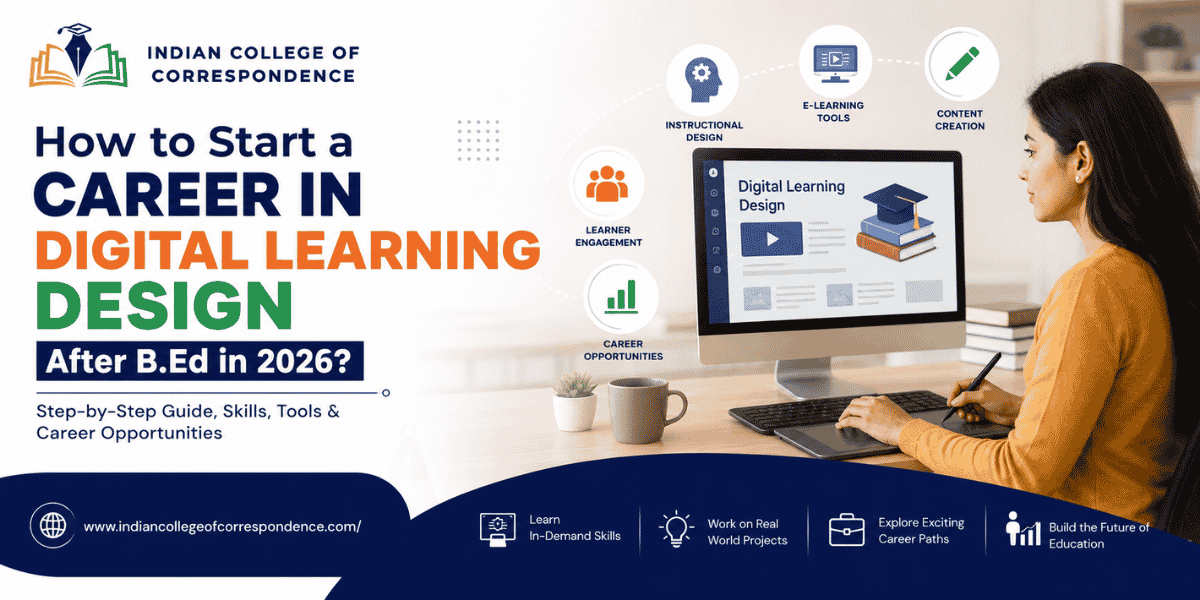
  • How to Start a Career in Digital Learning Design After B.Ed in 2026?

    • 14,Aug 2026
    • Posted By : opsadsthrivein@gmail.com opsadsthrivein@gmail.com
    • 0 Comments
    • B.Ed course for working professionals
    • M.Ed correspondence college in Bangalore
    • Teaching distance education
    The way we learn is changing. A classroom is no longer defined by four walls, a blackboard, and a textbook. Students are engaging with online courses, educational apps, interactive videos, virtual classrooms, and digital assessments. This evolution has created a unique opportunity for B.Ed graduates to think beyond the traditional classroom. Digital Learning Design is an emerging career that allows you to combine your knowledge of teaching, learning, and curriculum with technology and creativity. If you are a B.Ed graduate with a passion for developing engaging lessons and exploring new ways to teach, then you will find that Digital Learning Design can be a great way to leverage your teaching experience into a modern career. In 2026, Digital Learning Design is fast becoming integrated with instructional design, e-learning, AI-assisted content creation, and learning technology.

    What Is Digital Learning Design?

    Digital Learning Design is the process of designing and developing engaging and effective learning experiences for digital mediums. It is important to note that this is different from simply uploading a textbook onto a website. A learning designer must think about how the information can be presented, practised, and assessed in a digital environment. For example, a teacher explaining photosynthesis in a classroom can be transformed into a digital course with animated visuals, interactive activities, assessments, and much more. This is the core concept of Digital Learning Design. Professionals in this field can work on a variety of digital learning projects such as online courses, e-learning modules, educational videos, presentations, assessments, learning management systems, microlearning content, corporate training, and virtual classrooms. The Central Institute of Educational Technology’s recent initiatives also include instructional design, digital content, learner engagement, and LMS-related skills as part of online-course design.

    Why B.Ed Graduates Can Move Into Digital Learning?

    A B.Ed graduate has a unique advantage when it comes to a career in Digital Learning Design. You have knowledge of the teaching-learning process that cannot be achieved simply by learning software design. During your B.Ed program, you would have learnt about lesson planning, educational psychology, teaching methodologies, assessments, and much more. These are all critical components of Digital Learning Design. In other words, Digital Learning Design is simply an extension of what you already know. A B.Ed graduate already knows how to:
    • Break down complex topics into smaller concepts
    • Design learning objectives
    • Plan and deliver lessons
    • Assess and evaluate learners
    • Engage and motivate learners
    • Adapt to the needs of individual learners
    • Simplify concepts for better understanding
    • Identify common learning challenges
    All you need to do is complement your knowledge of teaching and learning with digital design and instructional-design principles to become a Digital Learning Designer. In fact, your B.Ed can be the foundation upon which you can build a successful career in Digital Learning Design. Current career guides for instructional designers also include B.Ed as a common educational qualification while emphasizing the need for advanced qualifications and digital learning skills.

    The Difference Between Teaching and Digital Learning Design

    Teaching and learning design are closely connected, but they are not the same job. A teacher generally works directly with learners. A digital learning designer focuses on building the experience through which learners will learn.
    Teaching Digital Learning Design
    Directly teaches learners Designs learning experiences
    Uses lesson plans Creates learning structures and storyboards
    Conducts classroom activities Creates digital activities
    Explains concepts Converts concepts into digital content
    Conducts assessments Designs quizzes and knowledge checks
    Manages classroom interaction Designs learner engagement
    Gives direct feedback Builds feedback into digital learning
    This difference is important because many B.Ed graduates initially assume that moving into digital education means simply becoming an online teacher. In reality, Digital Learning Design involves planning what learners will experience before, during and after a digital lesson.

    What Skills Do You Need for Digital Learning Design in 2026?

    It is important to understand that Digital Learning Design requires a combination of teaching skills, digital skills, instructional design skills, and technology skills. The best way to think about this is in terms of four pillars.

    1. Learning and Instructional Skills

    This is the foundational skills for Digital Learning Design. You must have a thorough understanding of the following:
    • Instructional design 
    • Learning objectives
    • Adult learning basics
    • Assessment and evaluation
    • Curriculum development
    • Learner analysis
    • Storyboarding
    • Course design
    It is important to have an understanding of the why behind instructional design rather than simply the how.

    2. Content Development Skills

    As a learning designer, you must have strong skills in developing content.  This includes:
    • Educational writing
    • Scriptwriting
    • Presentation development
    • Storytelling
    • Visual communication
    • Infographic 
    • Video development

    3. Digital Tools

    You do not need to be an expert programmer, but you should have working knowledge of digital tools.  This includes:
    • Canva
    • PowerPoint
    • Screen-recording tools
    • Video-editing tools
    • Learning Management Systems
    • E-learning authoring tools
    • Collaboration tools

    4. Emerging Technology Skills

    This is where Digital Learning Design becomes exciting, especially in 2026. The use of AI in learning design is set to explode in the coming years.  You can use AI tools for the following:
    • Developing lesson plans
    • Creating question banks
    • Generating examples
    • Simplifying complex concepts 
    • Creating activities
    • Developing scripts
    • Personalizing learning
    However, you must understand that AI should be used as a tool to complement your instructional-design skills rather than a replacement for them. A B.Ed graduate has the advantage of knowing how to evaluate information for accuracy, relevance, and appropriateness for a specific audience. This is a critical skill when it comes to AI-generated content.

    Digital Learning Design Course: What Should You Learn?

    If you are looking for a Digital Learning Design Course after your B.Ed, it is important to understand what to look for in a program. Ideally, the course should introduce you to instructional design, learning theories, storyboarding, e-learning development, digital content development, assessment design, learning analytics, educational technology, and practical projects. For example, IGNOU’s distance-education programs include instructional design, learner support, technology for learning enhancement, and digital content development. Most professional courses are also moving towards more practical training. KPMG India’s 2026 instructional-design program, for example, includes live learning, self-paced learning, and a capstone project. Another thing to look for in a Digital Learning Design Course is a portfolio-building component. In other words, do not waste your time and money on a course that only gives you a certificate. A portfolio can help you showcase your work and skills to potential employers.

    Build Your First Digital Learning Portfolio

    This is the most important step in your journey to becoming a Digital Learning Designer. You can start by building your first digital-portfolio. You do not need to wait for the “perfect” time to start working on real-world projects. In fact, your first digital-portfolio can consist of your very own sample projects. You can complete the following five projects as your sample portfolio:

    Project 1: School Learning Module

    Choose a topic of your choice and develop a 10-minute lesson. This lesson should include a learning objective, introduction, explanation, visuals, activities, and a quiz. It is important to document your thought process for each of the following:
    • Who is the target audience?
    • What is the problem you are trying to solve?
    • What is the learning objective?
    • What content will you use?
    • What activities will you include?
    • How will you assess learners?
    • What are your expected outcomes?

    Project 2: Corporate Training Module

    You can also build a simple employee-training module such as a communication module, cybersecurity awareness module, or time-management module.

    Project 3: Microlearning Course

    Build a 5-minute microlearning course that can be used for mobile learning.

    Project 4: Interactive Assessment

    Design a quiz with multiple question types and feedback.

    Project 5: Course Storyboard

    Develop a storyboard for an online course.

    Where Can Digital Learning Designers Work?

    One of the best things about a career in Digital Learning Design is that you can work in a variety of industries.  In fact, you can use your skills in the following industries:

    EdTech Companies

    EdTech companies require professionals who can design and develop engaging and effective digital courses.  You can explore the following roles:
    • Instructional Designer
    • Learning Content Developer
    • Curriculum Designer
    • E-learning Developer
    • Academic Content Specialist

    Schools and Universities

    Schools and universities are also embracing digital learning and online courses. You can work as a learning designer for educational institutions.

    Corporate Training

    Many corporations are also interested in training their employees.  You can work in the following roles:
    • Employee training designer
    • Compliance trainer
    • Product trainer
    • Leadership trainer

    Training Companies

    There are also a number of training companies that specialise in developing courses for businesses and institutions.

    Freelancing

    With the right skills and portfolio, you can also freelance as a digital learning designer.

    How Your Existing Education Can Support the Transition?

    If you are a working professional pursuing a B.Ed course, you already understand the importance of balancing your career and education. In fact, you can use your own experience as a working professional to better understand the needs of working learners. Similarly, if you are interested in Teaching distance education, your knowledge of distance learning can be a great advantage. The transition to a career in Digital Learning Design is not about abandoning education. It is about using your existing educational qualifications to build a new career. If you are considering an M.Ed correspondence college in Bangalore, you can also use your advanced educational qualifications to build a stronger foundation. It is important to note, however, that postgraduate education should be complemented with practical digital-learning skills if your goal is to become a digital learning designer.

    Can Students From Flexible Education Backgrounds Enter Digital Learning?

    Yes, students from flexible education backgrounds can make a successful transition into Digital Learning Design, provided they have the right skills and portfolio. Students who are considering distance education in Bangalore can use their flexible schedules to learn digital design and instructional-design skills while completing their education. Similarly, students who are considering a correspondence college in India can also use their time to build practical skills in digital learning design. What matters is what you can demonstrate beyond your qualifications. In other words, students from a correspondence degree college in Bangalore can use their time to complete relevant projects, training, and certifications to build a strong portfolio. The same applies to students who are considering IT distance education, management distance education in Bangalore, MBA distance education in Bangalore, BBA correspondence college in Karnataka, BA correspondence college in Bangalore, or Science distance education in Bangalore. Your educational background can serve as a foundation for a career in digital learning design.

    What Does a Digital Learning Designer Do Every Day?

    A Digital Learning Designer is much more than just a graphic designer or video editor. The role of a digital learning designer is to design and develop effective learning experiences.  The process typically involves the following steps:
    • Understanding learning requirements
    • Conducting learner research
    • Designing learning objectives
    • Planning and organizing content
    • Developing storyboards
    • Building digital content
    • Designing assessments
    • Testing and evaluation
    • Launching the course
    • Course improvement
    You can see that a digital learning designer must have both creative and analytical skills.

    Digital Learning Design Jobs After B.Ed

    After building the necessary skills, you can start looking for Digital Learning Design jobs after B.Ed. It is important to note that you should not limit yourself to one job title.  In fact, you can explore the following Digital Learning Design jobs after B.Ed:
    • Instructional Designer
    • Digital Learning Designer
    • Learning Experience Designer
    • E-learning Developer
    • Learning Content Developer
    • Curriculum Developer
    • Educational Content Specialist
    • LMS Executive
    • Training Content Developer
    • Learning and Development Specialist
    It is also important to note that job titles can vary from company to company. You can also explore instructional-design jobs in India to get a better idea of the types of roles available.

    Digital Learning Designer Salary in India

    The salary for a digital learning designer can vary depending on a number of factors, including experience, employer, location, portfolio, and skills. Ideally, you should start with an entry-level learning or content-design position and then move on to instructional design. With experience, you can also move into senior instructional design roles, learning experience design, learning consultancy, and leadership roles such as learning design lead and learning and development manager. According to Indeed’s January 2026 salary search, the average base salary for an instructional designer in India is ₹7.19 LPA with a limited sample size. Clearly, you should not base your career decisions on salary alone. Instead, you should focus on building the necessary skills to increase your earning potential.

    A Simple Six-Month Career Roadmap

    If you are looking for a simple six-month roadmap to a career in Digital Learning Design, then you should consider the following: Month 1:  Learn the fundamentals of learning design such as instructional design, learning objectives, learner analysis, and assessment.  Month 2: Learn the fundamentals of content design such as educational writing, storyboarding, presentations, and visual communication.  Month 3: Learn the fundamentals of digital design such as Canva, PowerPoint, video tools, and an e-learning authoring tool.  Month 4: Learn the fundamentals of an LMS (Learning Management System).  Month 5: Build a portfolio with at least three strong projects.  Month 6: Update your resume and LinkedIn profile and start applying for internships, entry-level instructional design roles, content-design roles, and learning-support roles.  Clearly, this is a much more practical approach than spending six months collecting certificates while doing nothing else.

    How AI Is Changing Digital Learning Design in 2026?

    AI is set to play a much bigger role in Digital Learning Design in 2026. In fact, AI tools can be used to support many aspects of learning design such as brainstorming examples, generating question banks, simplifying complex concepts, creating scripts, and much more. However, it is important to understand that AI tools should be used as supplements rather than replacements for your instructional-design skills. A learning designer must also understand the following considerations related to AI:
    • Accuracy
    • Bias
    • Copyright considerations
    • Age appropriateness 
    • Accessibility
    • Learning effectiveness
    • Data privacy
    In other words, the best learning designers will not only know how to use AI but also understand when not to use it.

    Two Things Employers Will Notice First

    Portfolio

    Your portfolio answers the question: “Can this person actually design learning?”

    Problem-Solving Ability

    Employers also want to know whether you can take a complicated learning requirement and turn it into a clear learner experience.
    Skill Area What You Should Demonstrate
    Instructional Design Clear objectives and logical learning flow
    Content Simple and learner-friendly explanations
    Technology Ability to use relevant digital tools
    Assessment Useful quizzes and knowledge checks
    Visual Design Clean and readable learning material
    AI Responsible and practical AI use
    Portfolio Realistic sample projects
    Communication Ability to work with teachers and SMEs

    Common Mistakes B.Ed Graduates Should Avoid

    The most common mistake that B.Ed graduates make is to assume that teaching experience is sufficient for a career in Digital Learning Design. It is also important to note that simply knowing how to use an authoring tool is not enough to become a digital learning designer.  Some common mistakes to avoid include:
    • Learning tools without learning theory
    • Creating nice slides without clear learning objectives
    • Having no portfolio
    • Relying on AI-generated content
    • No assessment design
    • No accessibility consideration
    • Collecting certificates without doing projects
    • Applying for only one job title
    • Failing to explain your teaching experience in terms of learning design
    Your teaching experience will only get you so far in a career in Digital Learning Design. You must also learn instructional design, digital design, and assessment design to be successful in this field.

    Career Growth After Your First Job

    Your first job is only the beginning of your career in Digital Learning Design. In fact, you can use your first job to build experience and move up the career ladder.  For example, you can follow this career progression: B.Ed Graduate → Content Developer → Instructional Designer → Senior Instructional Designer → Learning Experience Designer → Learning Design Lead Similarly, you can also follow this career progression: Teacher → EdTech Content Specialist → Instructional Designer → Learning Consultant Clearly, a career in Digital Learning Design offers tremendous growth opportunities.

    Is Digital Learning Design a Good Career After B.Ed in 2026?

    For B.Ed graduates who are interested in technology, content development, and learner engagement, a career in Digital Learning Design can be a great option. The education sector is undergoing a digital transformation, and there is a growing demand for professionals who can design and develop engaging and effective digital learning experiences. At the same time, this field is also becoming more professional, and employers are looking for instructional-design knowledge, digital skills, portfolio, and practical experience. Current educational initiatives in India also emphasize the importance of digital pedagogy, online-course design, digital content, instructional design, and learner engagement. In other words, the most successful digital learning designers are those who understand the learner, technology, and design.

    Conclusion

    The future of education is digital, and a career in Digital Learning Design can be a great way to leverage your B.Ed skills and knowledge. You can use your teaching expertise to build engaging digital learning experiences for schools, universities, EdTech companies, and corporations. Your knowledge of the teaching-learning process gives you an advantage over your peers who may only know how to use digital design tools. You do not need to learn everything at once, so start by learning instructional design, develop some digital design skills, build a portfolio, and start applying for relevant jobs. Whether you are a working professional, a distance-education student, or a correspondence-college student, your B.Ed can be the foundation upon which you can build a successful career in Digital Learning Design.

    Start Building Your Digital Learning Career Today

    A B.Ed will not chain you to a single career option: your understanding of learners can be utilised elsewhere, for instance, in the emerging domain of instructional design, e-learning and ed-tech. If you’re currently considering a B.Ed for working professionals, enhance your employability by learning both the technology and digital-learning fundamentals alongside your degree. If you’re considering a Teaching distance education, this can be particularly pertinent since it is closely linked to digital learning. The secret sauce, however, is learning how to: learn → practice → build → showcase → apply Explore suitable education options with Indian College of Correspondence, learn both digital-learning fundamentals and practical design skills, and begin creating projects that allow you to demonstrate your capability.

    FAQs

    1. Can I become a digital learning designer after B.Ed?

    Yes, in fact, a B.Ed can be incredibly helpful to someone who wishes to enter the domain of digital learning design. However, it is important to understand that it offers you a foundational understanding of teaching, learners, curriculum and pedagogy. If you wish to transition toward digital learning design, it will be important to also build your skills in instructional design, digital content and e-learning authoring tools, and develop your portfolio. You do not need to become a programmer to become a digital learning designer; your teaching skills will be incredibly valuable in digital learning design.

    2. What qualification is required for digital learning design?

    Unfortunately, there is no standard or unified qualification that most digital learning designers hold. Some of the qualifications mentioned below can offer you a significant advantage when applying for jobs. However, it is critical that you understand the specific recruitment criteria of the organisation you are applying to. A B.Sc., an education qualification or a postgraduate degree may offer you a foundational advantage. A post-graduate programme or certification in instructional design or digital learning design may offer you additional benefits. It is also important to gain practical experience and build your instructional design portfolio. It is recommended that you carefully consider the syllabus and eligibility of any course or certification, rather than blindly choosing it because it mentions the word “digital” or “AI”.

    3. Do digital learning designers need coding skills?

    Most often, you do not need to be a coder or programmer to become a digital learning designer. You will need to demonstrate your skills in instructional design, content-authoring tools, visual design, and learning management systems (LMS). Knowledge of basic HTML or technology and technology fundamentals can be advantageous to you in the long-term. As a fresher with a B.Ed, it is critical that you understand the importance of building your learning design portfolio, rather than focusing on acquiring technical skills such as coding.

    4. Which tools should I learn for Digital Learning Design?

    The best way to choose the best tool is to first choose the tool that allows you to build presentations, graphics, videos, assessments, and courses. Canva and PowerPoint are excellent tools to start with, while e-learning authoring tools and LMSs will enable you to build courses. You do not need to master all tools; rather, it is advised that you identify a handful of tools to start with, master them, and build portfolio-worthy projects using them.

    5. What is the difference between instructional design and Digital Learning Design?

    Instructional design and digital learning design are quite similar, but the latter is more tech-oriented. Instructional designers plan, design, and develop learning experiences, including learning content, resources, activities, and assessments. Digital learning designers perform similar functions as instructional designers but use digital mediums to deliver learning experiences to learners. Additionally, the terms instructional design and digital learning design are often used interchangeably; their meanings and scope can vary from organisation to organisation.

    6. Can teachers move into instructional design?

    Yes, certainly! Almost all instructional designers were once teachers, trainers, or facilitators. Instructional designers often come from a diverse background; it is not necessary that you have a degree in education to become one. Instructional designers understand how learners learn and what they need to be successful in their learning. If you are a teacher, all you need to do is build your skills in instructional design, content-authoring tools, visual design, and learning management systems (LMS). You can start by building your learning design portfolio. Several career coaches also recommend teachers to consider transitioning into instructional design.

    7. What is the salary of a Digital Learning Designer in India?

    Unfortunately, there is not a fixed or a standard salary since the job titles and domains vary from organisation to organisation. In India, the salary trends suggest that an instructional designer (average base salary: ₹7.19 LPA) earns roughly around ₹7.19 LPA on average, according to the job listings on Indeed, as of 2026. The sample size on Indeed is quite small for 2026. This suggests that fresher instructional designers may earn less than ₹7.19 LPA, while senior instructional designers and leads can earn significantly higher salaries.

    8. How can I build a portfolio without work experience?

    The easiest way to start building your instructional design portfolio is to start developing your own realistic projects. Try and build a school-level lesson or module, a corporate-based microlearning course, an assessment, and a storyboard for any project. You can also mention the intended audience, your intended objective, and describe your project’s design, content, and outcome for each project in your portfolio. A strong portfolio can demonstrate your knowledge and skill, even if you have no prior work experience.

Leave A Comment