
Admission opens for 2026-27 sessions for all university.

Blog Detail

  • How to Become a Learning Analytics Specialist After B.Ed in 2026?

    • 20,Aug 2026
    • Posted By : opsadsthrivein@gmail.com opsadsthrivein@gmail.com
    • 0 Comments
    • B.Ed course for working professionals
    • M.Ed correspondence college in Bangalore
    • Teaching distance education
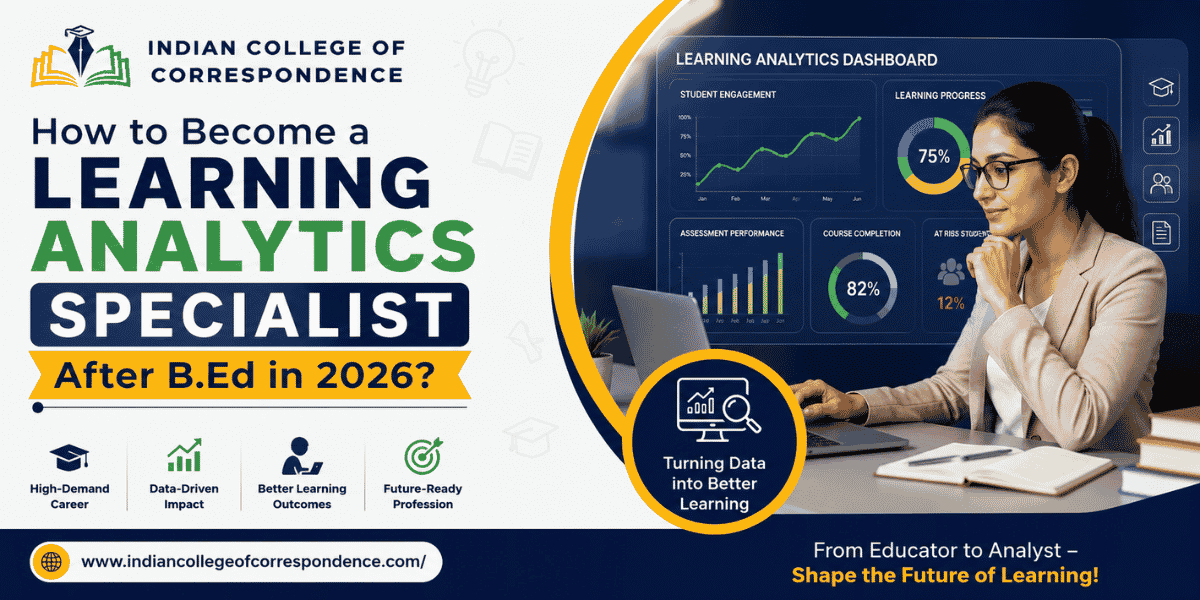
    A learning analytics specialist is the future profession for B.Ed graduates who are ready to evolve from the classic teacher’s role and venture beyond the traditional teaching-learning ecosystem. In 2026, educational institutions, EdTechs, corporates, and training organizations leverage learner insights and analytics to drive engagement, course completion, performance, and overall impact. As an aspiring learning analytics specialist, your understanding of teaching methodologies, assessments, classroom or virtual dynamics, and pedagogical interventions can help you interpret the learner data landscape better. However, to transition from being a B.Ed graduate to a learning analytics specialist, you need to develop skills in excel, sql, statistics, data visualization, Power BI, and LMS data analytics. But the exciting part? You don’t have to become a programmer or data scientist to be a successful learning analytics specialist. The next step is to build on your existing capabilities as a B.Ed graduate and invest in additional qualifications to enable you to derive actionable insights from data.

    Why Are B.Ed Graduates Looking Beyond Traditional Teaching?

    The pedagogical landscape is changing, with digital classrooms, online courses, learning management systems, virtual assessments, adaptive learning software, and artificial intelligence generating unprecedented volumes of data about the learning process. A teacher may ask themself questions such as:
    • Who are the students who need more support?
    • Are students doing their assignments on time?
    • What lectures are most engaging?
    • What assessment items are the most challenging?
    • Are students really benefiting from the intervention?
    A Learning Analytics Specialist can help by approaching these questions from an analytical perspective. This is where your B.Ed comes in: you understand education from a human perspective, and with learning analytics, you can bring in the empirical rigor to answer these questions. Moreover, the hiring landscape is changing too. Learning analytics is increasingly being sought after, both in edtech and education companies. In Bengaluru, job postings for learning technology and analytics positions have been rising, while educator focused roles often list SQL, data visualisation, statistical analysis, LMS data, and communication skills as a minimum.

    What Does a Learning Analytics Specialist Actually Do?

    A Learning Analytics Specialist performs several duties beyond just creating charts. Their work typically involves gathering, examining, analyzing, or evaluating various types of data relating to students’ learning processes and experiences. Additionally, it may consist of:
    • Performing student performance analyses
    • Carrying out learner engagement assessments
    • Evaluating attendance or dropout rates
    • Designing dashboards or reports
    • Assessing results or outcomes
    • Recognizing students in need of assistance
    • Conducting course evaluations
    • Undertaking program assessments
    • Presenting recommendations or reports to teachers, managers, or administration
    Contributing to the enhancement of educational services or policies through evidence-based insights or findings. For instance, if a newly developed online course has a 100% registration rate, but only 45% of the learners enrolled complete it, a Learning Analytics Specialist could investigate and evaluate the issue. They might determine the causes of the high dropout rate by exploring data such as the students who dropped out, the period when they left, how many modules they finished, their results on tests or assignments, or the videos viewed before stopping. Overall, the role entails much more than just working with numbers.

    How Does B.Ed Help You Enter Learning Analytics?

    One of the biggest advantages of becoming a Learning Analytics Specialist after B.Ed is that your existing knowledge can complement technical skills. You already understand concepts that a purely technical candidate may need to learn separately.
    Your B.Ed Knowledge Analytics Advantage
    Educational psychology Helps interpret learner behaviour
    Assessment methods Helps analyse performance data
    Lesson planning Helps evaluate learning effectiveness
    Classroom experience Adds real-world educational context
    Student engagement Helps understand participation patterns
    Learning outcomes Helps connect data with academic results
    This combination can be particularly useful in EdTech, academic operations, digital learning, instructional design, and education technology careers. A strong Learning Analytics Specialist is not simply someone who knows a dashboard tool. The professional must understand what the numbers mean in an educational context.

    What Skills Do You Need to Add After B.Ed?

    To add skills for learning analytics specialists, I propose a progressive learning curve: it is better to specialize than to try to acquire all skills at the same time.

    1. Basic Excel Skills

    I propose to start with Excel because it will give you an understanding of working with large amounts of data. You need to learn how to sort and find information, make pivot tables, use conditional formatting, and apply various formulas. Learn how to use Excel’s powerful tools: lookup tables, data validation, and charts. You also need to know how to work with data: remove unnecessary information, clean data, and do basic calculations.

    2. Statistics

    Statistics help to separate random fluctuations from meaningful trends. To identify trends, you need to know the concepts of average, median, mode, percentages, standard deviation, correlation, elementary probability theory, trends, and descriptive statistics. By the way, you don’t need to be an expert in statistics. The main thing is to understand how statistical series work and what changes in them.

    3. SQL

    SQL is used to extract information from databases. You need to learn SQL to get data, filter it, make joins, group statistics, and perform calculations. Moreover, you need to know how to process dates and write analytical queries. Working with databases is a must for any analyst today. This skill becomes especially important at the level of analytical reports since analysts need to combine statistical calculations with data visualization. In other words, to create dashboards, you need to know both Excel and SQL.

    4. Data Visualisation

    The ability to visualize data is what differentiates an analyst from an expert in data mining. Moreover, the visualization course is not just about drawing graphs; it also covers such aspects of the work as the choice of data presentation tools. Most often, analysts use Power BI and Tableau. Using these tools, you can, for example, show how many students have been hired, what the average test grade is, how much time is spent on the platform per week, how many students have dropped out, and how much the online classroom is attended.

    5. LMS Analytics

    Analyzing the data of the LMS (Learning Management System) is one of the most critical areas for a learning analyst. In LMS, students’ data about the educational process is stored: information about visits, the number of completed tasks, attempts to solve tests, the amount of time spent, and the overall degree of training. This information is crucial for the analyst, since it is he who monitors and evaluates the effectiveness of the learning process. Moreover, he should develop strategies for its improvement. Thus, the specialist will combine his knowledge of education and skills of an analyst, which is why he was invited to this job.

    Which Learning Analytics Tools Should You Learn in 2026?

    There is no need to learn every tool available. Build your toolkit around your career goals.
    Tool Beginner Use
    Excel Data cleaning and basic analysis
    SQL Database querying
    Power BI Interactive dashboards
    Tableau Data visualisation
    Python Advanced data analysis
    LMS platforms Learning activity analysis
    For someone beginning after B.Ed, Excel → SQL → Power BI is a practical sequence. Python can be added later when you want to move into advanced analytics, automation, or predictive modelling. Current education analytics roles increasingly combine analytics with LMS knowledge, data visualisation, and programming, especially at more advanced levels.

    Is Power BI Useful for a Learning Analytics Specialist?

    Yes, because Power BI for education can be applied to provide an analytical view of the learner’s performance data in case there is a necessity to visualize this information in charts. For instance, if many students’ results are stored in a spreadsheet, it might be difficult to detect any patterns there. In such a scenario, a dashboard can be really helpful. Student Performance Dashboard
    • Number of students: 2,500
    • Average test result: 72%
    • Number of course complements: 81%
    • Student at risk: 9%
    • The highest mark: Module 3
    • The most failed: Module 5
    With these visualizations, a learning analytics specialist can communicate with the faculty regarding the necessity to provide additional help for those who need it. However, in this case, Power BI is just a tool, and it is crucial to have the proper education and skills to work with data.

    How to Become a Learning Analytics Specialist After B.Ed: Step-by-Step Roadmap?

    If you are wondering how to become a Learning Analytics Specialist without completely changing your educational background, follow a gradual roadmap. Step 1: Know the Concept of Learning Analytics and Generation of Learner Data Get familiar with the concepts of learning analytics, and the generation of Learner Data and study real-world cases of Student performance, Engagement, Assessment, Retention, Course completion and Learning outcomes. Step 2: Brush Up Your Excel Skills, Learn Statistics and Prepare for Data Analysis Before jumping into the pool of Data Analysis, first, equip yourself with Excel, Statistics, and some programming language. The key is to be comfortable working with data. Step 3: Learn SQL And Practise Queries on Education-Based Datasets After getting good at basic data analysis concepts, you need to learn SQL and practice queries on Education-based Datasets. Step 4: Learn Microsoft Power BI And Design Dashboards Around Learner Data The next step is to learn Power BI and start designing dashboards around Learner Engagement, Student Performance, Attendance Analysis, Course Completion, and similar areas. This way, you will also build your portfolio as a Learning Analytics Specialist. Step 5: Understand Analytics In LMS (Learning Management Systems) Get familiar with the concept of analytics in Learning Management Systems. You need to understand what kind of data is generated through such systems and how this data is used, e.g., completion rates, learner engagement, assessment analytics, etc. Step 6: Build Education-Based Projects To Get Ready For A Job As A Learning Analytics Specialist This step is when you transform from a Data Analyst to a Learning Analytics Specialist. It is crucial to build your experience and portfolio in real-time projects related to Education, e-Learning, and Training fields. Step 7: Build Your Portfolio As A Learning Analytics Specialist It is time to showcase your skills and demonstrate how your dashboard can help Educational Institutions, Ed-Tech companies, or Businesses that provide corporate training. Step 8: Look For Positions That Fit Your Portfolio, Not The Other Way Around A Learning Analytics Specialist is a fairly new occupation, so job descriptions may vary. Instead of trying to fit yourself into a position description, research what kind of companies are interested in having a person who knows about Education Data Analytics.

    What Projects Should a B.Ed Graduate Build?

    A portfolio can help make your transition much easier to explain to potential employers. Here are three projects that you might want to consider:

    Project 1: The Student Performance Dashboard

    Using student grades, attendance, assignment, and assessment scores, your dashboard could address questions such as:
    • Who are our best-performing students?
    • Which subjects or topics are our students struggling with?
    • Is there a correlation between attendance and performance?
    • Are there any students who may need extra help?

    Project 2: Online Course Engagement Analysis

    Using fictional data, analyze the engagement of students taking a course through a learning management system. Consider such metrics as:
    • Number of logins
    • Completion of modules
    • Assignment submission
    • Quiz attempts
    • Where students dropped out of the course

    Project 3: Learning Intervention Analysis

    Conduct an analysis of learning intervention by comparing student performance prior to and following an educational intervention. By completing this project, you will be able to demonstrate your understanding of learning analytics in context. To demonstrate true understanding of learning analytics, a Learning Analytics Specialist should aim to demonstrate that analysis can inform an action, rather than just presenting an interesting visualization.

    Do You Need IT Distance Education After B.Ed?

    It is not mandatory if you want to become a learning analytics specialist. You should prioritize your educational goals according to your skill-building needs. IT distance education is suitable for students who want to pursue career-oriented paths in computer-related fields. However, learning analytics is not limited to IT-related areas since it also involves education, data, statistics, and science. If you are considering additional studies while being employed, a B.Ed course for working professionals is a great option to invest in. It is recommended you continue advancing your academic background rather than abandoning your career entirely. At the same time, be wary of unnecessary degrees that do not support your desire to gain relevant expertise.

    Can M.Ed Help You Become a Learning Analytics Specialist?

    An M.Ed can help you build credibility in education, research, assessment, curriculum, and learning. If you are looking for the best M.Ed Correspondence College in Bangalore, compare your options based on syllabus, recognition, flexibility, assessment criteria, and relevance to your professional goals. But an M.Ed cannot make you a Learning Analytics Specialist per se. You will still need to build expertise in areas such as:
    • Data interpretation
    • Excel
    • SQL
    • Data visualisation
    • Statistics
    • LMS analytics
    • Dashboard etc.
    The ideal combination of education + analytics + projects.

    Where Can a Learning Analytics Specialist Work?

    The career of a Learning Analytics Specialist is not limited to the school education sector only. A Learning Analytics Specialist can explore job opportunities in several different domains like:
    • EdTech 
    • Universities
    • Schools
    • Online learning platforms
    • Corporate training and development 
    • Academic research
    • Educational consultancy 
    • LMS companies
    • Digital learning organisations
    Moreover, there are several job roles related to learning analytics in Bengaluru, India, and other parts of the education and technology ecosystem. Some of the different Learning Analytics Specialist roles are:
    • Learning Data Analyst
    • Education Data Analyst
    • Learning Analytics Specialist
    • Academic Data Analyst
    • EdTech Data Analyst
    • Learning & Development Analyst
    • Learning Technology Analyst
    • Reporting Analyst

    What Is the Career Scope in 2026?

    The Learning Analytics Specialist career path is strongly linked with AI, predictive analytics, personalisation, and digital learning. At an entry level, your work may well involve reporting and dashboards – and as you gain experience, you could branch out into predictive analytics, experimentation, segmentation, or learning product analytics. At a more senior level, there’s a need for Python or R, advanced SQL, statistical modelling, machine learning, and experience with learning data – for example, in one current job posting in Bengaluru, the learning analytics manager position involves a combination of learning science, data analytics, AI/ML, SQL, and visualisation. So, in summary, there’s a wide range of potential roles and areas of specialisation, but you shouldn’t feel that you have to master everything at once.

    Learning Analytics vs Traditional Teaching: Which Path Is Better?

    There is no one-size-fits-all answer to this question. If you enjoy working with students, teaching them, delivering lessons, and having regular contact with them, you may want to continue working as a teacher. Yet if you have begun to enjoy the educational process more than the teaching itself and find more fulfillment in exploring technologies, data, dashboards, learning theories, and behaviors of students than interacting with them face-to-face, considering a different career as a Learning Analytics Specialist might be a good idea. Additionally, it is always possible to be both – a teacher who understands students’ behaviors on a deeper level thanks to analytics or an analyst who knows more about the subject they study than most educators.

    Can Teaching Distance Education Help With This Career?

    Teaching distance education provides a powerful insight into the world of online learning, where there are easily identifiable measures of learner engagement. If you are familiar with the concept of online or flexible learning, you will be aware of the following:
    • Digital delivery of courses
    • Online examinations
    • Communication with students
    • LMS or other similar platforms
    • Learning analytics
    This knowledge has the potential to become incredibly valuable in the role of a Learning Analytics specialist, providing you with the technical expertise required to progress your career. For people considering distance education in Bangalore, the availability of a highly flexible program is likely to increase the likelihood of pursuing the opportunity alongside further study.

    What About a Correspondence College in India?

    A correspondence college in India could be a good choice for someone who needs more flexibility in their studies. However, it is essential to assess the institution and programme first. It is worth considering such factors as the qualifications and approval of the institution, Curriculum, Exams, learning support, Flexibility, Duration, And relevance to the chosen career. For instance, in the case of a Learning Analytics Specialist, it would be desirable to combine theoretical courses with practical analytics training rather than study correspondence courses only.

    A Simple 6-Month Learning Plan

    You can structure your transition like this:
    Months Main Focus Expected Outcome
    1 Excel + statistics Understand and clean data
    2 SQL basics Query datasets
    3 Power BI Build dashboards
    4 LMS analytics Understand learner metrics
    5 Portfolio projects Create education-focused projects
    6 Resume + applications Target relevant roles
    This approach makes the transition more manageable. Instead of thinking, “I need to become a data expert,” think, “I need to build one useful skill at a time.”

    Common Mistakes to Avoid

    Many B.Ed graduates significantly complicate their job searching process. Below are the key mistakes that you should avoid: Learning too many analytical tools: It is not necessary to learn ten analytical tools, when Excel, SQL, and Power BI are sufficient. Ignoring the importance of statistics: A dashboard built without statistical knowledge can present incorrect information. Creating generic projects: To demonstrate your analytical skills, use education-specific data sets. Being obsessed with  certificates: A certificate proves that you have completed a course, but a project demonstrates your skills. Neglecting communication skills: As a Learning Analytics Specialist, you will need to be able to explain your findings to teachers, managers, and other professionals. Focussing only on coding: While advanced data mining requires Python or R programming, your primary task as a Learning Analytics Specialist will be understanding data.

    Why ICC Can Be Considered by B.Ed Graduates?

    For the seekers of additional qualifications, this option can be considered as a part of the wider correspondence college India. Beforehand, it is essential to check whether this college offers the required accreditation, course eligibility, syllabus, and other parameters. Therefore, for the would-be Learning Analytics Specialist, the most promising concept would be to combine the solid knowledge of the appropriate education with the practical experience in analytics, project management, and technology.

    Is Learning Analytics a Good Career After B.Ed?

    Yes, it can be a great option if one has an interest in both education and analytics. A B.Ed provides one with knowledge about learners, while analytics helps understand these learners better, and technology enables one to perform this understanding in real-time. Such a combination is progressively gaining ground due to the digitization of education. Therefore, the career option of a Learning Analytics Specialist can be an engaging and fulfilling choice for a B.Ed graduate who wishes to engage with education beyond the conventional classroom setup.

    Conclusion

    Learning Analytics is the perfect complement to a degree in B.Ed – in fact, it shouldn’t be seen as a departure from years of education and teaching at all. It is the combination of your existing knowledge of pedagogy, students, testing, learning, and teaching practices – with Excel, Power BI, SQL, statistics, and cutting edge learning technologies. This sets you up for a truly fascinating career, spanning both the traditional fields of teaching and learning as well as the emerging and exciting fields of learning analytics and data science. If you are pursuing further studies while embarking on this career path consider flexible programmes that allow you to truly understand these concepts, and build the practical, real-world analytics expertise that you need to advance your career. Indian College of Correspondence can be one such option for those who wish to pursue a blended higher-educational pathway, while your qualification, combined with the practical skills learned throughout the programme, can serve as the excellent catalyst needed to propel your B.Ed into the next phase of your career and life. Education technology will be a huge part of the future of learning, and if you want to be at the forefront, it’s never too early to start preparing yourself with the right skill-set.

    FAQs

    1. Can I become a Learning Analytics Specialist after B.Ed?

    Yes, you can definitely become a Learning Analytics Specialist after completing your B.Ed. B.Ed provides you with foundational knowledge of teaching, evaluation, learning behavior, pedagogy, etc. All you need to do is complement your B.Ed with analytical skills like Excel, statistics, SQL, etc. to become a Learning Analytics Specialist.

    2. Is coding compulsory to become a Learning Analytics Specialist?

    It is not mandatory to know coding to become a Learning Analytics Specialist at least at the entry-level. Proficiency in Excel, SQL, statistics, Power BI, etc. would suffice. However, you might need to learn Python or R if you want to go deeper into the field.

    3. What tools should I learn first?

    Excel, SQL, and Power BI are the most sought-after skills in the market right now. If you are a complete beginner, you can start with Excel, and then proceed to SQL, followed by Power BI, and later learn Python or R if you decide to specialize in higher-level analytics.

    4. Can B.Ed graduates work in EdTech?

    Yes, B.Ed graduates can definitely work in the EdTech industry. There are various job roles in the EdTech industry that require people with expertise in B.Ed or M.Ed, such as academic operations, instructional design, learning technology, content development, learning and development, education analytics, ed-tech consulting, etc. Many education jobs also require a blend of education and analytics skills.

    5. Is an M.Ed required for a Learning Analytics Specialist?

    There is no specific qualification that one needs to fulfill to become a Learning Analytics Specialist. However, if you are someone who wants to develop a strong foundation in education and pedagogy, doing an M.Ed. would be beneficial. At the same time, one would also need to gain proficiency in analytics-related skills to become a Learning Analytics Specialist.

    6. What is LMS analytics?

    LMS Analytics refers to analyzing learning data, such as learning behavior, learning trends, and patterns generated within a Learning Management System.

    7. What is the difference between learning analytics and educational data analytics?

    There is not much of a difference between the two, however, sometimes the two terms are used interchangeably. Educational data analytics focuses on analyzing educational data, whereas learning analytics focuses on learning behavior and patterns.

    8. Where can a Learning Analytics Specialist work?

    Various career options are available for a Learning Analytics Specialist, working with EdTech Companies, Schools, Colleges, Online education companies, Corporate sectors, Educational consultancies, and research companies.

Leave A Comment