Admission opens for 2026-27 sessions for all university.

Blog Detail

  • What Is BSc Biotechnology in 2026? Eligibility, Subjects, Fees & Career Scope

    • 07,Oct 2026
    • Posted By : uaeautomates@gmail.com
    • 0 Comments
    • BSc Biotechnology
    • BSc Biotechnology 2026
    • BSc Biotechnology career scope
    • BSc Biotechnology eligibility
    • BSc correspondence college in Karnataka
    • correspondence college in india
    • distance education in bangalore
    • distance Msc degree college in bangalore
    • Science distance education in Bangalore
    • Traditional distance education in bangalore
    Choosing a science degree after 12th is not only about selecting a subject you like. Students also need to consider how the programme is delivered, what they will study, what the qualification can lead to, whether they can continue to postgraduate education and whether the course fits their current commitments. That becomes particularly important for students exploring Science distance education in Bangalore, flexible degree options or a B.Sc correspondence college in Karnataka. BSc Biotechnology is an interesting option for students who want to study biology beyond school-level concepts and explore areas connected with genetics, microbiology, molecular biology, biochemistry and applied biotechnology. At the same time, biotechnology is a specialised science field, so students should understand the programme before choosing it through a distance or correspondence route. In 2026, the better way to evaluate BSc Biotechnology is not simply to ask, “What is the scope?” Instead, ask: What will I study? Am I eligible? What will the programme cost? Is the learning format suitable for me? What can I study after graduation? And does this degree fit the career direction I have in mind? This guide answers those questions while helping students understand what to look for when comparing flexible education options in Bangalore and Karnataka.

    BSc Biotechnology at a glance

    Before going into the details, here is the course in one view.
    Course factor BSc Biotechnology
    Level Undergraduate
    Field Science / Life Sciences
    Typical duration 3 years, depending on university and programme structure
    Suitable background Usually 10+2 with relevant science subjects
    Main areas Biology, microbiology, genetics, biochemistry, molecular biology and biotechnology
    Study options Depend on the university and programme approval
    Higher studies MSc and related postgraduate science programmes
    Career areas Biotechnology, laboratories, pharmaceuticals, food, agriculture, research and related sectors
    Best suited for Students interested in biological science and its applications
    The exact eligibility, duration, syllabus, fees and mode of delivery can differ between universities. That is why students should evaluate the actual programme, rather than choosing a course based only on the title “BSc Biotechnology.”

    Why are students considering BSc Biotechnology in 2026?

    Biotechnology has moved beyond the traditional image of a laboratory-based subject. The field brings together different areas of science to understand and apply biological processes. Depending on the specialisation and organisation, biotechnology knowledge can connect with pharmaceuticals, diagnostics, food processing, agriculture, environmental applications, research and biological data. For a student, this creates several possible academic directions. You may begin with: BSc Biotechnology and later move towards:
    • MSc Biotechnology
    • MSc Microbiology
    • MSc Biochemistry
    • MSc Bioinformatics
    • Molecular biology
    • Genetics
    • Environmental science
    • Food technology
    • Research-oriented study
    • Other related postgraduate science programmes
    The exact progression depends on university eligibility requirements. This is one reason students should think about the next qualification before joining the undergraduate programme. If you already know that you want to pursue a postgraduate science degree, check the eligibility requirements of that future programme before selecting your BSc.

    What will you actually study in BSc Biotechnology?

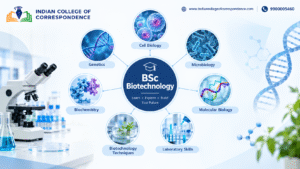
    One reason biotechnology can appear confusing to students is that the course is not limited to one subject. It combines several branches of science. BSc Biotechnology subjects including genetics, microbiology, cell biology and molecular biology Instead of looking at the syllabus as a long list of technical names, it is easier to understand it through the knowledge areas that build the course.

    Biology and cellular science

    Students may study areas such as:
    • Cell biology
    • Biological processes
    • Plant and animal biology
    • Cellular organisation
    These subjects establish an understanding of how living systems function.

    Chemistry and biochemistry

    Biochemistry helps students understand the chemical processes taking place within living organisms. This can include:
    • Biomolecules
    • Enzymes
    • Metabolism
    • Proteins
    • Biological reactions

    Microbiology

    Microbiology introduces students to microorganisms and their characteristics. It can become relevant later to areas such as:
    • Food science
    • Pharmaceuticals
    • Healthcare laboratories
    • Environmental biotechnology
    • Industrial processes

    Genetics and molecular biology

    These subjects take students deeper into biological information and cellular processes. Topics may include:
    • Genetics
    • DNA
    • RNA
    • Gene expression
    • Molecular mechanisms
    • Recombinant DNA concepts

    Applied biotechnology

    Later parts of the curriculum may connect scientific principles with applications. Depending on the university, this may include:
    • Genetic engineering
    • Industrial biotechnology
    • Pharmaceutical biotechnology
    • Food biotechnology
    • Environmental biotechnology
    • Plant biotechnology
    • Animal biotechnology
    • Bioinformatics
    The exact subjects should always be checked against the university’s current syllabus.

    Is BSc Biotechnology difficult?

    Biotechnology is a science degree, so students should expect scientific concepts rather than treating it as a general undergraduate course. Students may need to understand:
    • Biology
    • Chemistry
    • Microbiology
    • Genetics
    • Molecular concepts
    • Scientific terminology
    • Basic statistics
    • Research concepts
    The difficulty also depends on your academic background. A student who already enjoys biology and chemistry may find the transition more comfortable than someone choosing biotechnology without an interest in science. The important question is not whether the course is “easy.” Ask whether you are comfortable studying science consistently for three years and potentially continuing into postgraduate education.

    Who can apply for BSc Biotechnology?

    Eligibility depends on the university. Generally, undergraduate science programmes require completion of 10+2 or an equivalent qualification, with relevant science subjects. Depending on the institution, the required background may include subjects such as:
    • Biology
    • Chemistry
    • Physics
    • Mathematics
    Minimum marks and subject combinations can vary. Therefore, if you are searching for distance education in Bangalore or a B.Sc correspondence college in Karnataka, do not assume that every institution follows the same eligibility criteria.

    Before applying, confirm:

    Check Why it matters
    10+2 qualification Basic admission requirement
    Science subjects May be mandatory for biotechnology
    Minimum percentage University-specific requirement
    Subject combination Can vary between programmes
    Admission process May differ by institution
    Programme mode Confirm whether it is distance, correspondence or another approved format
    A counselling team should be able to explain these requirements before you proceed with admission.

    Can you study BSc Biotechnology through distance or correspondence education?

    This is one of the most important questions for students looking for flexible education. The answer depends on the specific university, programme and approved mode of study. Students often use terms such as:
    • Distance education
    • Correspondence education
    • Open learning
    • Flexible learning
    • Online education
    as if they mean exactly the same thing. They do not necessarily have identical structures. For a science programme, students should pay particular attention to practical requirements, examinations and the academic structure. If you are comparing Science distance education in Bangalore, check the following before making an admission decision:
    1. Which university awards the degree?
    2. What is the recognised mode of study?
    3. Is the specific programme available in that mode?
    4. What are the examination requirements?
    5. Are practical components applicable?
    6. What study materials are provided?
    7. What academic support is available?
    8. Can the qualification support your intended higher studies?
    The UGC Distance Education Bureau advises learners to verify recognised/entitled institutions and programmes before enrolling in ODL or online programmes. Students should use official regulatory information when making this verification. This is especially important for science courses because the structure of a programme can matter as much as the convenience of its study format. Distance education or regular college: which one makes sense for BSc Biotechnology? There is no single answer for every student. The better choice depends on how you need to study and what you want from the qualification. Before enrolling in a distance programme, students should verify the institution and programme recognition for the relevant academic session through the UGC Distance Education Bureau (DEB). 
    If your priority is… You may want to investigate…
    Full-time campus experience Regular college
    Extensive campus laboratory exposure Conventional programme with relevant facilities
    Studying alongside other commitments Flexible/distance options where appropriate
    Working while studying Flexible programme structure
    Continuing education without relocating Distance/correspondence options
    Planning postgraduate study A programme that meets the required progression criteria
    A student who has just completed school and wants a highly practical campus experience may have different priorities from a working learner who needs flexibility. This is why Traditional distance education in Bangalore can appeal to some learners, while others may prefer a conventional full-time science programme. The decision should be based on the student’s situation rather than treating one mode as automatically better.

    What should you check before choosing a BSc Biotechnology programme?

    This is where many students focus too heavily on fees. Fees matter, but they should not be the first and only filter. A better evaluation can be divided into six checks.

    1. Check the university

    First identify who awards the final degree. Do not judge the qualification only by the name of the local centre or admission provider.

    2. Check the programme

    Read the actual programme information. Look at:
    • Duration
    • Subjects
    • Eligibility
    • Examination structure
    • Study mode
    • Practical requirements
    • Project requirements

    3. Check recognition and current status

    Recognition should be checked against official sources applicable to the programme and academic session. Do not depend only on claims made in advertisements.

    4. Check the practical component

    This deserves special attention for biotechnology. Ask how practical requirements are handled, where applicable, and whether they form part of the academic structure.

    5. Check postgraduate progression

    If you are planning MSc after BSc, research the eligibility requirements now. For example: BSc Biotechnology → MSc Biotechnology may be appropriate for one student, while another may want: BSc Biotechnology → MSc Bioinformatics or another related field. The eligibility rules of the postgraduate programme should influence your undergraduate decision.

    6. Check the complete fee

    Ask for the complete expected cost rather than looking only at one number displayed in an advertisement.

    How much does BSc Biotechnology cost in 2026?

    There is no single fee applicable to every BSc Biotechnology programme. The total cost can depend on:
    • University
    • Programme structure
    • Study mode
    • Duration
    • Examination fees
    • Registration
    • Study materials
    • Practical requirements
    • Project work
    • Other academic charges
    ICC’s current BSc Distance Education information gives an approximate general BSc fee range of ₹10,000–₹50,000 per year, while noting that programme details can vary by university and specialisation. That should be treated as a general reference rather than a fixed BSc Biotechnology fee.

    Compare the complete cost

    Fee component Question to ask
    Tuition What is the total academic fee?
    Registration Is there a separate registration fee?
    Examination Are examination charges included?
    Study material Is material included in the fee?
    Practical Are practical charges applicable?
    Project Is project work included?
    Other charges Are there additional university charges?
    A lower advertised fee is not necessarily the better choice if the programme does not match your academic requirements.

    What are the career options after BSc Biotechnology?

    Career opportunities depend on the student’s qualification, skills, practical exposure and the role they apply for. A biotechnology graduate can explore areas such as:

    Pharmaceutical sector

    Possible areas include:
    • Quality control
    • Production support
    • Laboratory operations
    • Documentation
    • Research support

    Food industry

    Biotechnology knowledge can be relevant to:
    • Food microbiology
    • Quality assurance
    • Fermentation
    • Product development

    Agriculture

    Students can explore areas related to:
    • Plant biotechnology
    • Crop science
    • Agricultural research
    • Biological applications

    Environmental sector

    Biotechnology can contribute to:
    • Waste treatment
    • Environmental monitoring
    • Bioremediation
    • Biological processes

    Laboratories and diagnostics

    Depending on role requirements and additional qualifications, graduates may explore laboratory-related opportunities.

    Research

    Students interested in scientific research may continue with:
    • MSc
    • Research projects
    • Further specialised education
    • Doctoral study
    The important point is that BSc Biotechnology does not represent one single career. It provides a scientific foundation from which students can develop a particular direction.

    Which industries use biotechnology besides pharmaceuticals?

    If you are deciding whether biotechnology interests you, look beyond the pharmaceutical sector.
    Industry Biotechnology connection
    Pharmaceuticals Biological products, research and production
    Healthcare Diagnostics and laboratory science
    Food Fermentation, microbiology and quality
    Agriculture Plant science and biotechnology
    Environment Biological treatment and remediation
    Cosmetics Biological ingredients and testing
    Manufacturing Enzymes and bioprocessing
    Research Molecular and biological research
    Bioinformatics Biological data analysis
    This broader view can help students understand why biotechnology is not simply a “pharma degree.”

    What can you do after BSc Biotechnology?

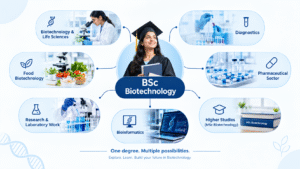
    For many students, graduation is not the final step. Postgraduate education can help students develop deeper knowledge in a particular scientific area. Career and higher study pathways after BSc Biotechnology including MSc and life science fields Possible routes include:
    • MSc Biotechnology
    • MSc Microbiology
    • MSc Biochemistry
    • MSc Bioinformatics
    • MSc Environmental Sciences
    • MSc Food Technology
    • MSc related life-science disciplines
    ICC currently lists multiple MSc distance education pathways, including Biotechnology, Biochemistry, Bioinformatics, Microbiology, Environmental Sciences, Food Technology and other science areas. However, students should verify the exact eligibility requirements of the university and programme before assuming that any BSc automatically qualifies them for a particular MSc.

    Why should you think about MSc before choosing your BSc?

    This is one of the most useful decisions a student can make. Imagine a student says: “I want to work in biotechnology research.” That goal may require a different academic plan from someone who says: “I want an undergraduate science qualification that I can complete while working.” The first student may need to think about: BSc → MSc → research experience → specialised role The second student may initially prioritise: recognised degree → flexible learning → manageable schedule → next qualification Neither route is wrong. The important thing is to select the undergraduate programme with the eventual destination in mind. This is particularly useful for students already researching a distance Msc degree college in Bangalore. Students interested in biotechnology should also explore the initiatives and skill-development opportunities supported by the Department of Biotechnology (DBT), Government of India, particularly as they plan their academic and career progression. 

    What skills should you develop alongside BSc Biotechnology?

    A degree gives you academic knowledge. Your additional skills can help you become more prepared for further study or employment.

    Scientific skills

    Develop familiarity with:
    • Scientific documentation
    • Research methodology
    • Data interpretation
    • Laboratory concepts
    • Basic statistics

    Digital skills

    Depending on your chosen direction, consider learning:
    • Excel
    • Data analysis
    • Data visualisation
    • Scientific databases
    • Basic programming
    • Bioinformatics

    Communication skills

    Scientific professionals still need to communicate clearly. Useful skills include:
    • Report writing
    • Technical writing
    • Presentations
    • Documentation
    • Professional communication

    Research skills

    You should gradually learn how to:
    • Read scientific papers
    • Identify reliable sources
    • Understand research methods
    • Interpret basic findings
    • Present information clearly
    These skills become particularly useful if you intend to continue into postgraduate education.

    Is BSc Biotechnology a good choice after 12th?

    It can be a suitable choice if your interests match the subject. Consider BSc Biotechnology if you enjoy:
    • Biology
    • Chemistry
    • Genetics
    • Microbiology
    • Scientific research
    • Laboratory-based subjects
    • Healthcare science
    • Agriculture
    • Food science
    • Environmental applications
    Think twice if you are selecting it only because someone told you it has “good scope.” A course should match your interests and long-term education plan.

    A simple self-check

    Question If your answer is “Yes”
    Do I enjoy biology? Biotechnology may be worth exploring
    Am I interested in molecular science? Review the BSc Biotechnology syllabus
    Do I want a science-based career? Compare biotechnology with related BSc options
    Do I need flexible education? Research recognised distance/correspondence options
    Do I want MSc later? Check postgraduate eligibility before admission
     

    BSc Biotechnology vs BSc Microbiology

    Students frequently compare these two courses because both involve biological sciences.
    BSc Biotechnology BSc Microbiology
    Broader biotechnology applications Strong focus on microorganisms
    Genetics Microbial biology
    Molecular biology Microbial physiology
    Genetic engineering Microbial applications
    Industrial biotechnology Food and medical microbiology
    Pharmaceutical biotechnology Environmental microbiology
    If you are particularly interested in microorganisms, microbiology may be more appealing. If you want broader exposure to genetic engineering, molecular biology, bioprocessing and biotechnology applications, BSc Biotechnology may align better with your interests. “Students interested in combining their science background with technology can also explore the Database Administrator B.Sc. programme as an alternative academic pathway with a focus on database and IT skills.”

    BSc Biotechnology vs BSc Biochemistry

    Biotechnology and biochemistry also overlap. Biochemistry focuses strongly on the chemical processes of living organisms. Biotechnology focuses more on applying biological knowledge to technologies, processes and products. Students interested in:
    • Proteins
    • Enzymes
    • Metabolism
    • Chemical processes in organisms
    may find biochemistry interesting. Students attracted to:
    • Genetic engineering
    • Biotechnology applications
    • Industrial processes
    • Molecular biology
    • Biological technologies
    may prefer biotechnology. The actual curriculum should always be compared before deciding.

    What if you are looking for a B.Sc correspondence college in Karnataka?

    The first thing to remember is that the college or admission centre is not the only factor. When comparing a B.Sc correspondence college in Karnataka, create a short verification checklist.

    Ask these questions:

    Who awards the degree? Know the university behind the qualification. What is the programme? Check the exact BSc specialisation rather than assuming all BSc courses are structured alike. What is the study mode? Confirm whether the programme is offered through the stated mode. What are the examinations? Understand how and where you will complete them. What about practical learning? This is particularly relevant to science courses. What will the full programme cost? Ask for the complete fee structure. What happens after graduation? Check whether the qualification fits your planned postgraduate course. This is a much safer way to compare a correspondence college in India than choosing based only on a fee advertisement.

    Why choose ICC for your distance education search?

    Students searching for flexible education often start with a course name and only later start comparing institutions. ICC is relevant at that stage because it provides access to multiple undergraduate and postgraduate education pathways. For students researching science education, ICC currently lists BSc options including Biotechnology and other science specialisations. The broader science category also includes postgraduate pathways, allowing students to investigate their next academic step rather than treating the undergraduate degree as an isolated decision.

    Explore the relevant ICC options

    BSc Distance Education For students beginning their undergraduate science search. MSc Distance Education For students planning postgraduate science education. Science Courses For comparing different science specialisations. Traditional Courses For students exploring traditional correspondence-style education pathways. BCA / BBA / BA / MBA For students whose interests move towards technology, business, management or other academic areas. The important point is not to select a course simply because it is available. Select the course that matches your academic background and the direction you want to take next.

    A student’s decision path for BSc Biotechnology in 2026

    Instead of starting with the question “Which college should I join?”, follow the sequence below.

    Step 1 — Start with your science background

    Check whether you meet the required 10+2 subjects and marks.

    Step 2 — Understand the course

    Read the BSc Biotechnology syllabus.

    Step 3 — Decide whether the subject interests you

    Look at genetics, microbiology, molecular biology, biochemistry and applied biotechnology.

    Step 4 — Think about the learning format

    If you need flexibility, investigate suitable distance or correspondence options.

    Step 5 — Verify the programme

    Check the awarding university, recognition, delivery mode and academic requirements.

    Step 6 — Calculate the complete fee

    Do not compare tuition alone.

    Step 7 — Plan your next qualification

    If MSc is your goal, check its eligibility now.

    Step 8 — Compare institutions

    Only after completing the above steps should you compare education providers. This process helps students make a course decision based on fit rather than advertising.

    BSc Biotechnology: questions students should ask before admission

    Question Why you should ask it
    Is my 12th qualification eligible? Prevents admission issues
    Which university awards the degree? Identifies the awarding institution
    What subjects are included? Helps you understand the academic content
    What is the duration? Helps with planning
    What is the complete fee? Avoids unexpected costs
    How are examinations conducted? Important for distance learners
    Are practicals applicable? Particularly important for science courses
    What support is provided? Helps you understand the learning experience
    Can I pursue MSc afterward? Supports long-term planning
    What is the approved mode? Important for programme verification

    Choosing BSc Biotechnology is a three-year decision—but it can shape the next stage of your education

    BSc Biotechnology can provide a foundation in genetics, microbiology, biochemistry, molecular biology and applied biotechnology. From there, students can explore different industries or continue into postgraduate science education. For students who need flexible study, the decision involves one additional layer: choosing the right learning format and verifying the specific programme before admission. If you are looking for a B.Sc correspondence college in Karnataka, check the awarding institution and programme details before making your decision. If you are already planning your postgraduate education, research the requirements of a distance Msc degree college in Bangalore before completing your BSc. And if you are comparing a correspondence college in India, do not make the decision on convenience alone. The right course is the one that fits your academic background, learning requirements, career direction and future education plan.

    Frequently Asked Questions about BSc Biotechnology

    What is BSc Biotechnology?

    BSc Biotechnology is an undergraduate science degree that combines biological science with the study and application of biotechnology. Subjects can include genetics, microbiology, biochemistry, molecular biology, cell biology and biotechnology applications.

    What is the eligibility for BSc Biotechnology?

    Eligibility varies by university. Generally, students need 10+2 or equivalent education with relevant science subjects, but the exact subject combination and minimum marks should be checked with the institution.

    What are the main BSc Biotechnology subjects?

    Depending on the university, subjects may include cell biology, genetics, microbiology, biochemistry, molecular biology, immunology, genetic engineering, industrial biotechnology, environmental biotechnology and bioinformatics.

    How much does BSc Biotechnology cost?

    Fees differ between universities and programme structures. ICC’s current general BSc Distance Education page gives an approximate range of ₹10,000–₹50,000 per year, but students should confirm the exact fee applicable to their selected programme.

    Can I study BSc Biotechnology through distance education?

    Availability depends on the specific university and programme. Students should verify the programme’s recognition, permitted mode of delivery, examination requirements and practical components before admission.

    What can I do after BSc Biotechnology?

    Graduates can explore further education or entry-level opportunities connected with biotechnology, pharmaceuticals, food, agriculture, laboratories, environmental applications, research and related areas. Specialised roles may require postgraduate education or additional skills.

    Can I do MSc after BSc Biotechnology?

    A relevant MSc can be a natural next academic step, but eligibility varies by university and specialisation. Students should check the specific MSc admission criteria.

    Is BSc Biotechnology better than BSc Microbiology?

    Neither course is universally better. Biotechnology generally provides broader exposure to biotechnology applications, while microbiology focuses more strongly on microorganisms and their applications. The better fit depends on the student’s interests.

    Final checklist before you enrol in BSc Biotechnology

    Before paying an admission fee, make sure you can answer all of these:
    • Do I meet the eligibility requirements?
    • Do I actually enjoy biological science?
    • Have I read the syllabus?
    • Who awards the degree?
    • Is the programme available in the stated mode?
    • Have I checked the current recognition/status information?
    • Do I understand the examination structure?
    • Do I know how practical requirements are handled?
    • Do I know the complete programme fee?
    • Have I considered what I want to study after graduation?
    • Does the programme fit my current schedule?
    If the answers are clear, you are in a much stronger position to choose your programme. For students exploring these options, Indian College of Correspondence provides BSc, MSc and other undergraduate and postgraduate pathways that can be evaluated according to individual academic goals. Start with the course you want. Understand the qualification. Verify the programme. Then choose the education pathway that fits you.

Leave A Comment