

| Career direction | Example entry-level roles | Skills worth developing |
| Marketing | Marketing assistant, campaign coordinator | Communication, research, digital marketing |
| Sales and business development | Sales executive, business development associate | Customer communication, negotiation, product knowledge |
| Human resources | HR assistant, recruitment coordinator | Organisation, communication, documentation |
| Operations | Operations assistant, process coordinator | Planning, reporting, problem-solving |
| Finance and administration | Accounts or finance support, administrative executive | Excel, accuracy, basic accounting knowledge |
| Customer relations | Customer support executive, client service associate | Listening, written communication, issue resolution |
| Entrepreneurship | Small-business or startup support roles; developing a venture | Market research, budgeting, sales and planning |
| Factor | BBA | B.Com | BA |
| Main orientation | Management and business functions | Commerce, accounting and finance-related areas | Arts, humanities or social sciences |
| May suit students interested in | Marketing, operations, management, business development | Accounting, commerce, taxation, finance | A chosen humanities or social science subject |
| Practical preparation | Can include business projects and case studies | Can include accounting, commerce and financial exercises | Depends on the chosen subject and programme |
| Further-study options | MBA and other eligible postgraduate programmes | M.Com, MBA and other eligible postgraduate programmes | Master’s study in the chosen or related discipline, subject to admission rules |
| What to compare | Management subjects, projects and specialisations | Accounting depth, commerce subjects and professional pathways | Subject depth, electives and future academic options |
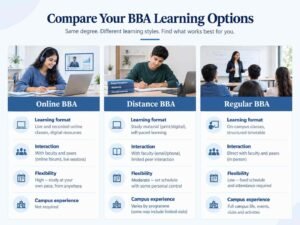
| Feature | Online learning | Open and Distance Learning (ODL) | Regular classroom learning |
| Typical learning arrangement | Digital learning platform, online resources and programme-specific virtual activities | Self-study resources, learning materials and academic support as defined by the institution | Scheduled classroom teaching and campus-based academic activities |
| Flexibility | May offer flexibility, depending on live sessions and deadlines | Often designed to support independent study, subject to programme requirements | Usually follows a fixed timetable |
| Interaction | May include online classes, forums and virtual discussions | Depends on the institution’s support arrangements | Typically includes face-to-face interaction |
| Assessment | May be online, centre-based or a combination, as officially specified | May include examinations or other assessments under the approved arrangement | Usually follows the institution’s regular assessment structure |
| Main consideration | Internet access, digital learning and online engagement | Self-discipline, learning resources and required academic or examination arrangements | Travel, attendance and campus schedule |
| What to verify | Question to ask | Why it matters |
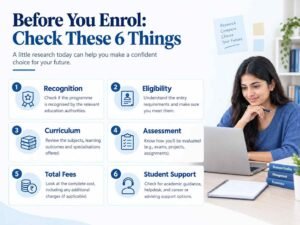
| Awarding institution | Which university awards the degree? | Establishes who is responsible for the qualification |
| Recognition | Is this specific programme recognised for the relevant mode and session? | Helps avoid relying on outdated or incomplete claims |
| Eligibility | What are the current admission requirements? | Prevents eligibility surprises |
| Total fees | What is the complete cost for the programme? | Makes comparisons more realistic |
| Curriculum | Which subjects and practical activities are included? | Helps determine academic fit |
| Assessment | How and where are examinations conducted? | Clarifies logistical requirements |
| Support | What academic help is available to enrolled learners? | Sets expectations about the learning experience |
| Further study | Will the degree meet the entry rules of the next programme I am considering? | Helps with long-term planning |
 Explore a business function early. Try small projects in marketing, accounting, customer service or operations to understand which work you enjoy.
Practice with relevant tools. Spreadsheet skills, presentation software, online collaboration platforms and basic data interpretation can be useful across many business roles.
Build a portfolio of work. Keep examples of projects, reports, presentations or market research that demonstrate what you have learned. Do not include confidential information from an employer or client.
Look for appropriate work experience. Internships, volunteering and supervised project work can help students understand workplace expectations. Availability and eligibility will vary.
Review real job descriptions. Identify recurring skills in entry-level roles and make a plan to develop those skills during the degree.
Improve professional communication. Clear writing, thoughtful questions, reliable follow-up and organised work are valuable in many business settings.
Keep learning after graduation. Some career paths require further qualifications, specialised software knowledge or professional certification. Students should research these requirements rather than assuming that a BBA covers everything.
For Indian students, the National Career Service portal can be a useful starting point for exploring employment resources, job opportunities and career guidance. Check current listings and eligibility conditions rather than treating a general career description as a guarantee of employment.
| If your main priority is… | What to evaluate first |
| Learning about business and management | BBA curriculum, subject coverage and practical projects |
| Building a foundation in accounting and commerce | Compare BBA with B.Com syllabi and future-study options |
| Studying while working | Timetable, assignment deadlines, exam arrangements and workload |
| Reducing travel | Online or ODL delivery details and any compulsory in-person requirements |
| Pursuing an MBA later | Eligibility rules for the MBA programmes you may target |
| Starting a business | Business fundamentals, practical projects, market research and additional entrepreneurship learning |
| Keeping future options open | Degree recognition, curriculum breadth and progression requirements |