
Admission opens for 2026-27 sessions for all university.

Blog Detail

  • How to Build a Career in AI Governance After MBA in 2026: Skills & Jobs

    • 25,Aug 2026
    • Posted By : opsadsthrivein@gmail.com opsadsthrivein@gmail.com
    • 0 Comments
    • BBA correspondence college in Karnataka
    • management distance education in bangalore
    • MBA distance education in bangalore
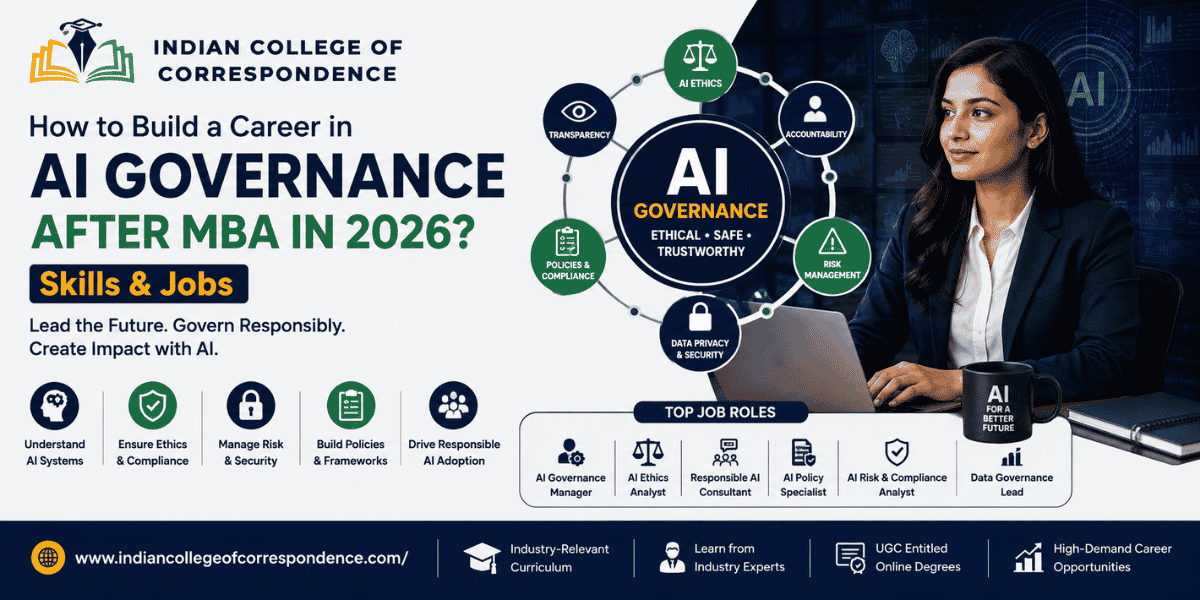
    Artificial intelligence (AI) has been evolving from a novelty to an essential business function. Corporations worldwide have started to leverage technologies like AI for customer service, recruitment, financial modelling, marketing analytics, operations, and decision-making. However, as these systems become more sophisticated, companies need qualified professionals who understand how to govern AI to maximize efficiency gains and ensure ethical and safe use. That is why you should consider building a career in AI governance as an MBA graduate. You may not need a degree in computer science to become an AI governance professional. Instead, you should use your MBA skills and knowledge of business processes and strategies to build a successful career in AI governance. When you want to build a career in AI governance, 2026 will be a great time to start. Many firms currently post job openings for AI governance and responsible AI leadership positions, including Wipro, Alstom, Unilever, and other organizations based in Bengaluru.

    Why Build a Career in AI Governance in 2026?

    Emerging markets for generative artificial intelligence (AI) pose a new challenge to enterprises: how to leverage AI’s benefits while limiting potential risks and harms to privacy, fairness, transparency, and overall social good. Professionals working in the field of AI governance can help organizations design AI strategies, manage inventories of AI-driven solutions, perform AI risk assessments, ensure compliance with regulations, store and audit information about AI technologies, and consult with different departments about AI decision-making. According to recent job descriptions, experts in this field are expected to have qualifications in responsible AI, risk management, data governance, compliance, and AI lifecycle management, alongside knowledge of technical, legal, and business aspects of AI technologies. Thus, the specialization of Build a Career in AI Governance can benefit MBA students by giving them an opportunity to influence corporate decision-making processes related to data privacy, AI ethics, and governance policies.

    What Does AI Governance Actually Mean?

    Before diving into considering how to build a career in AI governance, it is crucial to highlight the responsibilities that are involved in such positions. AI governance refers to policies, rules, processes, and organisational responsibilities aimed at guiding the implementation of trustworthy AI by an organization. In other words, if, for instance, the company wants to adopt an AI recruitment system, a person who will be responsible for AI governance will have to answer questions such as:
    • What data does it use?
    • Will it not produce discriminatory results?
    • Who will be accountable if the system recommends shortlisting someone unsuitable for the role?
    • How should employees’ data be secured?
    • How should the system be monitored?
    • What documentation should be produced?
    Whether the use case complies with internal and external standards and many more. Thus, it can be concluded that working in AI governance is not about building the systems per se but rather providing expert guidance on how to organise and regulate their use.

    Why an MBA Can Help You Build a Career in AI Governance?

    An MBA provides you with a great foundation since governance is not purely technical. Decisions, risk, compliance, operations, leadership, and communication are all key elements of governance. For example, an MBA graduate would have a basic understanding of:
    MBA Knowledge AI Governance Application
    Business Strategy Aligning AI initiatives with business goals
    Risk Management Identifying AI-related risks
    Operations Creating governance processes
    Finance Evaluating AI investment and risk
    Marketing Managing responsible customer-data use
    HR Reviewing AI use in recruitment
    Business Analytics Understanding data-driven decisions
    Management Coordinating multiple stakeholders
    This is why Building a Career in AI Governance does not presuppose a novice careerist. You are going to enrich your business expertise with AI and governance know-how.

    The Skills You Need to Build a Career in AI Governance

    A successful career in AI governance will be built on a combination of technical awareness, business acumen, and governance expertise.

    1. AI Foundations

    It is essential to have a basic understanding of:
    • Artificial intelligence
    • Machine learning
    • Generative AI
    • Large language models
    • AI agents
    • Model training
    • Data used by AI systems
    • AI deployment and monitoring
    While one does not need to be a ML engineer, it is essential to have enough technical knowledge to be able to understand and communicate with technical experts.

    2. AI Risk Management

    By and large, risk management is the cornerstone of AI governance.  It is essential to understand how companies identify risks related to:
    • Bias
    • Privacy risks
    • Security risks
    • Hallucinations
    • Lack of transparency
    • Lower data quality
    • Model performance issues
    • Unauthorized AI use
    • Third-party AI risks

    3. Responsible AI

    This domain covers concepts such as fairness, transparency, accountability, privacy, and safety, as well as human oversight and explain ability. The governance of AI currently overlaps significantly with responsible AI, compliance, and data governance.

    4. Communication Skills

    This is where an MBA can be particularly helpful. Ideally, one should be able to communicate complex technical models in simple business English. For example, while a technical risk assessment might read: “The model demonstrates insufficient performance variation across different demographic categories,” the business equivalent would be: “The model is not performing consistently across different groups, which could lead to fairness issues, reputational damage, and regulatory risks.” In this way, being able to effectively translate between technical and business domains becomes a valuable skill for an AI governance professional.

    Business Intelligence Power BI

    While planning to build a career in AI governance, I have realized that learning business intelligence might be helpful for my future career. Working with Power BI can enable me to work with dashboards, reports, analysing and processing of data sets. I think that in the sphere of AI governance, dashboards may be used to track particular KPIs, risks, level of compliance, AI adoption and others. In addition, I think that working with dashboard and reports may be required for effective governance. However, I believe that one does not need to be a BI developer to create reports and dashboards. Understanding of dashboards and data visualization may make governing easier. As an MBA student that would like to build a career in AI governance, I see value in my skills and knowledge. MBA+ AI+ Governance+ Business Intelligence can give me an opportunity to be a part of the team that can govern AI using data analytics and make evidence-based decisions.

    Business Intelligence Program

    A Business Intelligence Program could benefit learners by providing them with the knowledge on how organisations transform data into information helpful for business purposes. For learners that plan on Building a Career in AI Governance, such information could be used in managing AI inventories, risk reports, compliance dashboards, and management reports. For instance, if there are 100 AI use cases in different departments, a governance professional should be able to answer questions such as:
    • Which AI’s pose high risks?
    • Which departments utilise AI?
    • Which assessments are incomplete?
    • Which systems need to be reviewed?
    • Which controls are due?
    Business intelligence can be used in creating informative dashboards that can assist leaders and decision-makers in an organisation.

    Business Intelligence Tools

    Learning the most common Business Intelligence Tools can make you even more proficient in your analytical skills. Some examples of these tools are:
    • Microsoft Power BI
    • Tableau
    • Excel
    • SQL
    • Data visualisation tools
    For Building a Career in AI Governance, it is not important to know every single tool, but rather understand how data can be organized, analyzed, and visualized for governing AI.

    What AI Governance Jobs Can You Target After an MBA?

    Once you Build a Career in AI Governance you will discover that sometimes the roles are not very standardised. Some of the prominent names are:
    • AI Governance Analyst
    • AI Risk Analyst
    • AI Compliance Analyst
    • Responsible AI Analyst
    • AI Policy Analyst
    • AI Governance Consultant
    • AI Risk & Controls Specialist
    • AI Governance Manager
    • Responsible AI Manager
    • AI Product Governance Lead
    • AI Strategy and Governance Consultant
    As per the current job openings in Bengaluru, you can find these roles placed across various functions like governance, risk, compliance, product, technology and business. So while you are looking for a job in AI Governance, don’t just look out for these designations but also related functions.

    How to Build a Career in AI Governance From Different MBA Specialisations?

    Depending on your MBA specialisation, you can choose your own way to build a career in AI governance. If you have an

    MBA in Finance

    you can enter the fields of:
    • AI risk
    • Model risk
    • Financial AI governance
    • Compliance
    • Risk controls

    MBA in Human Resources

    You might consider focusing on:
    • AI recruitment governance,
    • Employee data
    • Workplace AI and
    • Responsible AI in HR
    • For your specialization.

    MBA Marketing

    Perhaps, you could examine:
    • Customer data governance
    • AI-generated marketing content
    • Privacy and
    • Responsible personalisation

    MBA Operations

    You can consider:
    • AI process governance
    • AI controls
    • Operational risk
    • AI implementation

    MBA Business Analytics

    It may be helpful for:
    • AI risk analytics
    • Governance dashboards
    • Model monitoring
    • Data governance

    MBA IT or Systems

    You may find a natural fit in:
    • AI governance
    • Technology risk
    • AI compliance
    • AI lifecycle management
    This is only one of the many reasons why Build a Career in AI Governance can help you to apply your MBA skills and experience to this exciting field.

    Do You Need Coding to Build a Career in AI Governance?

    Not necessarily. However, a career in AI governance cannot be built by avoiding technology altogether. An individual must be familiar with the fundamentals of:
    • How AI models function
    • Training data
    • APIs
    • LLMS
    • Deployment of AI models
    • Model monitoring
    • Basic cybersecurity and data governance.
    More specialized posts within the domain of AI governance may require a higher level of technical proficiency. Some positions even list knowledge of the AI/ML lifecycle, security, and model risk and governance frameworks as prerequisites. Thus, it can be concluded that technical literacy is an important skill for a career in AI governance, though advanced coding skills are not mandatory.

    A Practical Roadmap to Build a Career in AI Governance

    Here is a simple progression you can follow.
    Stage What to Learn Practical Outcome
    Step 1 AI fundamentals Understand modern AI
    Step 2 AI risks Identify common risks
    Step 3 Responsible AI Understand ethical principles
    Step 4 Governance Learn policies and controls
    Step 5 Data & BI Build reporting skills
    Step 6 Frameworks Understand governance standards
    Step 7 Projects Create a portfolio
    Step 8 Job preparation Apply for relevant roles
    This approach makes it easier to Build a Career in AI Governance without trying to learn everything at once.

    Build Projects Before You Apply for Jobs

    One of the best things about building a career in AI governance is that there are plenty of ways to demonstrate your knowledge. I suggest that you consider building a small portfolio of projects like the following:

    Project 1: AI Risk Assessment

    Take a hypothetical AI recruitment system and try to identify data, bias, privacy, security, business risks, and controls.

    Project 2: AI Usage Policy

    Develop a very simple company-wide policy on the use of generative AI by employees.

    Project 3: AI Governance Dashboard

    Build an AI governance dashboard in Power BI or another Business Intelligence platform of your choice. It should include fields such as: number of AI systems, risk category, assessment status, department, compliance status, review date.

    Project 4: AI Vendor Assessment

    Build a simple assessment or checklist for evaluating an outsourced AI vendor. These projects allow you to demonstrate your understanding of the domain and make building a career in AI governance more meaningful since you have actual results to use during job interviews.

    Which Frameworks Should You Understand?

    As you develop your career in AI Governance, it will be beneficial to understand key concepts and frameworks related to governance of AI. Depending on the role you’re targeting, you may come across the following areas:
    • NIST AI Risk Management Framework
    • ISO/IEC 42001
    • AI risk management
    • Responsible AI principles
    • Data governance
    • Privacy and data protection
    • AI lifecycle governance
    • Model risk management
    In current Indian job descriptions for AI governance roles, there is mention of frameworks such as NIST AI RMF and ISO/IEC 42001 as well as AI regulations and responsible AI principles. It is not necessary that you memorise the various standards and controls in detail. It is more important to understand the context in which these frameworks are used and how controls are implemented in practice.

    Where Can You Work After You Build a Career in AI Governance?

    Artificial intelligence governance is an emerging field with applications in multiple industries and sectors. Some of the industries where AI Governance expertise can be applied are:
    • Banking
    • Insurance
    • Healthcare
    • IT services
    • Consultancy
    • E-commerce
    • Telecom
    • Manufacturing
    • Education
    • Core Technology companies
    • Government and public sector 
    Bengaluru is also witnessing a rise in the demand for AI governance with roles recently being advertised by Wipro, Alstom, Unilever, and other prominent employers. This makes Build a Career in AI Governance an enticing proposition for tech-savvy professionals who are eyeing career opportunities in India’s commercial and industrial hubs.

    How to Find Your First AI Governance Opportunity?

    When you are looking for jobs to build a career in AI governance do not restrict your search to roles using the phrase “AI Governance”. Make sure to also research these variations: 
    • AI Risk
    • Responsible AI
    • AI Compliance
    • Technology Risk
    • Data Governance
    • Model Risk
    • AI Policy
    • AI Assurance
    • AI Strategy
    • Responsible Technology
    This is important as the market for AI governance is emerging and there is not yet a common set of job titles. Also recent market research highlights the convergence between governance, risk, compliance and responsible AI functions.

    Can Distance Education Support Your Career Transition?

    If you are already employed or you cannot pursue an on-campus course, distance learning can help you grow while ensuring that you maintain your job. Students searching for BBA correspondence college in Karnataka could consider looking into flexible management options as they plan their long-term career. Similarly, individuals seeking management distance education in Bangalore may benefit from looking deeper into which business, analytics, and management-related courses will complement their professional abilities the best. Meanwhile, students browsing through correspondence degree colleges in Bangalore could take a closer look at the structure, flexibility, accreditation, and support that such education programs offer to students. People employed full-time could benefit from considering distance education in Bangalore; it will allow them to continue learning and upgrading their skill set while being able to continue working. If you are a working professional aiming to learn both management and technology, then you may want to consider MBA distance education in Bangalore. Students interested in learning technology could pursue IT distance education, which will help them improve their technical knowledge and understanding while building their management skills. Students seeking education through distance learning programs should make sure that the chosen education path supports their long-term professional goals instead of only adding a new letter after their name.

    What Can You Earn After You Build a Career in AI Governance?

    It is crucial to understand that compensation depends considerably on the level of experience, area of work, industry, knowledge, profession, and seniority. That is why it is essential to evaluate AI governance career progression as a continuous process. An individual who is just entering the occupation can take on an analyst, risk, compliance, or governance professional function and move towards more complex specialisations, governance design, manager, consultant, lead, or strategic roles. Modern AI governance salary trends make it evident that the most in-demand professionals are those who combine governance, responsible AI, risk, data governance, and compliance expertise. Therefore, to build an AI governance career path and ensure good earnings throughout the professional lifetime, it is necessary to become a key AI risk advisor and driver for the business who understands technology, its business benefits, and how it operates within an organisation.

    Common Mistakes to Avoid

    As you Build a Career in AI Governance, avoid these common mistakes: Learning only theory: Governance becomes easier to understand when you work through real examples. Ignoring AI fundamentals: You cannot govern technology effectively if you do not understand how it works. Collecting too many certifications: Practical projects can demonstrate your ability better than a long certificate list. Focusing only on regulations: AI governance also involves technology, business, risk, security and people. Using a generic MBA resume: Highlight your experience in strategy, risk, analytics, compliance, operations and stakeholder management. Searching for only one job title: Use related terms such as AI risk, responsible AI, AI compliance and data governance.

    Why Choose ICC for Your Career Journey?

    For students who seek to gain various educational opportunities, studying at the institution can be a wise choice. This is explained by the fact that the organization offers a solid basis for future managers who desire to become familiar with the principles of management, decision-making mechanisms, and organizational behaviour while receiving proper training in the sphere of artificial intelligence. The critical aspect of such education is the fact that theoretical knowledge and practice should complement each other. In other words, when someone wants to Build a Career in AI Governance, they should use their academic expertise as the solid foundation for studying the fundamentals and intricacies of artificial intelligence, governance, risk management, analytics, and related spheres. This way, it becomes possible to realize that when students major in Management with an emphasis on AI, their MBA degree is only the beginning of their professional journey in management and governance.

    Conclusion

    AI governance is the concept that combines business, technology, and risk. That is why it is a good choice for those who are interested in both business processes and new technologies influencing these processes. Therefore, if you want to Build a Career in AI Governance, then first of all, learn the basics of AI, study its main risks and challenges, acquire knowledge about responsible AI, find out what governance is, practice working with Business Intelligence, and improve your skills in specific AI business areas. In addition, apply your gained knowledge and experience to solve relevant AI business problems, which will allow you to contribute to the development of solutions in this dynamic field.

    Ready to Build a Career in AI Governance?

    Ready to take the next step? Explore flexible learning options with Indian College of Correspondence and start building the knowledge needed for the evolving AI-driven workplace.

    FAQs

    1. Can I Build a Career in AI Governance after an MBA?

    You can build a career in AI Governance after an MBA and you need to enhance your existing managerial, strategic decision-making, risk management, operation, analytics and governance skills with fundamentals of AI, responsible AI, governance, compliance and risk to become successful in this domain.

    2. Is AI Governance a good career in 2026?

    AI Governance is emerging as a critical function in the business world due to businesses leveraging generative AI capabilities and the subsequent need for responsible management and use of AI in the enterprise. AI Governance jobs in Bengaluru are already open in various domains of responsible AI.

    3. Do I need coding skills for AI Governance?

    While advanced skills in coding are not required for AI governance roles, having foundational knowledge of coding helps comprehend AI, machine learning, LLMs, data, and the end-to-end AI lifecycle.

    4. What are the best skills for AI Governance?

    The fundamental skills that are most needed for a career in AI Governance are AI, foundational knowledge of risk, governance, responsible AI, data, compliance, analytics, and stakeholder management.

    5. What jobs can I get after an MBA in AI Governance?

    Based on experience, you can aim for roles like AI Governance Analyst, AI Risk Analyst, AI Compliance Analyst, Responsible AI Analyst, AI Governance Consultant, and later-scale up to AI Governance Manager, Lead, etc.

    6. Can Business Intelligence skills help in AI Governance?

    Your business intelligence skills can be leveraged to govern AI and report on risk, AI inventory, governance, and compliance needs within enterprises and help drive risk management processes and reporting.

    7. Is AI Governance only about ethics?

    AI Governance is not just about ethics; it also encompasses risk, compliance, operations, privacy, policies, controls, documentation, and accountability aspects.

    8. Which industries hire AI Governance professionals?

    Various verticals like banking, financial services, healthcare, IT, consulting, manufacturing, insurance, tech, e-commerce, and telecom look to hire AI governance professionals.

    9. What is the first step to Build a Career in AI Governance?

    The first step to build a career in AI governance is to learn fundamentals of AI to understand how AI works. Thereafter, learn about the risks associated with AI, responsible AI, governance, and risk-assessment processes. Then, you can start developing the projects and target the relevant roles.

Leave A Comment