Admission opens for 2026-27 sessions for all university.

Blog Detail

  • How to Build a Career in Prompt Engineering: Courses, Skills, Syllabus and Career Scope

    • 09,Oct 2026
    • Posted By : uaeautomates@gmail.com
    • 0 Comments
    • AI Career in India
    • AI Skills for Working Professionals
    • Career Opportunities in Artificial Intelligence
    • Generative AI Skills
    • IT distance education
    • Online Degree Courses India
    • Prompt Engineering
    • Prompt Engineering Career
    • Prompt Engineering Courses
    • Prompt Engineering Syllabus
    Artificial intelligence can help businesses analyse customer feedback, assist developers with code, organise research and prepare reports. But producing a useful result requires more than entering a question into an AI chatbot. Someone must define the problem, provide relevant context, test the response and decide whether the output is reliable enough to use. That is the practical value of prompt engineering. For Indian students, graduates and working professionals, learning to work effectively with AI can complement existing qualifications and create opportunities across technology, marketing, analytics and business operations. However, completing a short certificate does not automatically qualify someone for an AI job. Career progress depends on the skills developed, the problems a person can solve and the evidence of practical ability they can demonstrate. The right career plan begins with a question: Do you want to use AI in your current profession, build AI-powered applications or move into a broader technology role? Your answer determines which courses, technical skills and academic qualifications deserve your investment. For learners considering IT distance education, Indian College of Correspondence (ICC) provides a starting point for exploring academic pathways in information technology and management. These qualifications can be considered alongside specialist AI training, subject to programme availability, eligibility and applicable university requirements. This guide examines the career decisions behind AI skill development, including course selection, syllabus design, practical projects, salary expectations and education options in India.

    The First Career Decision: Using AI or Building AI?

    Not everyone who works with artificial intelligence needs to become a software engineer. Equally, knowing how to write effective instructions is not enough to build sophisticated AI applications. The first step is to identify the kind of work you want to perform.
    Career direction Typical work Skills to prioritise
    AI-assisted marketing Research, content briefs, campaign analysis and reporting Writing, SEO, analytics and AI evaluation
    Business analysis Document analysis, requirements and process improvement Business knowledge, spreadsheets and structured problem-solving
    AI quality evaluation Reviewing responses, testing instructions and identifying errors Research, analytical thinking and documentation
    Software development Using AI to assist with coding, debugging and testing Programming, data structures and software development
    AI application development Integrating language models into products and workflows Programming, APIs, databases and model evaluation
    AI product operations Testing features, documenting requirements and improving user workflows Product thinking, communication and testing
    These are related but distinct career directions. Their entry requirements, responsibilities and salary potential differ. A commerce graduate interested in business reporting might benefit from AI skills combined with spreadsheet analysis. A BCA student aiming for software development would need stronger programming fundamentals. Someone interested in building AI-powered products may eventually need to learn APIs, databases and application architecture. This distinction also affects your education decision. You may need a specialist course, a formal degree, practical projects or a combination of all three.

    What Does Prompt Engineering Actually Involve?

    Prompt engineering is the process of designing, testing and refining instructions given to a generative AI model to obtain an appropriate result. A useful prompt communicates the task, relevant background, constraints and expected output. The instructions can also include examples or evaluation criteria where necessary. Consider a small business that wants to classify incoming customer enquiries. A basic instruction might be: “Classify these customer messages.” A more useful instruction would define the available categories, explain how to handle ambiguous messages and request a structured output containing the category and a short explanation. The second instruction gives the model a clearer task. The output must still be checked, but it becomes easier to evaluate and use. Google Cloud’s prompt engineering guide explains the importance of clear instructions, context, examples and iterative improvement. In professional settings, the work can include:
    • Translating a business problem into precise instructions.
    • Creating reusable prompt templates.
    • Testing different approaches against the same task.
    • Evaluating accuracy, consistency and relevance.
    • Identifying unreliable responses and potential risks.
    • Integrating AI tools into existing workflows.
    • Documenting limitations and human-review requirements.
    The important distinction is between generating an answer and producing a result that meets a real requirement.

    Is prompt engineering a standalone profession?

    It can be a dedicated job function, but the title is not consistently used across employers. Some organisations recruit for specialist prompting roles, while others incorporate these responsibilities into software development, AI evaluation, business analysis, product management or marketing. For that reason, aspiring professionals should not build their entire career plan around one job title. Developing a complementary specialisation gives you more ways to apply AI skills as tools and employer requirements change.

    Choose a Course by Comparing the Skills It Teaches

    A course advertised as an AI or prompt engineering programme may focus on basic chatbot usage, structured prompting, technical implementation or a combination of these. These options serve different purposes. Before paying for training, compare the actual curriculum, practical work, assessment method and certificate provider.

    Learning options worth investigating

    Google Cloud — Prompt design resources Google Cloud’s learning resources are useful for understanding instruction design, context, examples and iterative testing. They can support self-learning before you commit to a paid programme. Applied generative AI training More advanced courses may cover API integration, structured outputs, retrieval-augmented generation (RAG), workflow automation and model evaluation. These subjects are more relevant to learners who want to move towards technical implementation. If you are still comparing technology specialisations, ICC’s article on high-demand IT courses in 2026 provides another starting point for exploring broader IT learning options.

    Course comparison checklist

    What to assess Questions to ask before enrolling
    Curriculum Does it teach principles or only provide prompt templates?
    Practical assignments Will you complete projects using real tasks?
    Evaluation methods Does the course explain how to identify errors and compare outputs?
    Technical depth Are Python, APIs or databases included if your target role requires them?
    Assessment Is there a meaningful test or project?
    Certificate Who issues it, and what does it certify?
    Cost and schedule Are the fees, duration and enrollment conditions transparent?
    A certificate can document training, but it does not independently prove professional competence. Look for a programme that helps you create something you can test, explain and improve.

    What Should a Practical Prompt Engineering Syllabus Include?

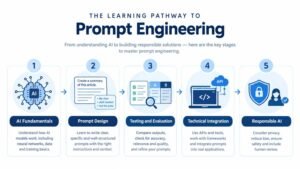
    There is no single standard syllabus followed by every provider. A useful curriculum should progress from understanding AI behaviour to building, evaluating and applying repeatable workflows. Five stages of prompt engineering learning, from AI fundamentals and prompt design to testing, integration and responsible AI. The following framework can help you assess courses or plan your own learning.
    Learning module Core topics Practical exercise
    Generative AI fundamentals Language models, context windows, tokens and model limitations Compare responses to the same question
    Prompt structure Tasks, context, constraints, examples and output formats Create a structured prompt for a business task
    Prompting techniques Zero-shot, few-shot, role-based and iterative prompting Test different approaches on the same dataset
    Output evaluation Accuracy, completeness, consistency and verification Score responses against defined criteria
    Technical integration Python, APIs, structured data and databases Build a small AI-assisted workflow
    Advanced applications RAG, automation and multi-step processes Create a document question-answering prototype
    Responsible AI Privacy, bias, security and human oversight Identify risks and add review rules

    Understanding the main techniques

    Zero-shot prompting: Asking the model to perform a task without giving examples. This can be useful for straightforward classification, summarisation or drafting. Few-shot prompting: Providing examples of the expected input and output. This is helpful when the result needs to follow a particular structure or pattern. Role-based instructions: Specifying a relevant professional perspective or responsibility. For example, asking a model to review a product description against a defined editorial checklist. Task decomposition: Breaking a complex request into smaller tasks. A market research workflow might separate source collection, data extraction, comparison and summary writing. Iterative testing: Changing instructions based on observed weaknesses and testing again. This is particularly important when the same task must be completed repeatedly. Advanced courses may also introduce RAG, which connects a model to relevant external information, and API-based workflows that allow AI functionality to be integrated into software. The goal is not to memorise every technique. It is to understand which method suits a particular task and how to establish whether the output is reliable.

    Build Skills That Employers Can Apply to Real Problems

    Prompting is one part of a broader skill set. The skills you prioritise should reflect the career direction you selected earlier.

    Analytical thinking

    You need to define the problem before asking an AI system to solve it. This involves identifying the required information, separating essential requirements from optional details and deciding what a successful result looks like.

    Communication and writing

    Clear instructions reduce ambiguity. Good communication also helps you explain AI-generated results, document limitations and collaborate with colleagues.

    Research and verification

    AI-generated statements may be incomplete or incorrect. Learn to check factual claims, dates, figures and references against appropriate sources. In coding tasks, run tests rather than assuming the suggested code works.

    Domain expertise

    Knowledge of a particular industry helps you identify mistakes that a general-purpose model may not recognise. A finance professional must understand the figures being summarised, while a marketing professional must judge whether a proposed message suits its audience.

    Programming and data literacy

    Programming is not essential for every role involving AI, but it becomes increasingly important for technical implementation. Python, APIs, SQL and basic data structures are useful starting points for learners who want to build applications or automate workflows.

    Responsible use

    Professionals must understand confidentiality, data privacy, bias and the need for human review. Do not upload sensitive company or customer information to an AI service without appropriate authorisation and safeguards. A useful way to measure progress is to ask whether you can solve a problem more reliably, explain your approach and identify when an AI output should not be trusted.

    Prove Your Ability With a Project, Not Just a Certificate

    Employers and clients need evidence that you can apply what you have learned. A portfolio provides a practical way to demonstrate your approach. Consider a project that classifies customer enquiries for a small business. Indian technology professional reviewing an AI-assisted customer-enquiry classification workflow on a laptop. The problem: Customer messages arrive in different formats, and staff spend time sorting them. The proposed solution: Use an AI model to categorise sample messages into billing, order status, product information and general enquiries. The project process:
    1. Prepare a set of sample messages with known categories.
    2. Define the classification rules and output format.
    3. Create an initial prompt.
    4. Test it against the sample messages.
    5. Record incorrect classifications and ambiguous cases.
    6. Revise the instructions and repeat the test.
    7. Document where human review is still required.
    Your portfolio should contain the original problem, prompt versions, test cases, evaluation criteria, observed errors and final limitations. If you claim that the workflow improves accuracy or saves time, show the measurements behind the claim. Otherwise, describe the result as a prototype or experiment. Other portfolio ideas include:
    • A document summarisation workflow with source verification.
    • A product-description assistant with a defined brand style.
    • An AI-assisted spreadsheet analysis project.
    • A code-review exercise with automated and manual tests.
    • A frequently asked questions assistant based on a controlled collection of documents.
    Two or three well-documented projects in your chosen field can be more informative than dozens of screenshots showing generic chatbot conversations.

    Career Scope: Where Can These Skills Be Applied?

    AI skills can support work across several sectors, but a course does not guarantee entry into any particular occupation. The following roles illustrate different ways to combine AI knowledge with existing professional capabilities.
    Career option What the role involves Additional preparation
    Prompt specialist Designing and testing instructions for particular applications Prompt evaluation and domain knowledge
    AI quality evaluator Reviewing responses for relevance, accuracy and consistency Research, analytical skills and documentation
    Business analyst Using AI to support reporting, requirements and process improvement Business analysis, spreadsheets and data interpretation
    AI-enabled content specialist Supporting research, drafting and content workflows Writing, SEO and editorial judgement
    Software developer Using AI to assist coding, testing and debugging Programming and software development
    AI application developer Integrating language models into products and services APIs, databases and application architecture
    Automation specialist Connecting AI tools with business processes Workflow design, integrations and process analysis
    These are possible career directions, not guaranteed outcomes of completing a short course. A learner interested in content operations may need strong writing and analytical skills. Someone pursuing AI application development will generally need deeper technical preparation. An AI evaluator may focus more heavily on testing, careful judgement and documentation.

    How should you evaluate the career market?

    Look beyond job titles. Review current vacancies and record the responsibilities, required qualifications, tools and experience employers mention. Search for several related titles, such as AI specialist, AI application developer, automation analyst, AI quality evaluator and business analyst. Compare the actual responsibilities instead of assuming that every role mentioning AI requires the same skills. This approach helps you identify a realistic target and avoid investing in training that does not match your intended career.

    Prompt Engineer Salary in India: What Should You Consider?

    Salary expectations vary with the role, employer, experience, location and technical depth required. There is no single dependable salary figure that applies to everyone working with AI prompting. A dedicated prompt engineering position should not automatically be compared with an AI engineer or software developer role. These jobs may involve very different responsibilities. Before using a salary figure to make an education decision, check recent vacancies and reliable salary data for the specific job title and experience level.

    What can influence compensation?

    • Technical expertise: Programming, API integration and AI application development may qualify candidates for a broader range of technical positions.
    • Industry experience: Understanding a specialised field can help you apply AI to problems that require subject knowledge.
    • Portfolio quality: Tested projects and clearly documented results can demonstrate practical ability.
    • Job responsibilities: A role involving system integration and evaluation may have different requirements from one focused on drafting and basic prompting.
    • Employer and location: Compensation varies by organisation, sector and work arrangement.

    How can you improve your earning potential?

    Build a combination of skills rather than relying on prompting alone. A developer might combine AI tools with Python and API integration. A marketer might combine AI with SEO, campaign analytics and content strategy. A business professional might focus on reporting, workflow improvement and data interpretation. Use current job advertisements to establish the skills that employers actually request. Treat any salary range as a guide for further research, not a guaranteed outcome of a course or degree.

    Where Does IT Distance Education Fit Into This Career Plan?

    A specialist AI course and a formal academic qualification serve different purposes. A short course can introduce a specific skill, while a degree may provide broader computing or management knowledge. For learners considering IT distance education, the relevant question is whether a formal qualification supports the role they want to pursue.

    If you are starting after Class 12

    An undergraduate qualification in computer applications or a related field may provide a foundation in programming, databases and computing concepts. Check the curriculum and eligibility conditions of the specific programme before applying. Learners who are still exploring their options can review ICC’s IT courses to investigate available education pathways. Confirm the current programme details and awarding institution before making an admission decision.

    If you already have a degree

    You may choose specialist AI training to build practical skills or consider a postgraduate qualification if it addresses a genuine academic or career requirement. For example, learners comparing postgraduate technical pathways can read ICC’s guide to distance MCA versus M.Tech. The appropriate option depends on eligibility, programme availability and the kind of work you intend to pursue.

    If you are working full-time

    A flexible learning arrangement may help you balance study with employment. However, you will still need to allocate time for practice, project development and assessment.

    Can an online BCA course for working professionals help?

    An online BCA course for working professionals may be worth considering if you need an undergraduate qualification in computer applications and meet the programme’s eligibility requirements. Before enrolling, check the syllabus, assessment structure, total fees and whether the programme is available in the intended mode. Also verify that the institution and programme are appropriately recognised for the relevant admission session. An academic qualification can support a longer-term career plan, but it does not replace hands-on AI practice or guarantee a particular job.

    Can a B.Tech correspondence college in India be the right choice?

    This requires particular care. Engineering programmes have specific regulatory requirements, and not every engineering qualification can be pursued through every distance or online mode. Do not assume that a B.Tech programme is valid simply because a college or website advertises it. Verify the exact programme and mode through the relevant regulator and awarding institution before paying fees. The UGC Distance Education Bureau provides official information about recognised or entitled institutions and their programmes. Use its current records and applicable regulatory information to verify the qualification you are considering.

    How to Compare Online Degree Courses India Without Choosing the Wrong Programme

    When comparing online degree courses India, evaluate the programme against your career objective rather than choosing solely on the basis of convenience or promotional claims. Use the following checklist before making an admission decision.
    Decision factor What to verify
    Career relevance Does the qualification support your intended next step?
    Curriculum Are the subjects relevant to the knowledge you need?
    Recognition Is the institution and specific programme authorised for the relevant mode and session?
    Eligibility Do you meet the admission requirements?
    Study format Can you manage the schedule, assessments and workload?
    Cost Are tuition, examination and other applicable fees clear?
    Practical learning Will you have time to complete projects and build complementary skills?
    The same principles apply when comparing distance learning programs or researching distance education in India more broadly. Flexible study can help learners manage competing responsibilities, but flexibility alone does not establish the quality or suitability of a qualification. Check the details before committing. For another perspective on choosing a technology pathway, ICC’s guide to online IT courses in India explores different learning areas and considerations for selecting a course.

    A 12-Week Plan to Move From Learning to Evidence

    Instead of measuring progress by how many prompts you have written, measure it by what you can demonstrate. The following 12-week framework is a suggested learning plan, not a guarantee of employment.
    Weeks Main focus Evidence of progress
    1–2 Learn generative AI fundamentals and model limitations Notes and basic experiments
    3–4 Practise prompt structure and different prompting techniques Tested prompts with revisions
    5–6 Choose a professional specialisation A clearly defined project problem
    7–8 Build a small AI-assisted workflow A working prototype
    9–10 Test outputs and document errors Evaluation results and limitations
    11–12 Improve the project and prepare applications A portfolio entry and targeted CV
    If your target is a technical position, use this period to identify additional gaps in programming, APIs, databases or software development. If your goal is a business-focused role, prioritise domain knowledge, analytical skills and workflow design. A formal qualification can run alongside this process, provided you can manage the workload.

    Common Questions Before Investing in AI Training

    Is prompt engineering suitable for beginners?

    Yes. Beginners can start with basic AI concepts, structured instructions and simple projects. The depth of technical preparation required depends on the intended role.

    Can a non-IT graduate enter an AI-related career?

    Potentially, yes. Non-IT graduates can apply AI skills in areas such as marketing, research, operations and business analysis. Technical development positions usually require additional computing skills.

    Is a prompt engineering certificate enough to get a job?

    No certificate guarantees employment. Practical projects, relevant experience, communication and the ability to evaluate AI outputs can strengthen a candidate’s profile.

    What should a prompt engineering course teach?

    A useful course may include generative AI fundamentals, prompt structure, prompting techniques, testing, evaluation, responsible AI and practical assignments. Advanced programmes may also cover APIs, RAG and automation.

    Can I learn AI while studying through distance education?

    Yes. You can pursue a suitable academic qualification while learning AI separately, provided you meet the requirements of both and can manage the workload.

    Is an MBA necessary for an AI career?

    No. An MBA may be relevant to business or management responsibilities, but it is not a universal requirement for AI-related work. Technical development roles generally require different preparation.

    How do I find realistic salary information?

    Review recent job advertisements and salary data for the precise role, experience level and location you are targeting. Avoid applying figures for AI engineers or other technical specialists directly to every prompt-focused position.

    How should I verify a distance or online qualification in India?

    Check the awarding institution, exact programme, learning mode, eligibility and recognition status for the relevant admission session. Use official UGC Distance Education Bureau information and confirm any additional regulatory requirements that apply.

    Conclusion: Build a Career Around What You Can Do With AI

    A sustainable AI career requires more than knowing how to phrase instructions. You need to understand a problem, select suitable tools, evaluate results and apply your knowledge within a professional context. Start by choosing a direction: AI-assisted business work, content operations, software development, quality evaluation or application building. Then select training that fills a genuine skills gap and create projects that demonstrate your progress. If you also need a formal academic qualification, compare suitable IT or management programmes carefully. Indian College of Correspondence can be a starting point for exploring available education options, while specialist AI training and independent projects can help you develop complementary skills. “Your next step should be based on the role you want to pursue, the skills you still need and the evidence you can build—not simply the popularity of a course title.” Explore Indian College of Correspondence to review available education options and seek programme guidance. Verify the relevant programme and university details before enrolling, and build your AI skills alongside the academic pathway that fits your goals.

Leave A Comment