
Admission opens for 2026-27 sessions for all university.

Blog Detail

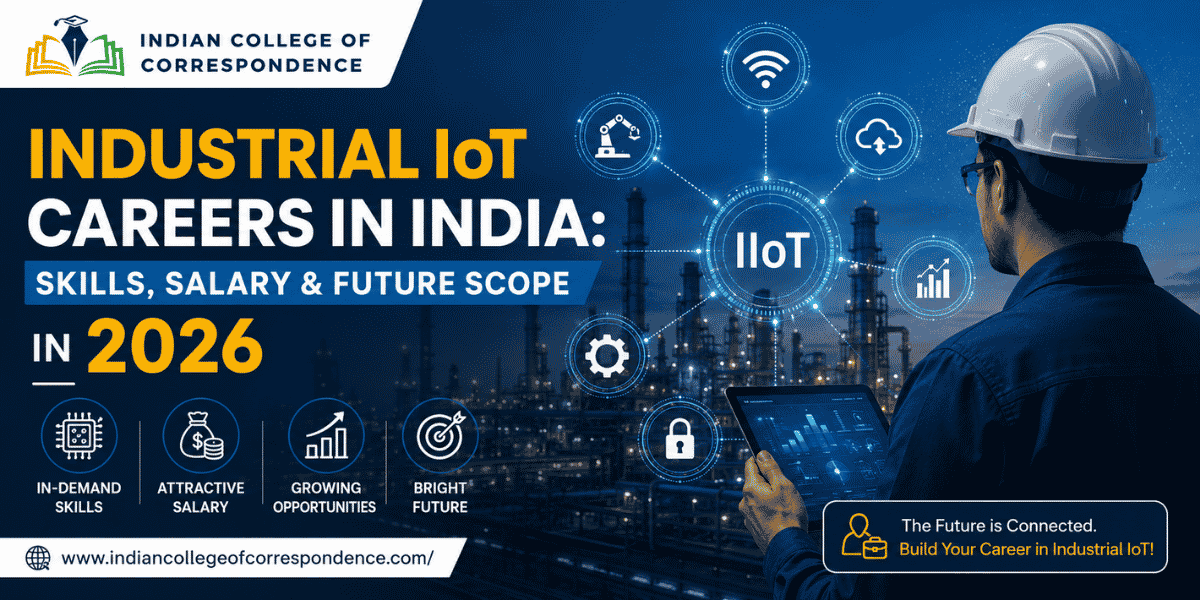
  • Industrial IoT Careers in India: Skills, Salary & Future Scope in 2026

    • 30,Jun 2026
    • Posted By : opsadsthrivein@gmail.com opsadsthrivein@gmail.com
    • 0 Comments
    • Diploma in Engr correspondence college in India
    • distance education in bangalore
    • Engineering distance education
    • M.Tech correspondence college in Karnataka
    Industrial IoT Careers in India are becoming one of the most exciting opportunities for engineering and technology professionals. As industries adopt smart manufacturing, automation, Artificial Intelligence (AI), and connected devices, the demand for skilled Industrial IoT professionals is increasing rapidly. Industrial IoT Careers in India combine engineering knowledge with software development, cloud computing, sensors, and real-time data analytics to improve industrial productivity and efficiency. From manufacturing plants to renewable energy projects, organizations are investing heavily in Industry 4.0 technologies. If you’re planning a future-ready career, understanding Industrial IoT Careers in India can help you prepare for one of the fastest-growing engineering domains in 2026 and beyond.

    What is Industrial IoT?

    Industrial Internet of Things (IIoT) refers to the use of internet-connected sensors, machines, industrial equipment, cloud computing, and Artificial Intelligence to automate manufacturing and industrial operations. Unlike consumer IoT devices such as smart watches or home assistants, Industrial IoT focuses on factories, power plants, transportation systems, logistics, and large-scale industrial environments. IIoT enables machines to communicate with each other, collect operational data, predict failures, reduce downtime, and improve production efficiency. Today, companies across automotive, healthcare, construction, aerospace, and energy sectors rely on IIoT to improve productivity while reducing operational costs. As Industry 4.0 continues expanding, Industrial IoT Careers in India are becoming increasingly valuable because organizations require professionals who understand both engineering and digital technologies.

    Why Industrial IoT Is Transforming Industries?

    The fourth industrial revolution has changed how businesses operate. Instead of manually monitoring machines, organizations now use connected devices that continuously collect and analyze data. Industrial IoT offers several advantages:
    • Predictive maintenance reduces equipment failures.
    • Smart factories improve production efficiency.
    • Real-time monitoring increases operational visibility.
    • AI-powered analytics improve business decisions.
    • Automated systems reduce human error.
    • Remote monitoring improves safety.
    • Connected supply chains increase productivity.
    Because of these benefits, companies are actively recruiting professionals who can design, implement, and maintain Industrial IoT systems. This growing demand makes Industrial IoT Careers in India one of the most promising technology careers today.

    Career Opportunities in Industrial IoT

    Industrial IoT professionals can work across multiple engineering and technology domains. Depending on their skills and specialization, they can pursue various high-demand job roles. Popular career opportunities include:
    • Industrial IoT Engineer
    • Automation Engineer
    • Embedded Systems Engineer
    • PLC & SCADA Engineer
    • IoT Software Developer
    • Industrial Network Engineer
    • Cloud IoT Engineer
    • Edge Computing Engineer
    • Industrial Cybersecurity Specialist
    • AI & IoT Integration Engineer
    • Data Analytics Engineer
    • Smart Manufacturing Consultant
    These professionals contribute to designing intelligent industrial systems, developing connected devices, improving manufacturing efficiency, and enabling data-driven decision-making. As organizations continue investing in digital transformation, Industrial IoT Careers in India are expected to generate thousands of new employment opportunities over the coming years.

    What are the key skills required for an entry-level IIoT engineer role in India?

    Employers hiring entry-level IIoT engineers look for candidates with a combination of engineering fundamentals and modern digital skills. Understanding programming, networking, automation, and cloud technologies significantly improves employability.

    Essential Skills for an Entry-Level IIoT Engineer

    Skill Importance
    Embedded Systems Device programming and hardware integration
    Python & C++ Software development for IoT applications
    PLC & SCADA Industrial automation and control systems
    Sensors & Networking Machine-to-machine communication
    Cloud Computing Data storage and IoT deployment
    AI & Machine Learning Intelligent automation and predictive analytics
    Cybersecurity Protecting industrial systems
    Data Analytics Business insights and operational improvements
    Apart from technical expertise, companies also value communication skills, teamwork, analytical thinking, and problem-solving abilities. Building hands-on projects using Raspberry Pi, Arduino, ESP32, and cloud platforms further strengthens your profile for Industrial IoT Careers in India.

    Industrial IoT Careers for Freshers

    Fresh graduates entering the Industrial IoT industry have numerous opportunities to begin their careers. Companies increasingly recruit engineering graduates who possess practical knowledge of automation, embedded systems, programming, and cloud computing. Students should focus on:
    • Learning Python and C++
    • Understanding industrial communication protocols
    • Building IoT projects
    • Learning cloud platforms
    • Exploring AI integration
    • Completing internships
    • Building GitHub portfolios
    • Earning industry certifications
    Students pursuing Engineering distance education can strengthen their technical foundation while complementing their studies with practical projects and certifications. Likewise, those completing a B.Tech correspondence college in India program can enhance their employability by gaining experience in Industrial IoT tools, automation software, and smart manufacturing technologies. A combination of technical knowledge and practical experience creates excellent opportunities for building successful Industrial IoT Careers in India.

    Industrial IoT Careers for Freshers Salary

    One of the biggest reasons students are exploring Industrial IoT Careers in India is the excellent salary potential. As industries rapidly adopt Industry 4.0, smart manufacturing, automation, and Artificial Intelligence, the demand for skilled IIoT professionals continues to grow. Fresh graduates with knowledge of embedded systems, IoT devices, cloud computing, PLC & SCADA, Python, and industrial networking often receive attractive salary packages compared to many traditional engineering roles.

    Average Industrial IoT Salary in India

    Experience Average Annual Salary
    Fresher (0–1 Year) ₹4–8 LPA
    2–5 Years ₹8–15 LPA
    5–8 Years ₹15–25 LPA
    Senior IIoT Architect ₹25–45+ LPA
    Freshers who have completed internships, industrial projects, AI certifications, or cloud computing training generally receive better offers. Knowledge of AWS IoT, Azure IoT, Siemens PLC, Schneider Electric automation, and industrial cybersecurity further improves salary prospects. Professionals who continuously upgrade their skills can expect significant career growth and higher compensation within a few years.

    Industrial IoT Companies Near Hyderabad

    Hyderabad has emerged as one of India’s leading technology and manufacturing hubs. The city offers excellent opportunities for professionals interested in Industrial IoT Careers in India, especially in sectors like aerospace, pharmaceuticals, manufacturing, electronics, and smart automation. Many organizations in Hyderabad hire IIoT professionals for roles involving automation, industrial software, embedded systems, AI integration, robotics, and predictive maintenance. Popular recruiters include:
    • Microsoft
    • Honeywell
    • Cyient
    • Tata Advanced Systems
    • Siemens
    • Schneider Electric
    • Qualcomm
    • LTIMindtree
    • Tech Mahindra
    • HCLTech
    Candidates with expertise in industrial networking, cloud computing, Python programming, PLC programming, and Industrial AI are highly preferred. Professionals pursuing IT distance education while gaining practical skills through certifications and live projects can also improve their employment prospects in Hyderabad’s growing Industrial IoT ecosystem.

    Industrial IoT Companies Near Bangalore

    Bangalore is India’s largest technology hub and one of the fastest-growing centers for Industrial IoT innovation. The city houses numerous multinational corporations, engineering firms, semiconductor companies, AI startups, and manufacturing organizations that actively recruit Industrial IoT professionals. Top employers include:
    • Bosch Global Software Technologies
    • ABB India
    • Siemens
    • Schneider Electric
    • Cisco
    • Intel
    • IBM
    • Wipro
    • Infosys
    • Tata Elxsi
    • GE Digital
    • Capgemini
    Professionals working in these companies contribute to smart manufacturing, Industrial AI, cloud automation, digital twins, robotics, and predictive maintenance projects. Students looking for flexible learning opportunities often explore distance education in bangalore alongside industry certifications and practical training to strengthen their technical knowledge and improve employability in Bangalore’s competitive technology market.

    Industrial IoT Companies Near Pune

    Pune is another major destination for engineering and manufacturing careers in India. Known for its strong automobile, industrial automation, and manufacturing ecosystem, Pune offers numerous opportunities for aspiring IIoT engineers. Leading recruiters include:
    • Tata Motors
    • Bajaj Auto
    • Mercedes-Benz India
    • John Deere
    • Siemens
    • Bosch
    • Cummins India
    • Emerson
    • SKF India
    • Bharat Forge
    • Whirlpool India
    • Honeywell
    These organizations recruit professionals for Industrial IoT implementation, automation engineering, embedded systems, predictive maintenance, industrial cybersecurity, and AI-enabled manufacturing projects. Candidates who continuously enhance their technical expertise and complete practical industrial projects remain highly competitive in Pune’s expanding Industry 4.0 landscape.

    Educational Pathways for Industrial IoT Careers

    A strong educational background provides the technical foundation required for successful Industrial IoT Careers in India. Engineering graduates often begin their journey by studying electronics, electrical engineering, mechanical engineering, computer science, or information technology. Students interested in flexible learning options can explore a Diploma in Engr correspondence college in India to build core engineering concepts before advancing into specialized Industrial IoT technologies. Those seeking higher technical specialization may also consider an M.Tech correspondence college in Karnataka, where advanced subjects such as embedded systems, automation, artificial intelligence, industrial networking, and cloud technologies can strengthen their expertise. Although formal education plays an important role, employers increasingly value practical experience, industry certifications, internships, and project portfolios. Combining academic qualifications with hands-on learning ensures long-term success in the rapidly evolving Industrial IoT industry and creates excellent opportunities for future career growth.

    Certifications That Can Boost Your Industrial IoT Career

    The Industrial IoT industry evolves rapidly, making continuous learning essential for long-term career success. While engineering degrees provide a solid academic foundation, employers often prefer candidates who also possess industry-recognized certifications. These certifications validate practical skills in automation, cloud computing, networking, cybersecurity, and Industrial AI. Some of the most valuable certifications include:
    • AWS Certified IoT
    • Microsoft Azure IoT Developer
    • Cisco Industrial Networking
    • Siemens PLC Programming
    • Schneider Electric EcoStruxure
    • Google Cloud IoT
    • Python for IoT
    • TensorFlow & Machine Learning Certifications
    • Industrial Cybersecurity Certifications
    These certifications help professionals remain competitive and increase their chances of securing better job roles and salary packages in Industrial IoT Careers in India.

    Challenges in Industrial IoT Careers

    Although Industrial IoT offers excellent career opportunities, professionals should also understand the challenges associated with this rapidly evolving field.

    Keeping Up with Technology

    Industry 4.0 technologies evolve quickly. New IoT devices, AI platforms, cloud services, and automation tools are introduced every year, requiring continuous learning.

    Cybersecurity Risks

    Industrial systems handle critical operational data. Professionals must understand cybersecurity principles to protect industrial networks from cyberattacks.

    Hardware and Software Integration

    Unlike traditional software development, Industrial IoT requires engineers to integrate hardware devices, sensors, embedded systems, and software platforms. Understanding both domains is essential.

    Industrial Standards

    Professionals often work with protocols such as MQTT, OPC UA, Modbus, and industrial Ethernet. Learning these standards improves efficiency and compatibility.

    Problem-Solving Skills

    Every manufacturing environment has unique operational requirements. Engineers must analyze issues, identify solutions, and optimize industrial processes. Overcoming these challenges helps professionals establish successful Industrial IoT Careers in India and positions them for leadership roles in smart manufacturing.

    Future Scope of Industrial IoT in India

    The future of Industrial IoT Careers in India looks exceptionally promising. Government initiatives supporting smart manufacturing, Digital India, Make in India, semiconductor production, renewable energy, and infrastructure development continue driving investments in advanced industrial technologies. Several emerging trends are creating new employment opportunities:
    • Industry 5.0
    • AI-powered manufacturing
    • Smart factories
    • Robotics integration
    • Digital Twin technology
    • Autonomous industrial systems
    • Edge Computing
    • Predictive maintenance
    • Green manufacturing
    • Smart logistics
    • Electric vehicle manufacturing
    • Renewable energy automation
    According to industry trends, organizations increasingly require professionals capable of combining engineering expertise with Artificial Intelligence, cloud computing, and industrial automation. This makes Industrial IoT Careers in India one of the strongest long-term engineering career options for students and working professionals.

    How ICC Helps You Prepare for Future Engineering Careers?

    Choosing the right educational pathway is one of the first steps toward building a successful engineering career. ICC helps students understand flexible educational options, compare programs, and make informed decisions based on current industry requirements. Whether learners are exploring engineering, automation, Artificial Intelligence, or emerging technology careers, ICC provides guidance that supports academic planning and long-term professional development. Along with choosing suitable programs, students are encouraged to develop practical skills, complete certifications, and participate in industry-focused projects. As technology continues transforming industrial operations, ICC supports learners in identifying educational pathways that align with the growing demand for Industry 4.0 professionals.

    Conclusion

    The rapid adoption of smart manufacturing, automation, cloud computing, and Artificial Intelligence is creating outstanding opportunities for professionals interested in Industrial IoT Careers in India. From manufacturing plants and automotive companies to renewable energy organizations and smart infrastructure projects, Industrial IoT professionals are becoming essential for driving digital transformation. Success in this field requires a combination of engineering knowledge, programming skills, industrial automation expertise, cloud technologies, cybersecurity awareness, and continuous learning. Building real-world projects, earning industry certifications, and staying updated with emerging technologies can significantly improve career prospects. Whether you are a student beginning your engineering journey or a working professional looking to upgrade your technical skills, investing in Industrial IoT Careers in India today can lead to rewarding job opportunities, competitive salaries, and long-term career growth in one of the fastest-growing technology sectors. Build Your Future in Industrial IoT with ICC Industrial IoT is transforming industries and creating exciting career opportunities for engineers and technology professionals. If you want to build a successful future in smart manufacturing, automation, and Industry 4.0, start by choosing the right educational pathway. Connect with Indian College Of Correspondence to explore flexible learning opportunities, understand admission options, and select programs that align with future engineering careers. Take the first step today toward becoming an industry-ready Industrial IoT professional.

    FAQs

    1. What is Industrial IoT (IIoT)?

    Industrial IoT (IIoT) refers to the integration of internet-connected sensors, machines, cloud computing, Artificial Intelligence, and automation technologies within industrial environments. Unlike consumer IoT devices, IIoT focuses on improving manufacturing plants, power stations, logistics, and smart factories through real-time monitoring and predictive maintenance. Businesses use IIoT to reduce downtime, improve productivity, and optimize operational efficiency. As Industry 4.0 continues to expand across India, the need for skilled professionals is increasing rapidly. Students pursuing Engineering distance education can build the technical knowledge required to understand automation systems, industrial networking, and connected manufacturing technologies that support successful IIoT careers.

    2. Is Industrial IoT a good career in India?

    Yes, Industrial IoT Careers in India offer outstanding growth opportunities due to increasing investments in smart manufacturing, renewable energy, electric vehicles, robotics, and digital transformation. Companies are actively hiring engineers who can develop and manage intelligent industrial systems using AI, cloud computing, and connected devices. As more organizations adopt Industry 4.0 technologies, demand for IIoT professionals is expected to grow significantly over the next decade. Students completing a B.Tech correspondence college in India program can strengthen their technical foundation and improve their employability by combining academic learning with practical projects, internships, and relevant Industrial IoT certifications.

    3. What skills are required for Industrial IoT jobs?

    A successful Industrial IoT professional needs expertise in embedded systems, PLC & SCADA, industrial networking, Python, C++, cloud computing, cybersecurity, sensors, and data analytics. Understanding Artificial Intelligence, machine learning, MQTT, Modbus, and industrial communication protocols also provides a competitive advantage. Along with technical knowledge, employers look for analytical thinking, teamwork, communication, and project management skills. Candidates interested in advanced technical roles often pursue an M.Tech correspondence college in Karnataka to specialize in automation, embedded systems, Industrial AI, and smart manufacturing technologies while enhancing their long-term career opportunities.

    4. What is the average salary of an Industrial IoT Engineer?

    Industrial IoT Engineers enjoy competitive salaries because their skills are in high demand across multiple industries. Fresh graduates generally earn between ₹4–8 LPA, while professionals with several years of experience can earn ₹15–25 LPA or more. Senior specialists working in automation, Industrial AI, cloud integration, and smart manufacturing often earn ₹30–45+ LPA depending on their expertise and employer. Students who complete a Diploma in Engr correspondence college in India and continuously upgrade their skills through certifications and practical experience can build rewarding careers with excellent salary growth in the Industrial IoT sector.

    5. Which industries hire Industrial IoT professionals?

    Industrial IoT professionals are recruited by manufacturing companies, automotive firms, aerospace organizations, renewable energy providers, healthcare institutions, pharmaceuticals, logistics companies, smart city projects, oil & gas industries, railways, and electronics manufacturers. These sectors rely on connected devices, automation, and real-time monitoring to improve efficiency and reduce operational costs. Professionals with strong programming, cloud computing, and industrial networking skills are highly valued. Students pursuing IT distance education can strengthen their software and networking knowledge while preparing for careers that combine information technology with industrial automation and smart manufacturing.

    6. Does Engineering distance education help in IIoT careers?

    Yes, recognized Engineering distance education programs can provide a strong theoretical foundation for students and working professionals who want to build careers in Industrial IoT. These programs cover essential engineering concepts while offering the flexibility to continue working or managing other commitments. To become industry-ready, learners should combine their academic knowledge with practical training, Industrial IoT certifications, internships, and real-world automation projects. Many professionals also choose distance education in bangalore because it provides flexible learning opportunities that help them develop technical expertise while preparing for the rapidly evolving Industry 4.0 ecosystem.

    7. Which programming language is best for Industrial IoT?

    Python is considered one of the best programming languages for Industrial IoT because of its simplicity and extensive support for automation, Artificial Intelligence, machine learning, and data analytics. C and C++ remain essential for embedded systems programming, while JavaScript, Java, and SQL support cloud applications, industrial dashboards, and software integration. Learning multiple programming languages allows engineers to build complete Industrial IoT solutions more efficiently. Students enrolled in a B.Tech correspondence college in India can strengthen these programming skills through hands-on projects, coding practice, and industry certifications to improve career prospects.

    8. Why should students choose ICC for educational guidance?

    ICC helps students identify educational pathways that align with emerging technology careers such as Industrial IoT, Artificial Intelligence, automation, and smart manufacturing. From understanding admission procedures to comparing flexible learning programs, ICC supports learners in making informed academic decisions. Students also receive guidance on selecting qualifications that complement future industry demands and career goals. Those searching for flexible higher education often explore distance education in bangalore to balance education with personal or professional responsibilities. Combined with practical skills, certifications, and continuous learning, ICC helps learners prepare confidently for future engineering careers.

Leave A Comment