
Admission opens for 2026-27 sessions for all university.

Blog Detail

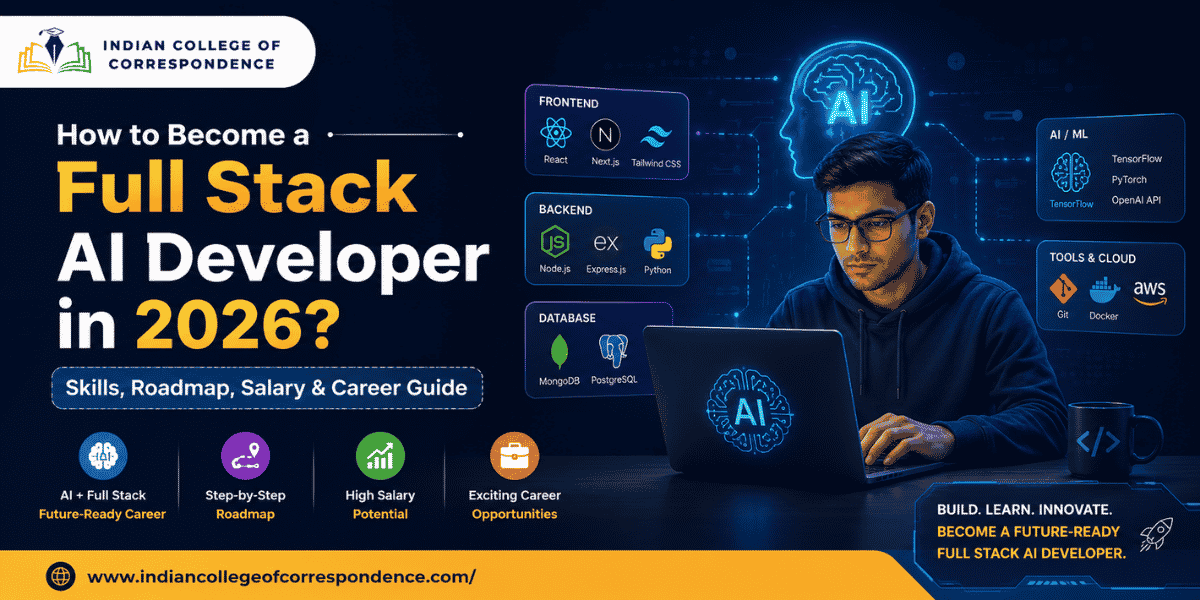
  • How to Become a Full Stack AI Developer in 2026?: Skills, Roadmap, Salary & Career Guide

    • 29,Jun 2026
    • Posted By : opsadsthrivein@gmail.com opsadsthrivein@gmail.com
    • 0 Comments
    • B.Tech correspondence college in India
    • distance education in bangalore
    • Engineering distance education
    • IT distance education
    Full Stack AI Developer in 2026 is one of the most searched and promising career paths in today’s technology-driven world. As Artificial Intelligence transforms industries, companies are actively hiring professionals who can build intelligent web applications from scratch. A Full Stack AI Developer in 2026 combines frontend development, backend programming, cloud technologies, databases, and AI capabilities to create smart digital solutions. Whether it’s AI chatbots, recommendation engines, healthcare platforms, or business automation tools, skilled developers are in high demand. If you’re planning a future-ready career, understanding the skills, roadmap, salary, and opportunities of becoming a Full Stack AI Developer in 2026 can help you make the right decision.

    Why Full Stack AI Development Is the Future?

    Artificial Intelligence is no longer limited to research labs. Today, businesses across healthcare, finance, retail, education, logistics, and manufacturing are integrating AI into their everyday operations. At the same time, organizations need developers who can build complete applications while also integrating AI models and automation tools. This is exactly where a Full Stack AI Developer in 2026 stands out. Instead of focusing only on coding websites or creating machine learning models, these professionals combine both skill sets to deliver intelligent digital products. Several factors are driving demand:
    • Rapid adoption of Generative AI
    • Growth of AI-powered business applications
    • Digital transformation across industries
    • Cloud computing expansion
    • Increased startup investments
    • Automation replacing repetitive tasks
    • Growing demand for AI-enabled customer experiences
    As businesses continue investing in AI technologies, professionals with both development and AI expertise will enjoy exceptional career opportunities.

    Who Is a Full Stack AI Developer?

    A Full Stack AI Developer is a technology professional who can build complete software applications while integrating Artificial Intelligence features. Unlike traditional developers who focus only on frontend or backend technologies, Full Stack AI Developers understand the entire development lifecycle. Their responsibilities include:
    • Designing user interfaces
    • Developing backend applications
    • Managing databases
    • Integrating AI models
    • Deploying applications on cloud platforms
    • Creating AI chatbots
    • Developing recommendation systems
    • Building intelligent automation tools
    Because of these diverse responsibilities, a Full Stack AI Developer in 2026 has become one of the highest-demand roles in the technology industry.

    Why Companies Prefer Full Stack AI Developers?

    Organizations today prefer hiring professionals who possess multiple technical skills rather than separate specialists for every task. Some key advantages include:
    • Faster product development
    • Lower development costs
    • Better collaboration
    • AI integration expertise
    • End-to-end project ownership
    • Improved innovation
    This versatility makes a Full Stack AI Developer in 2026 valuable across startups, multinational companies, and technology consulting firms.

    Step-by-Step Roadmap to Become a Full Stack AI Developer

    Building expertise requires structured learning. Rather than learning random technologies, students should follow a practical roadmap.

    Step 1: Learn Programming Fundamentals

    Start with programming concepts such as variables, loops, functions, object-oriented programming, and algorithms. Recommended languages:
    • Python
    • JavaScript
    • Java
    Python remains the preferred language for Artificial Intelligence because of its powerful libraries and simplicity.

    Step 2: Learn Frontend Development

    Master technologies such as:
    • HTML
    • CSS
    • JavaScript
    • React
    • Angular
    • Next.js
    Frontend skills help developers create attractive and responsive user interfaces.

    Step 3: Learn Backend Development

    Backend development powers application logic. Popular technologies include:
    • Node.js
    • Express.js
    • Django
    • Flask
    • FastAPI
    Understanding APIs and server-side programming is essential for every Full Stack AI Developer in 2026.

    Step 4: Learn Database Management

    Applications need efficient data storage. Important databases include:
    • MySQL
    • PostgreSQL
    • MongoDB
    • Firebase
    Knowledge of database design significantly improves development capabilities.

    Essential Skills Every Full Stack AI Developer Needs

    Skills Required for Success

    Skill Why It Matters
    HTML, CSS & JavaScript Build responsive websites
    React / Angular Develop interactive user interfaces
    Node.js / Django Create powerful backend applications
    Python AI and Machine Learning development
    SQL / MongoDB Database management
    Git & GitHub Version control and collaboration
    Machine Learning Intelligent application development
    Cloud Computing Deploy scalable AI applications
    These technical skills, combined with communication, problem-solving, and continuous learning, create a strong foundation for becoming a successful Full Stack AI Developer in 2026.

    Best Programming Languages for Full Stack AI Development

    Selecting the right programming languages is one of the most important steps toward becoming a Full Stack AI Developer in 2026. Instead of trying to learn every language available, focus on technologies that are widely used by employers and support both software development and Artificial Intelligence.

    Python

    Python is the backbone of AI development because of its simple syntax and extensive ecosystem. Popular libraries such as TensorFlow, PyTorch, Scikit-learn, Pandas, and NumPy make it the preferred language for machine learning, deep learning, and data analysis.

    JavaScript

    JavaScript remains essential for frontend development. Combined with React, Vue.js, or Angular, it helps developers create responsive and interactive user interfaces.

    TypeScript

    TypeScript enhances JavaScript by adding static typing, making large applications easier to maintain. Many enterprise organizations now prefer TypeScript for scalable development.

    SQL

    Every intelligent application relies on data. SQL helps developers efficiently manage relational databases and retrieve business-critical information.

    Java

    Java is still widely used in enterprise software, banking, healthcare, and Android development. Understanding Java increases career flexibility. Mastering these languages significantly improves your chances of becoming a successful Full Stack AI Developer in 2026.

    AI Tools and Technologies Every Developer Should Learn

    Artificial Intelligence is evolving rapidly, and employers expect developers to work with modern AI frameworks and cloud-based solutions. Learning the right tools can make your portfolio stand out. Some of the most in-demand technologies include:
    • ChatGPT API
    • OpenAI API
    • TensorFlow
    • PyTorch
    • Hugging Face
    • LangChain
    • Docker
    • Kubernetes
    • GitHub Copilot
    • AWS AI Services
    • Microsoft Azure AI
    • Google Cloud AI
    These technologies enable developers to build intelligent chatbots, recommendation engines, AI-powered websites, virtual assistants, document analyzers, and automation platforms. As businesses increasingly adopt Generative AI, familiarity with these tools is becoming essential for every Full Stack AI Developer in 2026.

    Top Online Platforms to Learn Full Stack AI Development in 2026

    If you’re planning to become a Full Stack AI Developer in 2026, choosing the right learning platform is just as important as selecting the right programming languages. Today, several online platforms offer industry-relevant courses that combine full stack development with Artificial Intelligence, machine learning, cloud computing, and real-world projects. Popular platforms such as Coursera, Udemy, edX, LinkedIn Learning, Codecademy, freeCodeCamp, DataCamp, DeepLearning.AI, Simplilearn, and Great Learning provide beginner-to-advanced courses designed by industry experts. Many of these programs include hands-on assignments, capstone projects, certifications, and practical AI applications that help strengthen your portfolio. While online courses are excellent for skill development, combining them with formal education, internships, and real-world coding projects can significantly improve your chances of securing high-paying Full Stack AI Developer roles in 2026.

    What are the course fees of an AI Full Stack Developer?

    The AI Full Stack Developer course fees can vary significantly depending on the institute, course duration, curriculum, certifications, and mode of learning. In India, short-term online certification programs generally cost between ₹20,000 and ₹80,000, while comprehensive bootcamps with live projects and placement support may range from ₹80,000 to ₹2.5 lakh. Degree-based programs or specialized postgraduate courses can cost even more. Before enrolling, compare the course syllabus, faculty expertise, hands-on projects, internship opportunities, certification value, and placement assistance instead of choosing a program based solely on fees. Students pursuing IT distance education or related technology programs can also complement their academic qualifications with AI Full Stack certifications to improve employability. Investing in a quality course that emphasizes practical skills, portfolio development, and real-world AI applications can provide excellent long-term career returns as demand for AI professionals continues to grow.

    Full Stack AI Developer Salary in India

    One of the biggest reasons students are attracted to this career is its excellent earning potential. Salaries vary depending on technical expertise, certifications, project portfolio, employer, and work experience.

    Average Salary of Full Stack AI Developers

    Experience Average Annual Salary
    Fresher ₹6–10 LPA
    2–5 Years ₹10–18 LPA
    5–8 Years ₹18–30 LPA
    Senior AI Developer ₹30–60+ LPA
    Professionals working for global technology companies or remote international employers often receive even higher compensation. Building practical AI projects and contributing to open-source platforms can further improve salary prospects for a Full Stack AI Developer in 2026.

    AI Full Stack Developer Salary for Freshers in India (2026)

    The demand for AI Full Stack Developers is growing rapidly, making it one of the highest-paying technology careers for fresh graduates. The AI full stack developer salary for freshers in India typically ranges from ₹6 LPA to ₹10 LPA, depending on technical skills, educational background, project portfolio, certifications, and the hiring company. Graduates with expertise in Python, JavaScript, React, Node.js, machine learning, cloud computing, and AI frameworks often receive better salary packages than those with only basic programming knowledge. Startups may offer competitive compensation along with learning opportunities, while multinational companies provide structured career growth and additional benefits. As freshers gain practical experience and build real-world AI applications, their earning potential can increase significantly, with experienced professionals earning ₹20 LPA or more within a few years.

    Full Stack AI Developer Salary in US

    The Full Stack AI Developer salary in US is among the highest in the technology industry due to the growing demand for professionals who can combine full stack development with Artificial Intelligence expertise. Entry-level Full Stack AI Developers typically earn between $100,000 and $140,000 per year, while professionals with 3–5 years of experience can earn $140,000 to $190,000 annually. Senior AI developers, AI architects, and machine learning specialists working at leading technology companies may earn $200,000 to $300,000+ per year, including bonuses and stock options. Salaries vary based on factors such as technical skills, experience, certifications, company size, and location. Cities like San Francisco, Seattle, New York, Austin, and Boston generally offer the highest compensation because of their strong concentration of AI startups, multinational technology companies, and innovation hubs. As AI adoption continues to accelerate across industries, salary prospects for Full Stack AI Developers in the US are expected to remain highly competitive.

    Educational Pathways to Become a Full Stack AI Developer

    While practical skills are essential, having the right educational foundation helps students understand programming concepts, software engineering principles, and problem-solving techniques. Many aspiring developers begin with bca distance education in bangalore, which provides strong fundamentals in programming, databases, networking, and application development. Students interested in engineering-focused technology careers often explore a B.Tech correspondence college in India to strengthen their technical knowledge and software development skills. Working professionals who want to continue learning while managing their jobs frequently consider IT distance education programs. These flexible learning options allow learners to build technical expertise without interrupting their careers. Similarly, Engineering distance education provides opportunities for professionals to enhance their engineering knowledge while developing industry-relevant skills in AI, cloud computing, and software technologies. Students seeking flexible learning opportunities also explore distance education in bangalore, where they can pursue academic goals while balancing personal and professional commitments. Those comparing institutions may also research a correspondence college in india to understand various educational pathways that support technology-focused careers. Although formal education provides a strong foundation, employers increasingly value practical skills, certifications, GitHub portfolios, internships, hackathons, and real-world AI projects.

    Industries Hiring Full Stack AI Developers

    Today, almost every industry is adopting Artificial Intelligence to improve customer experiences, automate business processes, and enhance operational efficiency. Some of the top hiring industries include:
    • Information Technology
    • Healthcare
    • Banking & Financial Services
    • FinTech
    • E-commerce
    • EdTech
    • Manufacturing
    • Cybersecurity
    • Digital Marketing
    • Logistics & Supply Chain
    • Artificial Intelligence Startups
    • SaaS Companies
    These industries offer exciting opportunities for professionals looking to build a long-term career as a Full Stack AI Developer in 2026.

    Common Mistakes Beginners Should Avoid

    Many aspiring developers begin learning Artificial Intelligence and full stack development with great enthusiasm, but several common mistakes slow their progress. Avoiding these errors can help you become a successful Full Stack AI Developer in 2026 more efficiently.

    Learning Too Many Technologies at Once

    One of the biggest mistakes is trying to master every programming language, framework, and AI tool simultaneously. Instead, focus on building a strong foundation in Python, JavaScript, databases, and one frontend framework before moving to advanced AI concepts.

    Ignoring Real Projects

    Employers value practical experience more than theoretical knowledge. Building AI chatbots, recommendation systems, portfolio websites, and automation tools demonstrates your skills far better than simply completing online courses.

    Skipping Data Structures and Algorithms

    Many students focus only on web development while ignoring Data Structures and Algorithms (DSA). Strong DSA knowledge improves coding ability and helps during technical interviews.

    Neglecting GitHub Portfolio

    Your GitHub profile often serves as your professional portfolio. Uploading projects regularly shows recruiters your coding skills, consistency, and practical experience.

    Not Learning Cloud Technologies

    Modern AI applications are deployed on cloud platforms such as AWS, Azure, and Google Cloud. Learning cloud deployment increases employability.

    Ignoring Communication Skills

    Technical expertise alone is not enough. Companies also value communication, teamwork, presentation skills, and problem-solving abilities. By avoiding these mistakes, aspiring professionals can build a stronger foundation and accelerate their journey toward becoming a Full Stack AI Developer in 2026.

    Career Roadmap to Become a Full Stack AI Developer

    Following a structured learning path helps students develop the right skills step by step. School / College Student Learn Programming Fundamentals Frontend Development Backend Development Database Management Cloud Computing & APIs Machine Learning Generative AI & LLMs Build Real-World AI Projects Create GitHub Portfolio Full Stack AI Developer in 2026 Senior AI Engineer AI Solution Architect / Technical Lead This roadmap allows learners to progressively build expertise and prepare for high-demand technology roles.

    Why Continuous Learning Is Essential?

    Artificial Intelligence is one of the fastest-evolving fields in the technology industry. New programming frameworks, AI models, cloud services, and automation tools emerge every year. Professionals who continue learning remain competitive and are better prepared for future opportunities. Useful ways to stay updated include:
    • Completing AI certifications
    • Participating in hackathons
    • Building open-source projects
    • Following technology communities
    • Reading AI research blogs
    • Practicing coding regularly
    • Experimenting with Generative AI tools
    Continuous upskilling ensures long-term success as a Full Stack AI Developer in 2026.

    How ICC Helps Students Build Future-Ready Careers?

    Choosing the right educational pathway is an important step toward a successful technology career. ICC helps students understand academic options, compare flexible learning programs, and identify career paths that align with current industry trends. Whether learners are beginning their journey in software development or planning to transition into Artificial Intelligence, ICC provides guidance that supports informed educational decisions. By combining quality education with practical skills, certifications, and industry-focused learning, students can confidently prepare for future technology careers. As Artificial Intelligence continues transforming businesses worldwide, ICC encourages learners to continuously improve their technical expertise and build real-world experience alongside academic qualifications.

    Conclusion

    The demand for a Full Stack AI Developer in 2026 is growing rapidly as organizations adopt Artificial Intelligence, automation, and cloud technologies to drive innovation. Professionals who combine full stack development skills with AI expertise are becoming some of the most sought-after technology specialists across industries. Success in this career depends on building strong programming fundamentals, mastering frontend and backend development, understanding databases, learning machine learning concepts, and continuously improving practical skills through projects and certifications. A well-planned educational pathway, combined with hands-on experience, can significantly improve career prospects. Whether you are a student, graduate, or working professional, starting your learning journey today can prepare you for exciting opportunities in one of the fastest-growing careers in the digital economy. With dedication and continuous learning, becoming a Full Stack AI Developer in 2026 can lead to excellent salary packages, global job opportunities, and long-term professional growth. Start Your Journey Toward Becoming a Full Stack AI Developer The future of technology belongs to professionals who can combine software development with Artificial Intelligence. If you’re planning a successful career in AI, start by choosing the right educational pathway, developing practical skills, and building real-world projects. Connect with Indian College Of Correspondence to explore flexible learning opportunities, understand admission options, and prepare yourself for a rewarding career in modern technology.

    FAQs

    1. How can I become a Full Stack AI Developer in 2026?

    To become a Full Stack AI Developer in 2026, begin by learning programming languages such as Python and JavaScript, followed by frontend frameworks like React and backend technologies like Node.js or Django. You should also understand databases, APIs, cloud computing, Git, and machine learning fundamentals. Building AI-powered projects and maintaining an active GitHub portfolio can significantly improve your employability. Students looking for flexible learning opportunities can also explore IT distance education, which provides a strong foundation in software development while allowing them to continue learning at their own pace. Continuous upskilling is the key to long-term success.

    2. What skills are required for a Full Stack AI Developer?

    A successful Full Stack AI Developer needs expertise in frontend technologies like HTML, CSS, JavaScript, and React, along with backend frameworks such as Node.js or Django. Knowledge of Python, SQL, MongoDB, machine learning, cloud platforms, Docker, APIs, Git, and version control is equally important. Soft skills like communication, analytical thinking, and problem-solving also help developers work effectively in teams. Students pursuing bca distance education in bangalore can strengthen these technical skills through practical projects, coding practice, internships, and AI certifications, making them more competitive in today’s technology job market.

    3. Is Full Stack AI Development a good career in India?

    Yes, Full Stack AI Development is one of the fastest-growing career paths in India. Businesses across healthcare, finance, education, e-commerce, manufacturing, and logistics are adopting Artificial Intelligence to improve efficiency and customer experiences. As a result, professionals who can develop complete AI-powered applications are highly valued. This career offers excellent job security, attractive salaries, and opportunities to work with global organizations. Students interested in technology can also consider Engineering distance education programs to build technical knowledge while balancing personal or professional commitments and preparing for future AI-driven careers.

    4. What is the average salary of a Full Stack AI Developer?

    The salary of a Full Stack AI Developer depends on experience, technical expertise, certifications, and project portfolio. Freshers usually earn between ₹6–10 LPA, while professionals with three to five years of experience may earn ₹15–25 LPA. Senior AI developers, solution architects, and technical leads often earn ₹30–50+ LPA, especially in multinational companies or global remote roles. Students graduating from a recognized B.Tech correspondence college in India and continuously improving their AI, cloud, and software development skills can significantly enhance their long-term earning potential.

    5. Can BCA students become Full Stack AI Developers?

    Absolutely. BCA graduates already possess foundational knowledge of programming, databases, networking, and software development, making it easier to transition into AI development. By learning Python, machine learning, cloud computing, frontend and backend technologies, and building real-world AI projects, BCA students can become successful Full Stack AI Developers. Practical experience through internships, coding competitions, and certifications further improves employability. Students enrolled in bca distance education in bangalore can also develop industry-relevant skills by combining academic learning with hands-on project experience and continuous technical practice.

    6. Does IT distance education help in AI careers?

    Yes, IT distance education can provide a strong academic foundation for students and working professionals interested in Artificial Intelligence and software development. These programs cover essential subjects such as programming, databases, networking, operating systems, and software engineering, which are valuable for AI careers. When combined with practical learning through AI certifications, online coding platforms, cloud computing projects, and GitHub portfolios, distance education can support career growth effectively. Many learners also choose distance education in bangalore because of its flexibility, allowing them to study while gaining valuable work experience.

    7. Which programming language is best for AI development?

    Python is widely regarded as the best programming language for AI development because of its simple syntax and powerful libraries like TensorFlow, PyTorch, Scikit-learn, NumPy, and Pandas. It enables developers to build machine learning models, automate workflows, and create intelligent applications efficiently. However, JavaScript is equally important for developing AI-powered web interfaces, while SQL helps manage application data. Students exploring technology education through a correspondence college in india can strengthen their programming skills while pursuing certifications and practical AI projects to improve their career prospects.

    8. Why should students choose ICC for career guidance?

    ICC supports students by helping them understand educational pathways, compare flexible learning programs, and identify courses aligned with current industry requirements. Whether learners are interested in Artificial Intelligence, software development, engineering, or management, ICC provides valuable guidance for selecting suitable academic programs. Students exploring flexible higher education often research a correspondence college in india before making important academic decisions. Along with choosing the right course, ICC encourages learners to build practical skills, complete certifications, and gain real-world experience, ensuring they are well-prepared for future technology careers.

Leave A Comment