Admission opens for 2026-27 sessions for all university.

Blog Detail

  • How to Become a Data Scientist Without a Computer Science Degree

    • 19,Oct 2026
    • Posted By : uaeautomates@gmail.com
    • 0 Comments
    • correspondence college in india
    • Data Science Career in India
    • Data Science Learning Roadmap
    • Data Science Skills
    • Data Science Without a Computer Science Degree
    • Data Scientist
    • How to Become a Data Scientist
    • IT distance education
    • Python for Beginners
    • SQL for Data Science
    Have you ever wondered whether you can build a successful career in technology without holding a Computer Science degree? If you enjoy solving problems, understanding numbers, and discovering patterns, becoming a Data Scientist could be a career path worth exploring. With the right combination of technical skills, practical experience, and IT Distance Education where appropriate, you can begin developing the knowledge needed to enter this growing field. Data science is no longer limited to people who studied programming at university. Businesses across industries use data to understand customers, improve operations, forecast demand, and make informed decisions. This creates opportunities for graduates from commerce, mathematics, statistics, science, and other backgrounds to develop relevant analytical skills. However, a career transition requires more than completing a few online tutorials. You need to understand how data works, practise programming, learn statistical concepts, and demonstrate your abilities through projects. So, how can you start from your current academic background and work towards a career in data science? This guide explains the skills to learn, educational pathways to consider, projects to build, and practical steps to prepare for suitable opportunities in India.

    What Is a Data Scientist?

    A Data Scientist is a professional who uses statistical methods, programming, analytical techniques, and domain knowledge to extract useful insights from data. Organisations collect information from websites, mobile applications, sales transactions, customer interactions, financial records, and many other sources. However, raw information does not automatically provide meaningful answers. It must be organised, analysed, and interpreted. This is where data science becomes valuable. For example, an online shopping company may want to understand why customers stop purchasing its products. A Data Scientist could examine purchase histories, customer behaviour, product preferences, and other relevant information to identify patterns and investigate possible reasons. Similarly, a healthcare organisation might analyse suitable datasets to study trends, while a financial company could use historical information to support risk assessment. A Data Scientist may perform tasks such as:
    • Collecting and cleaning data from different sources.
    • Exploring datasets to identify trends and relationships.
    • Using programming languages such as Python.
    • Applying statistical techniques to investigate questions.
    • Building and evaluating machine learning models.
    • Creating charts and visualisations to communicate findings.
    • Explaining results and limitations to business teams.
    The role combines technical knowledge with curiosity and critical thinking. The objective is not simply to work with numbers but to use evidence to answer meaningful questions.

    Why Is Data Science Worth Exploring as a Career?

    Before deciding how to become a Data Scientist, it helps to understand why organisations need people with analytical skills.

    1. Businesses Need Better Decisions

    Companies regularly make decisions about pricing, inventory, marketing, customer service, and expansion. Data analysis can help them evaluate different options instead of relying entirely on assumptions. For example, a retailer can examine historical sales to understand which products perform well during particular seasons.

    2. Data Is Used Across Different Industries

    Data science is relevant to more than technology companies. Retail, banking, manufacturing, education, logistics, agriculture, and healthcare organisations can all use data to investigate problems. This means that knowledge of a particular industry may become useful when combined with analytical skills.

    3. Analytical Skills Can Complement Existing Experience

    Suppose you have worked in accounting for several years. You may already understand financial statements, business transactions, and reporting requirements. Learning SQL, Python, and statistics can help you extend that knowledge into more advanced analysis. Likewise, a marketing professional may combine customer knowledge with data analysis to investigate campaign performance.

    4. The Field Offers Different Career Entry Points

    Not everyone needs to begin with an advanced Data Scientist position. Depending on qualifications and skills, some learners may initially pursue data analysis, reporting, or business intelligence roles before specialising further. The important point is to build relevant skills and understand the requirements of each position rather than expecting one course to guarantee employment.

    Can You Become a Data Scientist Without a Computer Science Degree?

    Yes, it is possible to work towards a career in data science without a Computer Science degree. However, your eligibility for specific jobs will depend on the employer, the role, and the qualifications required. Data science combines several disciplines, including statistics, programming, mathematics, and problem-solving. A formal CS degree can provide a useful foundation, but people from other academic backgrounds can develop many of these skills through structured learning and practical experience. Consider how different graduates might approach the same business problem.
    Academic background Existing knowledge that may help Skills to develop
    B.Com or commerce Accounting, finance, business operations Python, SQL, statistics, data visualisation
    B.Sc Mathematics or Statistics Numerical reasoning and quantitative methods Programming, data handling, machine learning
    Biology or life sciences Research methods and experimental thinking Python, probability, data analysis
    Arts or humanities Research, interpretation, communication Statistics, spreadsheets, SQL, programming
    Marketing or sales experience Customer behaviour and business metrics Data cleaning, SQL, visualisation, predictive analysis
    These are possible starting points rather than guaranteed career routes. Your current skills, previous subjects, and willingness to practise will influence what you need to learn. For example, a commerce graduate who already works with spreadsheets may find it easier to begin with SQL and Python for business analysis. Someone without numerical experience may benefit from spending more time on basic statistics before moving into machine learning. The key is to identify your starting point and build the missing skills systematically.

    What Qualifications Do You Need to Become a Data Scientist?

    There is no single qualification that every Data Scientist must hold. Employers may accept different academic backgrounds, while some positions specifically require degrees in computer science, mathematics, statistics, engineering, or related subjects. Your education should therefore support both your career goals and the eligibility criteria of the jobs you intend to pursue.

    Undergraduate qualifications

    A bachelor’s degree in mathematics, statistics, computer science, engineering, or a related field can provide relevant foundations. Graduates from commerce, arts, and other disciplines may also pursue data-related learning, although they might need additional preparation in mathematics and programming. If you are researching a B.Sc correspondence college in Karnataka, examine the specific subject and curriculum carefully. A general science qualification is not automatically a data science qualification, and practical computing skills may need to be developed separately.

    Postgraduate qualifications

    Some learners consider postgraduate study to strengthen their academic foundation or specialise in a relevant area. Depending on your previous degree and eligibility, options may include statistics, mathematics, computer applications, computer science, or data science programmes. When comparing a distance MSc degree college in Bangalore, check whether the particular programme covers subjects relevant to your intended career. An MSc in a related discipline may support your academic development, but the programme title alone does not establish that it prepares you for data science. Review the syllabus, practical components, admission requirements, and recognition status before applying.

    Can IT Distance Education help?

    IT Distance Education may be one option for learners who want to continue their education while managing work or other responsibilities. A relevant programme can help you build structured knowledge, depending on its curriculum. However, distance learning does not remove the need for independent practice. You will still need to work with datasets, write code, understand statistical concepts, and complete projects. You can explore the IT courses available through Indian College of Correspondence as part of your research. Compare the actual programmes against your educational background and career requirements rather than assuming that every IT course includes data science.

    What Skills Should You Learn to Become a Data Scientist?

    Once you understand the qualification requirements, the next step is to identify the technical and professional skills you need. Instead of attempting to learn everything at once, start with the foundations and gradually move towards advanced concepts. Learner practising Python, SQL, statistics, data visualisation, and machine learning on a laptop.

    1. Mathematics and Statistics

    Statistics helps you understand data, compare groups, recognise patterns, and evaluate whether an observation is meaningful. Start with:
    • Mean, median, and mode.
    • Percentages, ratios, and distributions.
    • Probability and sampling.
    • Variance and standard deviation.
    • Correlation and causation.
    • Basic hypothesis testing.
    For example, imagine a company reports that its average customer spending has increased. The average alone may not tell the complete story. A small number of unusually large purchases could raise the mean, even if most customers spend the same amount as before. Understanding different statistical measures helps you investigate what is really happening. You can learn more advanced mathematics as your skills develop. At the beginning, focus on understanding the concepts and applying them to practical questions.

    2. Python Programming

    Python is widely used for data analysis and machine learning because it offers libraries that simplify common analytical tasks. Begin with basic programming concepts such as variables, data types, conditions, loops, functions, and file handling. After developing these foundations, explore:
    • pandas: Working with structured datasets.
    • NumPy: Numerical calculations and arrays.
    • Matplotlib: Creating charts and visualisations.
    • scikit-learn: Learning and applying introductory machine learning methods.
    You can use the official Python documentation to study programming fundamentals. Do not worry about memorising every command. Focus on understanding how to write small programmes, read error messages, and solve problems independently.

    3. SQL and Database Management

    Organisations often store information in relational databases. SQL helps you retrieve, filter, combine, and summarise this information. For example, imagine a company maintains separate tables for customers, orders, and products. You may need to connect the tables to calculate the total sales generated by each customer. Start by learning:
    • SELECT and WHERE to retrieve and filter records.
    • ORDER BY to sort results.
    • GROUP BY to summarise information.
    • Aggregate functions such as SUM, COUNT, and AVG.
    • Joins to combine related tables.
    Practising these concepts with sample databases can help you understand how data is organised in real business environments.

    4. Data Cleaning and Preparation

    Real-world datasets are not always neat. They may contain missing values, duplicate records, inconsistent dates, spelling variations, or incorrect entries. Before analysing information, you must understand how to identify these issues and decide how to handle them. Suppose a sales dataset records the same transaction twice. If you calculate revenue without checking for duplicates, your results may be incorrect. Data cleaning helps prevent such errors and makes your analysis more reliable.

    5. Data Visualisation

    Charts and dashboards make it easier to communicate patterns to other people. Learn when to use bar charts, line charts, histograms, scatter plots, and other appropriate visualisations. You can explore tools such as Power BI, Tableau, or Python libraries depending on your goals. Imagine that a business manager wants to know which product categories are growing fastest. A well-designed chart can make the comparison much easier to understand than a spreadsheet containing hundreds of rows. A good visualisation should answer a question clearly rather than simply look attractive.

    6. Machine Learning Fundamentals

    Machine learning allows computers to identify patterns in data and use those patterns to make predictions or group similar observations. Once you are comfortable with programming, statistics, and data preparation, begin learning about:
    • Regression for estimating numerical values.
    • Classification for assigning categories.
    • Clustering for grouping similar records.
    • Training and testing datasets.
    • Model evaluation and overfitting.
    For example, you might build a beginner-level model to estimate house prices using suitable historical data. You would then test the model on data it has not seen before and examine how well its predictions perform. Remember that a model’s output is not automatically correct. Data quality, assumptions, evaluation methods, and the context in which a model is used all matter.

    7. Communication and Critical Thinking

    Technical skills are important, but a Data Scientist must also explain what the analysis means. You may need to present findings to a manager, client, or team member who does not understand programming. Practise explaining:
    • The question you investigated.
    • The evidence you used.
    • The pattern you discovered.
    • The limitations of your analysis.
    • The decisions your findings may help inform.
    These abilities help connect technical work with practical outcomes.

    How to Start Learning Data Science Without Feeling Overwhelmed

    Learning a new technical field can feel difficult when you are unfamiliar with programming. The solution is to break the process into smaller stages and focus on one outcome at a time.

    Step 1: Assess your current knowledge

    Before choosing a course, identify what you already know. Can you work with spreadsheets? Are you comfortable with percentages and averages? Have you used any programming language? Do you understand basic charts? Your answers will help you choose an appropriate starting point. If you are new to everything, begin with spreadsheets and introductory statistics. If you already work with numerical information, you may be ready to start learning SQL or Python.

    Step 2: Choose one learning resource

    Avoid enrolling in several courses at once. Choose one structured resource that matches your current level and complete its essential exercises. You can explore SWAYAM for online courses offered through participating educational institutions. Check the course syllabus, prerequisites, schedule, and certification conditions before enrolling. Combine structured lessons with regular practice. Watching someone write code is not the same as being able to write it independently.

    Step 3: Practise with small datasets

    Start with simple questions, such as:
    • Which product generated the highest sales?
    • How did monthly revenue change over a year?
    • Which customer group purchased most frequently?
    • What patterns appear in a suitable educational dataset?
    Use spreadsheets first if necessary, then repeat similar analyses using SQL or Python. This approach helps you connect technical concepts with problems you can understand.

    Step 4: Keep a record of your progress

    Maintain a learning journal or project notebook. Record the concepts you have learned, the errors you encountered, and how you solved them. Over time, this record can help you identify your strengths and the areas that need more attention. If you are balancing employment and education, you can also explore traditional and distance learning options while deciding which study format best suits your circumstances. The objective is to build a sustainable learning routine rather than complete a large amount of material in a short period.

    How Can You Gain Practical Experience Without a Data Science Job?

    One of the most common challenges for beginners is the lack of professional experience. Employers may want candidates who can work with real datasets, but new learners often have not had that opportunity. A personal project portfolio can help demonstrate your abilities while you build experience.

    Project 1: Analyse sales performance

    Find an appropriate sales dataset and investigate how revenue changes over time. You could examine product categories, seasonal trends, regional differences, and average order values. Use charts to present your findings and explain what a business might investigate further.

    Project 2: Explore customer behaviour

    Work with a suitable public dataset to compare purchasing patterns among different customer groups. You might investigate how purchase frequency or order value varies across groups. If you use clustering, explain how the groups were formed and why they might be useful.

    Project 3: Investigate public data

    The Government of India’s Open Government Data platform provides access to datasets across areas such as education, agriculture, transport, and the economy. Choose a dataset with a clear question in mind. For example, you might explore changes in an available agricultural indicator or compare regional information across a specified period. Check the dataset’s definitions, dates, completeness, and limitations before drawing conclusions.

    What makes a project valuable?

    A useful project demonstrates your reasoning, not just your ability to follow instructions. For every project, explain the problem, identify the data source, describe how you cleaned the data, document the methods you used, and present your findings. You should also mention what your analysis cannot establish. This shows that you understand the difference between identifying a pattern and proving a conclusion. Where appropriate, share your code and documentation through GitHub or another portfolio platform. Never publish private company data or personal information without proper authorisation.

    How to Prepare for Your First Data-Related Job

    Once you have learned the foundations and completed a few projects, you can begin exploring opportunities that match your current abilities. You do not necessarily need to apply only for Data Scientist positions. Depending on your qualifications, experience, and technical skills, you might also consider data analyst, reporting analyst, or business intelligence roles. These positions can provide experience working with databases, business questions, reports, and analytical tools. They are possible entry points, not mandatory stages for every aspiring Data Scientist.

    Build a skills-based resume

    Your resume should make your relevant abilities easy to identify. Include your academic qualifications, technical skills, project work, and relevant professional experience. Describe projects in terms of the questions you investigated and the methods you used. For example, rather than writing “Learned Python,” explain that you used Python and pandas to clean a dataset, analyse monthly sales, and create visualisations. Only include skills and achievements that you can explain confidently during an interview.

    Prepare for practical interview questions

    Interview preparation may include basic statistics, SQL queries, Python exercises, data interpretation, and explanations of your projects. Practise explaining why you selected a particular method and what you would do if the data contained missing values or unexpected results. You should also prepare to discuss the limitations of your work. Employers may be interested in how you think through a problem, not just whether you can produce an answer.

    Continue learning after you start working

    Data science is a broad field, and the tools used by different teams can vary. As your experience grows, you may decide to specialise in areas such as forecasting, experimentation, recommendation systems, or machine learning engineering. You do not need to master every specialisation before applying for your first suitable role. Build a strong foundation and expand your knowledge according to the work you want to pursue.

    A Practical 6–12 Month Roadmap for Beginners

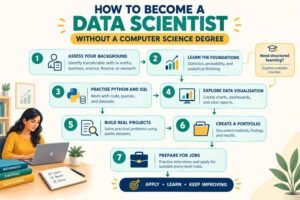
    A clear timeline can help you organise your learning without feeling that you must master every skill immediately. The following roadmap is designed for someone starting with limited technical experience and studying alongside other responsibilities. Flowchart showing the steps to become a data scientist without a computer science degree, from assessing existing skills to learning tools, building projects, and applying for jobs.
    Timeline Learning focus Practical milestone
    Months 1–2 Spreadsheets, statistics, and analytical thinking Complete a basic data analysis
    Months 3–4 Python fundamentals and SQL Clean a dataset and retrieve useful information
    Months 5–6 Data visualisation and exploratory analysis Publish two documented projects
    Months 7–8 Introductory machine learning Build and evaluate a simple model
    Months 9–10 Portfolio improvement and feedback Refine projects and prepare a skills-based resume
    Months 11–12 Interview preparation and job applications Apply for suitable roles and practise technical interviews
    This is a suggested schedule, not a guarantee of employment. Your progress will depend on your prior knowledge, available study time, project complexity, and the requirements of your target positions. To make the plan manageable, set a weekly study goal and review your progress at the end of each month. Ask yourself: Can I explain what I learned? Can I apply it without copying every step? Can I show someone a project that demonstrates the skill? If the answer is no, spend more time practising before moving to the next topic. A solid understanding of the fundamentals is more valuable than rushing through an advanced syllabus.

    How Can You Choose the Right Education Path?

    The best educational route depends on what you already have and what you want to achieve. If you have a relevant bachelor’s degree, you may be able to start with focused training in Python, statistics, and machine learning. If you need an additional academic qualification, compare eligible degree programmes and examine their curriculum carefully. Learners researching a correspondence college in India should consider more than convenience. Check programme recognition, admission criteria, examination arrangements, learning support, and the actual subjects taught. Likewise, those exploring distance education in Bangalore should compare options according to their career plans rather than selecting a programme solely because it is available in a preferred location. For prospective students considering correspondence degree colleges in Bangalore, it is useful to verify the specific university and programme approval for the relevant academic session. A college’s association with an institution should not be treated as proof that every programme it advertises is appropriate for every learner. The same care applies when researching a B.Sc correspondence college in Karnataka. Check the subject offered, eligibility criteria, and whether the curriculum provides the mathematical or technical foundation you need. Choose education that supports your goal, and combine it with practical work that demonstrates your abilities. A degree, certificate, or course can support your learning, but none should be treated as an automatic guarantee of a Data Scientist job. If you would like to understand the wider role of flexible education in career development, our earlier guide, What Is a Digital Librarian in 2026? A Complete Guide, offers another example of how to explore a career through its responsibilities, skills, and educational pathways.

    Conclusion

    Becoming a Data Scientist without a Computer Science degree is possible, but the journey requires a combination of relevant skills, practical experience, and realistic career planning. Start by understanding your existing strengths. Learn statistics, Python, SQL, and data visualisation in a logical order. Build projects using suitable datasets, document your findings, and practise explaining your results clearly. If you need further academic preparation, compare available qualifications and learning formats according to your eligibility and career goals. For learners considering flexible education, the Indian College of Correspondence is a starting point for exploring available programmes and education options. Review the curriculum and applicable recognition requirements before making an admission decision. Remember, you do not need to learn everything at once. Begin with one skill, apply it to a practical problem, and gradually build towards more advanced work. Ready to take the next step? Explore your education options, create a learning plan, and start building the skills that move you closer to your career goal.

    Frequently Asked Questions (FAQs)

    1. Can I become a Data Scientist without a computer science degree?

    Yes. You can work towards this career by learning programming, statistics, SQL, and machine learning and by building a portfolio of practical projects. However, some employers require specific degrees or subject backgrounds, so check job eligibility before applying.

    2. Can a B.Com graduate become a Data Scientist?

    Yes. A commerce graduate can build on existing knowledge of finance, accounting, and business operations by learning Python, SQL, statistics, and data visualisation. Practical projects can help demonstrate these skills to potential employers.

    3. Is coding compulsory for data science?

    Programming is an important part of many Data Scientist roles. Python is a useful starting point, while SQL helps you retrieve information from databases. You can begin with simple exercises and gradually develop your programming skills.

    4. Is mathematics difficult for beginners in data science?

    It depends on your existing knowledge. Start with basic statistics, probability, percentages, and averages. As you progress, develop the mathematical understanding needed for more advanced analytical methods and machine learning.

    5. Can IT Distance Education help me enter data science?

    It may help you pursue further education flexibly, depending on the programme. However, check whether the syllabus covers relevant technical subjects. You may need additional training and practical projects to develop data science skills.

    6. Which tools should a beginner learn first?

    Start with spreadsheets, Python, and SQL. Then learn data visualisation and introductory machine learning. This order gives you a foundation in data handling before you move into predictive modelling.

    7. How long does it take to become a Data Scientist?

    There is no fixed timeline. Depending on your background, study schedule, and target role, developing foundational skills and a portfolio may take several months or longer. Job readiness also depends on practical experience and employer requirements.

    8. Can I become a Data Scientist through correspondence education?

    Correspondence education may support your academic development, provided the programme is appropriate for your goals and meets the relevant recognition requirements. You should also practise programming, statistics, and data analysis independently.

    9. Which projects should beginners include in a data science portfolio?

    Start with projects such as sales analysis, customer behaviour exploration, public dataset analysis, and introductory prediction models. Explain the problem, data source, methods, results, and limitations of each project.

    10. What jobs can I apply for before becoming a Data Scientist?

    Depending on your qualifications and skills, you could consider data analyst, reporting analyst, business intelligence analyst, or junior analytics positions. These can be useful options while you continue developing towards more specialised data science roles.

    Ready to Take the Next Step Towards Your Career in Data Science?

    Your current degree doesn’t have to define your future. With the right education, practical skills, and a clear learning path, you can work towards a career in data science. Indian College of Correspondence can help you explore flexible education options that fit your academic background and career goals. Explore your options today and take the first step towards your future.

Leave A Comment