
Admission opens for 2026-27 sessions for all university.

Blog Detail

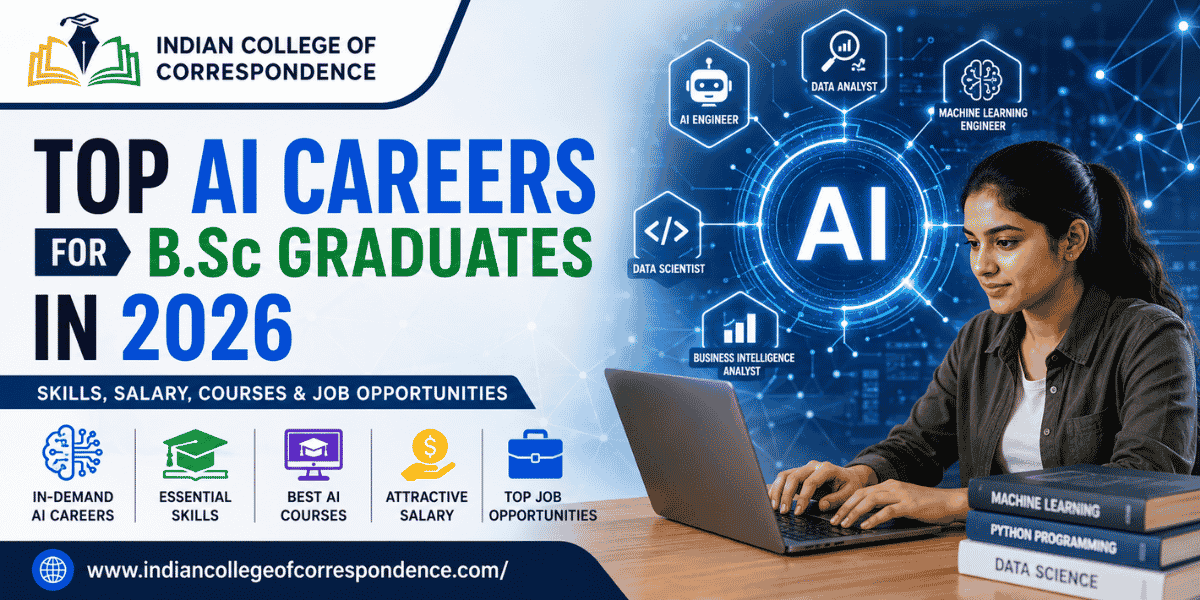
  • Top AI Careers for B.Sc Graduates in 2026: Skills, Salary, Courses & Job Opportunities

    • 03,Aug 2026
    • Posted By : opsadsthrivein@gmail.com opsadsthrivein@gmail.com
    • 0 Comments
    • B.Sc correspondence college in Karnataka
    • distance Msc degree college in bangalore
    • Science distance education in Bangalore
    The demand for Artificial Intelligence professionals is growing across almost every industry, making this the perfect time for science graduates to explore exciting career opportunities. This guide on AI Careers for B.Sc Graduates will help you understand the best AI job roles, required skills, salary expectations, professional courses, and future career scope in 2026. Whether you have completed a B.Sc in Computer Science, Mathematics, Physics, Statistics, Biotechnology, or another science discipline, AI Careers for B.Sc Graduates are becoming increasingly accessible through practical learning, certifications, and real-world projects. With continuous innovation in Artificial Intelligence, now is the ideal time to prepare for a rewarding and future-ready profession.

    Why AI Is a Great Career Choice for B.Sc Graduates?

    Artificial Intelligence is no longer limited to software engineers or computer science professionals. Companies today actively recruit graduates with strong analytical thinking, mathematical abilities, research skills, and scientific knowledge to work on AI-powered solutions. This is why AI Careers for B.Sc Graduates have become one of the fastest-growing career options worldwide. Industries such as healthcare, finance, education, manufacturing, agriculture, e-commerce, pharmaceuticals, and cybersecurity are investing heavily in Artificial Intelligence to improve productivity and automate complex processes. As a result, employers are searching for graduates who can analyze data, solve problems, and develop intelligent systems. Unlike traditional career paths, AI offers opportunities across multiple domains, allowing science graduates to combine their academic background with modern technology. Students pursuing Science distance education in Bangalore can also prepare for AI careers by learning programming, data analysis, Machine Learning, and cloud technologies while continuing their academic studies.

    Why Science Graduates Have an Advantage in AI?

    Many students believe only engineering graduates can build successful AI careers, but that is no longer true. Science graduates possess several strengths that employers highly value. These include:
    • Strong mathematical foundation
    • Statistical reasoning
    • Logical problem-solving
    • Research methodology
    • Data interpretation
    • Scientific thinking
    For example:
    • Mathematics graduates perform well in Machine Learning.
    • Statistics graduates excel in Data Science.
    • Physics graduates understand mathematical modelling.
    • Biotechnology graduates contribute to Healthcare AI.
    • Computer Science graduates transition naturally into AI development.
    This unique combination makes AI Careers for B.Sc Graduates highly rewarding. Students graduating from a B.Sc correspondence college in Karnataka can further strengthen their profiles through AI certifications, internships, and practical project experience that demonstrate real-world technical capabilities.

    Industries Hiring AI Professionals

    Artificial Intelligence is transforming nearly every sector. Some of the fastest-growing industries include:
    • Healthcare
    • Banking
    • Financial Services
    • Retail
    • Manufacturing
    • Agriculture
    • Pharmaceuticals
    • Cybersecurity
    • Education
    • Logistics
    • Automobile
    • Government Organizations
    These industries require professionals capable of developing intelligent systems, analyzing large datasets, automating business operations, and improving decision-making through AI. This AI Careers for B.Sc Graduates guide recommends developing practical skills because employers increasingly value hands-on expertise over theoretical knowledge alone.

    What are the most in-demand artificial intelligence roles?

    Artificial Intelligence offers diverse career opportunities for science graduates. Instead of limiting yourself to one specialization, you can choose a role based on your interests and technical strengths. Below are some of the highest-demand AI careers in 2026.

    1. Data Scientist

    Data Scientists collect, clean, analyze, and interpret large datasets to help organizations make informed decisions. Required skills:
    • Python
    • SQL
    • Statistics
    • Machine Learning
    • Data Visualization

    2. Machine Learning Engineer

    Machine Learning Engineers build intelligent models that learn from data and improve performance over time. Responsibilities include:
    • Model Development
    • Training Algorithms
    • Feature Engineering
    • Model Deployment

    3. AI Research Assistant

    Research Assistants contribute to developing new AI algorithms, conducting experiments, and improving existing technologies. This role is ideal for graduates interested in higher studies and innovation.

    4. Data Analyst

    Data Analysts help organizations understand business performance using data. Skills include:
    • Excel
    • SQL
    • Power BI
    • Python
    Many science graduates begin their AI journey as Data Analysts before progressing into Machine Learning roles.

    5. AI Consultant

    AI Consultants help businesses identify opportunities for Artificial Intelligence implementation. Responsibilities include:
    • Business Analysis
    • AI Strategy
    • Automation Solutions
    • Digital Transformation
    Excellent communication and analytical skills are essential.

    6. Computer Vision Engineer

    Computer Vision Engineers develop systems capable of understanding images and videos. Applications include:
    • Facial Recognition
    • Medical Imaging
    • Autonomous Vehicles
    • Security Systems
    This role continues to experience strong demand across healthcare and automotive industries.

    Top AI Career Options After B.Sc

    AI Career Required Skills Average Salary
    Data Scientist Python, Statistics, ML ₹8–18 LPA
    Machine Learning Engineer Python, TensorFlow ₹10–20 LPA
    Data Analyst SQL, Excel, Power BI ₹5–10 LPA
    AI Research Assistant Mathematics, AI ₹6–12 LPA
    Computer Vision Engineer Deep Learning, OpenCV ₹10–22 LPA
    AI Consultant Analytics, AI Strategy ₹8–20 LPA

    Why AI Careers Continue to Grow?

    Several global trends are driving demand for AI professionals. These include:
    • Generative AI
    • Cloud Computing
    • Big Data
    • Robotics
    • Automation
    • Healthcare AI
    • Financial Technology
    • Smart Manufacturing
    • Cybersecurity
    • Autonomous Systems
    This rapid transformation means AI Careers for B.Sc Graduates will continue expanding over the coming years, offering excellent job security and attractive salary growth for skilled professionals. Students interested in building long-term careers can also combine academic qualifications with IT distance education certifications, helping them gain additional technical knowledge while improving employability in competitive AI job markets.

    Skills Every B.Sc Graduate Should Learn for AI

    A successful AI career requires more than just a science degree. Employers look for candidates who can solve real-world problems using programming, mathematics, and data-driven decision-making. This AI Careers for B.Sc Graduates guide recommends building both technical and practical skills to stay competitive in the rapidly evolving job market. Here are the most valuable skills every aspiring AI professional should develop.

    1. Python Programming

    Python is the most widely used programming language in Artificial Intelligence because of its simplicity and extensive libraries. Learn libraries such as:
    • NumPy
    • Pandas
    • Scikit-learn
    • TensorFlow
    • PyTorch
    Strong Python skills open doors to careers in Machine Learning, Data Science, and AI development.

    2. Mathematics and Statistics

    Artificial Intelligence relies heavily on mathematics. Important topics include:
    • Probability
    • Linear Algebra
    • Calculus
    • Statistics
    A strong mathematical foundation makes learning AI algorithms much easier.

    3. SQL and Database Management

    AI professionals constantly work with large datasets. Learning SQL helps you:
    • Retrieve data
    • Clean datasets
    • Analyze information
    • Build reports
    SQL remains one of the most requested skills across AI-related job roles.

    4. Machine Learning Fundamentals

    Understanding Machine Learning concepts is essential. Learn topics such as:
    • Supervised Learning
    • Unsupervised Learning
    • Regression
    • Classification
    • Clustering
    • Model Evaluation
    These concepts form the foundation of modern AI systems.

    5. Data Visualization

    Communicating insights is just as important as building AI models. Popular tools include:
    • Power BI
    • Tableau
    • Matplotlib
    • Seaborn
    These tools help professionals present complex information in a simple and understandable format.

    6. Cloud Computing

    Many AI applications are now deployed on cloud platforms. Popular platforms include:
    • Microsoft Azure
    • AWS
    • Google Cloud Platform
    Cloud knowledge improves employability for AI professionals. Students pursuing distance education in Bangalore can enhance their learning by combining flexible academic programs with cloud certifications and AI-focused online training.

    How to start a career in AI without a degree?

    Many students believe that a formal computer science degree is mandatory for entering Artificial Intelligence. However, today’s technology industry values practical skills, certifications, and project experience just as much as academic qualifications. This AI Careers for B.Sc Graduates guide explains that anyone with dedication and consistent learning can build an AI career by following a structured roadmap.

    Step 1: Learn Programming

    Start with Python because it is the foundation of most AI applications. Practice coding every day by solving problems on coding platforms and building small projects.

    Step 2: Learn Data Analysis

    Understanding data is crucial for Artificial Intelligence. Focus on:
    • Excel
    • SQL
    • Python Libraries
    • Data Cleaning

    Step 3: Study Machine Learning

    Begin with beginner-friendly courses that explain:
    • Algorithms
    • Model Training
    • Prediction
    • Data Processing
    Avoid rushing into advanced concepts before mastering the basics.

    Step 4: Build AI Projects

    Employers value practical work. Some beginner projects include:
    • Chatbots
    • Movie Recommendation Systems
    • Spam Email Detection
    • Image Classification
    • Sentiment Analysis
    These projects demonstrate your ability to apply theoretical knowledge.

    Step 5: Earn Professional Certifications

    Industry-recognized certifications improve credibility. Popular choices include:
    • Google AI Essentials
    • IBM AI Engineering
    • Microsoft Azure AI Engineer
    • AWS Machine Learning
    • DeepLearning.AI
    Students planning higher education through a distance Msc degree college in Bangalore can combine postgraduate studies with these certifications to build stronger AI portfolios.

    Step 6: Create an Online Portfolio

    Build a GitHub profile showcasing:
    • AI Projects
    • Python Programs
    • Research Work
    • Documentation
    A professional portfolio often impresses recruiters more than academic marks alone.

    Best AI Courses After B.Sc

    Choosing the right course is one of the most important decisions for building a successful AI career. This AI Careers for B.Sc Graduates guide recommends selecting courses that combine theoretical concepts with practical implementation. Popular AI courses include:
    • Google AI Essentials
    • IBM AI Engineering Professional Certificate
    • Microsoft Azure AI Engineer
    • AWS Machine Learning Specialty
    • TensorFlow Developer Certification
    • DeepLearning.AI Machine Learning Specialization
    • Data Science Bootcamps
    • M.Sc Artificial Intelligence Programs
    Graduates from a B.Sc correspondence college in Karnataka can further strengthen their careers by pursuing these globally recognized certifications while continuing their higher education.

    AI Salary After B.Sc

    Artificial Intelligence professionals enjoy excellent salary growth due to increasing industry demand. Fresh graduates typically receive competitive packages, while experienced professionals earn significantly higher salaries based on expertise. Several factors influence salary, including:
    • Technical Skills
    • Certifications
    • Practical Projects
    • Internship Experience
    • Industry
    • Location
    Professionals specializing in Generative AI, Machine Learning, Computer Vision, and Cloud AI generally command the highest salaries.

    AI Skills vs Career Opportunities

    AI Skill Career Opportunity
    Python AI Developer
    SQL Data Analyst
    Machine Learning ML Engineer
    Deep Learning AI Engineer
    Data Visualization Business Intelligence Analyst
    Cloud Computing Cloud AI Specialist
    As AI adoption continues to grow, professionals with the right combination of technical knowledge, certifications, and practical experience will enjoy outstanding career opportunities. Whether you pursue formal education or focus on skill-based learning, consistent upskilling is the key to long-term success in Artificial Intelligence.

    Future Scope of AI Careers for B.Sc Graduates

    Artificial Intelligence is expected to become one of the largest employment sectors over the next decade. Organizations across healthcare, finance, education, agriculture, manufacturing, retail, biotechnology, cybersecurity, and government services are investing heavily in AI-powered technologies. As automation and intelligent systems become a part of daily business operations, the demand for skilled professionals will continue to rise. This AI Careers for B.Sc Graduates guide highlights that science graduates possess strong analytical and research abilities, making them excellent candidates for AI roles. Whether your specialization is Mathematics, Statistics, Physics, Computer Science, Biotechnology, or Life Sciences, there are growing opportunities to contribute to AI innovation. Future AI job roles include:
    • AI Engineer
    • Data Scientist
    • Machine Learning Engineer
    • AI Research Associate
    • Computer Vision Engineer
    • NLP Engineer
    • AI Product Manager
    • AI Consultant
    • Robotics Engineer
    • Generative AI Specialist
    With continuous learning and industry-recognized certifications, AI Careers for B.Sc Graduates offer excellent salary growth, international opportunities, and long-term job security.

    Common Mistakes B.Sc Graduates Should Avoid

    Many graduates delay their AI journey because of common misconceptions or poor learning strategies. Avoiding these mistakes can accelerate your career growth.

    1. Waiting to Learn Programming

    Python is one of the core skills in Artificial Intelligence. Delaying programming practice slows your overall progress.

    2. Ignoring Practical Projects

    Recruiters prefer candidates with GitHub repositories and real-world AI projects over resumes filled only with certifications.

    3. Learning Too Many Tools at Once

    Focus on mastering one technology before moving to another. Build a strong foundation in Python, SQL, and Machine Learning first.

    4. Skipping Mathematics

    AI algorithms rely on mathematics and statistics. Strengthening these concepts improves problem-solving skills.

    5. Not Building a Portfolio

    A portfolio demonstrates your practical abilities and often becomes the deciding factor during interviews.

    6. Ignoring Communication Skills

    AI professionals frequently collaborate with business teams, making communication and presentation skills equally important. Following a structured learning approach helps students build successful AI Careers for B.Sc Graduates without feeling overwhelmed.

    How ICC Helps Science Students Build AI Careers?

    Building a successful AI career requires the right academic foundation along with continuous skill development. ICC supports students by offering flexible learning opportunities that help them balance education with professional growth. Whether you are looking for Science distance education in Bangalore, planning higher studies through a distance Msc degree college in Bangalore, or searching for a trusted correspondence institution, ICC provides guidance that supports long-term academic and career goals. Students can combine their degree programs with AI certifications, internships, coding practice, and project-based learning to become industry-ready professionals. ICC encourages learners to embrace emerging technologies responsibly while strengthening both technical and practical skills. For students interested in upgrading their qualifications through distance education in Bangalore, ICC offers flexible pathways that make higher education more accessible while supporting career advancement in future-ready industries.

    Conclusion

    Artificial Intelligence is no longer limited to engineering graduates. Science students now have incredible opportunities to build successful careers by combining their academic knowledge with programming, Machine Learning, data analysis, and AI certifications. This AI Careers for B.Sc Graduates guide has covered the best AI job roles, essential skills, professional courses, salary expectations, and future opportunities available in 2026. By focusing on continuous learning, building practical projects, and earning recognized certifications, graduates can confidently compete in the growing AI job market. The future belongs to professionals who are willing to learn, adapt, and innovate. Start preparing today, and AI Careers for B.Sc Graduates can become a rewarding and future-proof career path.
    Start Your AI Career Journey with ICC
    Artificial Intelligence is creating exciting opportunities for science graduates across healthcare, finance, education, manufacturing, research, and technology. If you want to build a rewarding future in one of the world’s fastest-growing industries, now is the best time to begin. Indian College of Correspondence helps students combine quality education with industry-focused learning so they can confidently prepare for AI careers. Explore flexible science programs, strengthen your technical skills, and continue your higher education while building practical experience. Contact ICC today and take the first step toward a successful career in Artificial Intelligence.

    FAQs

    1. Can B.Sc graduates build successful AI careers?

    Yes. AI Careers for B.Sc Graduates are expanding rapidly as organizations seek professionals with strong analytical thinking, mathematical knowledge, and problem-solving abilities. Graduates from Computer Science, Mathematics, Statistics, Physics, Biotechnology, and Life Sciences can successfully transition into Artificial Intelligence by learning Python, Machine Learning, SQL, Data Analysis, and Cloud Computing. Employers increasingly value practical skills alongside academic qualifications, making GitHub portfolios, AI certifications, and real-world projects essential for career growth. Students pursuing a B.Sc correspondence college in Karnataka can further strengthen their employability by combining flexible education with internships, industry-recognized certifications, and hands-on AI project experience.

    2. Which AI course is best after B.Sc?

    The ideal AI course depends on your career goals and technical interests. Popular certifications include Google AI Essentials, IBM AI Engineering Professional Certificate, Microsoft Azure AI Engineer, AWS Machine Learning Specialty, TensorFlow Developer Certification, and DeepLearning.AI Machine Learning Specialization. These programs provide practical training in Python, Machine Learning, Deep Learning, Data Science, and AI model deployment. Courses that include real-world projects and industry-recognized certifications offer the greatest value. Students planning higher studies through a distance Msc degree college in Bangalore can combine postgraduate education with professional AI certifications to build advanced technical expertise and improve long-term career opportunities.

    3. What is the average AI salary after B.Sc?

    Artificial Intelligence professionals enjoy attractive salary packages due to increasing demand across industries. Fresh graduates typically earn between ₹6–10 LPA, while professionals with two to five years of experience often receive ₹10–18 LPA or more. Specialists in Generative AI, Computer Vision, Machine Learning, Natural Language Processing, and Cloud AI frequently earn even higher compensation. Salary depends on technical skills, certifications, practical projects, internships, and employer requirements. Graduates who consistently improve their AI expertise, build strong portfolios, and gain industry experience significantly enhance their earning potential and long-term career growth in the AI sector.

    4. Is Python mandatory for AI careers?

    Yes. Python is widely regarded as the most important programming language for Artificial Intelligence because it supports powerful libraries such as NumPy, Pandas, TensorFlow, PyTorch, and Scikit-learn. Most AI applications—including Machine Learning, automation, predictive analytics, and Deep Learning—are developed using Python. Strong programming skills help students build practical AI projects, solve complex problems, and improve employability. Developing expertise in Python is one of the most important steps toward building successful AI Careers for B.Sc Graduates. Regular coding practice, online challenges, and project development help learners gain confidence and become industry-ready professionals.

    5. Which industries hire AI professionals after B.Sc?

    Artificial Intelligence professionals are employed across diverse industries, including healthcare, banking, education, manufacturing, agriculture, pharmaceuticals, logistics, cybersecurity, e-commerce, consulting, and information technology. Organizations use AI for automation, predictive analytics, customer service, fraud detection, research, and intelligent decision-making. As digital transformation accelerates, demand for AI talent continues to rise worldwide. Students who enhance their programming, Machine Learning, and data analysis skills through IT distance education alongside professional certifications can improve their chances of securing rewarding positions in leading multinational companies, startups, research organizations, and technology-driven enterprises.

    6. Can distance education students build AI careers?

    Absolutely. Modern employers focus primarily on practical skills, technical knowledge, certifications, portfolios, and problem-solving abilities rather than the mode of education. Students pursuing distance education in Bangalore can successfully prepare for AI careers by learning Python, SQL, Machine Learning, Cloud Computing, and Artificial Intelligence tools while completing their degree programs. Participating in internships, contributing to open-source projects, building GitHub portfolios, and earning globally recognized certifications significantly improve employability. With consistent learning and practical experience, distance education students can compete confidently with regular graduates and build successful careers in Artificial Intelligence.

    7. Are AI projects important for getting hired?

    Yes. Practical AI projects are among the most valuable assets on a resume because they demonstrate your ability to apply theoretical knowledge to real-world challenges. Recruiters frequently review GitHub portfolios to assess coding quality, creativity, and technical skills before scheduling interviews. Beginner projects such as AI chatbots, recommendation systems, image recognition models, sentiment analysis applications, and predictive analytics dashboards help showcase practical expertise. Students who continuously build and improve AI projects develop stronger problem-solving abilities, gain confidence during technical interviews, and significantly increase their chances of securing entry-level and advanced AI positions.

    8. Is Artificial Intelligence a good career in 2026?

    Yes. Artificial Intelligence remains one of the fastest-growing career fields globally due to rapid adoption across healthcare, finance, education, manufacturing, agriculture, retail, logistics, and government sectors. Businesses continue investing in automation, Generative AI, robotics, intelligent software, and data-driven decision-making, creating strong demand for AI Engineers, Machine Learning Engineers, Data Scientists, and AI Consultants. Graduates who continuously upgrade their technical skills, complete professional certifications, and develop practical AI solutions can expect excellent salary growth, international career opportunities, and long-term job security. Building AI Careers for B.Sc Graduates is an excellent choice for students seeking a future-proof profession.

Leave A Comment