Admission opens for 2026-27 sessions for all university.

Blog Detail

  • B.Lib.Sc Courses in India 2026: Eligibility, Syllabus, Admission & Career Scope

    • 10,Sep 2026
    • Posted By : opsadsthrivein@gmail.com opsadsthrivein@gmail.com
    • 0 Comments
    • B.Sc correspondence college in Karnataka
    • correspondence degree colleges in bangalore
    • Science distance education in Bangalore
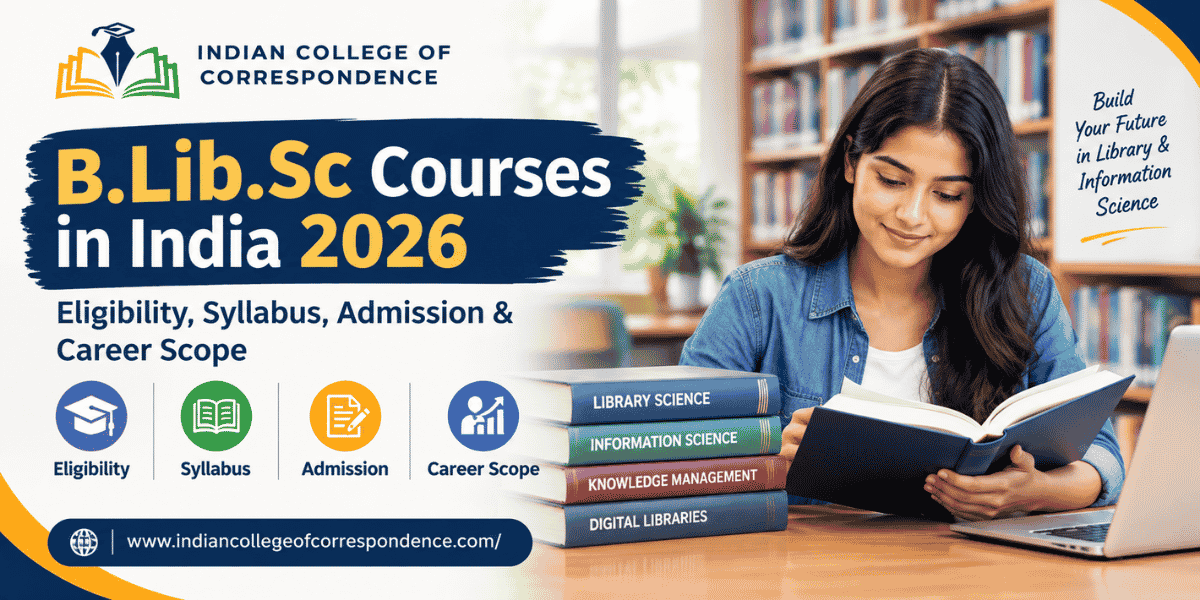
    Choosing a course after graduation is not always about following the most popular career path. Sometimes, students are more interested in information, research, books, organisation and knowledge management. That is where B.Lib.Sc Courses in India can offer an interesting professional direction. In 2026, libraries are no longer limited to shelves and printed books. They increasingly work with digital resources, databases, e-books, cataloguing systems and information management tools. For students exploring B.Lib.Sc Courses in India, the real question is not simply what the course teaches. It is also about eligibility, syllabus, admission options, practical learning, career opportunities and whether the field matches their long-term goals. This guide explains these areas in simple language so that you can understand what to expect before choosing a programme.

    What Makes B.Lib.Sc Relevant in 2026?

    A modern library is much more than a quiet place filled with books. Educational institutions, research centres, companies and public organisations need professionals who can organise, preserve and provide access to information. This changing environment is one reason B.Lib.Sc Courses in India continue to attract learners interested in library and information services. Students may learn about:
    • Library organisation and administration
    • Classification and cataloguing
    • Information sources and services
    • Digital library resources
    • Library automation
    • Information retrieval
    • Documentation
    • Research support
    • Basic information technology applications
    The curriculum in several universities combines theoretical learning with practical work, projects and internships. So, B.Lib.Sc Courses in India can be relevant for students who enjoy organised work but also want exposure to technology and information systems.

    B.Lib.Sc Course at a Glance

    Before going into eligibility and syllabus, it helps to understand the basic structure of B.Lib.Sc Courses in India.

    Table Block 1: Quick Course Overview

    Particular Details
    Course Name Bachelor of Library Science
    Common Alternative B.Lib.I.Sc / B.L.I.Sc
    Duration Commonly 1 year, depending on university
    Learning Areas Library Science, Information Management, Technology
    Admission Merit or entrance-based, depending on institution
    Practical Learning Classification, cataloguing, projects, internship
    Career Areas Libraries, information centres, documentation and research
    Higher Study M.Lib.I.Sc and related advanced programmes
    Many graduate-entry B.Lib.I.Sc programmes are structured as one-year or two-semester courses, although programme structures can vary.

    Who Can Apply for B.Lib.Sc in 2026?

    One of the very first questions that students ask about B. Lib.Sc Courses in India is whether they are eligible. The answer to this question will depend on the university. Many of the B.Lib.I.Sc programmes require candidates to have completed a bachelor’s degree from a recognised university. For instance, Himachal Pradesh University lists a bachelor’s degree in any stream with 50% marks as their general eligibility requirement, with relaxation for specified categories. Delhi University’s programme have their own subject specific eligibility requirements. Therefore the students must not always expect the same rules to be applied by every institution.

    Common eligibility considerations include:

    • Graduation from a recognized university
    • Minimum qualifying marks as prescribed by the university
    • Relaxation of the qualifying percentage in certain categories, if any
    • Specific additional eligibility criteria as prescribed by the universities
    • Eligibility criteria for B. Lib. Sc varies from one university to another or different variations of the course.
    It is best to check eligibility on the official websites of the desired universities before applying. This is because, in certain sites, eligibility has been described for different variations of the same course

    Is B.Lib.Sc Only for Students Who Love Books?

    Not necessarily. A genuine interest in books can be an advantage, but B.Lib.Sc Courses in India are also suitable for people with keen organisational skills, a passion for research, working with databases and helping people find the information they need. The profession has moved on from just managing books. A student who is happy using computers and is willing to upskill in digital information systems can learn transferable skills that are valuable in modern libraries and information centres. Thus, making the occupation more appealing than the average library job.

    What Do You Study in a B.Lib.Sc Programme?

    The B.Lib.Sc syllabus generally introduces students to the foundations of library and information science and then develops practical skills. Depending on the university, subjects may include:

    Library and Information Foundations

    Students learn about the purpose, development and social role of libraries and information centres.

    Classification

    Classification teaches students how information resources can be organised systematically so users can find them more easily.

    Cataloguing

    Cataloguing focuses on creating organised records for books and other information resources.

    Information Sources and Services

    Students understand different information sources and learn how reference and information services support users.

    Library Management

    This area introduces administration, planning, organisation and management of library resources and services.

    Information Technology

    Modern programmes may introduce students to technology applications used in library environments.

    Practical Work

    Practical components can include classification exercises, cataloguing, technology applications, projects and internships. For example, Delhi University’s current B.L.I.Sc curriculum includes library classification, cataloguing and information technology applications. The exact B.Lib.Sc syllabus should therefore be checked university by university rather than copied from a generic list.

    How Technology Is Changing Library Science?

    This is one of the most important highlights of B. Lib. Sc Courses in India 2026. The libraries have started to manage both tangible and intangible information. The candidates have an option of exploring:
    • Digital libraries
    • E-books
    • Online journals
    • Research data
    • Library automation
    • Digital catalogues
    • Information retrieval systems
    • Electronic records
    • Metadata and documentation
    The experts at Mahatma Gandhi University explain the B.Lib.Sc course is designed in such a way that it prepares the aspiring candidates to work in an organization that manages physical and electronic resources for its smooth functioning. Therefore, it is understood that the future libraries are not merely about preserving books but also making them accessible and organized. Consequently, it is essential for the students who are interested in making a career in this particular field to get a clear perspective of the technological aspect associated with B.Lib.Sc Courses in India.

    How Does B.Lib.Sc Admission Work?

    The admission process of B. Lib. Sc Courses in India can vary from university to university. While some universities may take into consideration the qualifying examination marks, others may have an entrance examination or any other preferred method of selection. For instance, Himachal Pradesh University declares that Admission to its B. Lib. I. Sc programme shall be on the basis of an entrance test whereas other universities may follow a different process. A student’s admission process may generally look like this: Verify eligibility criteria → Shortlist universities → Evaluate admission process → Apply → Give entrance exam (if applicable) → Merit/selection → Document verification → Pay fees Students are advised to have the below documents ready with them as most universities ask for these during their admission process:
    • Graduation marksheets
    • Graduation degree/provisional certificate
    • Official ID proof
    • Passport size photographs
    • Caste certificate (if applicable)
    • Migration/transfer certificate (if applicable)
    Depending on the university, the list of documents may vary.

    How to Select the Right B.Lib.Sc College?

    Finding B.Lib.Sc colleges in India is simple but finding the best college for you may be a bit challenging. Instead of choosing a college only on the basis of low fees, compare all the following points and select the one which offers you the best deal. Compare the following:
    • University recognition
    • Curriculum
    • Practical training
    • Internship opportunities
    • Digital library exposure
    • Faculty
    • Learning resources
    • Programme flexibility
    • Admission process
    • Fee structure
    • Student support
    • Future studies options
    If students search for correspondence colleges in India they might also be interested in the flexibility of a distance programme so you should compare other similar colleges offering such courses. Students who are searching for a correspondence degree college in Bangalore should make sure to see if the course is available and if the university is recognized and provides all the necessary practical training. The course name should not be the only criterion when selecting a college.

    Can Science Students Choose Library Science?

    Yes, depending on the eligibility rules of the institution. Students from different academic backgrounds may be able to enter library and information science programmes when they satisfy the prescribed requirements. For example, someone researching Science distance education in Bangalore may be exploring flexible study options after completing a science-related qualification. However, the exact eligibility for B.Lib.Sc should still be checked separately rather than assuming that every distance programme has identical admission rules. Students interested in a B.Sc correspondence college in Karnataka should also distinguish between a B.Sc programme and a library science programme because they lead towards different academic and professional areas.

    Skills You Can Develop Through B.Lib.Sc

    A major advantage of B.Lib.Sc Courses in India is that the programme can develop a combination of academic, organisational and technical skills. Some important skills include:

    Information Organisation

    You learn how information resources can be arranged and retrieved efficiently.

    Attention to Detail

    Cataloguing, classification and documentation require accuracy.

    Digital Skills

    Technology applications can help students understand modern information environments.

    Research Ability

    Working with information sources can strengthen research and information-search skills.

    Communication

    Library professionals often help students, researchers and other users locate useful information.

    Administrative Skills

    Managing resources and services requires planning and organisation. These skills can remain useful even as libraries continue to adopt new technologies.

    Career Opportunities After B.Lib.Sc

    Career planning is naturally one of the biggest reasons students research B.Lib.Sc Courses in India. The traditional career option is becoming a librarian, but the broader information field offers other possibilities too. Depending on qualifications, experience and recruitment requirements, graduates may explore roles such as:
    • Librarian
    • Library Assistant
    • Information Assistant
    • Cataloguer
    • Documentation Assistant
    • Reference Assistant
    • Information-related support roles
    • Records and documentation roles
    Career opportunities can exist in:
    • Schools
    • Colleges
    • Universities
    • Public libraries
    • Research institutions
    • Government organisations
    • Private educational institutions
    • Archives
    • Information centres
    • Corporate knowledge environments
    Career requirements vary by employer, so completing the degree does not automatically guarantee eligibility for every librarian post.

    Government and Private Career Opportunities

    One reason B.Lib.Sc Courses in India remain attractive is the possibility of working across both public and private environments.

    Government and Public Sector

    Depending on the vacancy and required qualifications, opportunities may arise in:
    • Government libraries
    • Universities
    • Public institutions
    • Research organisations
    • Educational departments
    • Public information centres
    Government recruitment can involve specific examinations, eligibility conditions, experience requirements and reservation rules.

    Private Sector

    Private opportunities may include:
    • Schools
    • Colleges
    • Universities
    • Research organisations
    • Corporate libraries
    • Documentation departments
    • Information service environments
    The right career path depends on the graduate’s skills, qualifications and the requirements of individual vacancies.

    What After B.Lib.Sc?

    For students looking beyond their initial qualification, B. Lib. Sc Courses in India can also serve as a basis for future studies. A typical progression would be: Lib. Sc → M. Lib. I. Sc → Research / NET / PhD / Advanced information roles An M.Lib.I.Sc can provide a more in-depth understanding of library and information science, and may be a good choice for students aiming to pursue a high-level career path. When researching a distance Msc degree college in Bangalore it is important to realise that an M.Sc and M.Lib.I.Sc are different qualifications. An M.Sc tends to continue a specialism in a particular science, whilst M.Lib.I.Sc concentrates on library and information science. The choice between the two qualifications should be based on what previous qualification a student has gained, and what career they are looking to pursue.

    B.Lib.Sc Career Scope in 2026

    The B.Lib.Sc career scope is witnessing the impact of the information age. The libraries, universities, and research institutions have turned more reliant on electronic resources. As a result, there emerges a great need for experts who understand and manage the information organisation along with the technology. The future field of B.Lib.Sc includes:
    • Digital library service
    • Information management
    • Documentation
    • Research assistance
    • Digital preservation of information
    • Information retrieval
    • Knowledge organisation
    • Library automation
    This does not suggest that the traditional library services are going to fade away soon. A professional who knows traditional library skills along with digital and technological expertise shall have the maximum scope in the future. Hence, for a student looking for B. Lib.Sc courses in India, it is essential that they learn traditional library skills and bolster their skills in the digital and technical field.

    B.Lib.Sc vs Other Flexible Education Options

    Students usually consider various options for their education and evaluate them by comparing one to another. For instance, a student considering enrolling at a correspondence college in India may also be considering various fields of study such as science, management or technology. In the same way, learners searching for correspondence degree colleges in Bangalore may also be considering whether a certain degree will accommodate their other duties including work and family. The critical idea is to evaluate a course in terms of relevance to a career rather than the easiest mode of study. A library science qualification is valuable to the extent that it supports one’s interest and profession.

    Why Choose ICC for Your Education Journey?

    If you are looking for a flexible learning path, ICC can be taken into consideration while comparing the existing educational options. However, before enrolling, the students should go through the programme details, eligibility, learning mode and academic support along with the current admission information. The right institution should offer more than just the course title, providing clarity of the programme structure, helping to understand what they have committed to.

    Is B.Lib.Sc the Right Choice for You?

    You may want to pursue B.Lib.Sc Courses in India if you:
    • Have interest in organizing information
    • Have interest in research and reading
    • Are good with details and facts
    • Want to work in an educational field
    • Are interested in computerized information
    • Want to help people find information resources
    • Like to work with organized information.
    It could be a good choice if you like to work in an organized way. If you think that you would rather go into engineering, medicine, pure science, or software design than into any of these fields, you might want to think twice about going into this course. The most important thing is, that the best course for you, is the course that suits your needs and desires, and not because it is popular.

    Common Mistakes to Avoid Before Admission

    Before choosing B. Lib. Sc Courses in India, avoid these mistakes:
    1. Do not assume that all universities have the same eligibility rules
    2. Do not select a college just because it offers cheaper fees
    3. Avoid leaving out any practical training
    4. Make sure that the programme covers digital library concepts
    5. Avoid using old admission information
    6. Assume that every librarian vacancy requires the same qualifications
    7. Confusion between B. Lib. Sc and B. Lib. I. Sc. without cross-verifying the actual programme
    8. Choosing the course without considering future higher-study options
    Always cross-verify the latest university notification before applying.

    Why B.Lib.Sc Can Be a Practical Choice in 2026?

    The biggest strength of B.Lib.Sc Courses in India is that the field connects knowledge with organisation and technology. A library professional today may work with printed books, electronic resources, databases, digital catalogues and information systems. That combination gives students an opportunity to build a career around information rather than focusing only on physical library collections. If you enjoy structured work, research, information management and helping people access knowledge, B.Lib.Sc Courses in India can be worth considering as part of your 2026 education plan.

    Conclusion

    Selecting a professional course becomes easy when we know what happens after class room B. Lib. Sc Courses in India can provide the basic knowledge of library management, information organisation, cataloguing, classification and digital information services. The course also opens the opportunity to work in libraries, education, research, documentation and information related areas. At the same time students must remember that eligibility, admission procedures and career requirements vary between different universities and employers. For those who plan a career in this field, the best solution is to compare the institutions and develop digital skills and choose a program that will help them achieve their career goals. If you are considering flexible education options, then ICC can be considered along with other accredited institutions after comparing the current course details and admission requirements.

    Ready to Build Your Career in Library and Information Science?

    If you have an interest in information, research, organisation and modern digital resources, B.Lib.Sc Courses in India can be a practical academic route to explore in 2026. Take time to compare eligibility, syllabus, learning mode, practical exposure and future opportunities before making your final decision. Explore your education options with Indian College of Correspondence and choose a programme that aligns with your academic background and career goals.

    FAQs

    1. What are B.Lib.Sc Courses in India?

    B.Lib.Sc Courses in India are the courses related to library and information science. The students get to learn about topics such as classification, cataloguing, library management, information sources, digital resources and information services. The course’s duration and syllabus may vary from university to university.

    2. What is the eligibility for B.Lib.Sc?

    The eligibility for B.Lib.Sc depends on the university. Most graduate level courses demand you to have a bachelor degree from a recognized university, some may have specialized criteria. You need to check the latest admission notification for the desired university.

    3. What is the duration of B.Lib.Sc?

    Many graduate level B.Lib.I.Sc courses are of one year duration which are divided into two semesters. However, the duration of course may vary from university to university.

    4. What subjects are included in the B.Lib.Sc syllabus?

    The B.Lib.Sc syllabus includes subjects such as library and information science, classification, cataloguing, information sources and services, library management, information technology, practical work and project/internship (if any).

    5. What jobs can I get after B.Lib.Sc?

    Depending on the vacancies, you can apply for jobs such as a librarian, library assistant, information assistant, cataloguer, documentation specialist and many more.

Leave A Comment