Admission opens for 2026-27 sessions for all university.

Blog Detail

  • Business Analyst vs Data Analyst: Roles, Skills and Career Differences

    • 12,Oct 2026
    • Posted By : uaeautomates@gmail.com
    • 0 Comments
    • Business Analyst career
    • Business Analyst jobs in India
    • Business Analyst skills
    • Business Analyst vs Data Analyst
    • Business Analyst vs Data Analyst salary
    • Data Analyst career
    • Data Analyst jobs in India
    • Data Analyst skills
    • IT distance education
    • portfolio projects for beginners
    Imagine an online retailer in India noticing that its sales are falling even though website visitors are increasing. The management team wants to understand what is going wrong and how to improve performance. A Business Analyst may investigate the business process, speak with different teams, identify customer difficulties and document possible improvements. A Data Analyst may examine website activity, sales records and customer behaviour to discover patterns that explain the decline. Both professionals contribute to the same business objective, but they approach the problem differently. Understanding this distinction is important if you are considering either career. The Business Analyst vs Data Analyst comparison is particularly relevant to students and working professionals exploring analytical careers. Both roles involve problem-solving, communication and evidence-based decisions. However, their responsibilities, daily activities and technical requirements can vary. This guide explains what each professional does, which skills and tools are useful, what educational pathways you can consider and how to prepare for entry-level opportunities. It also explores how flexible learning, including IT distance education, may fit into a longer-term career plan.

    Who Is a Business Analyst?

    A Business Analyst helps an organisation understand its problems, identify requirements and determine how a process, product or service can be improved. The role often involves working between business stakeholders and technical teams. A stakeholder is anyone who has an interest in, or is affected by, a project. This might include customers, managers, employees, software developers or department heads. For example, a college wants to simplify its student admission process. Applicants complain about repeated document submissions, while administrative staff struggle to track applications. A Business Analyst may investigate the existing process, speak with applicants and staff, document the difficulties and recommend a better workflow.

    Main responsibilities of a Business Analyst

    Understanding business problems: The analyst investigates why a process is not working as expected instead of immediately recommending a solution. Gathering requirements: They ask stakeholders what they need from a proposed system or process. These requirements describe the expected features, outcomes or rules. Documenting information: They prepare requirement documents, process diagrams, meeting notes and user stories so that everyone understands what needs to change. Analysing processes: They examine how work currently happens, identify unnecessary steps and suggest improvements. Supporting implementation: They help stakeholders and technical teams clarify requirements, review proposed solutions and check whether the delivered outcome addresses the original need. Communicating across teams: They explain business expectations to technical colleagues and communicate technical constraints to non-technical stakeholders. A Business Analyst is not necessarily a software developer or a manager. The precise role depends on the organisation. Some Business Analysts work extensively with software projects, while others focus on operations, reporting, customer experience or process improvement.

    Who Is a Data Analyst?

    A Data Analyst works with data to answer questions, identify patterns and communicate findings that can support business decisions. Data may come from sales transactions, customer records, websites, surveys, inventory systems or other sources. However, collecting numbers is only one part of the job. The analyst must also check their accuracy, organise them appropriately and interpret what they reveal. Consider an educational institution that wants to understand why enquiries are increasing but admissions are not growing at the same rate. A Data Analyst could organise enquiry records, examine the number of applicants progressing through each admission stage, compare monthly patterns and prepare a dashboard showing where potential students are dropping out. A dashboard is a visual summary of important information, often using charts, tables and performance indicators.

    Main responsibilities of a Data Analyst

    Collecting and organising data: The analyst obtains relevant information from spreadsheets, databases or business systems. Cleaning data: They identify missing values, duplicate records, inconsistent formats and other errors that could affect the results. Analysing patterns: They compare categories, periods and performance measures to answer specific questions. Using databases: They may use SQL, a language for retrieving and manipulating information stored in relational databases. Creating reports and dashboards: They present findings in a format that managers and other stakeholders can understand. Explaining insights: They communicate what the data suggests, what limitations exist and what further investigation may be necessary. For instance, a sales dashboard might show that one product category performs better during particular months. The analyst should explain the observed pattern without automatically claiming that a specific factor caused it. Data Analysts need both technical and communication skills. An accurate chart is useful only when the audience understands what it means and how it relates to a business question.

    Business Analyst vs Data Analyst: Key Differences

    The main difference is the kind of problem each professional is primarily responsible for solving.
    Comparison area Business Analyst Data Analyst
    Main objective Understand business needs and improve processes or solutions Analyse data and communicate evidence-based findings
    Typical question What needs to change, and why? What does the data show, and what patterns can we identify?
    Daily work Meetings, requirements, process reviews and documentation Data preparation, queries, analysis, reporting and visualisation
    Stakeholder interaction Often substantial, depending on the project Important for understanding questions and explaining findings
    Data handling Uses data to understand and support business requirements Frequently works directly with datasets
    Technical skills Requirements tools, spreadsheets and process-mapping methods Spreadsheets, SQL, visualisation and potentially programming
    Common tools Excel, Jira, Confluence and diagramming tools Excel, SQL tools, Power BI, Tableau and potentially Python
    Typical documents Requirement specifications, process maps and user stories Reports, dashboards, analysis summaries and datasets
    Core strengths Listening, structured thinking and requirements analysis Data accuracy, quantitative reasoning and pattern recognition
    Educational background Business, commerce, IT, engineering and related fields IT, mathematics, statistics, commerce, business and related fields
    Beginner priority Understand business processes and practise documentation Build spreadsheet, data-cleaning and SQL fundamentals
    Possible progression Senior Business Analyst, Product Owner or Business Consultant Senior Data Analyst, BI Analyst or Analytics Lead
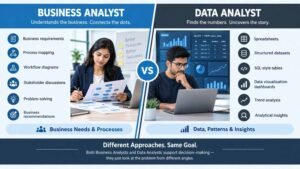
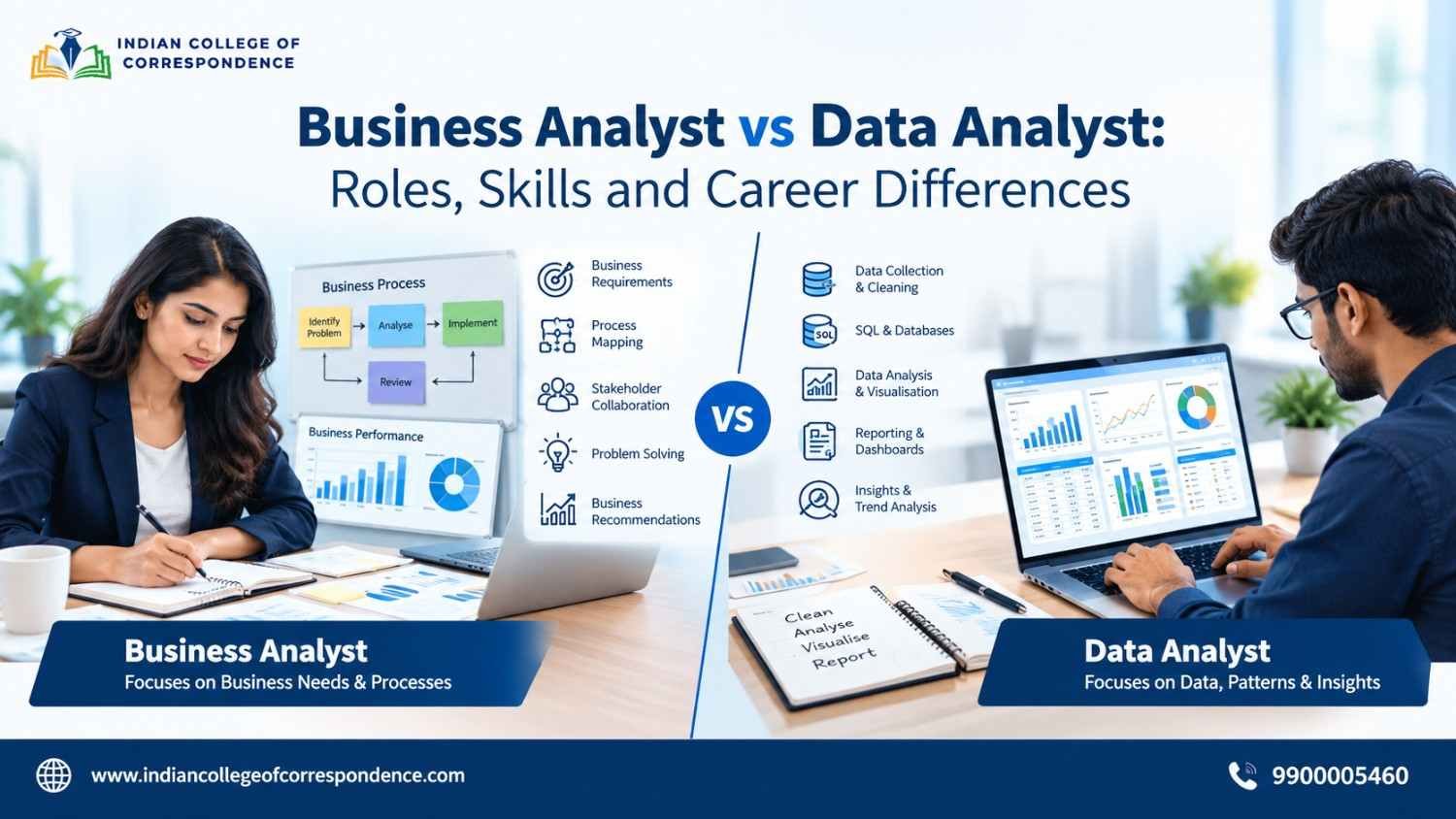
    These are common patterns rather than universal rules. Some Business Analysts write SQL queries or develop dashboards, while some Data Analysts spend considerable time gathering requirements and discussing business needs. Infographic comparing Business Analysts and Data Analysts, highlighting their key roles and skills. Business Analysts focus on business requirements, process mapping, workflow diagrams, stakeholder discussions, problem-solving, and business recommendations. Data Analysts work with spreadsheets, structured datasets, SQL tables, data visualization dashboards, trend analysis, and analytical insights. The image shows a woman reviewing business process diagrams and a man analyzing data dashboards on a computer, emphasizing how both roles support decision-making through different approaches. Job titles alone are not always enough to determine what a position involves. Read the responsibilities, required skills and expected deliverables in each job description.

    A Practical Example: How Both Roles Solve the Same Business Problem

    Consider a hypothetical Indian retail company that notices an increase in abandoned online shopping carts. Customers add products to their carts but leave before completing their purchases. The company wants to understand the problem and improve the shopping experience.

    What the Business Analyst investigates

    The Business Analyst begins by understanding how customers move through the purchase process. They might ask:
    • Are customers experiencing difficulties during checkout?
    • Are delivery charges displayed clearly?
    • Does the payment process involve unnecessary steps?
    • Have recent changes affected the customer experience?
    • What do the customer support and technology teams know about the issue?
    The analyst documents the current checkout process, collects feedback from relevant stakeholders and identifies requirements for possible improvements. Their deliverable might be a process map, a requirements document or a set of clearly defined improvements for the development team.

    What the Data Analyst investigates

    The Data Analyst examines available transaction and website data. They might ask:
    • At which checkout stage do users leave most frequently?
    • Does abandonment vary by device or payment method?
    • Are there differences between new and returning customers?
    • Did the pattern change after a particular website update?
    • Are the available records complete enough to support a reliable conclusion?
    The analyst cleans the data, calculates abandonment rates, compares relevant groups and presents the results in a report or dashboard. Their findings may help the team prioritise the stages that need further investigation.

    How their work complements each other

    The Data Analyst helps identify where the problem appears most pronounced. The Business Analyst investigates the underlying business process, gathers requirements and helps define a practical response. The development team may then implement a change, while both analysts help assess whether the proposed solution addresses the original issue. Neither professional automatically has the complete answer. Their findings must be interpreted carefully, and any proposed change should be evaluated using appropriate evidence. This example demonstrates why organisations may need both roles: one helps clarify business needs and improvements, while the other examines data to support decisions.

    Skills Required to Become a Business Analyst

    A Business Analyst needs to understand problems, organise information and communicate clearly. Beginners can develop these abilities through structured practice before moving on to specialised tools.

    Analytical thinking

    Analytical thinking means breaking a complicated problem into smaller questions. If admission processing takes too long, the analyst might examine document collection, verification, payment and approval separately.

    Problem-solving

    The ability to identify the actual cause of a problem matters more than immediately suggesting a solution. A delayed process, for example, may result from unclear responsibilities rather than a shortage of staff.

    Communication and active listening

    Business Analysts must understand what stakeholders mean, ask useful follow-up questions and confirm that their interpretation is correct. Active listening helps prevent misunderstandings.

    Requirement gathering and documentation

    A requirement should describe what is needed clearly enough for relevant teams to understand it. For an online booking system, requirements might specify the information users must enter, how booking confirmation should work and what happens when a slot is unavailable.

    Process analysis

    Process analysis involves examining the sequence of activities used to complete a task. A process map can reveal repeated approvals, unnecessary handovers or avoidable delays.

    Stakeholder management

    Different stakeholders may have conflicting priorities. A finance team might prioritise cost control, while customers may value speed and convenience. The analyst helps clarify these differences and document agreed requirements.

    Basic data interpretation

    Business Analysts should be comfortable reading spreadsheets, interpreting simple charts and understanding performance indicators. Advanced statistics are not necessary for every role, but evidence-based reasoning is valuable.

    Awareness of Agile methods

    Some technology teams use Agile approaches to organise work into smaller, iterative stages. Business Analysts working in these environments may help write user stories, clarify acceptance criteria and participate in project discussions. Beginners should prioritise communication, structured problem-solving, spreadsheets and documentation. Advanced modelling methods or specialised software can be learned when the target role requires them.

    Skills Required to Become a Data Analyst

    A Data Analyst needs to transform raw information into reliable, understandable findings. The exact technical requirements vary by employer, but several foundational skills are useful across many roles.

    Spreadsheet skills

    Excel or Google Sheets can help with sorting, filtering, formulas, pivot tables and basic summaries. A beginner might use a spreadsheet to compare monthly sales or identify duplicate customer records.

    SQL and database fundamentals

    SQL is used to retrieve and work with information stored in relational databases. A Data Analyst may use it to filter transactions, group sales by region or combine information from related tables. Learn basic queries first, followed by joins, aggregation and more advanced techniques when appropriate.

    Data cleaning

    Data cleaning involves checking information for missing values, duplicates, inconsistent categories and incorrect formats. A dataset containing multiple spellings of the same city, for example, may produce misleading summaries unless the entries are standardised appropriately.

    Descriptive statistics

    Descriptive statistics help summarise information. Common concepts include averages, medians, percentages, distributions and variation. An average alone may not explain a dataset fully. Comparing the median and the spread of values can sometimes provide a more useful picture.

    Data visualisation

    Data visualisation communicates findings through charts, graphs and dashboards. Beginners should learn to select a chart that matches the question rather than adding visual effects that obscure the message.

    Business understanding

    A technically correct calculation may still be irrelevant if it does not address the business question. Understanding sales, customer behaviour, inventory or operations helps analysts choose appropriate measures.

    Critical thinking and attention to detail

    Analysts must check whether their calculations make sense, whether the data is suitable and whether their conclusions are supported by the evidence.

    Python or R

    Python and R are programming languages used for data analysis. They can help automate repetitive work and handle larger or more complex datasets. However, not every entry-level position requires advanced programming.

    Communication

    A Data Analyst should be able to explain findings to people who may not understand SQL, statistical terminology or dashboard design. A concise explanation of what changed, why it matters and what remains uncertain is often more useful than a long technical report.

    8. Tools Used by Business Analysts and Data Analysts

    Tools support the work, but they do not replace understanding the problem.
    Tool Typical use
    Microsoft Excel or Google Sheets Calculations, organising information and preliminary analysis
    SQL Retrieving and manipulating database information
    Power BI Creating interactive reports and dashboards
    Tableau Visualising data and communicating patterns
    Jira Tracking tasks, issues and project work
    Confluence Maintaining project notes and shared documentation
    Visio or comparable diagramming tools Mapping processes and illustrating workflows
    Python Automating tasks and performing data analysis where required
    Some tools overlap between careers. Excel, for example, can help a Business Analyst examine a process and help a Data Analyst prepare a dataset. Jira and Confluence are often useful in project-based environments, but familiarity with a particular platform is not mandatory for every Business Analyst position. Beginners should avoid trying to master every tool simultaneously. Start with the tools that directly support your intended role, practise them using a small project and expand your toolkit when a clear need arises.

    Educational Qualifications and Learning Pathways in India

    There is no single academic route that qualifies every person for either profession. Employers set their own requirements, and these can vary according to the industry, seniority and responsibilities of the position.

    Relevant backgrounds for Business Analysts

    Graduates from business, commerce, management, engineering, information technology and related disciplines may find that their existing knowledge is relevant to particular Business Analyst roles. A commerce graduate might understand financial processes, while an IT graduate may be familiar with software systems. Both backgrounds can be useful, depending on the employer’s needs and the skills the candidate develops.

    Relevant backgrounds for Data Analysts

    Graduates in mathematics, statistics, computer science, information technology, engineering, commerce and business may have useful foundations for data analysis. Students from other backgrounds can also work towards relevant skills, although they may need to spend additional time developing spreadsheet proficiency, quantitative reasoning, SQL and data visualisation.

    Degree, diploma, certification or independent learning?

    These options serve different purposes.
    • Academic degree: Provides a structured qualification and broader subject knowledge.
    • Diploma: Offers focused study in a defined area, depending on the programme and awarding institution.
    • Certification: May demonstrate knowledge or competence in a particular subject or tool.
    • Short course: Helps learners develop specific skills within a limited scope.
    • Independent practice: Allows learners to apply concepts to projects and build evidence of their abilities.
    One option does not automatically replace another. A short course may teach SQL, for example, but it is not equivalent to an academic degree. Before enrolling, review the qualification awarded, eligibility criteria, curriculum, practical work and requirements listed by employers in your target field. Students considering flexible academic options should also consult the University Grants Commission’s official FAQ on distance education and recognition. It explains how learners can check recognition status and why the relevant academic session and programme matter.

    How IT Distance Education May Fit Into a Career Plan

    Flexible learning may be useful for students who need to manage education alongside employment, family responsibilities or other commitments. However, choosing a learning format should be part of a wider career plan rather than the only consideration. When evaluating IT distance education, ask whether the qualification and curriculum support your longer-term objectives. A programme that covers relevant computing or information systems concepts may help build foundational knowledge, but it will not automatically teach every skill required for a Business Analyst or Data Analyst position.

    What should you evaluate?

    Qualification awarded: Understand whether the programme leads to a degree, diploma or another credential. Recognition and applicable requirements: Verify the institution and the specific programme for the relevant academic session. Do not assume that a provider’s general claims establish recognition. Curriculum relevance: Review the subjects taught. Depending on your goal, useful topics might include databases, information systems, statistics, business processes or project management. Practical exercises: Look for opportunities to work with spreadsheets, sample datasets, process diagrams or other relevant materials. Assessment methods: Understand how learning is evaluated and whether you will have opportunities to demonstrate practical understanding. Learning support: Check what academic guidance, learning resources and support arrangements are actually provided. Time and cost: Consider fees, assessment schedules, study hours and other commitments before enrolling. A distance-learning qualification should complement practical preparation. Someone aiming for Data Analyst roles should still practise data cleaning, SQL and reporting. An aspiring Business Analyst should practise requirement gathering, documentation and process analysis. This distinction is important when comparing distance education in India with other learning formats. The best choice depends on your circumstances, the credibility of the qualification and the skills you still need to develop.

    Online Degree Courses in India: What Should Students Check?

    Students searching for online degree courses India should evaluate the actual academic programme rather than relying on a course title or advertisement. Online education can provide flexibility, but programme structures, assessment methods, academic support and recognition requirements differ. A course that sounds relevant may not cover the skills you need for your intended role. Use this checklist before making a decision:
    1. Institution and programme status: Verify the institution and the specific programme through the applicable official sources.
    2. Curriculum: Review the subjects, learning outcomes and practical components.
    3. Learning format: Understand whether teaching is online, distance-based or delivered through another format.
    4. Assessment: Check examination requirements, assignments and practical evaluations.
    5. Costs: Compare tuition, examination fees and other stated expenses.
    6. Time commitment: Assess whether the schedule fits your work or study routine.
    7. Career relevance: Compare the curriculum with skills mentioned in job descriptions for your target roles.
    8. Support and resources: Confirm which learning resources and academic assistance are available.
    For distance learning programs, verify the current status for the relevant session rather than relying solely on an older approval or recognition statement. Also distinguish an academic qualification from a job-specific course. A degree may provide broad academic foundations, while a specialised course may focus on a particular tool. You may need both formal education and independent practice to prepare effectively for your chosen career.

    Management Distance Education and MBA Distance Education

    Management knowledge can be useful in roles that involve business operations, organisational decisions, project coordination and stakeholder requirements. For aspiring Business Analysts, subjects such as operations management, marketing, finance, organisational behaviour and project management may help explain how departments work and why their priorities differ. However, management distance education is not automatically necessary for every Business Analyst position. Relevant experience, communication, requirements analysis and knowledge of the target industry may also matter.

    Is an MBA necessary for a Business Analyst?

    No. An MBA is not a universal requirement for this career. Some employers may prefer postgraduate management qualifications for specific positions, while others may prioritise relevant experience, analytical skills or familiarity with a business domain. MBA distance education may be worth evaluating if you want structured management learning while managing other commitments. Before enrolling, consider the programme’s recognition, curriculum, cost and relevance to your longer-term goals.

    Does an MBA prepare you for Data Analyst work?

    Management education can help develop business understanding, but it does not automatically provide practical SQL, data-cleaning, statistics or dashboard-development skills. Similarly, a technology qualification does not necessarily teach stakeholder management or business requirements in sufficient depth for every Business Analyst role. Choose a qualification because it addresses a genuine learning need. Avoid enrolling in a programme simply because you assume it is mandatory for a job title.

    Can You Become a Business Analyst or Data Analyst Without Coding?

    Yes, it is possible to begin preparing for some roles without programming, but the technical requirements depend on the employer and position.

    Business Analyst roles

    Many Business Analyst positions emphasise requirements, communication, process analysis and documentation rather than software development. However, technical Business Analysts may need SQL, API concepts, system integration knowledge or other technical skills. Understanding the environment in which a solution operates can be important even when the analyst is not writing application code.

    Data Analyst roles

    Some entry-level analysis tasks can be completed using spreadsheets and visualisation tools. Nevertheless, SQL is useful in many Data Analyst positions because organisations often store information in databases. Python or R may be required for roles involving automation, larger datasets or more specialised analysis, but advanced programming and machine learning are not universal entry-level requirements. A sensible starting point is to learn spreadsheets and analytical thinking, then develop the additional skills required by the jobs you intend to pursue. Do not treat the absence of coding as a permanent advantage or disadvantage. Evaluate the actual work you want to perform and build the relevant capabilities progressively.

    Career Opportunities in India

    Business Analysts and Data Analysts can work across industries. Their responsibilities depend on the organisation’s products, systems, customers and operational needs.
    Industry Possible Business Analyst work Possible Data Analyst work
    IT and software services Gathering software requirements and documenting workflows Analysing product usage, defects or operational data
    Banking and financial services Reviewing customer journeys and business processes Examining transaction patterns and service performance
    Retail and e-commerce Improving purchasing and returns processes Analysing sales, customer behaviour and inventory
    Healthcare administration Reviewing appointment and administrative workflows Analysing service volumes and operational indicators
    Logistics and supply chains Mapping processes and identifying operational requirements Examining delivery times, costs and inventory patterns
    Consulting Documenting client needs and evaluating processes Preparing analyses to support client decisions
    Telecommunications Supporting service changes and customer-process improvements Analysing usage, service quality and customer trends
    Education technology Defining platform and learner-service requirements Examining enrolment, engagement and learning-platform data
    These are illustrative examples, not a list of guaranteed vacancies. When exploring opportunities, read current job descriptions carefully. Search for variations in job titles, responsibilities and experience requirements. A reporting analyst, operations analyst or business systems analyst may perform work related to one or both career paths. The National Career Service portal is an official Government of India resource for career and employment-related services. It can be a useful starting point for broader career exploration and job-search preparation. Remember that an industry may employ both types of analyst, but the responsibilities and required tools can differ substantially between employers.

    Salary Expectations and Career Growth in India

    Salary is an important consideration, but comparing the two careers using a single figure can be misleading. Compensation varies according to experience, location, employer, industry, role complexity, technical skills and the scope of responsibility. A Business Analyst working on a specialised enterprise system may have a very different compensation package from someone in an entry-level operational role. The same applies to Data Analysts working with different datasets, tools and business functions. Rather than relying on an undated salary range, compare current job advertisements and trustworthy salary datasets. Make sure the roles have similar experience requirements, locations and responsibilities before drawing conclusions.

    What affects salary?

    • Experience: Professionals who demonstrate stronger judgement and can handle more complex work may qualify for different levels of responsibility.
    • Technical skills: SQL, dashboard development, systems knowledge or specialised tools may be relevant to particular positions.
    • Business knowledge: Understanding a domain such as finance, retail or healthcare can be valuable where that knowledge is required.
    • Communication: The ability to explain findings, manage expectations and work with stakeholders contributes to effective performance.
    • Role scope: An analyst responsible for larger projects or more complex decisions may have different compensation from someone handling routine reporting.

    How can these careers progress?

    A Business Analyst may progress towards senior business analysis, business systems analysis, product ownership, consulting or project-related roles, depending on experience and opportunities. A Data Analyst may move towards senior analysis, business intelligence, analytics management or more specialised data roles. These are possible pathways rather than automatic promotions. Progression depends on performance, additional learning, organisational needs and the skills required for the next role. For a broader understanding of official Indian labour-market indicators, the Ministry of Statistics and Programme Implementation’s eSankhyiki data catalogue provides access to statistical releases, including labour-force information. Such statistics provide broader employment context; they should not be treated as direct evidence of salaries or hiring demand for these two occupations.

    Which Career Is Better for Freshers?

    Neither career is automatically better for every fresher. The right choice depends on your interests, existing knowledge and willingness to develop the skills the role requires.
    If you enjoy… Consider exploring…
    Talking to people to understand their problems Business Analyst
    Documenting requirements and organising processes Business Analyst
    Understanding how departments and systems work Business Analyst
    Working with spreadsheets and structured datasets Data Analyst
    Finding numerical patterns and checking calculations Data Analyst
    Building reports and dashboards Data Analyst
    Explaining evidence to help people make decisions Either career
    These distinctions are starting points, not strict boundaries. Both professions involve collaboration, analytical thinking and communication.

    Ask yourself five questions

    1. Do I prefer understanding people’s requirements or investigating patterns in data?
    2. Am I willing to practise documentation and stakeholder conversations?
    3. Am I interested in learning SQL and data visualisation?
    4. Which role’s typical tasks would I enjoy practising regularly?
    5. What do current job descriptions expect from candidates at my experience level?
    If you are unsure, complete one small project from each field. For Business Analysis, map a process and prepare a requirements document. For Data Analysis, clean a sample dataset and create a simple report. The experience of completing the work can tell you more about your preferences than choosing a career based on its title alone.

    How to Start a Career as a Business Analyst

    Use this suggested roadmap to build a foundation. You can adjust the sequence according to your background and the requirements of your target roles.

    Step 1: Learn business fundamentals

    Understand how organisations manage customers, operations, finance, products and services. Choose a familiar process, such as college admissions or online shopping, and identify the people and activities involved.

    Step 2: Develop spreadsheet and analytical skills

    Practise sorting, filtering, formulas, basic calculations and interpreting tables. These skills help you organise information before documenting a business problem.

    Step 3: Practise requirement gathering

    Choose a simple hypothetical project, such as improving a college appointment-booking system. Write down questions you would ask students, administrators and other stakeholders.

    Step 4: Learn process mapping

    Draw the current workflow, including its steps, decisions and handovers. Identify where confusion or unnecessary repetition could occur.

    Step 5: Understand user stories and project workflows

    Learn how teams describe a feature from the user’s perspective and define the conditions that would make it acceptable. Explore Agile concepts if they appear frequently in your target job descriptions.

    Step 6: Prepare a sample requirements document

    Include the business problem, objectives, stakeholders, scope, requirements, assumptions and questions that remain unresolved.

    Step 7: Complete a process-improvement project

    Document an existing workflow, explain the difficulties and propose improvements. Clearly distinguish assumptions from findings supported by evidence.

    Step 8: Build a portfolio and prepare for interviews

    Organise your diagrams and documents into a clear case study. Practise explaining why you chose a particular approach, how you handled competing needs and what you would investigate next.

    Step 9: Review suitable job descriptions

    Identify repeated requirements and use them to prioritise further learning. Apply for positions that reasonably match your current skills and experience. This roadmap can help demonstrate readiness, but it does not guarantee employment.

    How to Start a Career as a Data Analyst

    A beginner Data Analyst roadmap should progress from handling simple information to investigating questions and communicating findings.

    Step 1: Learn spreadsheets

    Practice formulas, sorting, filtering, pivot tables and charts. Use a sample sales dataset to calculate totals and compare performance across categories.

    Step 2: Understand data types and cleaning

    Learn how numbers, dates, text and missing values are represented. Practise identifying duplicates and inconsistent categories, and document any changes made.

    Step 3: Learn SQL fundamentals

    Start with selecting columns, filtering rows, sorting results, grouping records and calculating summaries. Progress to joins when you understand how related tables work.

    Step 4: Study descriptive statistics

    Understand averages, medians, percentages, distributions and variation. Practise explaining what a statistic means and what it cannot establish.

    Step 5: Learn visualisation and dashboards

    Create a simple report with a clear purpose. Select charts that answer specific questions and label them so another person can interpret the findings.

    Step 6: Complete two or three original projects

    Use public data or clearly labelled synthetic data. Choose questions that are manageable and relevant to your interests.

    Step 7: Document your findings

    Explain the question, data source, cleaning decisions, methods, results and limitations. Keep conclusions proportional to the available evidence.

    Step 8: Practise communicating insights

    Prepare a short explanation for a non-technical audience. Describe the main pattern, its relevance and any further checks needed before making a decision.

    Step 9: Build a portfolio and apply

    Present your projects in an organised format. Review entry-level job descriptions to identify the tools and knowledge that should guide your next stage of learning. You do not need to master every analytics tool before beginning. A small number of well-explained projects can demonstrate your learning process more clearly than a long list of unfinished courses.

    Portfolio Projects That Help Beginners Demonstrate Their Skills

    A portfolio helps you show how you approach problems. It does not need to contain confidential business information or claim results from real organisations. A professional woman working at a desk with business analyst and data analyst portfolio displays. The business analyst portfolio features a workflow diagram, project requirements, and project planning documents, while the data analyst portfolio showcases sales dashboards, charts, regional performance, and product analytics on a laptop. Books on business analysis, process mapping, and project management, along with reports, spreadsheets, and notes, highlight the skills and tools used in both career paths.

    Business Analyst project ideas

    Project 1: Mapping a college admission process
    • Problem: Applicants may find it difficult to understand the steps required for admission.
    • Skills demonstrated: Process mapping, stakeholder analysis and requirements documentation.
    • Expected output: A current-state process map, a list of potential difficulties and a proposed future-state workflow.
    • Presentation: Explain the assumptions, possible improvements and questions that would need validation.
    • Interview discussion: Describe how you would confirm the proposed process with students and administrative staff.
    Project 2: Investigating customer-support delays
    • Problem: A hypothetical service team wants to understand why some requests take longer to resolve.
    • Skills demonstrated: Problem definition, process analysis and requirements gathering.
    • Expected output: A workflow diagram, a list of information needed and a proposal for measuring resolution time.
    • Presentation: Show how you would investigate the issue before recommending a change.
    • Interview discussion: Explain what additional information you would collect before deciding on the cause.
    Project 3: Preparing requirements for an online booking system
    • Problem: A small service provider wants customers to book available appointments online.
    • Skills demonstrated: User stories, scope definition and acceptance criteria.
    • Expected output: A requirements document covering booking, cancellation, confirmation and availability.
    • Presentation: Explain which requirements are essential and which would be optional improvements.
    • Interview discussion: Describe how you would handle conflicting stakeholder requests.

    Data Analyst project ideas

    Project 1: Analysing public education data
    • Problem: Explore a question about enrolment, participation or another measure represented in an available public dataset.
    • Skills demonstrated: Data cleaning, spreadsheet analysis and interpretation.
    • Expected output: A cleaned dataset, summary tables and a short report.
    • Presentation: Identify the data source, definitions, limitations and observed patterns.
    • Interview discussion: Explain how you checked the data and avoided making unsupported causal claims.
    Project 2: Building a sample sales dashboard
    • Problem: A hypothetical retailer wants to understand sales across products and months.
    • Skills demonstrated: Data organisation, aggregation and visualisation.
    • Expected output: A dashboard showing clearly defined sales measures and useful comparisons.
    • Presentation: Label the dataset as synthetic if the numbers are invented for practice.
    • Interview discussion: Explain which questions the dashboard can answer and which require additional information.
    Project 3: Analysing customer-support response times
    • Problem: A fictional service team wants to examine the time taken to respond to requests.
    • Skills demonstrated: Data cleaning, descriptive statistics and visualisation.
    • Expected output: A report comparing response times across clearly defined categories.
    • Presentation: Document the assumptions, sample data and limitations.
    • Interview discussion: Explain how you would distinguish an observed association from a proven cause.
    For either career, prioritise clarity and transparency. A well-documented beginner project should show your reasoning, not merely display a polished chart or diagram. “Students interested in business intelligence and data-driven decision-making can explore ICC’s Business Intelligence Analyst programme to learn more about the available learning option.”

    How Indian College of Correspondence May Fit Into Your Education Journey

    Choosing an education provider should begin with your career objective, existing qualifications and learning needs. Indian College of Correspondence (ICC) is a point of contact for learners exploring educational options. If you are considering a Business Analyst or Data Analyst career, first identify the knowledge you need to develop and the type of qualification you are looking for. For example, you may need a formal academic qualification, additional technical skills, better business understanding or practical experience with relevant tools. These are different requirements and may need different learning solutions. Before choosing any programme, ask:
    • What qualification or certificate will I receive?
    • Does the curriculum cover subjects relevant to my intended career?
    • What are the eligibility requirements and learning format?
    • Is the institution and specific programme appropriately recognised for the relevant session, where applicable?
    • Will I need additional practical training or independent projects?
    • What fees, assessments and academic commitments should I plan for?
    You can visit the Indian College of Correspondence to begin exploring available information. Confirm current programme details directly with ICC before making a decision. This article does not assume that ICC offers a specific Business Analyst course, Data Analyst course or MBA programme. Course availability, fees, eligibility, recognition and learning arrangements should be verified from the relevant official information before publication or enrolment. The goal is to select an educational route that fits your circumstances and complements the practical preparation needed for your intended role.

    Common Mistakes to Avoid When Choosing Between These Careers

    Choosing only on the basis of salary: Salary estimates vary. Consider the actual work, entry requirements and skills needed for progression. Assuming Business Analysts never work with data: Many roles involve reports, spreadsheets, metrics or technical investigation. Assuming Data Analysts only create charts: Data cleaning, validation, querying and interpretation are often essential parts of the job. Collecting certificates without practising: Courses can provide structure, but practical projects help demonstrate what you have learned. Ignoring communication: Both roles require people to understand the problem, the findings and the proposed next steps. Learning tools without understanding their purpose: SQL, Excel and visualisation software are more useful when applied to a clearly defined question. Ignoring educational recognition and curriculum: Check the specific programme, its requirements and what it actually teaches. Expecting a qualification to guarantee employment: Hiring depends on many factors, including role requirements, skills, experience and employer decisions. Applying without reading job descriptions: Similar job titles can involve very different responsibilities. Use the description to identify what the employer actually needs.

    Frequently Asked Questions

    1. What is the main difference between a Business Analyst and a Data Analyst?

    A Business Analyst primarily investigates business needs, requirements and processes to help define improvements or solutions. A Data Analyst primarily examines data to identify patterns, answer questions and communicate findings. Both use analytical thinking and work with stakeholders, and their responsibilities can overlap depending on the organisation.

    2. Which career is better for freshers in India?

    Neither career is universally better. Business Analysis may appeal to students who enjoy understanding business processes, gathering requirements and communicating with different teams. Data Analysis may suit those who enjoy spreadsheets, structured information, quantitative reasoning and reporting. Review entry-level job descriptions and try a small project in each field before deciding.

    3. Is coding necessary to become a Business Analyst?

    Not every Business Analyst role requires programming. Many focus on requirements, documentation, process analysis and stakeholder communication. However, technical roles may require SQL, systems knowledge or other technical skills. Check the actual responsibilities of the positions you want to pursue rather than assuming that all Business Analyst jobs have identical requirements.

    4. Does a Data Analyst need to learn SQL?

    SQL is useful for many Data Analyst positions because it allows professionals to retrieve and work with information stored in databases. Some entry-level tasks may rely mainly on spreadsheets, but SQL can expand the types of analysis you can perform. Begin with basic queries, filtering, grouping and joins, then practise with suitable datasets.

    5. Can I become a Business Analyst or Data Analyst without an MBA?

    Yes, an MBA is not a universal requirement for either career. Employers may accept different academic backgrounds depending on the position. Business Analysts need relevant analytical and communication skills, while Data Analysts need appropriate data-handling and analytical skills. An MBA may support certain goals, but evaluate its relevance rather than treating it as compulsory.

    6. Which educational background is suitable for Data Analyst jobs?

    IT, computer science, mathematics, statistics, engineering, commerce, business and related backgrounds can provide useful foundations. Requirements vary by employer. Candidates from other disciplines may also prepare by learning spreadsheets, SQL, data cleaning, statistics and visualisation, then demonstrating their abilities through well-documented projects.

    7. Can distance education help me prepare for a career in business or data analysis?

    It may help you pursue a formal qualification while managing other responsibilities, depending on the programme and your circumstances. However, the qualification alone may not develop every job-specific skill. Verify the programme’s recognition and curriculum, and supplement your learning with relevant tools, practical exercises and portfolio projects.

    8. What projects should beginners complete before applying for jobs?

    Aspiring Business Analysts can map an admission process, document requirements for a booking system or investigate a customer-support workflow. Aspiring Data Analysts can clean a public dataset, analyse sample sales figures or build a dashboard using clearly labelled synthetic data. Document the problem, approach, findings, limitations and skills demonstrated in each project.

    Conclusion: Choosing the Right Career for Your Goals

    The difference between a Business Analyst and a Data Analyst comes down mainly to the questions they investigate and the outputs they produce. A Business Analyst focuses on understanding business needs, gathering requirements and helping improve processes or solutions. A Data Analyst works with data to identify patterns, interpret performance and communicate evidence-based findings. Both careers require analytical thinking, clear communication and an understanding of the problem being solved. Neither role is automatically more suitable, technical or rewarding for every candidate. If you are a fresher, start by evaluating your interests and reviewing real job descriptions. Practise a small project, identify your skill gaps and build a learning plan around the responsibilities you want to perform. If you are considering IT distance education or another flexible learning option, check the qualification, curriculum, recognition requirements and practical learning opportunities before enrolling. A suitable academic pathway can support your development, but your preparation should also include relevant skills and demonstrable project work. For your next step, explore the available educational information through Indian College of Correspondence and verify the details of any programme that interests you. Choose a learning route that fits your goals, and build your career plan around the skills you need to develop.

Leave A Comment